Five Ways Mindfulness Helped Me Write My First Novel

Image of typewriter generating letters on desk with notebook, pen, and glasses and title of blog post "Five Ways Mindfulness Helped Me Write My First Novel"

A funny thing happened over the last few years: I wrote a novel. This was never something I had intended to do. As a blogger, of course, I love writing. But as a lawyer, my focus is usually on the facts. I generally didn’t spend my time dreaming up stories.

But then one day, I noticed that I had dreamt up a story. I have a special place in my heart for A Christmas Carol. And I have attended a meditation retreat around the New Year several times. At some point, the two things merged a story about a lawyer who goes on retreat came to mind.

I didn’t quite know what to do with this idea at first or if I would do anything with it at all. Eventually, though, I sat down and let myself write. Then I decided that I liked what I had written well enough to keep working on it. Now, my plan is to publish this little novel by the holidays.

How did I go from nebulous idea to official project? As you may have guessed, mindfulness sure helped. Here are the five ways that mindfulness helped me write my first novel.

1. Mindfulness Helped Me Recognize the Idea.

It’s really hard to recognize a good idea or even be aware that you are having an idea in a crowded mind. Many lawyers try mindfulness with the notion that they will get a clear mind – one with few or at least fewer thoughts. After more than a decade of meditation practice, that hasn’t exactly been my experience.

My thoughts haven’t stopped coming. Far from it, they have continued on much like they did before. It’s just that, with a lot of meditation practice, my mind is much better at knowing which thoughts deserve my time and attention.

I don’t feed all the thoughts and give them energy now. This means that I have a lot more mental space. I can see individual thoughts more clearly. This leaves room for wisdom about which ones are significant.

When it comes to ideas, this really matters. New ideas don’t often yell at us and demand our attention. Instead, they often whisper. When the novel started coming to me, it was very subtle. I would get a flash of a scene that might last only a few minutes. After a few weeks, I realized that this was a pattern and I started to take note.

Without clear, nonjudgmental awareness, I would have easily missed these tiny moments of inspiration. Because my mindfulness practice had honed this trait, though, I was able to see it and let the idea emerge.

2. Mindfulness Practice Gave Me the Patience to Let the Novel Emerge.

As you may have noticed by now, this book has taken a long time to unfold. It began coming to me late in 2022 but I didn’t recognize it until the next year. I started writing it early in 2023, but then didn’t finish until the very end of 2024. In 2025, I thought about publishing but then got sidetracked by my hectic law practice and copious speaking engagements. Only now in 2026 did I decide once and for all that I was going to publish the novel.

My point should be obvious by now: writing takes time. You can’t force an idea to emerge. Creativity doesn’t flow when you exert too much control. After years of writing, I have learned that I have to let inspiration guide me. As a practicing lawyer and mom too, I have also learned that I have to pick my battles in terms of creative ventures.

If there is one thing that breath focus meditation will teach you, it is patience. There have been countless times when I wanted to quit meditating when I was tired or bored or just over it. I won’t lie. Sometimes I did quit. But many times, maybe most, I continued on. In the moment I didn’t always know why.

Now, I know why not quitting matters. All those times, I was practicing patience. I was practicing keeping an open heart and a calm mind when things took longer than I preferred. In the moment, I wasn’t sure my effort was worth it, but I am sure now. Patience is an essential trait for a writer and I am glad mindfulness practice helped me cultivate it.

Image listing the five ways that mindfulness helps with writing a novel as shared in the blog post

3. Meditation Gave Me Plenty of Experience Dealing with Doubt and Resistance.

If you are anything like me, the odds are that you will have an initial wave of pride after completing a new project. Soon enough, though, it may be followed by a wave of self-doubt and resistance. When I finished writing the novel, I had both.

Doubt definitely came up because I had never written fiction before. This was not unexpected. As I have written before, doubt is often strong for me. Any time I try something new, I have grown accustomed to looking for doubt to show up.

Normally, I can breeze right through it. But this doubt enlisted a friend: resistance. Do you ever have times when you just put things off? Or stubbornly refuse to do things you know you should? That’s resistance.

It can be a huge impediment to creative pursuits, like writing, and also moving forward in life. My resistance lied to me. It told me that I was too busy to focus on a novel. It worked with my doubt to convince me that nobody would read it anyway and continued effort would be a waste of time.

So, what did I do? Like in my meditation practice, I just kept paying attention. For a while, the doubt and resistance worked and the novel faded into the background. But when things calmed down in my life and law practice again, the novel came back to my mind. I realized that I cared about it enough to face the doubt and deal with the resistance. Because of my mindfulness practice, I knew that I could.

4. Mindfulness Taught Me Trust Myself, an Essential Trait for Writing a Novel.

I have written a few times before that mindfulness practice builds confidence. This isn’t in the brazen or brash kind of way. Instead, I think it comes from really knowing yourself. When you study yourself closely, you learn what works better for you and that helps you face life on your terms.

Writing is a deeply personal thing, even when the story you share is a made up one. Years of writing has helped me slowly build the courage to share my own story in this blog and elsewhere. It’s allowed me to see that I can be okay if nobody reads my writing or if people don’t react as I had hoped.

In part, this is because I often feel pride and joy in the act of writing and sharing itself. And, as a bonus, some people have read my writing and it has helped me make friends and build community.

Make no mistake. When you write, it is intimate and vulnerable. Because mindfulness helped me know myself so well, I developed good instincts about sharing. I learned I could trust myself and trust others too. That trust helped me see the book in terms of possibilities rather than fears.

5. Self-Compassion Helped Me Craft a Plan to Finish and Publish the Novel.

Did I mention that I have never written fiction before? So that means I was writing a novel without knowing how to write a novel. I was an English major in college but I have never so much as taken a creative writing course.

How did I let myself write a novel with no road map? Well, in a word, I used self-compassion, which may be the very best trait derived from my mindfulness practice. Years of writing has taught me that the first draft does not have to be good. Instead, it just needs to be out. I have to allow the messy mind dump so I can see what I have.

When I first read the draft, I needed self-compassion again. Rather than looking at it with an eagle eye, I paid attention to how I felt. I wasn’t looking for plot holes or typos. I was looking to see if I laughed or cried. Fortunately, I did both.

Finally, after languishing for more than a year, my last act of self-compassion was to enlist some help. I asked some friends to beta read the draft. I got some editing help. And I made a plan to get this project done this year. After all, haven’t I written before that success on long-term goals requires adequate support?

Now that I have some support, I have a real plan for publishing the novel in time for the holidays this year.

Image of an open book with the words "novel coming soon" and "stay tuned" and "Holidays 2026"

Mindfulness Helped Me Write My Book. What Could It Help You Do?

Mindfulness practice offers many wonderful benefits, including reduced stress, less rumination, improved health, and better relationships. I experienced all of those things. But when you hear about those benefits, you don’t always understand what it means in terms of a real life. As I shared in this post, all those wonderful traits from my mindfulness practice helped me pursue something I love: writing.

Most recently, it even helped me keep writing when a project I didn’t anticipate or ask for came up. My mindfulness practice helped me write my first novel. Now, I’d love to know, hear about, or see what mindfulness practice helps you do.


Want to learn more about mindfulness and compassion? Check out my new book, How to Be a Badass Lawyer, for a simple guide to creating a meditation practice of your own in 30 days. And to share mindfulness with your little one, check out my new children’s book, Mommy Needs a Minute.

Like this post? Subscribe to the blog here or follow us on social media:

How to Recover When Your Meditation Habit Gets Sloppy

Image of a post it note with the phrase "habit is persistence in practice" and the title of the blog post that says "How to Recover When Your Mediation Habit Gets Sloppy"

In January, my habit tracker showed nice long streaks for meditation. I was laser focused on starting the year strong and practiced mindfulness each day. Now, it’s halfway through February and my meditation practice is a bit of a mess. What is a lawyer to do?

Well, this lawyer is a mindfulness teacher who has been meditating for over a decade. This is not my first rodeo when it comes to a less than perfect meditation practice.

In case you are wondering, here are the three proven steps I will take to get my meditation practice back on track. I also offer three supports you can consider if you need a little bit more help getting your own habit back in order.

1. Lawyers Are Busy, So Don’t Panic or Beat Yourself Up.

The first thing that many people do when they notice a habit slipping is to beat themselves up. I encourage you to avoid this trap. Yes, meditation is an important practice. Yes, it offers many benefits.

These truths can easily cause high achievers like lawyers take their practices very seriously. And that seriousness can lead to self-criticism and even spiraling when the habit is not easily maintained.

Don’t take the bait. Instead, be practical and realistic. For most lawyers and professionals, it is not realistic to expect perfection with any healthy habit. Instead, it makes more sense to think about what we do most days.

If you criticize yourself every time you miss, that won’t motivate you to get back to practice any more quickly. Instead, it will induce hopelessness and shame. This is why the best thing you can do when you notice your meditation habit slipping is to avoid panic and self-judgment.

2. Identify the Impediment to Meditation Practice

When you can bring some neutrality to the situation, it is possible to next review the situation practically. Looking at things from a place of self-compassion, it is easier to see that most of us don’t skip on healthy habits because we are undisciplined or don’t care.

Instead, for lawyers and professionals, the culprit is more likely to be a practical impediment. This is why the next step in the process is to review the things that are getting in the way of meditation.

This might include schedule changes or a hectic period at work. It could also include events in your personal life that create a resistance to practice. Even though meditation can be a great way to process complex emotions or care for yourself, doing so during tough times can be a challenge. Acknowledging this kind of resistance as a human reality may help you work through it.

Other potential impediments could be even easier to address. You may consider, for example, if there is anything you don’t like about the experience of meditation. Then you can consider how you can make the practice a bit more pleasant to get yourself to the cushion.

Ultimately, most people don’t skip meditation because they don’t care about the benefits. Instead, problem-solving the issue from the habit formation level may help you figure get your practice back on track.

Image listing the three steps to Get Your Meditation Habit Back on Track shared in the post, including don't judge yourself or panic, identify the impediment to practice, and just get back to practice.

3. Come Back to Meditation Practice

In truth, you don’t need the first two steps every time you miss a meditation session or get off track with practice for a few days. Instead, the more efficient route may be to just come back to meditation practice.

This may be the most essential lesson from basic breath practice: you can always begin again. Just like there is always another breath to note, there is always another day to come back to meditation.

You don’t have to apologize or make amends. You just start practicing again the same way you did the very first time. That’s the beauty of meditation. It’s always there for you when you need it even if you have been away from practice for a while.

If you have missed practice for a long time, it may be best to ease back into it. I suggest starting small to give yourself time to rebuild the habit. But you may find that you can increase your time more quickly than you could when you were new to practice. Either way, there is no need to rush because meditation is a practice for life.

In the end, the way to maintain a consistent habit is to not give up on the habit when you miss a day, a week, or longer. The best way to get back on track is to just come back to meditation practice.

But What If The Steps Above Aren’t Enough?

After more than a decade of meditation, I can tell you that sometimes getting back to practice is easy and sometimes it is hard. In the easy cases, the three steps above or just step three alone are enough.

For hard cases, you may need some more support. Sometimes we stop meditating due to massive schedule or life changes, personal loss or difficulty, or even health-related conditions that make practice a challenge.

If you are really struggling to get back to regular meditation despite a desire to do so, you may consider the following three steps to support yourself.

1. If Needed, Reflect on What Meditation Offers to Your Life.

When I need motivation to get my habits back on track, I instinctively look to my intention. If your meditation practice is struggling, one way to help yourself recover is to consider if your intention has changed.

This happens with meditation from time and time and it may not be a bad sign. When I first started meditating, my fundamental aim was dealing with stress. I just wanted to rest and find some relief from all my copious thoughts.

After a few years, though, meditation helped me and the thoughts gradually slowed down. I had to rethink why the practice mattered to me. When I did, I realized that my new focus was to create a refuge for myself to deal with the challenges of everyday life.

The reality is that most lawyers don’t meditate to get really good at meditation or because we think we will become enlightened. Instead, we do it because we want benefits in our lives outside of meditation.

For this reason, it can help to reflect every so often on the ways that meditation supports your life. Once you are clear about your reasons for practice, it may be easier to bring yourself back to regular practice.

Image defining a habit as "a pastime that becomes a regular part of your life because you don’t give up on even though you repeatedly fail to do it perfectly or as much as you want"

2. If Needed, Get Support from a Meditation Teacher or Community.

As I have written many times before, a teacher or community support a meditation practice more than anything else. I know that for many lawyers and professionals, it may be a practical necessity to meditate alone most of the time.

It definitely takes more time to meet up with others at a course or retreat to meditate and it may take some work to find a teacher. Even so, that investment of time is worth even for the busiest lawyers.

If you are struggling with your meditation practice, a great way to refresh it is to get some support. Taking a course, doing a retreat, or finding a meditation group can help you get needed direction. It can also make the practice feel less lonely and more fun.

So, if you practice is struggling, a great way to bring it back it get help from a teacher or a community.

3. If Needed, Here’s a Worksheet to Help You Rework Your Meditation Habit.

For major life or schedule changes, you may also need to rethink how meditation fits into your life. That is something that most lawyers and professionals can expect to do from time to time.

Even subtle schedule changes cause by shifts in family or work obligations can throw wrenches into our normal systems. Instead of thinking of yourself as an undisciplined failure as noted above, it makes more sense to think practically about how the system works.

If you need help restructuring your daily meditation practice, you might check out the guide I wrote here. You can also download the meditation habit worksheet to find ways to make the practice more obvious, satisfying, and easy to do.

Conclusion: Meditation Is a Practice for Life, So Lawyers Can Expect Times of Ebb and Flow.

If you meditate for long enough, you are bound to face disruptions with your normal habits. This is a reality that most lawyers and professionals will face as they navigate life and work changes and busy lives. If you meditation practices gets off track, you can use the steps and supports identified in this post to recover.


Want to learn more about mindfulness and compassion? Check out my new book, How to Be a Badass Lawyer, for a simple guide to creating a meditation practice of your own in 30 days. And to share mindfulness with your little one, check out my new children’s book, Mommy Needs a Minute.

Like this post? Subscribe to the blog here or follow us on social media:

Mindfulness in Crisis: How Titration Helps Lawyers Manage News Stress

Image of man reading news online with title of post that says "Mindfulness in Crisis: How Titration Helps Lawyers Manage News Stress"

I didn’t get a new post written last week. This time, my schedule is not to blame. I was home due to the massive snowstorm that plowed through my community and much of the United States. Instead, my only excuse was that I struggled to write because I was troubled by the news.

I try to avoid taking positions on the news in this blog. I don’t want to give people the wrong idea that mindfulness practice is restricted to a single political persuasion. It isn’t. But as a mindfulness teacher and a lawyer it does not feel right for me to pretend like political and social events don’t affect us. They do.

My point here is not to take a position on the events in the news. I do that via appropriate means in other ways. It is important to address the reality that the news cycle recently has been hard on almost all of us. In this post, I will share a mindfulness strategy that has helps me deal with the news: titration.

Two common solutions for lawyers trying to deal with the news.

There are two common forms of mental health advice when it comes to the news cycle. One camp suggests avoidance and self-preservation. The appeal of this school of thought is obvious. The news cycle recently and often in general is filled with violent images and stories of conflict.

Though these stories stir our emotions, they often relate to things outside of our control. This is a recipe for empathic overwhelm. Based on this, some people argue that we should turn off the news, stay off our phones, and focus on self-care.

Others take the opposite view. They tell us that we are scared and concerned for a reason. They urge us to find ways to act, to call our senators, raise our voices, make donations, or even attend meetings or protests.

This path does not offer the respite of the first, but it promises a greater sense of agency in the world. It also offers a use for all of the energy we are bound to feel watching conflict play out on the news. It could even help us feel less alone and more engaged in our community, especially it leads us to in-person experiences.

Can mindfulness offer lawyers a middle path?

As indicated above, there is wisdom in both of the approaches stated above, but there are also downsides. For lawyers, the downside of the self-care route may be that it could inspire guilt. It could also be really hard to actually relax and rest for too long, knowing that turbulence is happening in the world.

The downside of the engagement approach, of course, is that many lawyers may not feel safe to do so. Client opinion or law firm policies may prevent us from engaging with social or political issues as much as lawyers might like. Some lawyers may not have the energy or mental space to even face the news, let alone engage civically or politically in response to it.

Given the pros and cons for each approach, the mindfulness teacher in me reflexively looks for a middle way. After some struggle this weekend, I think I finally found my answer. The issue is not a true dichotomy between self-care and engaging with the world in turbulent times. Instead, it is possible to do both. A practice called “titration” provides a useful model.

The Mindfulness Practice of Titration

Titration is a mindfulness practice that allows us to approach difficult experiences slowly, gradually, and in manageable doses. A very common way of using this strategy in meditation practice is in response to powerful emotions or difficult bodily sensations.

The classical mindfulness directive is to allow the difficult experience to arise and be fully present with it. But for truly powerful emotions or painful sensations, though, this advice can leave us overwhelmed. For people with trauma or other conditions, this advice may be impractical.

Out of self-compassion and wisdom, then, we can instead learn to titrate by noticing small bits of the experience over time. To do this, you might notice the challenging emotion or sensation for a few moments. Instead of simply staying with that difficult experience, though, you would then shift attention to something pleasant or neutral as a means of rest and recovery.

When you feel ready again, you can return attention to the area of difficulty. This strategy is called pendulation, a specific variety of titration, because it helps you take small doses of a difficult experience instead of taking it in all at once.

Image with question asking what titration is and answer which says "Titration is a mindfulness practice that allows us to approach difficult experiences slowly, gradually, and in manageable doses. To do this, you might notice the challenging emotion or sensation for a few moments, then shift attention to something pleasant or neutral as a means of rest and recovery."

Why titration helps.

Titration is a great skill for lawyers for work and life in general. Many of us face times of high conflict and stress. Lawyers must often deal with people who present us with difficult circumstances and issues.

Titration offers us the ability to face the difficulties of life on our terms. It marries courage with self-kindness. It balances stability with flexibility. It gives us a real strategy for caring for our minds, hearts, and bodies as we engage with a sometimes challenging world.

As someone who has had anxiety most of my life, I have found that mindfulness practices like titration build a lot of confidence. Even though they don’t mean that I will never be afraid, they give me a road map to follow when fear arises.

This means I am allowed to be afraid because I have faith that I can manage it when it arises. If I can be afraid, that means I can do the things in life and work that I need to do. This translates to faith in myself and great confidence for managing my life.

How to apply the concept of titration to a challenging news cycle.

I know it sounds weird to say this, but you can apply titration to the news and world events too. With this practice, you can take the wisdom of the people advocating rest and self-care and combine it with the necessity of engaged citizenship.

With this approach, you do not have to shield yourself entirely from the news during difficult times. You can scroll social media, listen to or watch the news for the purpose of obtaining information. As you do, though, it is best to monitor yourself for how the news is affecting you.

If it is affecting your mood, behavior, or leading to compulsive doomscrolling, it may be time for a break. You also might consider caring for yourself with restorative practices, including exercise, calming strategies, or talking with a trusted friend.

Another strategy that I like is to take some small but productive action in response to what I see on the news. I may make a donation, research ways to offer help, or find ways to support a worthy cause. Then after I have done my part, I let go of the issue and turn my attention elsewhere.

Given how engrossing TV news and social media can be, it may be wise to schedule breaks or plan activities to avoid overwhelming yourself. This may mean scheduling time with other people, getting outside, or just leaving your phone out of arm’s reach.

Conclusion

There is never a lack of challenging information waiting for us on the news and social media. When times are particularly difficult, it can be tempting for lawyers and other professionals to take an all or nothing approach. We can either be sucked in by the neverending news cycle, which may lead to overwhelm. Or we can be tempted to check out in the pursuit of self-preservation.

This post is not intended to tell you how you should respond to the social and political issues you see on the news. Instead, it explains one strategy, titration, that may provide a way to balance self-care and engaged citizenship as we face turbulent times.


Want to learn more about mindfulness and compassion? Check out my new book, How to Be a Badass Lawyer, for a simple guide to creating a meditation practice of your own in 30 days. And to share mindfulness with your little one, check out my new children’s book, Mommy Needs a Minute.

Like this post? Subscribe to the blog here or follow us on social media:

Why Skepticism Can Enhance Your Meditation Practice

Image of woman looking quizzically at book she's reading with title of post "Why Skepticism Can Enhance Your Meditation Practice"

Sometimes other lawyers tell me that they are interested in trying meditation but they are skeptical. With this question, people are suggesting that their doubts get in the way of trying the practice.

I get why these questions arise. Lawyers tend to be a skeptical bunch. We don’t like to waste our time. If we try something, we want o have some assurances that it will be worth it.

In reality, though, skepticism is not a true impediment to meditation practice. It actually supports it. Here are a few reasons why.

Skepticism Defined.

Before I explain why skepticism can support a meditation practice, it’s important to define what I mean. When I talk about skepticism here, I am talking about a state of being unsure or having doubts.

This is different from certainty or having one’s mind made up. Clearly, if someone truly believed that meditation would not be helpful to them, that would be an impediment to practice. In that case, you would expect that the person would be very unlikely to try meditation. Even if they did, they would not be interested in looking at it clearly.

Skepticism, on the other hand, is not certainty. Instead, it is a state of having doubts, being unsure, or being confused. Most lawyers do not enjoy states like these, but they are actually really useful for meditators.

Why Skepticism Can Be Good for Meditation

Most lawyers even remotely interested in meditation have probably heard the term “beginner’s mind.” This term, made most famous by the Zen teacher and author of the seminal book, Zen Mind Beginner’s Mind, generally refers to looking at things with fresh eyes (paid link).

This sounds beautiful and alluring and it is often what attracts many people to meditation. But let’s be real. How often do you exhibit beginner’s mind in ordinary life? How often do you see things with truly fresh eyes?

Most of us do not. In fact, this is one reason that new meditators are often instructed to “get curious” about their mundane life experiences. Curiosity is the state where we stop assuming we know and we look deeper.

Image with definition of skepticism shared in post which says "A state of being unsure or having doubts.
This is in contrast to certainty or having one's mind made up. A variety of confusion that can support curious investigation."

Skepticism Encourages Curiosity

This is where skepticism can actually come in handy. I said earlier that lawyers are skeptical people. And why is that? Well, in part it is because we are used to drilling down deeply into the facts and evidence. We do this because we often need a good grasp of the facts before we can help our clients.

Lawyers don’t often think of it this way, but that skill is curiosity. As we go digging into the facts, we have an open mind as we search for the truth.

This same skill can and ideally should come into play with meditation. Let’s say that you are unsure that meditation will work for you. How could you actually answer that question for yourself?

Well, you might become an amateur scientist and set up your own little meditation experiment. You’d give meditation a try, try to make it as enjoyable as possible, and pay extra close attention to how it affected you. Why would you be able to pay close attention? Because you aren’t sure about something but want to get some answers.

An Example for Lawyers from Real Life

I know you think that this is just hooey that a meditation teacher would tell you to try to get you to meditate. But in truth, skeptical is exactly how I was when I started meditating. As I have written before, I did not start meditation with certainty that it would do any good.

Instead, I started meditation out of desperation. I was a young associate and a new mom with a two-week trial coming up. I was so busy I could not see straight. I was also exhausted because my daughter was still not sleeping through the night.

I was filled with anxiety, constantly overthinking and exhausted. I first started mediating in one-minute sessions because it was all I could handle. I didn’t start practicing because I knew it would help. I started meditating because nothing else had.

As I learned to sit for longer periods of time, I was looking with an eagle eye for any signs that it didn’t help. I didn’t find them. Instead, what I found was a reduction in the physical signs of stress, less overthinking, and a practice that I could rely on when life was hard.

Image of man in suit with quote "Lawyers are used to drilling down deeply into the facts. That skill is curiosity and it is perfect for meditation."

Experts Also Say Skepticism Can Support Meditation

Okay, I get it. I’m talking to skeptics here. Perhaps anecdotal evidence is not enough to convince you. In that case, my closing argument is that the masters of meditation say that skepticism can support meditation.

I mentioned the Zen school of meditation already. This school is famous for using states like confusion and bewilderment to achieve the beginner’s mind mentioned above. Why would confusion ever be useful in meditation? Of course, it is because we look closer and get more curious when we are confused.

If we keep skepticism from hardening into a misguided variety of certainty, it can work the same way. In truth, skepticism truly is a variety of confusion. We are often skeptical about things that we don’t fully understand. When we get curious and look closer, that’s how we can build understanding.

This is why Jon Kabit-Zinn, the founder of mindfulness-based stress reduction, wrote in Full Catastrophe Living that skepticism is a good trait for new meditators (paid link). Kabat-Zinn is a researcher of mindfulness who has worked with thousands of new meditators over the decades. And he says that skepticism is no impediment to meditation practice. Instead, he says it can help.

Conclusion: You Can Stay Skeptical

So what does this mean for you? First, it means that there is nothing wrong with being skeptical about meditation. It’s human, normal, and arguably healthy. Second, it also means that meditation and skepticism are not incompatible. Lawyers don’t have to become true believers before they explore mindfulness. Instead, being less than totally convinced might actually be better. Third, if you are interested in meditation but are still skeptical, there is one good way to resolve your confusion. Give meditation a good faith effort, pay close attention, and see what happens.


Want to learn more about mindfulness and compassion? Check out my new book, How to Be a Badass Lawyer, for a simple guide to creating a meditation practice of your own in 30 days. And to share mindfulness with your little one, check out my new children’s book, Mommy Needs a Minute.

Like this post? Subscribe to the blog here or follow us on social media:

5 Years of Blogging: Lessons Learned for Mindful Lawyers

Cover image for blog post with picture of birthday cake with candle in shape of number five and title "5 Years of Blogging: Lessons Learned for Mindful Lawyers"

I am really proud to say that I just celebrated five years of blogging. I started this blog in 2020 with little more than a vague notion that I wanted to write about mindfulness for lawyers. I was not sure I would be able to keep the blog going, but I did.

Here are the most surprising lessons I learned along the way.

1. Start with a Vision and Let the Plan Emerge.

Many people start a new goal and think a clear plan is an essential first step. I don’t disagree with this, but this could be an impediment for something new. When I started this blog, I knew a lot about mindfulness but I knew almost nothing about blogging.

What made me start was more of a vision. I knew that my mind was active and I need a place to share my thoughts. I also knew a lot about mindfulness and loved sharing about it. From experience, I also knew that there was a need for practical and accessible instruction for lawyers on the subject.

I did chart out a rough plan to get started. I planned to post weekly and created a few categories of posts to get me started, including:

At first, I stuck to this framework and I have on average stuck to my goal of writing weekly. Over time, I added more categories, resources, and meditations.

In other words, sometimes a vision is all you need to get started and a clearer plan can emerge with time.

2. Blogging Takes Some Discipline.

When I tell people that I practice law, teach mindfulness and manage a blog, they always comment on my discipline. While I have sometimes been skeptical about discipline, they do have a point.

In truth, much like mindfulness practice, discipline will not sustain a long-term habit like blogging. But that doesn’t mean it’s not important at all. Much like with mindfulness, I needed discipline to keep coming back to the practice.

There have been so many days when I did not feel like writing or told myself I could not think of a good idea. Then I made myself sit down for a little bit and at least try to write. And you know what? A blog post emerged. Over time, I kind of started to like this. I found it pretty magical.

That magic could not have happened without the small amount of discipline it took me to sit down and try. Discipline is not everything and should not be everything for a habit you mean to last for years but it matters.

3. Blogging Needs to Be Fun.

I have written before about the fact that mindfulness practice should ideally become at least a little bit enjoyable. Even with all the discipline in the world, I never would have kept blogging for 5 years if I wasn’t having some fun.

I love writing. It makes my mind feel better. It allows me to get some of my copious thoughts out of my head and provides much needed mental space. I also love sharing about things that light me up, whether it is mindfulness practices, good movies or music, or stories of amazing people.

There is no doubt that blogging is a ton of work. It required a lot of effort and time. But it also was fun for me to share my story and things I love and to watch something I built grow over time. Good habits require discipline for sure, but the best ones are also fun.

Image that says "celebrating five years of sharing mindfulness for lawyers! Thank you to our guest bloggers, readers, followers, and friends."

4. Good Habits Grow with You.

For good habits to stay fun, though, they have to change along with you. The thing about this blog’s five-year anniversary that makes me the most proud is that it really has grown with me. Change is something that most lawyers deal with frequently.

In the last five years, though, I experienced a lot. I had two job changes, I wrote 2 books and edited a treatise, and my daughters went from little kids to pre-teens. Because of this, I had to keep my blogging flexible.

There were times when I had to pause or take a break from writing. There were times when I wrote more because I had the energy. Part of the reason I think I made it to five years is that I let the blog have this level of flexibility.

5. The Best Habits Sustain You.

This is the thing that most lawyers don’t believe when I tell them. Blogging and writing in general give me more energy than they take. People always ask me how I find the energy to keep a blog going. Some of the answer is that creating things creates energy for me.

As I said, this blog has been with me through a lot of change. Some of the times in the last five years have been really hard. Though this blog takes a lot of effort, it also sustained me during those hard times.

For one thing, having a way to share beneficial things helped me avoid hopelessness when the the world was a challenging place. As a practical matter, much like I have written about when it comes to meditation, all the time I spent writing was time that I didn’t spend agonizing over work or my life.

In this way, writing on the blog gave me something to focus on besides the heavy parts of my life. Sure, I have to come back and face those parts eventually. But I could usually face them with a clearer mind and a fuller heart after spending a little time writing.

Conclusion

There are the lessons I have learned after blogging about mindfulness for five years. I am so glad that I got started and kept going even on the days that I wasn’t sure I could. Just like my mindfulness practice, writing helps me stay mentally healthy and teaches me so much. Thanks to all the lawyers, readers, followers, and friends who have supported the blog. It’s been a great five years and I hope I get to celebrate many more anniversaries in the future.


Want to learn more about mindfulness and compassion? Check out my new book, How to Be a Badass Lawyer, for a simple guide to creating a meditation practice of your own in 30 days. And to share mindfulness with your little one, check out my new children’s book, Mommy Needs a Minute.

Like this post? Subscribe to the blog here or follow us on social media:

How Lawyers Can Use Self-Compassion for Growth

Image of growth charts and progress markers in business with title of blog post "How Lawyers Can Use Self-Compassion for Growth"

December can be hit or miss for lawyers depending on how your year was. It can be a big celebration if you had a lot of growth. But it can be a struggle if the year did not quite go as you had hoped. In both cases, self-compassion is in order.

Now, you may think it’s odd that I say self-compassion is important if you achieved your goals. If so, jump down to point 2 below. Most of us understand innately why self-compassion might help when we fail to achieve our goals.

The struggle, of course, is in remembering to use employ it. That is why I am reminding you about it here (and trying to remind myself in the process). If self-compassion is a struggle for you, know that you aren’t alone. But keep reading because this post has some tips and a good resource to help you learn more.

Lawyers Should Be Cautious about Raising the Bar

One of the reasons that I am thinking about this now is that I did not achieve all my goals this year. It was a great year for me. I achieved many of the goals I had set for myself. Sadly, I did not achieve them all and one significant personal project fell by the wayside.

When you are a high achiever, like many lawyers are, it can be really easy to expect that you will achieve all your goals. This can cause you to forget that many of our goals are challenging and subject to conditions outside of our control. What this means is that accomplishing the goals we set for ourselves is not always something we can realistically expect.

How can we reflect on the year in a way that keeps our standards high, but doesn’t continuously raise the bar to unhealthy levels?

Assess Your Growth with Self-Compassion

Self-compassion is the tool that can help us find balance here. As I have written before, self-compassion has three simple steps: (a) mindfulness; (b) common humanity; and (c) self-kindness.

Contrary to popular belief, these steps are not about being “easy” on yourself. Instead, they are about being fair to yourself. Self-compassion is about not judging yourself more harshly than you would judge someone else.

Even if you struggle with self-compassion, using the three steps in your year-end reflection can help you take a balanced and accurate view.

Step 1: Mindfully Review the Data

The first step – mindfulness – does not require meditation though that can help. Instead, mindfulness here refers to awareness. To review your year with self-compassion, you would review the data of what transpired.

To do this, you might ask questions like these:

  • What did you accomplish this year?
  • How did you use your time?
  • How do you feel about the year?
  • What happened during the year that was unexpected or out of your control?

When you ask these questions, be as objective and neutral as you can be. It may help to review your calendar and any relevant data points to ensure your reflections are based on accurate data.

Step 2: Celebrate the Victories

In a normal year, the odds are that the questions above will elicit both positive and negative recollections. Though it may be easy to do, I encourage you to not gloss over the positive parts.

One part of self-compassion that lawyers easily forget is enjoying positive things. If you achieved goals or hit milestones, by all means, celebrate them.

If you struggle to even recognize the positive things you did, as some lawyers might, you can try to reflect on these questions:

  • What did you do well? 
  • What personal or professional growth did you experience?
  • What goals did you achieve or what habits did you make last?
  • What makes you proud about the last year?

This is not an exercise of selfishness or arrogance. In fact, one benefit of reflecting on achievements is that it inevitably leads to reflection of the people and supports who helped you along the way. If these arise, share your celebration by expressing gratitude or praising the people who deserve it.

Step 3: Identify the Areas of Growth

Of course, the biggest struggle for many of us is with the goals we did not achieve. These dreaded “areas of growth” can easily make us feel defeated or hopeless. As people who come to expect high performance, lawyers often don’t know how to process failure when it comes.

This is where self-compassion is really essential. Mindfulness can help us get clear about the things that did not go as we had hoped. The second step, common humanity, is what can help us stay clear and avoid judging ourselves too harshly.

To identify the areas of growth from the year, we can ask ourselves these questions:

  • What projects did you not get to? 
  • On what goals did you fall short?
  • What problems or struggles did you encounter?
  • What things or experiences are missing in your life and work? 

After we identify these items, the key is to remember that we are human and that most humans are imperfect. Most humans do not always achieve 100% of their goals 100% of the time. Then, instead of beating ourselves up, we might reflect on the things that were struggles for us and consider what we need to recover or move forward.

Use Self-Compassion to Set New Year Goals

As I have written before, self-compassion is not just for reflecting at the end of the year. It can also help you apply more self-kindness when you set goals for the new year.

This may help you find motivation to start strong with a new habit. It could help you learn to stop procrastinating on one of those nagging projects that you’ve avoided for too long. It can even make sometimes heart-wrenching resolutions, like checking unhealthy habits or weight loss, feel less painful.

If you are looking to set high goals or form healthier habits in the new year, don’t forget about self-kindness and honoring your human needs.

Where Lawyers Can Learn More

Image for webinar event  shared in the blog post that is called "recharge your legal mind: year end reflection for growth in the new year"

If you want to learn more about this topic, you are in luck. I will be presenting a webinar for CLE credit on this subject for the Knowledge Group on December 12, 2025 at 12 PM EST. The session will be available on-demand after that date as well.

I will be speaking about Self-Compassion for End of Year Self-Reflection and Goal-Setting. Fellow lawyers and mindfulness teachers, Ron Wilcox and Alexandra Echser-Rasmussen will offer session on mindfulness practices and self-care.

If you would like to join the session, you can connect with me on LinkedIn and send me a message for a 50% off code.


Want to learn more about mindfulness and compassion? Check out my new book, How to Be a Badass Lawyer, for a simple guide to creating a meditation practice of your own in 30 days. And to share mindfulness with your little one, check out my new children’s book, Mommy Needs a Minute.

Like this post? Subscribe to the blog here or follow us on social media:

Why Lawyers Need Support in Tough Cases

Image of lawyers dealing with emotional client and title that says "Why Lawyers Need Support in Tough Cases"

I’m presenting a new CLE for Lawline today on dealing with difficult people in law practice. This is something that most lawyers come to experience at some point in their practice.

As I wrote last week, I have practiced with and against many fine lawyers in my years of practice. In fact, the majority of the attorneys I have worked with have been wonderful people.

Unfortunately, though the attorneys who have behaved badly are among the minority in my experience, they have created more than their fair share of stress and difficulty.

Difficult People in Law Practice

Even so, in the presentation I make an effort to separate the people from the behavior. I focus instead on offering strategies rooted in mindfulness and compassion that can help support one’s mental health and well-being when dealing with difficult cases.

I will share more about this in the CLE, but in case you can’t watch or attend, I offer the most important point here. The single best thing lawyers can do to support themselves when dealing with a difficult opposing counsel or party is to get help.

Lawyers Deserve Support with Difficult Cases

I’m sorry if that is a let down but it’s true. Lawyers tend to be independent people. We are accustomed to solving other people’s problems. As a result, we can sometimes exaggerate how many problems we can handle on our own.

But when I say “get help” here, I don’t mean to imply that lawyers can’t handle a difficult case on their own. In fact, most of us probably do this regularly. What I mean instead is that, for those really difficult cases involving counsel or parties with whom you struggle, getting some support can really help.

Social Support Is Essential for Lawyers

Remember that lawyers are humans first. The most effective and healthy way to process and manage stress is to get social support. If you are dealing with a difficult opposing counsel, client, or party in a case, you deserve support from colleagues, family, and friends.

This support may just be good for you. It also may be essential for ensuring that lawyers make good judgments about the case. In difficult times, even the most seasoned lawyers may struggle to see issues objectively when an opposing counsel has made their life miserable for months on end.

In this way, getting support from a trusted colleague or your firm’s ethics or general counsel may help you ensure your choices are strategic and not reliatory. This can help you stay true to your values in difficulty and stress instead of forgetting them due to high emotions.

How Lawyers Can Get Support for Their Cases

Some lawyers may struggle with asking for help. I know that I used to be like this. In recent years, though, I have drastically changed my approach. This is in part because I have learned that I often solve problems faster, most effectively, and with less pain when I do.

Dealing with difficult counsel, clients, or parties can create a lot of problems for lawyers. This can include extra work or overwhelm. It can also include dealing with big feelings, ranging from anxiety, frustration, anger, or even sadness. It can also include confusion about strategy and doubt or imposter syndrome about one’s own abilities.

In this way, you can start asking for help by seeking support or delegating work tasks if possible. You can also ask for help just by asking a trusted colleague or friend to listen while you share your feelings. Where possible, it can be a wonderful support to talk over a case with a fellow lawyer to get perspective and strategy ideas.

Getting Help Can Make Dealing with a Difficult Case Bearable

Of course, you know that getting help when dealing with a difficult case, opposing counsel, or party does not solve the whole problem. Getting help does not make all the stress go away. Social support does not mean lawyers can avoid the people or cases who make their law practice hard.

In my experience, though, getting some help and support does one really important thing. It makes dealing with the difficult case bearable. It makes the situation less lonely. It often reduces overwhelm. It can sometimes inspire confidence and newfound motivation to handle the matter effectively and stay true to your values.

If you are dealing with a difficult case, check out the new CLE on Lawline for tips and strategies for navigating it well. But if you can’t make it, follow my next best advice. Don’t handle the case entirely on your own. Get social support and help as you navigate the difficult case.

Image of founder Claire E. Parsons with details of Lawline CLE called "Dealing with Difficult People: Mindfulness Strategies for Lawyers"

Want to learn more about mindfulness and compassion? Check out my new book, How to Be a Badass Lawyer, for a simple guide to creating a meditation practice of your own in 30 days. And to share mindfulness with your little one, check out my new children’s book, Mommy Needs a Minute.

Like this post? Subscribe to the blog here or follow us on social media:

Five Reasons Kindness Is Essential for Lawyers

Image of people in suits exchanging a heart shape with title "Five Reasons Kindness Is Essential for Lawyers"

In honor of World Kindness Day, I am giving a talk this week on the power of kindness for lawyers and legal professionals. Many lawyers are skeptical of kindness, at least in relation to our work. We worry that kindness will be viewed as weakness by others and lead to passivity in ourselves.

Clearly, I don’t have illusions that I can convince an entire profession on this point, but I don’t think I have to do any convincing. If you pay attention to what kindness really is, you will see that it is powerful and essential for lawyers today. Here are five things to consider as you explore this for yourself.

1. Kindness Is Rare for Lawyers and Therefore Precious.

As a general matter, I have had mostly positive experiences with other lawyers. In general, I have experienced that lawyers are polite and professional in most settings. Real kindness, on the other hand, is more rare.

As discussed below, law practice is often challenging and filled with stress. This both makes kindness more essential and also more challenging. As most of us know, the difference between a difficult and unbearable situation is kindness. I cannot tell you how much of a difference it makes to work with an opposing counsel who is kind. We communicate more effectively and work through problems more efficiently as a result.

Though I know that many clients think they want a bulldog lawyer, I have found those types of litigators to often be ineffective. Therefore, if you want to really show power, calm, control, and courage in law practice, being kind is the way to go.

2. Kindness Is Essential in Difficult Times.

I have written before that kindness is an essential trait for difficult times. Lawyers, of course, are usually dealing with difficult times. We are literally paid to manage other people’s problems. This means our stock and trade is dealing with people going through really hard situations.

If lawyers are to weather these storms, we must learn skills for caring for ourselves and others. Sometimes this may include tending to our own fears, worries, and hurts. Sometimes it may mean patience with a stressed or unskillful opponent. And sometimes it may mean showing calm courage for our scared clients.

Either way, kindness is essential for lawyers because it helps us and our clients navigate challenging situations.

3. Kindness Is An Antidote to Fear and Aggression.

Because stress and conflict is a big part of law practice, fear and aggression unfortunately are too. This can be hard for our clients, but it is definitely hard for lawyers. One of the reasons that kindness is so powerful is that it helps people feel safe or at least safer.

In this way, kindness is an antidote to fear and aggression. It is a way that we can calm our own nerves and built trust and safety with those around us. Kindness may not make fear and aggression disappear entirely but it can help us create a sense of steadiness and comfort during emotional upheaval.

This can help lawyers focus more squarely on the relevant issues and avoid creating additional fights.

Image sharing the five ways that kindness is essential for lawyers as shared in the blog post

4. Kindness Builds the Connections that Lawyers Need.

Related to the feeling of safety is trust. Most lawyers know that relationships are at the core of law practice. Relationships permeate what we do as lawyers, including those with our firm, opposing counsel, and clients.

Kindness is a way to build trust because it is how we demonstrate care and concern for others. One of the reasons that litigation is so difficult is that trust is often lacking between parties and legal counsel as well. This is one reason that kind and professional speech is so important in litigation contexts.

When trust is lacking, it is easy to misunderstand each other and overreactions are bound to occur. Kindness is a way to cut through this animosity and rebuild the trust that is so essential to our working relationships.

5. Kindness Looks Soft but Feels Like Power.

The best and final argument I can make for kindness is not an argument at all. That’s because the best argument for kindness is in the experience of it. Lawyer struggle with kindness because it is easy to misunderstand.

In many situations, kindness has a softness to it. When we feel kindly towards someone, we may feel a softening of our hearts and a sense of generosity towards them. When someone is kind to us, we may notice a quiet, soothing voice and a non-threatening posture.

Next time you offer or experience kindness, though, I urge you to pay closer attention. Though kindness undoubtedly has a softness to it, it often also includes stability, calm, courage, and support. In this way, even though kindness may look soft to an observer, it often feels powerful to those who give and receive it.

In truth, kindness is power because it offers us the possibility of transforming a situation or building a connection with a little bit of courage, presence, and an open heart.

Don’t Take My Word for It. Try This for Yourself.

Here’s the truth: you probably already know how essential kindness is. Most of us wouldn’t have gotten as far as we have without kindness in our lives. Even so, most of us would love to have more kindness in our lives. If you are nervous about showing more kindness in your life or work, you aren’t alone. Kindness takes courage, discipline, and patience.

But when you pay attention, you may notice that it feels really good and usually leads to even better results. That’s what this post was really about anyway. I hope it helps you know where to look and to look for when it comes to kindness in your life and work. The more you study and notice kindness, the more you will want to experience and share it with others.


Want to learn more about mindfulness and compassion? Check out my new book, How to Be a Badass Lawyer, for a simple guide to creating a meditation practice of your own in 30 days. And to share mindfulness with your little one, check out my new children’s book, Mommy Needs a Minute.

Like this post? Subscribe to the blog here or follow us on social media:

How Mindfulness Helps Break Mental Patterns

Image of lawyer breaking through glass wall with title of blog post that says "How Mindfulness Helps Break Mental Patterns"

Seeing your mental patterns clearly is one of the biggest benefits of a mindfulness practice. I experienced this recently and the results of a few minutes of meditation were so pronounced that I had to write about it. I had a big attack of anxiety about a party with my law firm. Despite this beginning, the night was actually really fun. I had an amazing time and ended up singing “Pink Pony Club” in front of my colleagues without the slightest feeling of fear.

So what changed? How did I go from social anxiety to social butterfly in the course of a night? The long story is that I have practiced mindfulness for more than a decade. The short answer relevant to this particular situation is that I spotted my mental pattern.

This post will share some steps for recognizing and navigating challenging mental patterns with mindfulness and self-compassion.

What Are Mental Patterns?

People new to meditation are likely to notice that the mind generates a lot of thoughts. If you keep meditating long enough, you eventually will see that thoughts are often not original. Many of the same thoughts repeat themselves or fall into categories.

These can fall into a wide array of categories, but many people have a select few that dominate their minds. Some examples include obsession with planning, a recurrent theme of self-doubt, or even a preoccupation with past harms or slights.

One of my most obnoxious mental patterns is the anxiety that arises around social settings. No matter what I do, I can’t seem to shake the fear of being rejected in a social situations. This can make it hard to enjoy myself during the networking events and parties that lawyers often have to attend.

Clearly, taken to the extreme or left unchecked, patterns like this can cause us to feel shame, and miss out on connection, opportunities, and fun. This is why learning to recognize and navigate mental patterns is one of the most important power moves that mindfulness practice can offer.

The Problem: Mental Patterns Can Be Tricky

Here’s the problem with well-worn mental patterns: we often don’t recognize them for what they are. Many lawyers are too busy to pay close attention to our thoughts and feelings. We also are often intent on projecting an image of strong self-assuredness.

So, when nasty mental patterns arise, they can be hard to spot. These patterns don’t announce themselves. Instead, they slink in through the back door of your mind and whisper awful things about you and your life. They have the bleakest and most savage view of every situation.

In my case, the pattern revealed itself by creating little worries about nearly everything associated with the event. My mind criticized the outfit I had selected. It worried about whether my shoes would be too uncomfortable. It offered concerns about whether I would be too tired to have fun. It presented me with mental imagery of me standing alone in a crowded room with nobody to talk to.

Does any of this sound familiar?

Image with quote from blog post that says "mental patterns don't announce themselves. Instead, they slink in through the back door of your mind and whisper awful things about you and your life."

Mindfulness Can Help You Recognize Mental Patterns

After a while of these nagging thoughts, I started to zoom out and get some perspective. Instead of seeing the thoughts as individual rational reflections, I saw them for what they were. These thoughts were the manifestation of my social anxiety.

This hardly sounds like good news, right? I know it is counterintuitive to feel relief that a litany of negative self-talk is *just* one’s anxiety. Even so, there is a very practical benefit to be had from recognizing that the worrisome thoughts are part of a pattern.

An implicit idea underlying all of my nasty thoughts was the idea that I was not good enough and would never be good enough. This is a constant lie that anxiety tells me. But when I saw the mental pattern as just my social anxiety talking, I realized that it was not the voice of reason. I stopped believing it for a moment and that gave me enough space to break free.

The Practice: Holding the Toxic Mental Pattern in Mindful Awareness

When I created enough space, I saw that I was struggling. So I did the thing that I have trained myself over years to do: I took a pause.

It is not a fun to sit and let nasty thoughts just bounce around in your mind. I am sure that this is why so many people say that they can’t meditate. Trust me, I get it. It truly sucks.

Over the years, however, I have learned something cool. If you can sit and let the thoughts bounce around in your mind, they don’t hurt so much. Sometimes the thoughts change. Sometimes other insights arise to counter them. Or sometimes the thoughts just bounce around until they lose energy and they just stop or disappear.

With this experience, I knew that I should just meditate for a few minutes and let the thoughts do whatever they wanted. I let them wash over me and thrash around. All the while I kept returning my focus to my breath or softening and relaxing my body.

Finally, the big insight came that I was nervous about the party. My thoughts weren’t truths. They were signs of my fear. They were signals that I wanted to connect with people, but was afraid I wouldn’t be able to do so.

The Red Flag: Don’t Judge Yourself

In years past, noticing a childlike vulnerability like this in myself might have made me feel worse. But in my case, this was actually the path forward. Years of mindfulness practice, has taught me a lot about self-compassion. That has helped me cultivate a healthy dose of caution when it comes to self-judgment.

Instead of feeling like a loser about my anxiety, I recognized that I just needed some self-assurances. I needed to take care of my fear. First, I offered myself some perspective by reminding myself that this was supposed to be fun instead of a test. Then I remembered that I did not have to stay at the party for any specific period and could leave if it wasn’t fun.

Finally, I drew on common humanity to remember that I was probably not the only person who had these fears. I recalled that social situations are hard for a lot of people and that we had several other new people in the firm. In reality, most of us were too busy, but we made the effort to attend the party because connection matters.

Image sharing the four steps to break mental patterns with mindfulness as shared in the blog post: recognize, hold it in awareness, use self-compassion, and disobey the pattern.

The Result: Being Brave Enough to Break the Pattern

The final step of the process is to break the pattern. Once you see the pattern, investigate it, and take care of yourself, the only way to get out of a pattern is to disobey it.

I won’t lie. This is really hard. If you are new to mindfulness practice, it may not always be possible to get out of mental patterns so easily or you may have to take baby steps. As someone who has practiced mindfulness for more than a decade, I have learned that part of changing my patterns is acceptance.

Life experience helps me run a quick cost benefit analysis whenever my anxiety flares up. I know that fear, worry, and nerves are often going to be part of many social activities I undertake. So I sit with them, take care of my fear, and then make the brave choice to proceed anyway.

Before the party, all my anxious thoughts were attempted roadblocks. They were concocted objections and warnings trying to convince me to skip the party. Life experience has taught me that the best way to silence those thoughts was to take their power. I did that by ignoring them. I just decided to go to the party and be afraid. A few minutes in at the party, I wasn’t afraid anymore.

Conclusion: Mindfulness Practice Is One Way to Check Mental Patterns

Don’t get me wrong here. There are a lot different types of mental patterns. All of us cannot necessarily expect to face those mental patterns on our own. We all deserve the support of trusted friends, medication, and other mental health treatment to face down our most challenging mental patterns, including those relating to anxiety. Even so, one of the great blessings of mindfulness practice is that it can help you support yourself and build the skills to check, disrupt, and break free from some of the mental patterns that hold you back.

This post is just one example of how this can be done, but once you learn a process that works for you it can help you many times over the course of your life. I hope that, like I was able to do in the example shared here, you can recognize difficult mental patterns before they keep you from doing the things you want to do in life.


Want to learn more about mindfulness and compassion? Check out my new book, How to Be a Badass Lawyer, for a simple guide to creating a meditation practice of your own in 30 days. And to share mindfulness with your little one, check out my new children’s book, Mommy Needs a Minute.

Like this post? Subscribe to the blog here or follow us on social media:

Five Steps to Help Lawyers Handle Hopelessness

Image of sad lawyer sitting by laptop  with title of blog post "Five Steps to Help Lawyers Handle Hopelessness"

­There is a lot going on in the world right now, but if you are a lawyer in the United States the term “a lot” doesn’t quite cover it. It’s not just that major and devastating events are happening. It’s that the conflict surrounding each event may call into question the legal system in which we work every day.

Regardless of your political viewpoints on the events themselves, the turmoil surrounding our institutions of government might leave any lawyer questioning their work. The term that keeps popping up in conversations, messages from lawyer friends, and my social media feed is “hopelessness.”

While you may not have thought about it this way, hope is important to legal work. Clients put faith in us to handle their problems. In turn, we put our faith in the law, the legal system, and our own talents and processes to secure the best results we can.

All of this turns on the idea of hope: that we have the power to do something good for someone else. But, when institutions change, appear to change, or are called into question by world events, hope can be hard to muster. This can drain energy, distract us from critical work, and in the extreme lead to conditions like rumination, anxiety, and depression.

So, what can lawyers do when they feel a sense of hopelessness? It’s a hard problem and I don’t know that there is one perfect answer, but I have experienced this before myself. Here are the steps that have helped me.

Image with quote from blog post about dealing with hopelessness for lawyer which states "Feelings just need to be felt."

1. Let yourself feel the hopelessness.

People ask me all the time how to “mitigate” or “deal with” emotions like sadness, anger, loss, or even hopelessness. My answer is always the same: let it be there. This is the hardest step and perhaps the hardest truth of life to accept, but feelings just need to be felt.

Sometimes we may want to push them away or try to rush through them because we may fear that the feelings will last forever or that they signify more doom and gloom in the future. As we all know, though, all things are temporary, and we can’t really know the future until it comes.

So, if you are feeling hopeless, let yourself feel hopeless. That means noticing what’s there, whether it is thoughts or physical sensations or moods. Don’t push yourself to feel hopeful or pretend that you are happy when you’re not. Just let yourself feel how you feel.

2. Treat hopelessness like a form of grief.

When you allow your feelings to be there, it may be obvious to you what you need next. Directly experiencing your own pain or emotions often gives you clues about what you need to address them. If not, though, your imagination can help.

My experience of hopelessness is often very similar to any other kind of loss. The bad news is that most lawyers hate and fear loss. The good news is that most emotions, including those relating to grief and loss, don’t last forever. Thus, the best approach is to care for yourself the way you would care for any friend who has experienced a loss.

Image of woman comforting man with quote that says "When you feel hopeless, care for yourself just as you would care for any friend who experienced a loss."

To do this, you’d ask them if there was anything you could do or anything they might need. Do this for yourself and give yourself what you need. If this is too much for you to do effectively on your own, connect with a friend or loved one and ask for help. Most of us wouldn’t try to handle a broken heart on our own, so don’t feel any obligation to deal with your own hopelessness by yourself.

After you have given yourself the time to feel and heal a bit, it can help to start reconnecting with positive things in your life. When you experience hopelessness, you may almost need to remind yourself that good things still exist.

Let yourself experience those things as if they are totally new to you. Let yourself be surprised by how much even small things mean to you. Resist the urge, however, to jump to this step to push the negative feelings away with positive distractions. The point here isn’t to override or ignore how we feel, but instead to reconnect with the positive parts of our life as part of the healing process.

Image with quote from blog post that says "The nature of our human experience is that we can enjoy beauty in a world that is often harsh and find goodness even in dark times."

You may have to be intentional about this because, when bad things happen, we can sometimes feel guilty or even foolish for enjoying positive things. In truth, however, the nature of our human experience is that we can enjoy beauty in a world that is often harsh and find goodness even in dark times. We also may have to get away from our devices so we can stop the negative information loop.

We don’t have to rid the world of all darkness or ourselves of all dark emotions to earn the right to good things. We deserve good things and, as a practical matter, we need them more when life is hard. Reconnecting with positive things, whether we plan them specially for ourselves or just enjoy what’s there in our everyday lives, is a way to remind ourselves of this truth.

As I have written and shared before, some examples of positive things that always lift my spirits include:

4. Draw inspiration from lawyers who didn’t quit.

Once I have reached a certain level of equilibrium with bouts of hopelessness, it always helps me to remember the people who didn’t quit when they faced hopelessness. I intentionally wait to do this step until later in the process because it can easily turn into comparisons and self-judgment.

Image with quote from blog post that says "When I feel discouraged, I draw inspiration from people in my life or historical figures who didn't quit when they experienced hopelessness."

After stabilizing my emotions, though, I find it inspirational to remember the people in my life or from history who must have faced hopelessness and continued in their struggle. This is a way of connecting with the idea of “common humanity” because it reminds me that it is normal and human for even the best people to experience hopelessness at times. It also helps me because it reminds me that there is value in doing good work even if success doesn’t happen every time or if circumstances derail your efforts.

In case you need help with this, I created a guided meditation with this very practice. It’s inspired by Mr. Rogers’ sage advice to “look to the helpers” in times of trouble. I have used this practice during stressful times in my law practice and I hope it helps you.

5. Remember your values.

One of the hardest parts of hopelessness is that it can cause us to question our identities or our roles in the world. Hopelessness happens when our faith in something essential is shaken, so it can create all kinds of doubts about the work we do, the way we are living our lives, and the people with whom we spend our time.

Doubt can be hard for us lawyers because we often look for certainty and solidity since we rely on those things as we advise clients and help them through difficult times. Yet, the truth is that we don’t really need certainty or solidity; those things just make us feel more comfortable, safe, and supported.

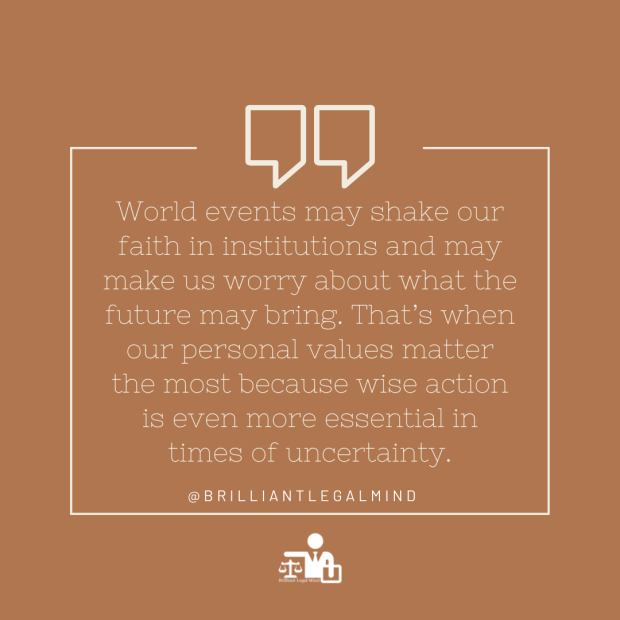
So, what can we do when the world gives us a lot of reasons to doubt? The same thing we do when there are gray areas in the law: we trust ourselves and make a judgment call. When it comes to something like hope, this means we remember what we value and we try to live accordingly. World events may shake our faith in institutions and may make us worry about what the future may bring. That’s when our personal values matter the most because wise action may be even more essential in times of uncertainty. For this reason, reconnecting with our personal values may help us remember the ways that we can bring good into the world even during difficult circumstances.

Image with quote from blog post that says "World events may shake our faith in institutions and may make us worry about what the future may bring. That's when our personal values as lawyers matter the most because wise action is even more essential in times of uncertainty."

Hopelessness is a difficult emotion to experience because it is something that can make us feel helpless, alienated, unmotivated, and alone. Though it can be a challenging emotion to face, each of us can learn to hold our own hopelessness in kindness.

This will help us reconnect to ourselves, reevaluate our roles in our communities, and better understand the values we wish to bring into the world. Perhaps we may never recover the same hope we experienced before, but I don’t know that must do so in order to lead a good and happy life. Instead, it may be more effective to learn to let new forms of hope grow in us in each new phase of our lives.


Want to learn more about mindfulness and compassion? Check out my new book, How to Be a Badass Lawyer, for a simple guide to creating a meditation practice of your own in 30 days. And to share mindfulness with your little one, check out my new children’s book, Mommy Needs a Minute.

Like this post? Subscribe to the blog here or follow us on social media: