How to Recover When Your Meditation Habit Gets Sloppy

Image of a post it note with the phrase "habit is persistence in practice" and the title of the blog post that says "How to Recover When Your Mediation Habit Gets Sloppy"

In January, my habit tracker showed nice long streaks for meditation. I was laser focused on starting the year strong and practiced mindfulness each day. Now, it’s halfway through February and my meditation practice is a bit of a mess. What is a lawyer to do?

Well, this lawyer is a mindfulness teacher who has been meditating for over a decade. This is not my first rodeo when it comes to a less than perfect meditation practice.

In case you are wondering, here are the three proven steps I will take to get my meditation practice back on track. I also offer three supports you can consider if you need a little bit more help getting your own habit back in order.

1. Lawyers Are Busy, So Don’t Panic or Beat Yourself Up.

The first thing that many people do when they notice a habit slipping is to beat themselves up. I encourage you to avoid this trap. Yes, meditation is an important practice. Yes, it offers many benefits.

These truths can easily cause high achievers like lawyers take their practices very seriously. And that seriousness can lead to self-criticism and even spiraling when the habit is not easily maintained.

Don’t take the bait. Instead, be practical and realistic. For most lawyers and professionals, it is not realistic to expect perfection with any healthy habit. Instead, it makes more sense to think about what we do most days.

If you criticize yourself every time you miss, that won’t motivate you to get back to practice any more quickly. Instead, it will induce hopelessness and shame. This is why the best thing you can do when you notice your meditation habit slipping is to avoid panic and self-judgment.

2. Identify the Impediment to Meditation Practice

When you can bring some neutrality to the situation, it is possible to next review the situation practically. Looking at things from a place of self-compassion, it is easier to see that most of us don’t skip on healthy habits because we are undisciplined or don’t care.

Instead, for lawyers and professionals, the culprit is more likely to be a practical impediment. This is why the next step in the process is to review the things that are getting in the way of meditation.

This might include schedule changes or a hectic period at work. It could also include events in your personal life that create a resistance to practice. Even though meditation can be a great way to process complex emotions or care for yourself, doing so during tough times can be a challenge. Acknowledging this kind of resistance as a human reality may help you work through it.

Other potential impediments could be even easier to address. You may consider, for example, if there is anything you don’t like about the experience of meditation. Then you can consider how you can make the practice a bit more pleasant to get yourself to the cushion.

Ultimately, most people don’t skip meditation because they don’t care about the benefits. Instead, problem-solving the issue from the habit formation level may help you figure get your practice back on track.

Image listing the three steps to Get Your Meditation Habit Back on Track shared in the post, including don't judge yourself or panic, identify the impediment to practice, and just get back to practice.

3. Come Back to Meditation Practice

In truth, you don’t need the first two steps every time you miss a meditation session or get off track with practice for a few days. Instead, the more efficient route may be to just come back to meditation practice.

This may be the most essential lesson from basic breath practice: you can always begin again. Just like there is always another breath to note, there is always another day to come back to meditation.

You don’t have to apologize or make amends. You just start practicing again the same way you did the very first time. That’s the beauty of meditation. It’s always there for you when you need it even if you have been away from practice for a while.

If you have missed practice for a long time, it may be best to ease back into it. I suggest starting small to give yourself time to rebuild the habit. But you may find that you can increase your time more quickly than you could when you were new to practice. Either way, there is no need to rush because meditation is a practice for life.

In the end, the way to maintain a consistent habit is to not give up on the habit when you miss a day, a week, or longer. The best way to get back on track is to just come back to meditation practice.

But What If The Steps Above Aren’t Enough?

After more than a decade of meditation, I can tell you that sometimes getting back to practice is easy and sometimes it is hard. In the easy cases, the three steps above or just step three alone are enough.

For hard cases, you may need some more support. Sometimes we stop meditating due to massive schedule or life changes, personal loss or difficulty, or even health-related conditions that make practice a challenge.

If you are really struggling to get back to regular meditation despite a desire to do so, you may consider the following three steps to support yourself.

1. If Needed, Reflect on What Meditation Offers to Your Life.

When I need motivation to get my habits back on track, I instinctively look to my intention. If your meditation practice is struggling, one way to help yourself recover is to consider if your intention has changed.

This happens with meditation from time and time and it may not be a bad sign. When I first started meditating, my fundamental aim was dealing with stress. I just wanted to rest and find some relief from all my copious thoughts.

After a few years, though, meditation helped me and the thoughts gradually slowed down. I had to rethink why the practice mattered to me. When I did, I realized that my new focus was to create a refuge for myself to deal with the challenges of everyday life.

The reality is that most lawyers don’t meditate to get really good at meditation or because we think we will become enlightened. Instead, we do it because we want benefits in our lives outside of meditation.

For this reason, it can help to reflect every so often on the ways that meditation supports your life. Once you are clear about your reasons for practice, it may be easier to bring yourself back to regular practice.

Image defining a habit as "a pastime that becomes a regular part of your life because you don’t give up on even though you repeatedly fail to do it perfectly or as much as you want"

2. If Needed, Get Support from a Meditation Teacher or Community.

As I have written many times before, a teacher or community support a meditation practice more than anything else. I know that for many lawyers and professionals, it may be a practical necessity to meditate alone most of the time.

It definitely takes more time to meet up with others at a course or retreat to meditate and it may take some work to find a teacher. Even so, that investment of time is worth even for the busiest lawyers.

If you are struggling with your meditation practice, a great way to refresh it is to get some support. Taking a course, doing a retreat, or finding a meditation group can help you get needed direction. It can also make the practice feel less lonely and more fun.

So, if you practice is struggling, a great way to bring it back it get help from a teacher or a community.

3. If Needed, Here’s a Worksheet to Help You Rework Your Meditation Habit.

For major life or schedule changes, you may also need to rethink how meditation fits into your life. That is something that most lawyers and professionals can expect to do from time to time.

Even subtle schedule changes cause by shifts in family or work obligations can throw wrenches into our normal systems. Instead of thinking of yourself as an undisciplined failure as noted above, it makes more sense to think practically about how the system works.

If you need help restructuring your daily meditation practice, you might check out the guide I wrote here. You can also download the meditation habit worksheet to find ways to make the practice more obvious, satisfying, and easy to do.

Conclusion: Meditation Is a Practice for Life, So Lawyers Can Expect Times of Ebb and Flow.

If you meditate for long enough, you are bound to face disruptions with your normal habits. This is a reality that most lawyers and professionals will face as they navigate life and work changes and busy lives. If you meditation practices gets off track, you can use the steps and supports identified in this post to recover.


Want to learn more about mindfulness and compassion? Check out my new book, How to Be a Badass Lawyer, for a simple guide to creating a meditation practice of your own in 30 days. And to share mindfulness with your little one, check out my new children’s book, Mommy Needs a Minute.

Like this post? Subscribe to the blog here or follow us on social media:

Why Skepticism Can Enhance Your Meditation Practice

Image of woman looking quizzically at book she's reading with title of post "Why Skepticism Can Enhance Your Meditation Practice"

Sometimes other lawyers tell me that they are interested in trying meditation but they are skeptical. With this question, people are suggesting that their doubts get in the way of trying the practice.

I get why these questions arise. Lawyers tend to be a skeptical bunch. We don’t like to waste our time. If we try something, we want o have some assurances that it will be worth it.

In reality, though, skepticism is not a true impediment to meditation practice. It actually supports it. Here are a few reasons why.

Skepticism Defined.

Before I explain why skepticism can support a meditation practice, it’s important to define what I mean. When I talk about skepticism here, I am talking about a state of being unsure or having doubts.

This is different from certainty or having one’s mind made up. Clearly, if someone truly believed that meditation would not be helpful to them, that would be an impediment to practice. In that case, you would expect that the person would be very unlikely to try meditation. Even if they did, they would not be interested in looking at it clearly.

Skepticism, on the other hand, is not certainty. Instead, it is a state of having doubts, being unsure, or being confused. Most lawyers do not enjoy states like these, but they are actually really useful for meditators.

Why Skepticism Can Be Good for Meditation

Most lawyers even remotely interested in meditation have probably heard the term “beginner’s mind.” This term, made most famous by the Zen teacher and author of the seminal book, Zen Mind Beginner’s Mind, generally refers to looking at things with fresh eyes (paid link).

This sounds beautiful and alluring and it is often what attracts many people to meditation. But let’s be real. How often do you exhibit beginner’s mind in ordinary life? How often do you see things with truly fresh eyes?

Most of us do not. In fact, this is one reason that new meditators are often instructed to “get curious” about their mundane life experiences. Curiosity is the state where we stop assuming we know and we look deeper.

Image with definition of skepticism shared in post which says "A state of being unsure or having doubts.
This is in contrast to certainty or having one's mind made up. A variety of confusion that can support curious investigation."

Skepticism Encourages Curiosity

This is where skepticism can actually come in handy. I said earlier that lawyers are skeptical people. And why is that? Well, in part it is because we are used to drilling down deeply into the facts and evidence. We do this because we often need a good grasp of the facts before we can help our clients.

Lawyers don’t often think of it this way, but that skill is curiosity. As we go digging into the facts, we have an open mind as we search for the truth.

This same skill can and ideally should come into play with meditation. Let’s say that you are unsure that meditation will work for you. How could you actually answer that question for yourself?

Well, you might become an amateur scientist and set up your own little meditation experiment. You’d give meditation a try, try to make it as enjoyable as possible, and pay extra close attention to how it affected you. Why would you be able to pay close attention? Because you aren’t sure about something but want to get some answers.

An Example for Lawyers from Real Life

I know you think that this is just hooey that a meditation teacher would tell you to try to get you to meditate. But in truth, skeptical is exactly how I was when I started meditating. As I have written before, I did not start meditation with certainty that it would do any good.

Instead, I started meditation out of desperation. I was a young associate and a new mom with a two-week trial coming up. I was so busy I could not see straight. I was also exhausted because my daughter was still not sleeping through the night.

I was filled with anxiety, constantly overthinking and exhausted. I first started mediating in one-minute sessions because it was all I could handle. I didn’t start practicing because I knew it would help. I started meditating because nothing else had.

As I learned to sit for longer periods of time, I was looking with an eagle eye for any signs that it didn’t help. I didn’t find them. Instead, what I found was a reduction in the physical signs of stress, less overthinking, and a practice that I could rely on when life was hard.

Image of man in suit with quote "Lawyers are used to drilling down deeply into the facts. That skill is curiosity and it is perfect for meditation."

Experts Also Say Skepticism Can Support Meditation

Okay, I get it. I’m talking to skeptics here. Perhaps anecdotal evidence is not enough to convince you. In that case, my closing argument is that the masters of meditation say that skepticism can support meditation.

I mentioned the Zen school of meditation already. This school is famous for using states like confusion and bewilderment to achieve the beginner’s mind mentioned above. Why would confusion ever be useful in meditation? Of course, it is because we look closer and get more curious when we are confused.

If we keep skepticism from hardening into a misguided variety of certainty, it can work the same way. In truth, skepticism truly is a variety of confusion. We are often skeptical about things that we don’t fully understand. When we get curious and look closer, that’s how we can build understanding.

This is why Jon Kabit-Zinn, the founder of mindfulness-based stress reduction, wrote in Full Catastrophe Living that skepticism is a good trait for new meditators (paid link). Kabat-Zinn is a researcher of mindfulness who has worked with thousands of new meditators over the decades. And he says that skepticism is no impediment to meditation practice. Instead, he says it can help.

Conclusion: You Can Stay Skeptical

So what does this mean for you? First, it means that there is nothing wrong with being skeptical about meditation. It’s human, normal, and arguably healthy. Second, it also means that meditation and skepticism are not incompatible. Lawyers don’t have to become true believers before they explore mindfulness. Instead, being less than totally convinced might actually be better. Third, if you are interested in meditation but are still skeptical, there is one good way to resolve your confusion. Give meditation a good faith effort, pay close attention, and see what happens.


Want to learn more about mindfulness and compassion? Check out my new book, How to Be a Badass Lawyer, for a simple guide to creating a meditation practice of your own in 30 days. And to share mindfulness with your little one, check out my new children’s book, Mommy Needs a Minute.

Like this post? Subscribe to the blog here or follow us on social media:

Tips for Starting a Meditation Practice in the New Year

Image of lawyer meditating in a group with the title of the blog post "Tips for Starting a Meditation Practice in the New Year"

It’s the beginning of a new year, so lawyers may be thinking about new years goals and resolutions. For many people, this might include the goal of exploring mindfulness or starting a meditation practice.

If this is your intention for the year, I think it’s a great one. But all of us know that noble intentions in January sometimes fade by February. How can you start a meditation practice in January that has the hope of lasting the year and beyond?

That’s why I wrote this piece. In this post, I will share some tips intended to help you explore meditation and turn it into a real practice.

Establish Meditation as a Habit

My first advice for lawyers exploring meditation is to start small. That isn’t only because it’s kinder to yourself. It’s also much easier to do something repeatedly if it takes less time.

The biggest problem many lawyers and professional have with meditation is finding the time to practice. Given this, it is essential to not overwhelm yourself at the beginning.

I started my meditation practice over a decade ago at 1 minute per day because that is all I could handle. Though I was quickly able to add minutes on as the days went by, this small increment of time meant I had very few excuses to skip practice.

This meant that I quickly established a habit of meditating every day. If you want the benefits of meditation, making the practice regular is important. To do this, start with short sessions but aim for regular, ideally daily, practice. If you need any more help on brainstorming meditation as a habit, download this free worksheet.

Focus on Building Skills Instead of Being “Perfect” at Meditation

Now, you may be worried that even if you make meditation a habit, you still don’t know what you are doing. So you may be worried about doing the practice wrong or wasting your time.

I have shared basic meditation instructions on this blog and posts about a variety of different meditation practices, including breath practice, body scan, joy, and loving-kindness. At the beginning, though, I would not worry so much about being right in meditation.

Of course, no lawyer wants to waste their time. But the mistakes in meditation are often the best teachers. Meditation is not a thought exercise. It is an experiential practice. You learn how to do the practice by meditating.

At the beginning, then, the object is not to be perfect but instead to cultivate some basic skills. These include the following:

  • Patience with yourself;
  • Focus (including which focal point works for you);
  • Learning what calms and soothes you;
  • Connecting with bodily sensations;
  • Noticing when you are thinking;
  • Redirecting attention; and
  • Self-kindness.
Image of author Claire E. Parsons with quote from post "Of course, no lawyer wants to waste their time. But the mistakes in meditation are often the best teachers. Meditation is not a thought exercise. It is an experiential practice. You learn how to do the practice by meditating."

Don’t Expect to See Quick Progress in Meditation

Many lawyers start a meditation practice because they want the benefits they have read about in research studies. They want to feel less stress, they want to be able to focus on demand, and they want more happiness and kindness.

Then they sit down in meditation and they feel stressed because they can’t focus. They feel tired and bored. Their feet fall asleep, their knees and back hurt. All of this is bound to make any reasonable lawyer think the practice doesn’t work.

But here’s the thing: the benefits of meditation often don’t show up in the practice itself, at least not right away. After a while, practice should come to feel a bit more enjoyable and soothing in itself. At first, though, you are still building skills. Expecting to see mastery in your practice is like expecting not to struggle at all when you start a new exercise routine.

This means that you should give yourself some time (four to eight weeks) before you look for any benefits to emerge. And if those benefits emerge, they probably will show up outside of meditation first. These might include things like rushing less, a reduction in the physical signs of stress, or less reactivity.

Though benefits very likely will emerge with consistent meditation practice, be cautious about your expectations. Don’t expect immediate results and look for the benefits in life first before they show up in meditation practice.

Keep Your Practice Simple

One of the problems that knowledge seekers like lawyers may encounter at first is that they can’t decide which mindfulness practice to explore. The list of skills mentioned above may suggest that you must master all forms of meditation in order to gain benefits. Allow me to set the record straight.

While it is great to explore a variety of practices, ultimately simplicity is ideal. Keeping your practice simple will reduce decision fatigue. This means that there is less chance that your actual practice time will be delayed or derailed by too many planning questions.

Over the years, I have done a variety of practices with and without guiding. Eventually, though, I settled into a simple routine that consists mostly of breath focus practice, open awareness, and loving-kindness. I generally don’t do formal body scan practices, but I enjoy them on occasion if I have a special need to relax or calm my body.

Based on this, it is great to explore and shop around with practices at first. After a few days or weeks, though, it is best to settle on the practice that allows you to relax and focus the most. This will allow you time to build proficiency with the practice, so that you can experience benefits and build confidence.

As the months and years go on, you can always adjust your practice. In fact, you may need to do so to address specific issues like increased stress, sleepiness or spacing out, or just to refresh your practice.

Image sharing five tips for lawyers starting a meditation practice as shared in the blog post

Don’t Go It Alone

I offer my last bit of advice with a strong sense of humility. When I started meditating, I practiced totally on my own. I had no teacher or community and at first hid my practice from my family.

It was not until years later that I realized the error in this approach. When I attended my first retreat, I was amazed at how supportive it was to meditate with other people. I couldn’t believe how helpful a few minutes of chatting with a teacher was.

Though many lawyers pride ourselves for our independence, we do best when we remember that humans are social animals. When we humans want to make real habit change, social support is the way to go. If you want to make meditation a lasting part of your life, finding a teacher or community should be a priority.

Now, as I said above, time is often a challenge for lawyers. I am no stranger to this. To be sure, meditation can be learned and practiced on your own and you should not feel ashamed at all about that. If, however, you have any options to meditate in a group, learned from a trained mindfulness teacher, or go on retreat, it will support your practice.

For anyone in the legal profession looking for such a community, the Mindfulness in Law Society provides a highly accessible option.

Conclusion

These are my tips for starting a meditation practice in the new year. They are offered to help busy people like lawyers be kind to themselves while forming a habit that can last. Regardless of the goals you set, I wish you luck in the new year and hope you find whatever practices support you and your community best.


Want to learn more about mindfulness and compassion? Check out my new book, How to Be a Badass Lawyer, for a simple guide to creating a meditation practice of your own in 30 days. And to share mindfulness with your little one, check out my new children’s book, Mommy Needs a Minute.

Like this post? Subscribe to the blog here or follow us on social media:

How to Craft Your Daily Meditation Practice

Cover image for blog post with title that says "How to Craft Your Daily Meditation Practice"

One of the most common questions I get as a meditation teacher is also my favorite question to ask other meditators. That question is “what does your meditation practice look like?” As a teacher, I know people are asking for guidance about what their practice should or could be.

When I am asking the question, though, I am not asking it to test the other person. Instead, I am asking it because someone’s daily practice can tell you a lot. I love seeing the variety of ways that people find to make meditation their own, so I enjoy hearing people talk about it.

Though certain lineages may have preferred meditation practices, there aren’t universally applicable rules that apply to all of us. In addition, even very experienced meditators may have to rethink or revamp their practice regimen from time to time. Here are some things to consider when crafting or reshaping your meditation practice.

1. Identify the Intention Behind Your Meditation Practice.

One of the reasons that I cannot offer a generally applicable “ideal” meditation practice is that I think meditation works best when it supports personal intentions. By this, I don’t mean that meditation must or should be a solely individualistic endeavor. I have said many times before that community is essential to meditation and that, ideally, meditation will help us engage more fully in our communities.

Even so, meditation is a long-term practice. If you are going to make the habit stick, it helps if it supports your life, values, and goals. As a result, an important first step in crafting a meditation practice is to consider your intention for meditating.

Do you want the health benefits? Do you want a time to rest? Do you want to learn better ways of managing stress? Do you want a time to check in with yourself? Do you want to relax so you can get better sleep? Whatever it is, identifying the purpose driving you can help you tailor a meditation practice.

Image with quote from the blog post that says "Meditation works best when it supports personal intentions."

2. Consider the Meditation Technique that Supports Your Intention.

Identifying your intention for practice is important because there are so many options for practice technique. Meditation practices come from a variety of spiritual lineages, secular disciplines, and include a seemingly endless number of techniques.

If your practice lasts long enough, crafting your meditation routine may include exploration of everything from breath focus, to body scan, mantra, loving-kindness, and beyond. Exploration is a great thing, but ideally your daily practice will become relatively simple, stable, and consistent.

Your specific purpose in meditating will help you decide which practice best supports your life. This may take some trial and error and experimentation. Pay attention to how you feel in practice and any changes that you may be experiencing in life. This can tell you if the practice is supporting your intention or not.

3. Decide the Frequency, Duration, and Setting for Your Meditation Sessions.

Once you have selected a practice, then you must decide how long, how often, and where to practice. Many people ask me for a minimum time they must practice to get benefits. Though I recommend starting small for those new to practice, ideally the duration of your sessions will grow over time. So, the real question is what amount of time will you, as a practical matter, meditate consistently?

That is because consistency is what transforms meditation from a pastime to a practice. As a practicing lawyer myself and a busy mom, I don’t claim to meditate every day without fail. But I meditate most days and strive for 30 minutes of daily practice. That period of time is sustainable for me long-term and it allows me to rest, connect with myself, and cultivate focus and stability.

In the same way, it helps to have a designated meditation spot which may include your meditation cushion or a comfortable chair. Meditation on the go is a necessary option for most lawyers and one I frequently use. With that said, a special spot can help to remind you of practice and settle more quickly when your meditation starts.

Image with quote that says: "People often ask for the “minimum” amount of time they must meditate to see benefits. A better question is: what amount of time will you, as a practical matter, meditate consistently?"

4. Don’t Forget to Ask for Help.

Still feel lost with all of the details regarding meditation practice? That’s normal. It could be a sign that you need some more exploration time to feel at ease in your practice. It could also be reason to consider getting more support for your practice.

Over the millennia, meditation has been taught in groups and with teachers. Technology has allowed us to learn the practice without these supports and I got my practice started without them. Whether you use guided meditations or prefer an unguided practice, starting with the help of an app (or this blog!) may be great for those of us who want to explore meditation before we commit.

For more in-depth understanding of the practices and the many shapes that meditation can take, you can always explore working with a meditation teacher, taking a course, or finding a community. Even if you meditate alone most of the time, getting help and support may instill confidence that you have a practice that supports your life.

Image that shares the 4 tips for crafting a meditation practice shared in the blog post

Conclusion

There are many effective ways that you can structure a daily or regular meditation practice. If you practice meditation for long enough, you are bound to find that your practice will shift and change with time. Whether you are new to meditation or are experienced and looking for a change, this post is offered to help you evaluate your daily practice to ensure it continues to benefit your life.


If you want some immediate help for your practice, check out the Resources page and our guided meditations. In particular, these downloads may be helpful in shaping a practice that works for you:


Want to learn more about mindfulness and compassion? Check out my new book, How to Be a Badass Lawyer, for a simple guide to creating a meditation practice of your own in 30 days. And to share mindfulness with your little one, check out my new children’s book, Mommy Needs a Minute.

Like this post? Subscribe to the blog here or follow us on social media:

The Right Intention Can Sustain a Meditation Practice

Cover image for blog post called the right intention can sustain a meditation practice

When I was new to meditation, I used to hate it when a guided practice would encourage me to “set an intention” for practice. I didn’t know what that meant. I was not used to thinking about my intentions or living my life as if I got to pick one. In general, I was sitting because I was tired or thinking too much or because I was trying to keep my meditation habit alive.

For a long time, this intention was enough to sustain my practice. Early on, the physical benefits of learning to manage my stress were so obvious that feeling better was my sole intention. In those days, I would sit and find some new energy or cure a headache. With benefits like those, the intention was apparent: I just wanted to feel better.

Rethinking Intention

This week, though, I have been thinking about the power of intention in a deeper way. I am preparing to give a dharma talk to my local meditation community about how I went from novice meditator to teacher. My path was far from perfect and includes a span of nearly a year in which my practice faded away entirely.

In the course of preparing the talk, I realized that a shift in intention made all the difference for me. Meditation has always been a self-care strategy for me. It helps me slow down, get in touch with myself, and care for myself physically, mentally, and emotionally. It helps me face challenges and remember self-compassion.

From Self-Care to Guiding Principle

At some point along the way, though, meditation became more than self-care for me. Eventually, after years of sitting, I started to realize that my meditation practice didn’t just help me care for myself better. Instead, meditation helped me take care of everybody I came in contact with better.

This is in part what led me to start teaching. I knew from personal experience that stress, anxiety, and overwhelm as a lawyer led to bad conduct and worse results. I began teaching other lawyers and professionals about mindfulness practices because they had made such a difference for me.

Image for blog post with options for common intentions for meditation practice

Intention Inspires Action

Over and above this, though, was the truth that I behaved better, acted more kindly, and was more available to help others when I kept my meditation practice robust. In fact, I have found that my practice is stronger when I am busy because I know that is when I need it most. Indeed, I even have increasingly made time to go on retreat because I know it makes me a calmer lawyer, more present parent, and a happier person all around.

Realizing these benefits helps me stick with my practice even when motivation is hard to muster. Even as a meditation teacher, my practice is far from perfect. I struggle with laziness, resistance, and excuses like anyone. Sometimes I am tired, I don’t feel good, or I just don’t feel like meditating.

These are the times when my intention helps me the most. I remember that I’m not just meditating for me. I’m meditating for everyone I love, for everyone I work with, everyone who depends on me, and everyone I meet. In short, I remember that I can give my best to others when I take care of myself first.

What Intentions for Meditation Are There?

There are different schools of thought about the intention which should guide meditation practice. If your intention is purely self-care, there is no shame in that. That was my sole motivation for years and it made a huge difference in my life.

If your intention is self-improvement, that can be wonderful too. In reality, I have experienced how a balanced effort to improve oneself can lead to more ethical living and benefit others.

Image asking the question what is your motivation for meditation practice

What Motivates Your Meditation Practice?

The point of this post is not for me or any other teacher to tell you what your intention should be. Rather, the point is to encourage you to discover the intention for your own mindfulness practice. You may not know what your intention is right away and that’s okay.

If you keep asking, though, you may eventually realize what is motivating you to keep meditating. Once you understand this you will discover a powerful motivational tool to help keep your practice robust. If you are lucky, you may also unearth a guiding principle that can positively influence the direction of your life.


If you have struggled with motivation for your meditation practice, we have some resources that might help. Check out our Meditation Habit Worksheet to see if any subtle tweaks can make a difference. You can also check out our Pause and Begin Again e-book, which offers strategies for starting and restarting a meditation practice. Lastly, consider ways to make your practice more enjoyable here.


Want to learn more about mindfulness and compassion? Check out my new book, How to Be a Badass Lawyer, for a simple guide to creating a meditation practice of your own in 30 days. And to share mindfulness with your little one, check out my new children’s book, Mommy Needs a Minute.

Like this post? Subscribe to the blog here or follow us on social media:

Meditation Is Not a Time Suck; It’s a Time Saver

I never ask anyone to explain themselves to me when it comes to meditation. Even so, I give talks about mindfulness a lot and people tend to volunteer why it can’t/won’t work for them. I never mind this because it’s an opportunity for both of us to learn something. The number one reason that people, especially other lawyers, tell me they can’t meditate is insufficient time.

For lawyers, this is surely a believable excuse. We are a notoriously time poor profession. There are significant financial incentives for using any extra time we have to bill hours or market and network to get the next client in the door. And then we might want to actually, hey, have a life to do things besides bill too. Trust me. I get it. I have no intentions here of telling lawyers that they have more time than they think.

Here’s the thing, though. Meditation is not a time suck. It’s a time-saver.

I’m a lawyer, a community leader, a blogger, and a mom. Do you really think I sit around meditating because I’m just bored? Even if you thought that, do you really think I’d pick the single most boring activity on the planet to fill my time? Of course not.

I don’t meditate because I have nothing better to do. I meditate because I have tons of other better things to do besides overthinking, reacting to every little thing in life with anger and hostility, and rushing so much that I miss those tiny joyous moments that creep into life unexpectedly.

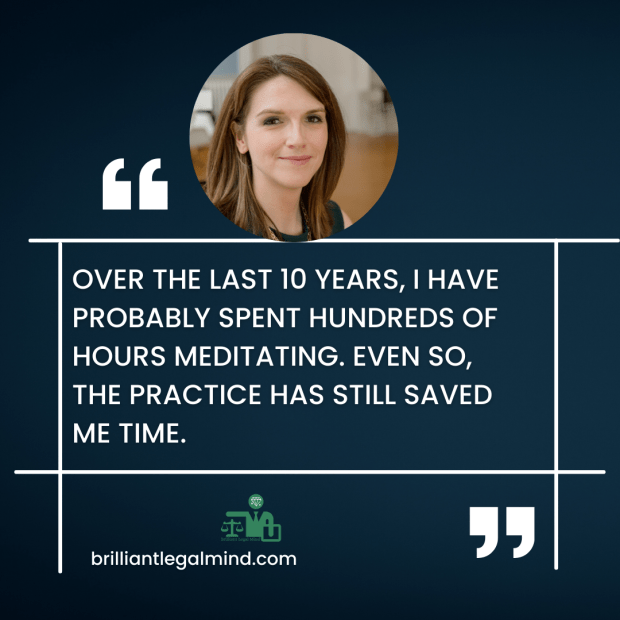
Sure, over the last 10 years, I have probably spent hundreds (if not thousands) of hours meditating. That’s a lot. But what I have not done or done far less is spend hours agonizing over some thing in the future I am worried about that never transpires. Or fretting for days about something awkward I said at a happy hour last week. Or scheming endlessly about the best way to handle a situation.

Instead, now I see when I am stuck in thought mode, regret mode, or perfectionist planning mode and I disrupt the loop. I make a decision to write down a few notes to get the idea out of my brain, talk to a friend, apologize, or just let it go by doing something else. The hours saved alone here is enough ROI for my practice, but the impact on my life by remaining engaged in the world rather than lost in thought is even more significant.

And can we talk about the sleep that I haven’t lost when I am dealing with a stressful situation? Or the fatigue or frustration that didn’t derail my work because I had a quick and reliable way of resting and recharging? Or the physical signs of stress I recognized early on and knew how to care for so I could avoid a disaster?

Look, I don’t write this piece to make you feel bad if you tried meditation and struggled with it because you are busy. The truth is that I have too. I have missed a ton of sessions over the last ten years. I have had to restart and reenergize my meditation habit multiple times. Sometimes it feels like a slog when I do.

I keep coming back to it though, not because I magically find extra minutes, but because I want to be present and content in the minutes I have. So, if time is the thing that sticks in your mind when it comes to meditation, maybe try thinking about time in a new way. Don’t just focus on the few minutes that it will take to meditate. Focus instead on the minutes that meditation might save you and the minutes of your life that meditation might improve.

Want to learn more about mindfulness and compassion? Check out my new book, How to Be a Badass Lawyer, for a simple guide to creating a meditation practice of your own in 30 days. And to share mindfulness with your little one, check out my new children’s book, Mommy Needs a Minute.

Like this post? Subscribe to the blog here or follow us on social media: