Why Lawyers Need Support in Tough Cases

Image of lawyers dealing with emotional client and title that says "Why Lawyers Need Support in Tough Cases"

I’m presenting a new CLE for Lawline today on dealing with difficult people in law practice. This is something that most lawyers come to experience at some point in their practice.

As I wrote last week, I have practiced with and against many fine lawyers in my years of practice. In fact, the majority of the attorneys I have worked with have been wonderful people.

Unfortunately, though the attorneys who have behaved badly are among the minority in my experience, they have created more than their fair share of stress and difficulty.

Difficult People in Law Practice

Even so, in the presentation I make an effort to separate the people from the behavior. I focus instead on offering strategies rooted in mindfulness and compassion that can help support one’s mental health and well-being when dealing with difficult cases.

I will share more about this in the CLE, but in case you can’t watch or attend, I offer the most important point here. The single best thing lawyers can do to support themselves when dealing with a difficult opposing counsel or party is to get help.

Lawyers Deserve Support with Difficult Cases

I’m sorry if that is a let down but it’s true. Lawyers tend to be independent people. We are accustomed to solving other people’s problems. As a result, we can sometimes exaggerate how many problems we can handle on our own.

But when I say “get help” here, I don’t mean to imply that lawyers can’t handle a difficult case on their own. In fact, most of us probably do this regularly. What I mean instead is that, for those really difficult cases involving counsel or parties with whom you struggle, getting some support can really help.

Social Support Is Essential for Lawyers

Remember that lawyers are humans first. The most effective and healthy way to process and manage stress is to get social support. If you are dealing with a difficult opposing counsel, client, or party in a case, you deserve support from colleagues, family, and friends.

This support may just be good for you. It also may be essential for ensuring that lawyers make good judgments about the case. In difficult times, even the most seasoned lawyers may struggle to see issues objectively when an opposing counsel has made their life miserable for months on end.

In this way, getting support from a trusted colleague or your firm’s ethics or general counsel may help you ensure your choices are strategic and not reliatory. This can help you stay true to your values in difficulty and stress instead of forgetting them due to high emotions.

How Lawyers Can Get Support for Their Cases

Some lawyers may struggle with asking for help. I know that I used to be like this. In recent years, though, I have drastically changed my approach. This is in part because I have learned that I often solve problems faster, most effectively, and with less pain when I do.

Dealing with difficult counsel, clients, or parties can create a lot of problems for lawyers. This can include extra work or overwhelm. It can also include dealing with big feelings, ranging from anxiety, frustration, anger, or even sadness. It can also include confusion about strategy and doubt or imposter syndrome about one’s own abilities.

In this way, you can start asking for help by seeking support or delegating work tasks if possible. You can also ask for help just by asking a trusted colleague or friend to listen while you share your feelings. Where possible, it can be a wonderful support to talk over a case with a fellow lawyer to get perspective and strategy ideas.

Getting Help Can Make Dealing with a Difficult Case Bearable

Of course, you know that getting help when dealing with a difficult case, opposing counsel, or party does not solve the whole problem. Getting help does not make all the stress go away. Social support does not mean lawyers can avoid the people or cases who make their law practice hard.

In my experience, though, getting some help and support does one really important thing. It makes dealing with the difficult case bearable. It makes the situation less lonely. It often reduces overwhelm. It can sometimes inspire confidence and newfound motivation to handle the matter effectively and stay true to your values.

If you are dealing with a difficult case, check out the new CLE on Lawline for tips and strategies for navigating it well. But if you can’t make it, follow my next best advice. Don’t handle the case entirely on your own. Get social support and help as you navigate the difficult case.

Image of founder Claire E. Parsons with details of Lawline CLE called "Dealing with Difficult People: Mindfulness Strategies for Lawyers"

Want to learn more about mindfulness and compassion? Check out my new book, How to Be a Badass Lawyer, for a simple guide to creating a meditation practice of your own in 30 days. And to share mindfulness with your little one, check out my new children’s book, Mommy Needs a Minute.

Like this post? Subscribe to the blog here or follow us on social media:

Five Reasons Kindness Is Essential for Lawyers

Image of people in suits exchanging a heart shape with title "Five Reasons Kindness Is Essential for Lawyers"

In honor of World Kindness Day, I am giving a talk this week on the power of kindness for lawyers and legal professionals. Many lawyers are skeptical of kindness, at least in relation to our work. We worry that kindness will be viewed as weakness by others and lead to passivity in ourselves.

Clearly, I don’t have illusions that I can convince an entire profession on this point, but I don’t think I have to do any convincing. If you pay attention to what kindness really is, you will see that it is powerful and essential for lawyers today. Here are five things to consider as you explore this for yourself.

1. Kindness Is Rare for Lawyers and Therefore Precious.

As a general matter, I have had mostly positive experiences with other lawyers. In general, I have experienced that lawyers are polite and professional in most settings. Real kindness, on the other hand, is more rare.

As discussed below, law practice is often challenging and filled with stress. This both makes kindness more essential and also more challenging. As most of us know, the difference between a difficult and unbearable situation is kindness. I cannot tell you how much of a difference it makes to work with an opposing counsel who is kind. We communicate more effectively and work through problems more efficiently as a result.

Though I know that many clients think they want a bulldog lawyer, I have found those types of litigators to often be ineffective. Therefore, if you want to really show power, calm, control, and courage in law practice, being kind is the way to go.

2. Kindness Is Essential in Difficult Times.

I have written before that kindness is an essential trait for difficult times. Lawyers, of course, are usually dealing with difficult times. We are literally paid to manage other people’s problems. This means our stock and trade is dealing with people going through really hard situations.

If lawyers are to weather these storms, we must learn skills for caring for ourselves and others. Sometimes this may include tending to our own fears, worries, and hurts. Sometimes it may mean patience with a stressed or unskillful opponent. And sometimes it may mean showing calm courage for our scared clients.

Either way, kindness is essential for lawyers because it helps us and our clients navigate challenging situations.

3. Kindness Is An Antidote to Fear and Aggression.

Because stress and conflict is a big part of law practice, fear and aggression unfortunately are too. This can be hard for our clients, but it is definitely hard for lawyers. One of the reasons that kindness is so powerful is that it helps people feel safe or at least safer.

In this way, kindness is an antidote to fear and aggression. It is a way that we can calm our own nerves and built trust and safety with those around us. Kindness may not make fear and aggression disappear entirely but it can help us create a sense of steadiness and comfort during emotional upheaval.

This can help lawyers focus more squarely on the relevant issues and avoid creating additional fights.

Image sharing the five ways that kindness is essential for lawyers as shared in the blog post

4. Kindness Builds the Connections that Lawyers Need.

Related to the feeling of safety is trust. Most lawyers know that relationships are at the core of law practice. Relationships permeate what we do as lawyers, including those with our firm, opposing counsel, and clients.

Kindness is a way to build trust because it is how we demonstrate care and concern for others. One of the reasons that litigation is so difficult is that trust is often lacking between parties and legal counsel as well. This is one reason that kind and professional speech is so important in litigation contexts.

When trust is lacking, it is easy to misunderstand each other and overreactions are bound to occur. Kindness is a way to cut through this animosity and rebuild the trust that is so essential to our working relationships.

5. Kindness Looks Soft but Feels Like Power.

The best and final argument I can make for kindness is not an argument at all. That’s because the best argument for kindness is in the experience of it. Lawyer struggle with kindness because it is easy to misunderstand.

In many situations, kindness has a softness to it. When we feel kindly towards someone, we may feel a softening of our hearts and a sense of generosity towards them. When someone is kind to us, we may notice a quiet, soothing voice and a non-threatening posture.

Next time you offer or experience kindness, though, I urge you to pay closer attention. Though kindness undoubtedly has a softness to it, it often also includes stability, calm, courage, and support. In this way, even though kindness may look soft to an observer, it often feels powerful to those who give and receive it.

In truth, kindness is power because it offers us the possibility of transforming a situation or building a connection with a little bit of courage, presence, and an open heart.

Don’t Take My Word for It. Try This for Yourself.

Here’s the truth: you probably already know how essential kindness is. Most of us wouldn’t have gotten as far as we have without kindness in our lives. Even so, most of us would love to have more kindness in our lives. If you are nervous about showing more kindness in your life or work, you aren’t alone. Kindness takes courage, discipline, and patience.

But when you pay attention, you may notice that it feels really good and usually leads to even better results. That’s what this post was really about anyway. I hope it helps you know where to look and to look for when it comes to kindness in your life and work. The more you study and notice kindness, the more you will want to experience and share it with others.


Want to learn more about mindfulness and compassion? Check out my new book, How to Be a Badass Lawyer, for a simple guide to creating a meditation practice of your own in 30 days. And to share mindfulness with your little one, check out my new children’s book, Mommy Needs a Minute.

Like this post? Subscribe to the blog here or follow us on social media:

How Mindfulness Helps Break Mental Patterns

Image of lawyer breaking through glass wall with title of blog post that says "How Mindfulness Helps Break Mental Patterns"

Seeing your mental patterns clearly is one of the biggest benefits of a mindfulness practice. I experienced this recently and the results of a few minutes of meditation were so pronounced that I had to write about it. I had a big attack of anxiety about a party with my law firm. Despite this beginning, the night was actually really fun. I had an amazing time and ended up singing “Pink Pony Club” in front of my colleagues without the slightest feeling of fear.

So what changed? How did I go from social anxiety to social butterfly in the course of a night? The long story is that I have practiced mindfulness for more than a decade. The short answer relevant to this particular situation is that I spotted my mental pattern.

This post will share some steps for recognizing and navigating challenging mental patterns with mindfulness and self-compassion.

What Are Mental Patterns?

People new to meditation are likely to notice that the mind generates a lot of thoughts. If you keep meditating long enough, you eventually will see that thoughts are often not original. Many of the same thoughts repeat themselves or fall into categories.

These can fall into a wide array of categories, but many people have a select few that dominate their minds. Some examples include obsession with planning, a recurrent theme of self-doubt, or even a preoccupation with past harms or slights.

One of my most obnoxious mental patterns is the anxiety that arises around social settings. No matter what I do, I can’t seem to shake the fear of being rejected in a social situations. This can make it hard to enjoy myself during the networking events and parties that lawyers often have to attend.

Clearly, taken to the extreme or left unchecked, patterns like this can cause us to feel shame, and miss out on connection, opportunities, and fun. This is why learning to recognize and navigate mental patterns is one of the most important power moves that mindfulness practice can offer.

The Problem: Mental Patterns Can Be Tricky

Here’s the problem with well-worn mental patterns: we often don’t recognize them for what they are. Many lawyers are too busy to pay close attention to our thoughts and feelings. We also are often intent on projecting an image of strong self-assuredness.

So, when nasty mental patterns arise, they can be hard to spot. These patterns don’t announce themselves. Instead, they slink in through the back door of your mind and whisper awful things about you and your life. They have the bleakest and most savage view of every situation.

In my case, the pattern revealed itself by creating little worries about nearly everything associated with the event. My mind criticized the outfit I had selected. It worried about whether my shoes would be too uncomfortable. It offered concerns about whether I would be too tired to have fun. It presented me with mental imagery of me standing alone in a crowded room with nobody to talk to.

Does any of this sound familiar?

Image with quote from blog post that says "mental patterns don't announce themselves. Instead, they slink in through the back door of your mind and whisper awful things about you and your life."

Mindfulness Can Help You Recognize Mental Patterns

After a while of these nagging thoughts, I started to zoom out and get some perspective. Instead of seeing the thoughts as individual rational reflections, I saw them for what they were. These thoughts were the manifestation of my social anxiety.

This hardly sounds like good news, right? I know it is counterintuitive to feel relief that a litany of negative self-talk is *just* one’s anxiety. Even so, there is a very practical benefit to be had from recognizing that the worrisome thoughts are part of a pattern.

An implicit idea underlying all of my nasty thoughts was the idea that I was not good enough and would never be good enough. This is a constant lie that anxiety tells me. But when I saw the mental pattern as just my social anxiety talking, I realized that it was not the voice of reason. I stopped believing it for a moment and that gave me enough space to break free.

The Practice: Holding the Toxic Mental Pattern in Mindful Awareness

When I created enough space, I saw that I was struggling. So I did the thing that I have trained myself over years to do: I took a pause.

It is not a fun to sit and let nasty thoughts just bounce around in your mind. I am sure that this is why so many people say that they can’t meditate. Trust me, I get it. It truly sucks.

Over the years, however, I have learned something cool. If you can sit and let the thoughts bounce around in your mind, they don’t hurt so much. Sometimes the thoughts change. Sometimes other insights arise to counter them. Or sometimes the thoughts just bounce around until they lose energy and they just stop or disappear.

With this experience, I knew that I should just meditate for a few minutes and let the thoughts do whatever they wanted. I let them wash over me and thrash around. All the while I kept returning my focus to my breath or softening and relaxing my body.

Finally, the big insight came that I was nervous about the party. My thoughts weren’t truths. They were signs of my fear. They were signals that I wanted to connect with people, but was afraid I wouldn’t be able to do so.

The Red Flag: Don’t Judge Yourself

In years past, noticing a childlike vulnerability like this in myself might have made me feel worse. But in my case, this was actually the path forward. Years of mindfulness practice, has taught me a lot about self-compassion. That has helped me cultivate a healthy dose of caution when it comes to self-judgment.

Instead of feeling like a loser about my anxiety, I recognized that I just needed some self-assurances. I needed to take care of my fear. First, I offered myself some perspective by reminding myself that this was supposed to be fun instead of a test. Then I remembered that I did not have to stay at the party for any specific period and could leave if it wasn’t fun.

Finally, I drew on common humanity to remember that I was probably not the only person who had these fears. I recalled that social situations are hard for a lot of people and that we had several other new people in the firm. In reality, most of us were too busy, but we made the effort to attend the party because connection matters.

Image sharing the four steps to break mental patterns with mindfulness as shared in the blog post: recognize, hold it in awareness, use self-compassion, and disobey the pattern.

The Result: Being Brave Enough to Break the Pattern

The final step of the process is to break the pattern. Once you see the pattern, investigate it, and take care of yourself, the only way to get out of a pattern is to disobey it.

I won’t lie. This is really hard. If you are new to mindfulness practice, it may not always be possible to get out of mental patterns so easily or you may have to take baby steps. As someone who has practiced mindfulness for more than a decade, I have learned that part of changing my patterns is acceptance.

Life experience helps me run a quick cost benefit analysis whenever my anxiety flares up. I know that fear, worry, and nerves are often going to be part of many social activities I undertake. So I sit with them, take care of my fear, and then make the brave choice to proceed anyway.

Before the party, all my anxious thoughts were attempted roadblocks. They were concocted objections and warnings trying to convince me to skip the party. Life experience has taught me that the best way to silence those thoughts was to take their power. I did that by ignoring them. I just decided to go to the party and be afraid. A few minutes in at the party, I wasn’t afraid anymore.

Conclusion: Mindfulness Practice Is One Way to Check Mental Patterns

Don’t get me wrong here. There are a lot different types of mental patterns. All of us cannot necessarily expect to face those mental patterns on our own. We all deserve the support of trusted friends, medication, and other mental health treatment to face down our most challenging mental patterns, including those relating to anxiety. Even so, one of the great blessings of mindfulness practice is that it can help you support yourself and build the skills to check, disrupt, and break free from some of the mental patterns that hold you back.

This post is just one example of how this can be done, but once you learn a process that works for you it can help you many times over the course of your life. I hope that, like I was able to do in the example shared here, you can recognize difficult mental patterns before they keep you from doing the things you want to do in life.


Want to learn more about mindfulness and compassion? Check out my new book, How to Be a Badass Lawyer, for a simple guide to creating a meditation practice of your own in 30 days. And to share mindfulness with your little one, check out my new children’s book, Mommy Needs a Minute.

Like this post? Subscribe to the blog here or follow us on social media:

Five Steps to Help Lawyers Handle Hopelessness

Image of sad lawyer sitting by laptop  with title of blog post "Five Steps to Help Lawyers Handle Hopelessness"

­There is a lot going on in the world right now, but if you are a lawyer in the United States the term “a lot” doesn’t quite cover it. It’s not just that major and devastating events are happening. It’s that the conflict surrounding each event may call into question the legal system in which we work every day.

Regardless of your political viewpoints on the events themselves, the turmoil surrounding our institutions of government might leave any lawyer questioning their work. The term that keeps popping up in conversations, messages from lawyer friends, and my social media feed is “hopelessness.”

While you may not have thought about it this way, hope is important to legal work. Clients put faith in us to handle their problems. In turn, we put our faith in the law, the legal system, and our own talents and processes to secure the best results we can.

All of this turns on the idea of hope: that we have the power to do something good for someone else. But, when institutions change, appear to change, or are called into question by world events, hope can be hard to muster. This can drain energy, distract us from critical work, and in the extreme lead to conditions like rumination, anxiety, and depression.

So, what can lawyers do when they feel a sense of hopelessness? It’s a hard problem and I don’t know that there is one perfect answer, but I have experienced this before myself. Here are the steps that have helped me.

Image with quote from blog post about dealing with hopelessness for lawyer which states "Feelings just need to be felt."

1. Let yourself feel the hopelessness.

People ask me all the time how to “mitigate” or “deal with” emotions like sadness, anger, loss, or even hopelessness. My answer is always the same: let it be there. This is the hardest step and perhaps the hardest truth of life to accept, but feelings just need to be felt.

Sometimes we may want to push them away or try to rush through them because we may fear that the feelings will last forever or that they signify more doom and gloom in the future. As we all know, though, all things are temporary, and we can’t really know the future until it comes.

So, if you are feeling hopeless, let yourself feel hopeless. That means noticing what’s there, whether it is thoughts or physical sensations or moods. Don’t push yourself to feel hopeful or pretend that you are happy when you’re not. Just let yourself feel how you feel.

2. Treat hopelessness like a form of grief.

When you allow your feelings to be there, it may be obvious to you what you need next. Directly experiencing your own pain or emotions often gives you clues about what you need to address them. If not, though, your imagination can help.

My experience of hopelessness is often very similar to any other kind of loss. The bad news is that most lawyers hate and fear loss. The good news is that most emotions, including those relating to grief and loss, don’t last forever. Thus, the best approach is to care for yourself the way you would care for any friend who has experienced a loss.

Image of woman comforting man with quote that says "When you feel hopeless, care for yourself just as you would care for any friend who experienced a loss."

To do this, you’d ask them if there was anything you could do or anything they might need. Do this for yourself and give yourself what you need. If this is too much for you to do effectively on your own, connect with a friend or loved one and ask for help. Most of us wouldn’t try to handle a broken heart on our own, so don’t feel any obligation to deal with your own hopelessness by yourself.

After you have given yourself the time to feel and heal a bit, it can help to start reconnecting with positive things in your life. When you experience hopelessness, you may almost need to remind yourself that good things still exist.

Let yourself experience those things as if they are totally new to you. Let yourself be surprised by how much even small things mean to you. Resist the urge, however, to jump to this step to push the negative feelings away with positive distractions. The point here isn’t to override or ignore how we feel, but instead to reconnect with the positive parts of our life as part of the healing process.

Image with quote from blog post that says "The nature of our human experience is that we can enjoy beauty in a world that is often harsh and find goodness even in dark times."

You may have to be intentional about this because, when bad things happen, we can sometimes feel guilty or even foolish for enjoying positive things. In truth, however, the nature of our human experience is that we can enjoy beauty in a world that is often harsh and find goodness even in dark times. We also may have to get away from our devices so we can stop the negative information loop.

We don’t have to rid the world of all darkness or ourselves of all dark emotions to earn the right to good things. We deserve good things and, as a practical matter, we need them more when life is hard. Reconnecting with positive things, whether we plan them specially for ourselves or just enjoy what’s there in our everyday lives, is a way to remind ourselves of this truth.

As I have written and shared before, some examples of positive things that always lift my spirits include:

4. Draw inspiration from lawyers who didn’t quit.

Once I have reached a certain level of equilibrium with bouts of hopelessness, it always helps me to remember the people who didn’t quit when they faced hopelessness. I intentionally wait to do this step until later in the process because it can easily turn into comparisons and self-judgment.

Image with quote from blog post that says "When I feel discouraged, I draw inspiration from people in my life or historical figures who didn't quit when they experienced hopelessness."

After stabilizing my emotions, though, I find it inspirational to remember the people in my life or from history who must have faced hopelessness and continued in their struggle. This is a way of connecting with the idea of “common humanity” because it reminds me that it is normal and human for even the best people to experience hopelessness at times. It also helps me because it reminds me that there is value in doing good work even if success doesn’t happen every time or if circumstances derail your efforts.

In case you need help with this, I created a guided meditation with this very practice. It’s inspired by Mr. Rogers’ sage advice to “look to the helpers” in times of trouble. I have used this practice during stressful times in my law practice and I hope it helps you.

5. Remember your values.

One of the hardest parts of hopelessness is that it can cause us to question our identities or our roles in the world. Hopelessness happens when our faith in something essential is shaken, so it can create all kinds of doubts about the work we do, the way we are living our lives, and the people with whom we spend our time.

Doubt can be hard for us lawyers because we often look for certainty and solidity since we rely on those things as we advise clients and help them through difficult times. Yet, the truth is that we don’t really need certainty or solidity; those things just make us feel more comfortable, safe, and supported.

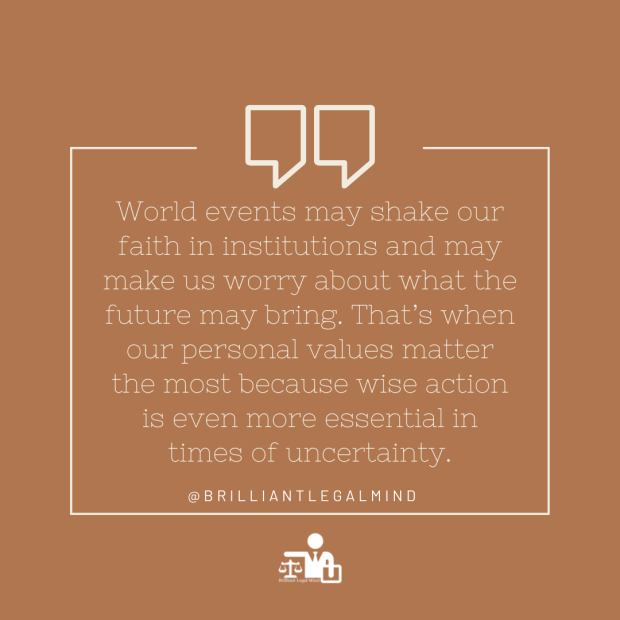
So, what can we do when the world gives us a lot of reasons to doubt? The same thing we do when there are gray areas in the law: we trust ourselves and make a judgment call. When it comes to something like hope, this means we remember what we value and we try to live accordingly. World events may shake our faith in institutions and may make us worry about what the future may bring. That’s when our personal values matter the most because wise action may be even more essential in times of uncertainty. For this reason, reconnecting with our personal values may help us remember the ways that we can bring good into the world even during difficult circumstances.

Image with quote from blog post that says "World events may shake our faith in institutions and may make us worry about what the future may bring. That's when our personal values as lawyers matter the most because wise action is even more essential in times of uncertainty."

Hopelessness is a difficult emotion to experience because it is something that can make us feel helpless, alienated, unmotivated, and alone. Though it can be a challenging emotion to face, each of us can learn to hold our own hopelessness in kindness.

This will help us reconnect to ourselves, reevaluate our roles in our communities, and better understand the values we wish to bring into the world. Perhaps we may never recover the same hope we experienced before, but I don’t know that must do so in order to lead a good and happy life. Instead, it may be more effective to learn to let new forms of hope grow in us in each new phase of our lives.


Want to learn more about mindfulness and compassion? Check out my new book, How to Be a Badass Lawyer, for a simple guide to creating a meditation practice of your own in 30 days. And to share mindfulness with your little one, check out my new children’s book, Mommy Needs a Minute.

Like this post? Subscribe to the blog here or follow us on social media:

Mindfulness vs. Ego: Finding Balance in a Digital World

Image of pawns with social media graphics with title "Mindfulness v. Ego: Finding Balance in a Digital World"

I spoke to a group of new law students this week and someone asked the best question about mindfulness and ego. I loved it because it showed a lot of courage and insight. The student asked me if mindfulness practice and blogging or social media are at odds because they contribute to ego.

The short answer I gave him is that this certainly can be a problem but it doesn’t have to be. I explained that anyone who writes or uses social media must learn some skills with managing their ego. And I explained how mindfulness practice can help with that.

After leaving the session, though, the question was still in my mind. It pointed to some fundamental questions about mindfulness and ego that I thought others might be asking. So in this post, I will explore mindfulness and ego a bit more deeply.

What Is the Ego?

Many of us use the word “ego” in conversation but we may not take the time to define the term. A common dictionary definition is “a person’s sense of self-esteem or self-importance.” Most of us wouldn’t argue that a healthy sense of self-esteem is a good thing.

But when I hear the phrase “ego” uttered, it usually has a pejorative connotation. This is because, as most lawyers have observed, it is very easy to get an inflated sense of self-importance. In fact, our hyper-individualistic culture can contribute to this.

This is why it may be helpful to look at the psychological and clinical meaning of the ego. The Cleveland Clinic explains that it is the “part of your personality that helps you make practical, rational decisions.” It also supports your ability to:

  • adapt to your environment;
  • regulate your emotions; and
  • feel like yourself.

Viewed in this more neutral light, you can see that ego is a part of the human psyche that may serve an important function.

Image of dictionary definition of ego as stated in the post which is "a person's sense of self-esteem or self-importance"

You Need a Healthy Sense of Self-Esteem

Given this, it would be a misunderstanding in my opinion to say that the goal of mindfulness practice is to overcome or eliminate the ego. In truth, as I have written before, I would be cautious about setting any specific goal for mindfulness practice at all.

Intention can be a wonderful guiding force to help motivate practice. Goals, however, often add a level of expectation that can undermine the cultivation of mindfulness.

In addition, high achievers like lawyers are encouraged to be cautious about pushing themselves too hard when it comes to self-improvement. If you are anything like me, you may need to learn to be kinder to yourself in meditation rather than more disciplined.

Along the same lines, some people may benefit from a more robust sense of self rather than a diminished one. This can include people with particular sensitivities, including histories of trauma or neurodivergence.

But It Helps to Get Clear about Your Life

With that said, mindfulness practices can help you explore the role of ego in your own life. As I have explained before, mindfulness practices are likely to help you explore the very concept of the self. Practicing mindfulness can help you see that “the self” to which you have grown accustomed is not a stable or static thing at all.

Taking time in your day to be present with your thoughts and feelings can give you an opportunity to become aware of patterns in your life. This can give you greater ability to notice, check, or even change some patterns that may not be ideal for you. It may also help you see the ways in which you are not separate from, but instead integrally connected with, others.

In many cases, you are bound to find (much like I have) that the ego is a present driving force in life. You may notice when a need to feel important or especially loved or better than others pushes you in ways that are not wholesome for you or other people. And even better, you may see ways that you can take care of your feelings and find greater connection with others in your life.

In all of these ways, mindfulness can help you understand yourself better, including the role of ego in your life. It can help you become clearer about your place in the world, so that you can navigate relationships more ethically. This can be a truly wonderful and life-changing part of the practice, but it is important to balance this inquiry with self-compassion.

Image of blog post author Claire E. Parsons with quote "Mindfulness practice doesn't mean we have to drop out of the world. It doesn't mean we can't pursue goals or things we love. It doesn't mean we have to change who we are."

Mindfulness, Ego, and Social Media

Given this clearer understanding, I want to return to the law student’s question to illustrate the concepts more clearly. The student asked whether things like blogging and social media are contrary to mindfulness practice because they can contribute to ego.

The operative word in this question is “can”. Most of us know that social media can certainly contribute to one’s sense of self-importance. We know that, depending on how it is used, social media is also associated with adverse mental health consequences and sometimes abhorrent conduct. Even if you aren’t a blogger, you may see how that can have the same effect. But I will say from experience that those things aren’t universally true.

For some people, blogging and social media might lead to unhealthy states of mind, like social comparison or perfectionism. I’d be lying if I didn’t admit that those struggles sometimes happened for me. But I have learned to recognize when a striving attitude is taking hold and to give myself a break. I have adopted an attitude of fun and play when it comes to writing and the use of social media. I’ve also let go of expectations. If I have a goal, it is to share ideas and connect with others.

And in truth, I have had to learn how to navigate the negative aspects of social media too. I have had to learn how to not fight with strangers on the internet. I have hard to learn to state my opinions with humility and respect for the viewpoints of others.

In addition, I will be honest that blogging and social media have inspired a lot of humility in me. I have written so many things that never get read. I have had times where people criticize my writing. I have faced imposter syndrome so many times when I see talented people who do things better than me. In all these ways, blogging and social media have provided at least as many checks on my ego as they have provided temptations for it.

What Does This Tell Us about Mindfulness, Ego, and Pursuing Goals?

The big conclusion from all of this that most lawyers will care about is that I don’t think mindfulness practice means we have to get rid of our egos. Mindfulness practice doesn’t mean we have to drop out of the world. It doesn’t mean we can’t pursue goals or things we love. It doesn’t mean we have to change who we are.

Instead, mindfulness practice is really more about understanding ourselves more clearly so that we can engage in the world with greater kindness and skill. In this way, mindfulness practice is not inherently antithetical to the use of social media or to creating a robust body of work in the world.

The caveat here is that, of course, mindfulness practice should inspire you to watch the way you go about pursuing goals and crafting your body of work. It should cause you, at every turn, to consider the impact of these things on you as well as on the community around you.

If you practice mindfulness long enough, you inevitably will question yourself at times just like the law student questioned me. This part of the practice can sometimes be a gut check – or maybe an ego check – but it is one that has changed my life. And it is one that helps me stay honest on this blog and when I use social media. If you learn to make space for questions like these in your own mindfulness practice, they can change your life too.


Want to learn more about mindfulness and compassion? Check out my new book, How to Be a Badass Lawyer, for a simple guide to creating a meditation practice of your own in 30 days. And to share mindfulness with your little one, check out my new children’s book, Mommy Needs a Minute.

Like this post? Subscribe to the blog here or follow us on social media:

Tips for Lawyers: Manage Stress Getting Back to School

Image of chalk board and school supplies with title of blog post "Tips for Lawyers: Manage Stress Getting Back to School"

As a school lawyer, I normally love back to school season. This year, though, I am struggling. The summer was busier than I expected and the back to school rush at work happened earlier too. This means that I am feeling overwhelmed, tired, and stressed.

What is a lawyer and meditation teacher to do with this situation? Well, I don’t promise to be an expert here. This struggle is real for many of us for a reason. But I can say that a few intentional strategies have helped me establish order and get ready for back to school.

Manage the Biggest Stress Points First

When things get very busy, I narrow the scope of my focus. My guiding principle is to do now what has to be done today. Clearly, this is not a sustainable approach on a long-term basis. Living day to day has some advantages, but so does planning ahead.

Even so, focusing on what has to be done right now is an essential strategy for regaining order in times of chaos. It can help you build some momentum for managing the challenges of life. It can also help you avoid other problems that may emerge later if you don’t tackle priorities first.

Thus, when your schedule is too busy or life is in flux, a first essential step is identifying prioriy tasks and addressing those first.

Simplify and, If Possible, Delegate

After you have triaged the priority issues, another step for reestablishing order is to simplify whatever you can. Remove unnecessary steps or flourishes from projects. Look for easier ways to accomplish tasks. Delegate or get help in any way that you can.

Many lawyers tend to be high achievers. This means that we often do more than what the circumstances truly require. When time allows, this is not a terrible life strategy to adopt. But in times of stress or change, it can add work and sap energy that you do not have. Simplifying tasks and focusing on what is truly essential can help you avoid this trap.

As a quick example of this, I used this strategy to handle some of the back to school chores for my kids. They had a doctor’s appointment and needed new shoes. Instead of going to my favorite shoe store, I went to one very close to the doctor’s office. This allowed me to consolidate travel time, so the kids could get new shoes and I could get the job done.

When time is limited, don’t make extra work for yourself. Simplify tasks as much as possible.

Image of post it note with question "How could I make this simpler?" as discussed in the blog post about back to school

Prioritize Healthy Habits

When times are busy or stressful, healthy and supportive habits are often the first things to suffer. Even though most of us know what is good for us, disarray in one’s schedule can make it harder to eat, sleep, and exercise like we should. These habits, though, can have an immediate beneficial impact on how we feel mentally and physically.

For this reason, when my schedule is in flux, I often prioritize the basics. I try to refresh my sleep hygiene protocols and get a regular schedule back in place. I make sure I have some healthy ingredients on hand so that I can eat nutrient-dense meals to power my days. Even though it can be a struggle, I get back to my normal meditation and exercise routine too.

Let me be clear. All of these things take time and energy to manage. Despite this, I prioritize them in times of change or stress because I know they are priorities. These habits help me feel my best and manage stress, so that I can face whatever I need to face in my daily life. In addition, because these practices are part of my normal routine, returning to them helps me create a sense of normalcy and order.

Conclusion

Back to school time can be a fun and exciting time. For many lawyers, though, it is also a stressful time. It’s a time of change and extra work to transition to a new phase in life. With some intentionality, though, you can manage the time crunch, stress, and extra work. I hope these tips help you regain some control and establish a new order that will help you and your family thrive this school year.


Want to learn more about mindfulness and compassion? Check out my new book, How to Be a Badass Lawyer, for a simple guide to creating a meditation practice of your own in 30 days. And to share mindfulness with your little one, check out my new children’s book, Mommy Needs a Minute.

Like this post? Subscribe to the blog here or follow us on social media:

The Connection Between Mindfulness and Personal Boundaries

Blog post of women talking with title of blog post "The Connection Between Mindfulness and Personal Boundaries"

“Can you talk about setting boundaries?” I got this question during a presentation about mindfulness and compassion for a law firm last week. Though I did my best to answer it, this topic is one that took more time than I had during a webinar. As a result, the question stayed with me long after the presentation ended.

Boundaries are tough for many of us. They are especially challenging for lawyers and others in service professions. My answer when the question was presented to me was that mindfulness and compassion can definitely help with this. In this article, though, I will explain in more detail precisely how.

The Ways that Mindfulness Helps with Boundaries

Boundary setting sounds like a single-step process but it truly has multiple aspects. This means that our ability to set boundaries may require us to execute more than one task successfully. The other problem with boundaries is that they are by definition individualized. We can’t simply copy other people. Instead, we must learn through life experience what our needs are and how to ensure that they are met.

This is why mindfulness and compassion can help us set boundaries in the following ways:

  1. Supporting us in identifying personal needs;
  2. Helping us to explore the concept of interconnection;
  3. Cultivating clarity about what kindness and compassion truly are; and
  4. Building skill with being uncomfortable.

I’ll explain each one below in more detail.

1. Mindfulness and Identifying Needs

One of the reasons that boundaries can be hard to set is that we may be in the habit of overlooking our own needs. This is not a criticism but an observation of life. Lots of us are busy. Lawyers, caregivers, and others in service industries may be accustomed to focusing on the needs of others. For these reasons, it is quite easy to just not notice what you need.

Mindfulness practices can be transformational for this basic reason. The practices force you, at least for a few minutes, to check in with yourself. Inherently, meditation or other practices like yoga include noticing what’s in your mind, heart, and body. This clarity about your thoughts, feelings, and emotions is a foundational step to help you identify needs so that you can set boundaries.

2. Mindfulness of Interconnection

We live in a highly individualistic culture, so many people can get the idea that setting boundaries is about focusing only on themselves. I think this is a mistake for a practical reason. Despite the constant encouragement to think about ourselves, humans are social animals. We live in and depend on community to live happy and productive lives.

Mindfulness practices can help us get clarity about our rightful role in the world. As we pay attention to our own minds, bodies, and hearts, it is nearly impossible to avoid the social situations in which our feelings, thoughts, and emotions arise. Over time, this helps us see how connected we are to others.

When we pay attention to this interconnectedness, we build wisdom about the importance of honoring all human needs, including our own. Paying closer attention to these connections may also help us better understand what our essential needs truly are. Over time, this may help us develop more balance in navigating our own boundaries in relationship to others.

Image listing the four ways that mindfulness and compassion can help with setting personal boundaries that are shared in the blog post

3. True Compassion Respects Boundaries

Some people struggle with setting personal boundaries because they may think it seems selfish. Others may have the idea that kindness and self-sacrifice are synonymous. Regular mindfulness and compassion practice help us see that neither are really true.

As I have shared before, a regular mindfulness practice should include the four heart practices, including kindness and compassion. If you do these practices regularly, you will build clarity about what kindness and compassion truly are. Kindness isn’t meekness or consistently denying oneself. Compassion is not merely sacrificing oneself for others.

Instead, both of these traits and responses are premised on the idea that all people, including yourself, deserve to be healthy, safe, happy, and at peace. If you practice long enough, you will likely see that kindness and compassion flow much more easily and robustly when your own needs are met. In this way, practicing mindfulness may help you internalize the idea that compassion and kindness for others are compatible with and supported by setting personal boundaries.

4. Setting Boundaries Can Be Uncomfortable but Mindfulness Helps with That

Another practical thing that keeps many of us from setting good boundaries: it’s uncomfortable. Most of us, especially lawyers and others in service professions, don’t like to tell other people no. It can cause conflict. We may worry it will cause others to judge us. At a minimum, it can make us feel awkward and unsure.

This good news is that mindfulness practice can help with that. The bad news is that mindfulness helps because it often includes being uncomfortable. Most of us don’t want to sit quietly and watch our thoughts. Most of us don’t want to avoid moving when we have an itch on our arm. We don’t want to persist when our backs hurt or we are falling asleep or our minds won’t shut up.

When we can persist with these challenges, though, it builds patience, courage, and the skill of being with discomfort. Though I emphasize gradualism and self-kindness at all stages of meditation, I am the first to say that these skills are invaluable. If you can sit in meditation for a few minutes with a difficult thought or uncomfortable sensation, this means you can face the same things when they arise in a conversation about boundaries.

Conclusion: Mindfulness Builds the Skills We Need to Set Boundaries Effectively

In short, mindfulness and compassion practices help with setting boundaries because they cultivate some of the fundamental skills necessary for doing so. These include, identifying personal needs, clarity about kindness and our role in community, and the ability to handle discomfort. Of course, setting boundaries is something that we cannot do with meditation alone. With time, though, mindfulness practice can help us bring these traits into our lives so that we can set personal boundaries more effectively.


Want to learn more about mindfulness and compassion? Check out my new book, How to Be a Badass Lawyer, for a simple guide to creating a meditation practice of your own in 30 days. And to share mindfulness with your little one, check out my new children’s book, Mommy Needs a Minute.

Like this post? Subscribe to the blog here or follow us on social media:

Mindfulness for Job Seekers: Transforming Adversity into Opportunity

Cover image for blog post with picture of people waiting for job interview with title "Mindfulness for Job Seekers: Transforming Adversity Into Opportunity"

Most of us know that looking for a job can be a hard thing to do. If you haven’t looked for work in recent history, you probably know some job seekers who have. Many people, including a lot of lawyers, are actively looking for work or trying to transition to a new role.

When I was asked to talk about mindfulness to a local group that supports job seekers, I quickly said yes. Though I had not experienced joblessness in my career, my friends and relatives have. I also knew from personal experience that mindfulness and compassion are essential for facing adversity in life.

In this post, I will share details about and access to my talk.

A Great Resource for Job Seekers

I offered my talk to the Northern Kentucky Accountability Group, created by the Kenton County Public Library. This group does far more than offer job listings and business books to its members. It is a support group for anyone looking for jobs or interested in moving into a new professional role.

The group offers support and community, skills classes, and access to volunteer speakers and coaches. People local to Northern Kentucky and Cincinnati attend events in-person at the library. Many people outside of the Cincinnati metro area access the programs online and via Zoom.

I share this information here so that everyone can learn more about the program. Please review their offerings and share with any job seekers who need support.

Image of woman facing stressful situation with laptop and quote that says "Mindfulness and compassion practices helped me learn how to cope when life did not go well."

Highlights from the Presentation to Job Seekers

In my talk, I spoke about my experience handling personal setbacks that led to professional growth. My talk was entitled Navigating Life’s Trials: A Story of Mindful Transformation and Community Impact. In it, I shared my story with postpartum depression and how it led me to explore mindfulness.

As I have shared here before, this in turn helped me take important steps forward in life. Mindfulness helped me learn how to network. It taught me about leadership. It also helped me develop the courage to start writing and find my voice as a mental health advocate.

Why Mindfulness and Compassion Can Help

Besides sharing my story, the talk also included some teachings about mindfulness and compassion. Specifically, it explained how these human faculties help us navigate hard times in life. This is essential for job seekers and anyone dealing with life’s challenges.

The talk explains in simple terms what mindfulness and compassion are. It also explains why meditation helps to remove barriers to those capacities. Then it explains a few of the simple meditation practices that can support the cultivation of mindfulness and compassion.

The active engagement from the audience further enhanced the talk. They asked great questions and shared their own experiences and challenges.

How to Watch the Presentation

Another great thing about the Northern Kentucky Accountability Group is its online library of talks from past speakers. The library has recordings from many of its speakers dating back to 2022. All of the talks are tailored to active job seekers and others looking to build professional skills. You can browse through each year of the library to find a variety of excellent talks.

My talk, Navigating Life’s Trials, is listed under April, 2025. You will find a link and a password to view the recording. The session is about an hour in length. Don’t sleep on the Q&A session at the end. The questions were good and I mention extra resources too.

Image of women showing herself love with quote that says "When done right, mindfulness practice also supports the cultivation of kindness."

More Resources for Job Seekers

When asked about confidence and imposter syndrome, I mentioned these resources from the blog:

All of these resources offer valuable insights for those handling change in life and work.

Community and Mindfulness Can Support Job Seekers

If you are searching for a job, communities like the one I discuss here can be a great support. As I shared in my talk, building critical skills like mindfulness and compassion can also help too. I wish all of the job seekers out there the best. I also hope that the resources and ideas shared here will support you in your job search.


Want to learn more about mindfulness and compassion? Check out my new book, How to Be a Badass Lawyer, for a simple guide to creating a meditation practice of your own in 30 days. And to share mindfulness with your little one, check out my new children’s book, Mommy Needs a Minute.

Like this post? Subscribe to the blog here or follow us on social media:

How to Handle Emotions of Overwhelm in Five Mindful Steps

Cover image from post with lawyer being inundated with things and the title from the blog post "How to Handle Emotions of Overwhelm in Five Mindful Steps"

Overwhelm is one of the emotions that I dislike the most. As someone who struggles with anxiety, I am not talking about being overwhelmed with positive emotions, like love, joy, or gratitude. When those things happen, they are amazing.

More often, I experience the nasty kind of overwhelm. This is when I am confronted with a challenge that is so big, new, or strange that I feel totally unable to handle it. In times like these, I feel defeated, powerless, and usually ashamed.

When Does Overwhelm Arise?

I’m thinking of this phenomenon because I just experienced it when I bought my daughter a new “big girl” bed. Initially, I prided myself for my efficiency when I shipped a Smastad loft-style bed from IKEA. That feeling immediately transformed to regret when I saw a collection of 6 large, heavy boxes and at least 4 other smaller packages filling my garage.

For some backstory, I am historically awful at assembling items. My husband usually jumps in immediately to save me from myself but he’s a CPA dealing with his own variety of overwhelm during tax season. I considered hiring a handy person to help, but the number of boxes suggested that managing the handy person would be more work than doing the project myself.

I stood before the boxes with few good options and had to face the facts. I was overwhelmed.

Mindful Step 1: Don’t Fight the Overwhelm.

Since I am a mindfulness teacher and a lawyer trained to solve problems, I bet you are hoping that I had some magic trick up my sleeve. Nope. Not at all. Even so, life experience has taught me this: it doesn’t help to fight emotions like overwhelm.

You can’t make overwhelm pretty or nice or satisfying. You can’t gloss it with a silver lining or fill it’s cracks with gold. At least, you can’t do it on the front end. With overwhelm, the first best step you can take is to not fight it.

I stood in my garage, staring at the boxes. I let my mind race about how long it would take. I allowed my mind create horror stories about how exhausting and frustrating it would be. I raged at myself for an impulse purchase of this magnitude without considering the consequences.

In other words, I let the overwhelm be there. I didn’t fight it. I felt it. I let it have it’s moment and fully accepted the situation that I had created for myself.

Image of blog post author with the quote "You can't make overwhelm pretty or nice or satisfying. With overwhelm, the first best step you can take is to not fight it."

Mindful Step 2: Honor Your Emotions.

With most big emotions, mindfulness practice has taught me that time and space are the best salves. In this case, that means I left the gigantic boxes sitting in my garage for a week. To put it another way, I didn’t rush in to handle the situation. I just waited until I calmed down and I could stand to look at the boxes again.

Ultimately, the thing that pushed me to move forward was being annoyed with the boxes themselves. I was sick of climbing over them to get to the garage. I wanted my daughter to have the awesome new loft bed. I also started to feel curious about whether I could find a way to get this thing built without driving myself crazy.

By giving myself time and space, I let the overwhelm subside and made room for the feelings that motivated me to act. They helped me refocus on the goals I had originally, so I could get back on track.

Mindful Step 3: Make a Plan Tailored to Your Human Needs.

When my motivation was restored, I decided that there was no way to get started without first assessing the situation clearly. My first job was to unbox everything, locate the instructions, and gather all the pieces.

That was no small feat, so I gave myself time to rest before I began the organization phase. Since I had always struggled putting things together, I decided to take the remaining steps very slowly. I took time to study the instructions and even found some handy YouTube videos about assembling this very item.

I divided the project into three phases and made sure my daughter would still have a bed to sleep in even if gaps occurred. This helped me account for my own frustration and fatigue. It took the pressure off and accounted for the inevitable mistakes I would make in following the instructions.

Mindful Step 4: Execute the Plan Step by Step.

After creating your plan, the next phase is execution. This is when the old adage about eating an elephant comes to mind. How do you do that? Bit by bit. In this case, I subdivided my phases into even smaller microsteps.

I first organized and arranged all the hardware (pro tip: a muffin tin is perfect for this). I gathered all my tools. I lined all the pieces up exactly as illustrated in the instructions and then followed the instructions step by step. Any time where I made what felt like a judgment call, I noted it so I could retrace my steps if needed.

In other words, I did the opposite of what my millennial brain told me to do when I get a new product. I didn’t play around and figure it out. Instead, I moved in super slow motion as if I was an assembly robot. This kept me organized, allowed me to take breaks when needed, and kept my mood and mindset in check.

Image listing the five mindful steps for handling emotions of overwhelm as shared in the blog post

Mindful Step 5: Celebrate the Victory.

Recently, I finished phase 1 of my massive project. This means that I assembled the bookcase/wardrobe that serves as the foundation of the bed mostly on my own. Am I concerned that someone else could have done this faster? Not at all.

I celebrated the crap out this achievement. I showed it to my daughter. I reveled in the feeling of progress and compared it to my feelings of overwhelm just a few weeks before.

The point here, of course, is that celebration is a critical component to any big project. Sure, it’s only phase one. Yes, two arguably more challenging phases remain for me to complete. The difference, though, is that now I have a renewed sense of confidence. I have evidence that I can find a way to work my way through the rest of the steps to accomplish my goal.

Because a big project involves so much effort and patience, it is smart to offset it with a healthy amount of celebration at each milestone. You better believe that I am going to celebrate fully when this bed is finally assembled.

Conclusion: Overwhelm Is Hard but You Can Manage It Step by Step.

Whether it is caused by a major work project or an imposing box from IKEA that is gathering dust, overwhelm happens to us all. It is an emotion that can sap our motivation and cause us to want to run and hide. With mindfulness and self-compassion, though, we can work through overwhelm just like we go step by step through any big project. In this post, I offered you a brief instruction manual with 5 steps to help you navigate if overwhelm happens to you.


Like this post? Subscribe to the blog here or follow us on social media:

Want to learn more about mindfulness and compassion? Check out my new book, How to Be a Badass Lawyer, for a simple guide to creating a meditation practice of your own in 30 days. And to share mindfulness with your little one, check out my new children’s book, Mommy Needs a Minute.

The Connection Between Mindfulness and Writing Success

Cover image for appearance on Dear Indie Author podcast on mindfulness and writing

As a mindfulness teacher and blogger, the connection between mindfulness practice and writing comes up for me a lot. Though I have always been drawn to writing and I do it every day in my work as a lawyer, I didn’t always consider myself a writer. It took many years for it to emerge as a real passion and part of my life.

How Meditation Led to Writing

If I never started meditating, there’s a good chance that I never would have discovered this meaningful pastime at all. As I have explained before, meditation helped me create the mental space that was necessary to recognize some of my copious thoughts as ideas. Over time, I also cultivated self-compassion and became more aware of latent judgments, so I could get ideas on the page.

Then, finally all the time sitting in meditation and the benefits it imparted convinced me of something fundamental: using some of my time to please myself was worthwhile. This helped me get over all the fears about writing being a “waste of time” or “too much work” or that “nobody would care.”

The Interview Discussing Mindfulness and Writing

I was fortunate to get a chance to discuss all of these things and more with fellow writer and coach, Shonda Ramsey. I met Shonda online when I saw her searching for self-published authors. Writing my first book was a great experience and one that has led to many other wonderful opportunities in my life.

I was glad to get to talk to Shonda about it and explain how mindfulness and creativity are interconnected. I was also pleased to discuss the fact that writing, a traditionally lonely endeavor, was something that led me to cultivate greater community. In fact, I was proud to share that I got help from a book coach to make the leap from blogger to author quickly.

How to Watch or Listen to the Interview

If you are interested in writing or wonder what mindfulness can do to help you get more creative in life, check out the full interview on the Dear Indie Author podcast. You can listen online, Apple Podcasts, or Spotify or watch the interview on YouTube here:


Like this post? Subscribe to the blog here or follow us on social media:

Want to learn more about mindfulness and compassion? Check out my new book, How to Be a Badass Lawyer, for a simple guide to creating a meditation practice of your own in 30 days. And to share mindfulness with your little one, check out my new children’s book, Mommy Needs a Minute.