A Socratic Dialogue with Thor about Anger in Meditation

If you went to see Thor: Love and Thunder last month, you probably spent less time focused on Thor’s discussion of meditation with genius scientist and lost love, Jane Foster. As the two discuss their past, they confided that they each had tried meditation to heal from their losses. Rather hilariously, Thor proclaimed that it didn’t work for him because it “just made him angrier.” It was a relatable quip that most people in the audience may have heard, laughed about, and moved on from to the rest of the movie. 

When I heard it, though, the biggest “well actually” line of dialogue began streaming through my mind. Obviously, I had to restrain myself from announcing this in the theater, but that only made me think about it more later. Because Thor’s misconceptions about meditation and anger are likely shared by many of us mere mortals, I offer this imagined dialog with Thor. Not sure it’s truly a Socratic method but what we experienced in law school probably wasn’t either, so close enough. 

Camera pans out to reveal a strange light in the sky. The light grows into a bright white circle. From it, emerges a woman never before seen in the movie and who does not rightfully belong in it. Thor stands back from the light and reaches for his weapons in alarm. When he sees it is just a woman who clearly has no martial arts training beyond the occasional Peloton shadow boxing class, he stands confused but at ease. 

Thor: Who are you and what are you doing here? 

Claire: Hey, Thor, I am a human from earth. You and Jane are doing a great job showing vulnerability to address some unresolved issues. I don’t want to derail that but you said something about meditation that isn’t quite right. 

Thor: How did you get here? Did Gorr the God Butcher send you?

Claire: I have no idea but no, Gorr is clearly the bad guy here. If only he had learned how to hold his grief, we wouldn’t be in this mess. That’s why I am here to talk about meditation and anger. 

Thor: You don’t appear to be one of Gorr’s monsters, but I’d really like to get back to talking to Jane. 

Claire: We all want you to get back to talking with Jane, so I’ll get to the point. That thing you said about meditation just “making you angrier” it’s not really true. 

Thor: Now I am concerned that you are Loki trying to trick me. Are you trying to tell me you know my experience better than I do?

Claire: Not at all. I also don’t know what kind of meditation you were doing. But, I’m guessing you tried to sit and focus on your breath or something? Did you try Headspace or 10% Happier?

Thor: I have an app called ZenGod. It’s specifically for gods but similar. Yes, I tried to focus on my breath, but I couldn’t because I just became filled with rage. 

Claire: Got it. And yes, that is totally normal. It happens to the best of us. What did you do when the rage came up?

Thor: I immediately stopped meditating and went to kill monsters with my ax.  

Claire: Did that help you feel less angry?

Thor: It felt pretty good to kill those monsters, but the feeling didn’t last. 

Claire: That’s really good too. Not good that you felt that way, but that you noticed it. 

Thor: What do you mean? How could it possibly be good that I noticed this?

Claire: Well, the reason we meditate is to notice what’s there. When we notice what’s there, over time that becomes wisdom and we are in a better position to know what to do about what’s there. Sometimes the only thing we can do is to let things be, but the wisdom is seeing this. 

Thor: I am a god. I don’t “let things be.” I hit bad things with my ax and summon power from the universe to destroy them. 

Claire: Well, how did that approach work for your anger?

Thor: It didn’t work at all and I can tell because I am getting very angry right now. 

Claire: That’s okay. It’s perfect actually. There’s nothing wrong with anger. You have every right to be angry. You’ve lost a lot. You’ve taken on a lot for other people. Your anger has helped you to protect others several times. Can you just let it be there now?

Thor: It’s hard. I don’t like it. I am very powerful and it makes me nervous to feel like I can’t control it. 

Claire: Excellent. You are doing so great. Anger does scare a lot of us because it makes us feel out of control. The more powerful we are the harder it can be because we are responsible for a lot and we don’t want to do something bad. But, remember, you are holding it now. What exactly does your anger feel like now?

Thor: Feel like? It’s anger. Why do I need to explain it?

Claire: Great job again. You are so good at this. You don’t need to explain it to me or anyone else. What I’m saying is to feel it. Where in your body do you feel the anger? What sensations are there that tell your brain you are angry?

Thor: My jaw is clenched. My hands are gripping my ax. My shoulders are tight. I feel like I am holding my breath. My neck and cheeks feel hot. I want to hit something. 

Claire: Wonderful. You are doing great. All of those things are normal. That feeling of wanting to hit is energy. We may not like it, but the function of anger is to make it clear to us when something is wrong and motivate us to act. Because you are a superhero, your habit is to discharge angry energy by hitting things. That can be good sometimes, but it can also be good to just learn to hold it for the times when you aren’t fighting monsters. 

Thor: So what do I do when I need to hold it? I still feel angry now. 

Claire: The first thing is to do what you just did. Notice what’s there. Recognize it as anger. Allow yourself to feel how you feel. After that, the most common way to come back to neutral is to breathe. 

Thor: Breathe? That’s so basic. I’m a superhero. Can’t you do better than that?

Claire: You are a god but you have enough human in you such that the breath is the way you can calm down the body. Think of your breath as the ax you use to fight the monster of anger? Does that help? When you focus on your breath, specifically the exhale, it sends a signal to the body that things are okay, that you’re safe. Try it out. Take a deep breath in, feeling what sensations happen as your lungs expand. Hold it for a moment. Then exhale and sense what it feels like to let go. 

Thor: *Rolls eyes but tries breathing* 

Claire: Let’s try that one more time. This time see if you can make that exhale just a beat longer than the inhale. 

Thor: *Continues on and then opens eyes*

Claire: Great job. How was that?

Thor: It helped. I still feel a little angry but I no longer wish to hit anything. But, I’m confused. I thought I was supposed to be calm when I meditated. You told me to feel angry. 

Claire: Excellent question. Meditation isn’t about just feeling calm. Many people do it to learn how to get calm or get back to it. But the real object of meditation is to learn to be present with whatever comes up. If that’s anger, then it’s practicing presence with anger. The reason this helps you get calm is that eventually you learn that when you are angry, you can just be angry and you don’t always have to act based on it. 

Thor: But what if I screw it up when things are too much?

Claire: You are going to screw things up. Meditation doesn’t make you perfect. It just gives you a new tool to use. The next part is forgiving yourself but I think the rest of the movie is going to cover that, so I will let you and Jane be. 

Thor: Movie? What? 

Claire: Ummm, errr . . . I just mean that I know you will figure that one out. But, if not, feel free to DM me @BrilliantLegalMind and we can talk again. Good luck with Gorr! 

Thor: Goodbye, strange woman from Earth! 

A bright light emerges again in the sky and a white circle enshrouds Claire. Thor and Jane return to talking and Claire continues watching from her seat in the theater. 

Don’t get me wrong, this post is not intended to tell you to meditation-splain to random people out in the world, particularly not if they are large superheroes with magical axes. But, if you have ever struggled with anger in meditation, at least you know you are in good company. Best of luck in your practice, fighting whatever monsters in life you have to fight, and I hope you enjoy the summer blockbuster movies as much as I have.

If you struggle with anger in meditation or otherwise, you aren’t alone. Check out this article I wrote for Above the Law which shared my experience with it and what helped me. If you have any strategies or practices that have helped you, leave us a comment to share your wisdom with others.

Want to learn more about mindfulness and compassion? Check out my new book, How to Be a Badass Lawyer, for a simple guide to creating a meditation practice of your own in 30 days. And to share mindfulness with your little one, check out my new children’s book, Mommy Needs a Minute.

Like this post? Subscribe to the blog here or follow us on social media:

What Is Restorative Yoga and Why Should Lawyers Try It?

Lots of people tell me that they can’t meditate because they can’t sit still. I usually tell them that they don’t have to sit still to meditate. Strangely, people also tell me with a similar frequency that they can’t do yoga because they can’t do the poses. Sometimes they say that they can’t balance. Sometimes they say that they aren’t flexible. Sometimes they express a concern that they look silly. In other words, these people tell me the inverse of what the people who can’t sit still during meditation say: that they can’t move the right way during yoga.

When I hear these concerns, one of the first things I say is to acknowledge that I used to struggle with yoga too, but that letting go of the idea that there was a “right way” to move was what helped me learn to love it. One of the practices that helped me do this was restorative yoga. When I finally tried yoga for real, I already had an active meditation practice but it helped me realize I had to develop some ways of caring for my body in addition to my mind.

Though I’d been athletic growing up, I had not worked out consistently in years, so I started with yoga as a way to ease back into movement even though my earlier attempts with it had not been successful. Because I needed time to build up cardio endurance, I had to start with slow and gentle classes first. That’s when I found restorative yoga. Lucky for me, it was enough like meditation that I could enjoy it but different enough that it could serve as a segue into more yoga exploration.

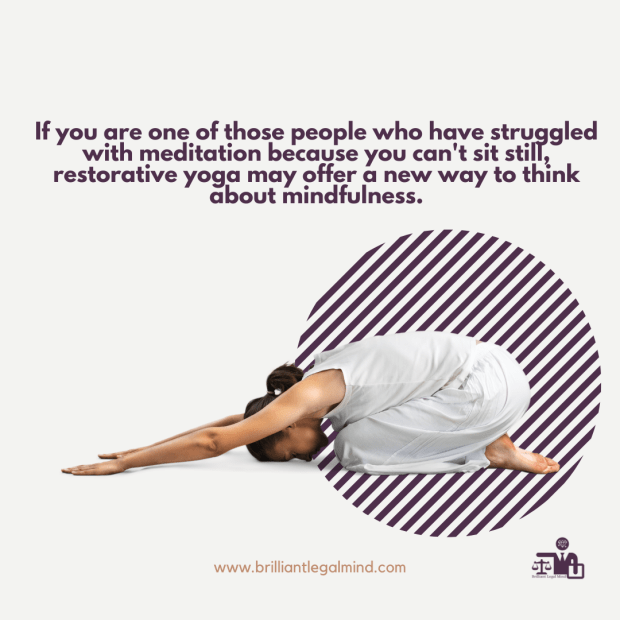
Restorative yoga is a restful kind of yoga. Poses are part of the process, but the poses are supported rather than held. You don’t build strength and balance with the poses. You practice rest instead and you practice letting yourself be supported. In most cases, the poses are done lying on the floor, reclined on props, including blankets, blocks, or bolsters, or resting against the wall or a chair for support. This is because yogis hold the poses in restorative class for at least 5 and often as much as 15 or 20 minutes at a time.

So, why is this good for lawyers? It’s good for a lot of reasons. Restorative yoga practices rest and being supported. Most of us lawyers are in the habit of being active all of the time and doing many things on our own. For this reason, practicing another way of being is a way to offer balance to our lives. In addition, the poses themselves are beneficial to the body. Poses that help open the chest or arch the back may counteract the effects of sitting at a desk all day and inversions may balance hormones and offer relief from the effects of gravity and wearing uncomfortable shoes.

Finally, if you are one of those people who have struggled with meditation because you can’t sit still, restorative yoga may offer a new way to think about mindfulness. The instruction in most restorative classes is just to be in the experience of the pose, to feel oneself resting, and not to drift off in thought.

This is similar to the practice of sitting meditation, but it has some additional physical and restful components that may help you relax into and tolerate the experience more. Even if you enjoy meditation like I do, you may find that restorative yoga is a nice way to mix things up or can offer a chance to find mindfulness when life makes meditation seem a bit too intense.

If you are interested in learning more about restorative practice, you can find it at many yoga studios. Some fitness apps and online platforms, such as Peloton offer it too. In addition, you can easily start a home practice by finding a set of restorative props online.

You can also check out some of the work of Judith Hanson Lasater, Ph.D., P.T. Her book, Relax and Renew offers pictures and explanations of poses and full sequences to help you do the practices on your own at home.

Just as you don’t have to sit still to meditate, you don’t have to move to do yoga. Restorative yoga offers lawyers the chance to practice rest so that they can find peace in stillness and pay closer attention to how their bodies feel. It is a beautiful practice that offers people in stressful jobs many benefits. Giving you the chance to experience how expansive yoga can be is just one of them.

Do you want to try restorative yoga? Check out our Supported Fish Pose with Self-Kindness Guided Mediation. Or you can try our Legs Up the Wall Guided Meditation even if you don’t have any props. All you need are your legs and a wall.

Want to learn more about mindfulness and compassion? Check out my new book, How to Be a Badass Lawyer, for a simple guide to creating a meditation practice of your own in 30 days. And to share mindfulness with your little one, check out my new children’s book, Mommy Needs a Minute.

Like this post? Subscribe to the blog here or follow us on social media:

PSA: 988 Suicide and Crisis Lifeline Is Now Available

Today is an important day in the United States, we now have a national, dedicated hotline for individuals to call for mental health emergencies. In the case of fire, severe physical injury, or crime, most of us wouldn’t hesitate to say “call 911.” Mental health situations may be different, however, and may require a response from trained professionals other than traditional first responders. Starting today, we can now call 988 for such situations.

What happens when you call 988? The program connects you immediately with a trained mental health professional. This is significant because anyone who has experienced any kind of mental health situation knows that there is almost always a waiting period to begin care. Moreover, like any other professional, counselors, therapists, and other mental health providers usually work during normal business hours. Though we have existing emergency services, like fire, EMTs, and police, those officials are not always trained to provide care for mental health needs.

With the new 988 lifeline, anyone who is experiencing a mental health emergency can now receive immediate help. There is also a chat function available at 988lifeline.org that will allow individuals another means of connecting to help. In addition, the website offers resources to help those of us who may be supporting a loved one experiencing a mental health emergency. It even offers a resource for helping someone you may know less well from social media.

In addition to providing a support for people in need during a mental health emergency, another aspect of the lifeline is normalizing seeking help. The 988 lifeline has media kits and logos for public use and a hashtag #Bethe1To to spread the word about suicide prevention. It also has a collection of stories of hope and recovery from those who have experienced suicidal thoughts or mental health challenges in the past and tools to help those who wish to share their own story. As someone who has written about my own mental health challenges, these are powerful tools for individual healing, building community, reducing shame and stigma, and spreading awareness.

Having experienced mental health challenges myself, I have experienced how hard it can be to recognize symptoms in yourself and to seek out help. For this reason, it is essential to have a lifeline, supports, and education available to empower communities to promote and protect mental health. I am glad that this new tool exists to support lawyers, professionals, and the entire community in the United States with mental health emergencies. Please help spread the word about it.

Want to learn more about mindfulness and compassion? Check out my new book, How to Be a Badass Lawyer, for a simple guide to creating a meditation practice of your own in 30 days. And to share mindfulness with your little one, check out my new children’s book, Mommy Needs a Minute.

Like this post? Subscribe to the blog here or follow us on social media:
Noticing “Why” Questions Can Help You Be More Present in Life

Nonjudgmental awareness is the goal of most meditation sessions and cultivating it is the goal of most meditators. Teachers will tell us to “just notice what’s there” instead of getting lost in our reactions. But, for us lawyers, this is not an easy feat. We are trained to judge, evaluate, and appraise. Clients pay us and specifically ask for our reactions. This means that our jobs incentivize us to automatically react to any situation we encounter.

If we could easily restrain this tendency to our work lives, we perhaps wouldn’t have any need for meditation. Most of us are not that fortunate, however, and we may find ourselves lost in judgments instead of present in our lives, whether in or outside of work. Even so, the habit of reacting to our experiences in life rather than experiencing life directly is deeply ingrained. How on earth can we start to undo it?

For most of us, this will be a gradual process and it won’t do much good to simply resolve to stop reacting so much. But, in my years of meditation practice, I have found one simple thing that has helped me: being watchful of “why” questions. You may have never thought about this before. Asking “why” questions as a kid probably helped make you the smart, talented person that you are. And, to be sure, a sense of curiosity is actually a good thing for most of us trying to make meditation a habit.

When I tell you to watch out for “why” questions, I’m not saying to dispense with your inclination to explore. I’m actually saying the opposite. I’m recommending that you notice how the “why” questions come up for you. In many cases, you may find that they aren’t questions at all, but instead are implicit judgments about your situation.

For example, if you can’t focus on your breath in meditation, you may ask yourself “why is this so hard for me?” Implicit in that question are several latent assumptions: (a) that meditation shouldn’t be hard; (b) that meditation shouldn’t be hard for you; (c) that things in general shouldn’t be hard for you; and (d) that failing to focus on the breath means you are doing something wrong in your meditation practice. With questions like this, the word “why” is an illusion that suggests that there is an easy answer out there that we are missing, but in most cases in life there isn’t one. When we notice this pattern of speech, it can help us see a pattern of our mind to judge.

Even when we are using “why” in the exploratory sense, paying attention to how it arises for us can help us uncover less obvious judgments. Let’s shift the example above to a less overtly judgmental question like “why do I do this?” That may seem fairly innocuous, but even here the question still implies that (a) the thing you keep doing is wrong or a problem to be solved; (b) the thing you are doing is part of a pattern with a singular cause; and (c) the solution to the problem can be discovered through logical reasoning. Sometimes things fit those descriptions, but often in life they don’t. When we narrow the focus of inquiry too much with a pointed “why” question, we can miss some of what life experience is trying to show us.

So, what’s the answer here? It is literally in the question. Once we have started to become aware of all the “why” questions we ask about our lives and our practices, we can then start to ask something more fundamental: what. Instead of asking ourselves “why” things are the way they are, we drill down on the facts of what is actually taking place. Much like refocusing our attention on the breath when the mind wanders, the “what” question brings our mind back to reality instead of getting lost in theories about causation.

My experience with this shift has produced a paradoxical result. The more I have learned to ask “what” in my life and meditation practice, the more that the “why” questions became irrelevant. When I focused with more intention, clarity, and precision on the facts and situation before me, I implicitly understood the “why” or realized that the “why” wasn’t as important as I had previously believed it to be.

Not only did becoming skeptical of “why” questions help me become aware of my judgments, it also helped me understand that I couldn’t take a short cut to get to understanding about myself or the world. Instead, the only way to get that understanding and all the peace and happiness that came with it was to stay rooted in the realities of what life and the world really was.

There isn’t a quick and easy way to become less judgmental in life. It’s a deeply ingrained habit for most of us and it will take time and practice to change. Even so, noticing how we use the word “why” may be one small thing we can do to bring awareness to our habits of judging and reacting to life. Training ourselves to ask “what” instead–even when we think we already know–may help us come back to presence with life exactly as it is.

Want to learn more about mindfulness and compassion? Check out my new book, How to Be a Badass Lawyer, for a simple guide to creating a meditation practice of your own in 30 days. And to share mindfulness with your little one, check out my new children’s book, Mommy Needs a Minute.

Like this post? Subscribe to the blog here or follow us on social media:

How My Long-Term Goal of Writing a Book Became a Reality

I have been quiet on the blog for the last few months, but I promise I have some pretty good excuses. One reason for the break is that, after several years with the same firm, I decided to transition to a new firm. Though I am thrilled with the new role and looking forward to expanding my practice, it was an emotional and complicated process and I needed some time to rest. The other excuse is also pretty awesome: I am writing a book. Actually, I am finishing up writing the book and should send a manuscript to my editor this week.

I have thought about writing a book for many years. I know I first had the idea for it in 2015 after I won two big awards in the span of a few months for community leadership and career success. I had already written how, in 2012 and 2013, I struggled with my first pregnancy, the birth of my daughter, and my transition into life as a working mom. In a few years, though, things changed drastically for me and I remember reflecting at the time that I wanted to write about it.

Of course, not much happened on the writing front for a few years, but in 2018 I decided to try to the Writers in Residence program for Ms. JD. That was the first time I had written about things that weren’t purely legal topics, including mindfulness. It went well and some of my posts were republished and got some kudos from people other than my best friends and mom.

After that, I started to think more seriously about the book and began talking to friends and contacts who had written books to gather information. Late in 2018, I attended a friend’s CLE and she did an exercise where she asked us to take a Jenga block from a symbolic brick wall and write our stretch goal on it to help make the world and legal profession better. I wrote the word “BOOK” on it and kept the block in my office.

Still, a clear idea of what to write about and the way to do it did did not emerge. So, I started writing on LinkedIn regularly. At the same time, I started speaking about mindfulness and compassion. I was nervous about that at first but it, too, went much better than I expected. The LinkedIn writing helped me build a network, allowed me to experiment with writing styles, and let me gather feedback about what people really wanted and needed. The pandemic gave me the time to focus on this writing, to speak a lot about mindfulness and compassion, and to get training so that I could better explain why mindfulness and compassion worked.

This blog was one of the fruits of that experience. I launched it the week I finished my meditation teacher certification as a celebration. The other fruit was that I realized that lawyers were fairly knowledgeable and comfortable with mindfulness but they knew a lot less about compassion. Lawyers like mindfulness because we like the idea of calm and we like the idea that we can get a handle on our thinking. But, compassion cultivation can give us emotional intelligence, resilience, greater happiness, and better relationships. It is the stuff we need when we are not calm and lawyers are often dealing with situations that are not calm.

Then, last year the idea for my book finally hit me. I texted a friend about how I want to write about how compassion is badass. I wanted to explain to lawyers how the soft, gooey, touchy feely side of compassion is actually really powerful. I wanted to write about mindfulness and compassion in a way that was real, funny, and let those of us with messy lives see how good we are. And, so the idea for my book was born in a text message to my friend. I still didn’t know what to do at that point, but at least a vision was starting to emerge.

Shortly thereafter, I met a fellow meditation teacher on LinkedIn who told me about a guy who ran a coaching program that helped people write mindfulness books. I was too busy at the time to act on it but made contact with the coach via email. At about the same time, I recorded an episode of the Legally Blissed Conversations podcast with Suzi Hixon, Esq. and said I planned to write a book “one of these days.”

I promptly forgot about that comment and episode because my law practice became incredibly busy. I dodged the emails from the writing coach and kept apologizing for being too busy. Then, late in 2021, I realized something interesting: I was turning 39 soon. I’m bad at math but even I could figure out what that meant. It meant I would be turning 40 in 2023. So, I reached back out to the writing coach, apologized for the semi-ghosting antics, and set up a call. Ten minutes into that I was convinced it was what I needed, so I signed up.

I got started with the process thinking it would be smooth sailing from there, but then out of nowhere I got the urge to make some changes in my law practice. That totally took over my life for a few months and I was able to write nothing. I even had to stop writing for the blog for a while because my creative energy totally faded away. I eventually decided to just pause the blog posts for while so I could recover and focus on the book.

My patience for myself was rewarded. I started writing the book in May and wrote more than 45,000 words in 12 chapters by the end of June. My coach guided me to scale this back and focus more directly on one topic, so I ultimately revised, removed chapters, and wrote a few more. Now the book is 30,000 words and 10 chapters but I have some extra content for a second book. In addition, as an added bonus, a strange little poem creeped out of my brain that I have turned into a children’s book (Mommy Needs a Minute which should be released in 2023) with my talented friend who draws pictures. Now, I will have my book published by the time I turn 40, have another on the way, and the beginnings of a third.

What is the lesson from all of this? The lesson is to follow your instincts and trust yourself. If something is important to you, a path will emerge. That may mean you have to keep coming back to the path when you get sidetracked. It may mean you have to be patient with yourself as ideas start to form and you learn the skills needed to make the project work. I have been thinking about writing a book for seven years now, but in that time I have not only been thinking. I see now that that steps I took along the way weren’t wasted time or distractions because they helped me build skills, create a community, and find my voice.

If you have a long-term goal, say it to yourself. Then say it to your friends. Even if the timing isn’t right to get started on the goal immediately, don’t let it go and don’t discount the impact that play and experimentation along the way can have for you. I have noticed in my meditation practice that the best ideas tend to come back to me again and again. This can be true in life too. Sometimes life can get in the way of our big goals, but the best ones for us, the most meaningful ones, may come back to us again and again until we are ready to act on them.

Update: the book is now here and available on Amazon, Barnes & Noble, and BookShop!

Like this post? Subscribe to the blog here or follow us on social media:

Mindfulness Basics: How to Find Your Breath

Breath practice is what many people think of when they think of meditation. The instructions seem simple. You are supposed to focus on your breath and return–ideally without mentally flagellating yourself–to the feeling every time your mind wanders. But as soon as you sit down to get started, you may be greeted by the somewhat disturbing recognition that you have no idea how to find your breath.

This may be shocking since, presumably, you’ve been breathing your whole life. You may think, “how can I not find my breath? I just had it a minute ago.” You may feel as foolish as that time (or in my case all those times) you rushed into the grocery store for a quick purchase and realized you didn’t pay attention to where you parked your car. Sigh.

In truth, this may be a collective sigh. Many of us have trouble finding our breath, or at least settling on a focal point that works for us, at first. In my view, if you notice that you aren’t quite sure what it means to focus on your breath, that’s actually a good sign.

It means you are starting to slow down and you’re noticing things you never noticed before. It means you are starting to ask questions about experiences you previously ignored or overlooked. That’s one of the critical benefits a meditation practice can offer, so you should be encouraged by it instead of discouraged.

Reading not your thing? Listen to our video here.

Beyond this, the reason it might be hard to find your breath is that there isn’t any right answer. When you are told to focus on your breath, most teachers mean to focus your attention on the sensations of the breath coming in and going out. The sensations are the thing and not the thoughts or judgments about it.

Different teachers, however, recommend different focal points. Some traditions instruct students to focus on the tip of one’s nose to feel the flow of air in and out. Others recommend focusing on the feeling of rising and falling in the chest or belly as the air fills your lungs. Which should you choose?

My recommendation is to start with the place that calls out to you the strongest and stick with it. When I started meditating, I focused on my nose because one of the first books I read about meditation recommended that. I struggled immensely with this. For me, the sensations of the breath just weren’t very strong at the tip of my nose.

When I finally went to a Zen retreat, I asked the teacher and she said she focused on her belly because she wanted “to get as far away from her head as she could.” I liked that answer a lot and tried focusing on my belly. Voila! Problem solved. My practice got much easier and my mind started unconsciously settling on my breath as I went about my daily tasks.

Does this mean that the belly is a better focal point than the nose? Not in my opinion. What it means is that the belly is a better focal point than the nose for me. For anyone new to meditation, I recommend focusing on the area that is strongest so you can get your practice started without much struggle. In the early stages, the important thing is to establish a habit and do what helps you focus and doesn’t discourage you.

Once your habit is established and you know your mind and body a little bit better, you can branch out and explore. In fact, if you use guided meditations, you will probably end up doing this automatically because some teachers will direct you to focus on different aspects of the breath.

Breath practice is an excellent place to start when you are first learning to meditate. It is infinitely scalable so you can start with sessions as short as 1 to 2 minutes and grow your practice to lengthier sessions over time. In addition, the breath is an ideal focal point for meditation because it is always “with” you.

Lawyers today lead busy, active, and mobile lives, but no matter where you are or what you are doing, you can pause for a bit of mindfulness during your day to calm yourself and refocus on the most important issues in any given moment. Once you have developed a comfort level with breath practice, you can use it to begin exploring other types of mindfulness practices that can help you in your practice and in your life.


Want to learn more about mindfulness and compassion? Check out my new book, How to Be a Badass Lawyer, for a simple guide to creating a meditation practice of your own in 30 days. And to share mindfulness with your little one, check out my new children’s book, Mommy Needs a Minute.

Like this post? Subscribe to the blog here or follow us on social media:

How Do You Know Which Inner Voice to Follow?

Recently, I came to a startling recognition: I have a somewhat inconsistent view about life choices. On the one hand, I have railed against succumbing to the voice in one’s head so many times that I cannot account for them all. Yet, on the other, I have also said that my life transformed and became much happier when I started to listen to that little whisper inside that told me to try something new. A few weeks ago, it came to me in a flash that perhaps I was speaking out of both sides of my mouth on this one. How could one both ditch the voice in one’s head and yet feel compelled to listen to it to follow one’s bliss?

For me, this flash revealed a paradox more than a cognitive dissonance. I knew from experience that both things were true. The trouble was, though, that I couldn’t quite distill the factors that made them both true. So, I left the question open for a while and sat with it for a few weeks. Ultimately, I concluded that the answer had been staring me in the face all along: life experience was the only real way to tell the difference between the voices in one’s head because experience tells us not just how those voices manifest and feel but also shows us the results of heeding them.

Experience has told me that I have more than one kind of inner voice: the doubt voice and the childlike urge to explore. My doubt voice usually appears in the form of words. It is like a parent that comes to keep me safe and in line. It tries to present itself as the voice of reason but can quickly become abusive at the slightest hint that I may ignore it. The other voice, however, usually isn’t a voice at all. It rarely manifests for me as anything so organized as a sentence. At most, I might get a single word that echoes in my mind for too long. More often, though, I get a sense—just a sense—that I want to try something. It’s like the urge to touch a soft fuzzy blanket just to see what it feels like. If it lasts long enough, my mind may start to offer scenes and imaginings of how this newfangled idea might work. Sometimes my doubt voice may push the idea away as irrational or impractical, but the most powerful ideas come back to me repeatedly when my mind relaxes when I am driving, or exercising, or meditating.

Following the divergent paths my inner voices have offered has produced insights too. The doubt voice invariably tells me to take the road more traveled. In some cases, there is an initial sense of relief when I have decided to let an idea go. What ultimately caused me to stop listening to this voice every time, however, was the recognition that listening to it often led me not to feel safe, but instead cloistered and stuck. Where the voice told me staying with the familiar would help me feel secure, it regularly left me feeling insecure because I kept failing to trust myself. On the other hand, following the childlike urge to explore usually felt more like play. Most of the time I have followed this voice, I would think “I have no idea what I’m doing or why I’m doing it.” I can’t say that this necessarily felt good. In many cases, it felt bad as I worked to create or try something new while my doubt voice stormed in the background of my mind. But the thing was that I didn’t care. It was like I knew I would be proud of myself just for trying even if whatever I did was a total failure and a waste of time.

Unfortunately, I can’t offer anyone a line in the sand that can tell you which inner voice to listen to at any given moment in your life. I can say, however, that awareness of those voices, including how they feel and where they lead, can provide the experience needed to distinguish between the two (or more) inner voices for yourself. A sense of balance and proportion may also serve as a guiding principle for many of us. Lawyers often find themselves guided by the voice of doubt since it is so closely associated with the logic that is our stock and trade. We may, therefore, benefit from time to time in letting another part of our selves take the reins and following those less rational and teleological notions to explore, experiment, and create.

Ultimately, though, the desire to really know the difference between the voices in our head and to have unshakable confidence that we are listening to “the right one” may point to something more fundamental: the reality that we can’t predict the future or totally control our lives. Noting the differences between our inner voices may give us signs to help us make decisions in life, but eventually we just have to let go and give ourselves the grace to make mistakes. Thus, while it may be a challenge to have these competing voices in our heads pulling us in opposite directions, it is not entirely a bad thing.

When we listen to our childlike voice and seek adventure, we may find challenges and a life we never imagined. When those choices lead to mistakes and mishaps, and you can bet that they will, our inner voice of reason may offer us a path to safety and security so that we can heal and recover until we are ready for adventure once again. Perhaps, then, these varying inner voices don’t represent a cognitive dissonance or a fracturing of our psyche at all. Instead, they may just represent the fact that a complete life has many facets and many seasons. In the end, it may not be so important to know which inner voice to listen to in any given moment, as much as it matters that we listen to our inner voices at all.

Want to learn more about mindfulness and compassion? Check out my new book, How to Be a Badass Lawyer, for a simple guide to creating a meditation practice of your own in 30 days. And to share mindfulness with your little one, check out my new children’s book, Mommy Needs a Minute.

Like this post? Subscribe to the blog here or follow us on social media:

Book Review: The Confidence Gap by Russ Harris

What is confidence? That question lies at the heart of Russ Harris’ book, The Confidence Gap. Most of us view confidence as a feeling and, in fact, that is how most dictionaries define the term. Oxford defines “confidence” as “a feeling of self-assurance arising from one’s appreciation of one’s own abilities or qualities.” What this definition doesn’t tell us, of course, is when this feeling should or must emerge.

To be confident, is it necessary that one start out that way?

Whether we acknowledge it or not, most of us may assume that this is in fact the case. We may believe that good and necessary action emanates from an unshakable, and perhaps innate, belief in ourselves, our teams, or our values.

We may have watched the courageous actions of others from movies, history, or even our own communities that made it appear that their bold acts flowed from confidence. As a result, we may value confidence highly and simply assume that feeling confident is essential to living a worthy life. This, however, is the very confidence gap that Harris argues against falling into in his book.

A quote about confidence and how the feeling may not emerge until we do the challenging task

According to Harris, the confidence gap is the space between action and feelings of confidence.

He argues with clarity and wit that many of us believe that feeling confident is a necessary precondition to acting with force and skill. As a result, many of us never begin and take the action necessary to develop true confidence. Over time, this process can accumulate into a cluster of memories and fears that make us feel powerless, stuck, and drained.

The way out of this, according to Harris, is to instead accept the reality that anything challenging in our lives will inevitably cause most of us to feel unsure. In other words, Harris tells us to stop expecting and trying to feel confident from the outset.

Can mindfulness help us become more confident?

He suggests that we use mindfulness strategies to help us allow uncomfortable bodily sensations and acknowledge the troubling thoughts that may impede action. Harris suggests that neither thoughts nor feelings are themselves problematic if we can learn to “defuse” from (or not overidentify with) them.

As we go through this challenge and take on new risks, Harris also explains that a healthy amount of self-acceptance (or self-compassion as I would call it) is essential.

An image with a quote about confidence and not allowing fear to hold us back

Specific mindfulness practices that can help build confidence.

To that end, much of the book is devoted to describing strategies for defusing in detail, including my favorite, which is to sing your nasty inner commentary to yourself to the tune of “Happy Birthday” or to type the statements out and put them in a funny font.

I mean, doesn’t the phrase “I’m going to ruin my life.” seem less threatening when you type it out in pink Comic sans? And don’t these well-worn self-doubt phrases seem a little less dire when you sing them to yourself in the tune of “Happy Birthday”: “I’m a terrible mom. I’m a bad attorney. I am a total failure. My life is a mess.”

They sure do. Because, as Harris suggests, the words and the feelings don’t have power in themselves. They only have power because they can create discomfort in us that can stun us into inaction.

Giving ourselves space can help us bridge the confidence gap.

If we can use mindfulness strategies, however, to give ourselves some space and grace in the midst of that discomfort, we can still learn to move forward. That’s when we find confidence because we learn that fear can come but it doesn’t have to hold us back. In this way, Harris suggests that confidence is in reality a process rather than a feeling.

An image showing the use of mindfulness strategies to challenge thoughts that deplete confidence

You could learn a lot of the lessons from The Confidence Gap without reading the book. In fact, I liked the book because it seemed to explain back to me in logical and research-based terms what I had experienced in my own life.

I had always struggled with self-doubt and overthinking, but started to work my way out of those habits with years of mindfulness practice. Eventually, I learned my pattern: I would feel a rush of inspiration to try a new thing, then set out to try it, and then feel scared and want to quit.  

Do you need a book to teach you these lessons?

After a while, my mindfulness practice became established enough that, instead of quitting or never starting at all, I learned how to not accept as true every thought that came to mind, care for my fear, and keep going. Over time, I noticed how often my fears were exaggerated and how rarely they affected my actual performance.

Now, even though few new challenges go by where I don’t experience some fear and doubt, I am far more confident in myself because I know what to do with the fear and doubt. Now, I just bring it along for the ride instead of letting it drive the bus.

Why The Confidence Gap is a worthy read.

The Confidence Gap (paid link) is a useful read because it can help you sort out the mélange of thoughts, sensations, and expectations that arise in the space between ideas and actions. The analysis in the book may help you understand what confidence really means for you and the strategies may help you avoid letting the confidence gap turn into a lifelong (or maybe just too long) inaction rut.

So, if you want more confidence in your life or to understand the subject better, check out The Confidence Gap by Russ Harris for insightful analysis, useful strategies, and a much-needed examination of what confidence means.

A quote that discussed how mindfulness can help you manage fear and doubt and thereby build confidence

The link to the book mentioned in this review is an affiliate link. The review is unsponsored and sincere but the link to Amazon is paid.

Want to learn more about mindfulness and compassion? Check out my new book, How to Be a Badass Lawyer, for a simple guide to creating a meditation practice of your own in 30 days. And to share mindfulness with your little one, check out my new children’s book, Mommy Needs a Minute.

Like this post? Subscribe to the blog here or follow us on social media:

Four Reasons Why I Don’t Like the Term “Imposter Syndrome”

It’s no secret that I am a self-doubter. I have struggled with it since I was a kid and, despite all my mindfulness training, I don’t think it’s ever going to go away. Doubt, it seems, is a part of my personality. So, you might be surprised to know that I don’t really like the term “imposter syndrome.” Clearly, I don’t dispute that the phenomenon occurs. And I know how self-doubt, even in the face of overwhelming evidence demonstrating competence, can harm individuals and the organizations who need their talents. But I just don’t like the implications of what the term “imposter syndrome” conveys. Here are a few reasons why.

1. It Pathologizes What Might Just Be a Normal Human Experience.

A “syndrome” doesn’t have to be a medical condition, necessarily, but that is the most prevalent use of term. By saying “imposter syndrome”, therefore, we are reifying the notion that self-doubt is somehow aberrant or harmful. Certainly, as stated below, I don’t doubt the potential for harm on an individual or social level. I am saying, though, that the idea of self-doubt as inherently problematic may not be altogether fair.

Sure, self-doubt hurts and at times it can put us in boxes that we may have to escape. But it is part of the human condition too. Self-doubt, like all so-called negative emotions and experiences, doesn’t necessarily have moral value. Instead, it’s a state that comes and may go if we learn to let it. In my experience, it’s also a personality trait that, when balanced with some care and courage, can have beneficial results. I’ve learned to accept that, though my own self-doubt drives me nuts on occasion, it also makes me check my facts and keeps me honest, humble, and connected to my human experience.

For this reason, I don’t like the implication that “imposter syndrome” is inherently wrong because that view can contribute to self-judgment and impede the understanding and self-compassion that are needed to keep doubt from impeding growth. I think the better approach is to recognize that self-doubt is a part of the human condition and to account for it, with appropriate supports, as part of the healthy path to growth.

2. It Suggests that We Should Feel Solid in Our Identities, Despite the Fact that They Are Always Changing.

Identity is at the core of imposter syndrome. The use of the term “imposter” is intended to convey an experience most of us have had: that other people will somehow discover we aren’t as perfect/talented/smart/capable/kind/beautiful/worthy/lovable, etc. as we may seem. If you break this down logically, you will see that the concern here is that our “true” identities may not measure up to the perceptions others have of us. If you know anything about Buddhist philosophy, however, alarm bells should be ringing in your ears because, according to that school of thought, no true identity in fact exists.

The concept of “not self” or “anatta” as it is traditionally called tells us that there is no stable and lasting self to which we can cling. And even if you haven’t studied Buddhism, you can experience this for yourself. Go ahead and look for your self. Or watch that self of yours behave over time and in different contexts. You can test me on this if you like, but I bet you’ll find it hard to find a sold, steady self in there driving the bus of your life.

What does this have to do with imposter syndrome? Well, imposter syndrome suggests to us that it’s a problem if we feel unsure about our identities. If you look at it from a “not self” perspective, though, it’s not a problem at all. It actually is far more consistent with reality than the so-called “confident” and “normal” people who don’t question their identities. Now, of course, when this analysis becomes protracted, painful, and gets in the way of necessary action or growth, that can become a problem. But those issues are likely to be the result of attempts to cling too tightly to identity. The way out isn’t to strive to feel more solid in our identities, but instead to recognize that identity shifts as life changes and so doubts about it inevitably may arise.

3. It Suggests that People Who Don’t Doubt Their Abilities Are Necessarily Higher Achievers or Better Performers.

How many times have you been told that confidence is essential to success? Probably many, many times, right? Well, did you ever ask that person what confidence means? If you did, they’d probably look at you quizzically and say something like “You know, feeling good about yourself. Feeling capable or self-assured. Feeling strong.” That’s close to the dictionary definition of the term “confidence” to be sure.

But, does this mean that, in the midst of a challenge one must in the present moment feel capable, strong, or self-assured to get good results? As a lifelong self-doubter and high-achiever, I can tell you that’s not true. Not all self-doubt impedes performance. As I’ll discuss when I review The Confidence Gap, it’s the self-doubt that impedes action which is the problem.

And that’s the problem with thinking of imposter syndrome as a syndrome. It doesn’t distinguish between the self-doubt that should be expected with growth and new challenges and the self-doubt that keeps us from taking the actions necessary to grow and face challenges. To truly understand that distinction for ourselves, we need to look at our self-doubt without judgment to see how it affects us.

If we assume it is inherently bad or detrimental, we may get the wrong idea that we are destined to fail or be stuck in our current circumstances until we can force ourselves to feel assured even in the face of risk. But, that’s not confidence, that’s bluster and potentially arrogance and it doesn’t necessarily translate to better long-term performance. So, instead of focusing so much on the detriments of imposter syndrome, it may be more effective to re-think what confidence really means.

4. It Suggests that the Problem Is with the Individual When We Are All Interconnected.

Finally, I don’t like the term imposter syndrome because it perpetuates the myth of separation. While the nod to identity in the term acknowledges that we are social beings with deep needs for social approval, most of the discourse on the subject has focused solely on the individual experience of it.  Last year, the Harvard Business Review offered a refreshing take on the subject which suggested that imposter syndrome for many may be the byproduct of systemic bias. In this discussion, the authors suggest that it is time to dispense with the notion that individuals must fix themselves by overcoming imposter syndrome because, instead, we might spend our time better fixing the systems that have created it.

That’s a pretty good point but I might also add that there are some other cultural biases at play here, including the preference for certainty, authoritarian leadership, and the aversion to vulnerability and emotions in professional life. In this way, I’d agree that the emphasis shouldn’t be on “fixing” the people who have experienced imposter syndrome.

Perhaps, the emphasis should be on creating a society and workplace culture where people, including leaders, feel safe acknowledging risk and doubt. To do this, we probably need the talents and wisdom of the people who know what self-doubt feels like and what to do about it. If the advice continues to be that imposter syndrome must be shed before leadership and success can occur, we may never get the leaders who can help us make that change.

In short, I don’t doubt that imposter syndrome occurs. I have experienced it most of my life. But I don’t like the way it is portrayed most of the time because it is at odds with my mindfulness training and my life experience. I don’t think my self-doubt makes me a bad lawyer or poor leader. Rather, I think facing my self-doubt and learning to care for it is what makes me a great leader and courageous lawyer. So, instead of focusing on ridding ourselves of imposter syndrome, overcoming it or even fixing it, maybe we should learn instead to accept ourselves as we are and life as it is to build the skills needed to face the inherent doubts, risks, and uncertainties in life and work.  

Want to learn more about mindfulness and compassion? Check out my new book, How to Be a Badass Lawyer, for a simple guide to creating a meditation practice of your own in 30 days. And to share mindfulness with your little one, check out my new children’s book, Mommy Needs a Minute.

Like this post? Subscribe to the blog here or follow us on social media:

Grounding Practices Can Catch You When You Feel Untethered

When I was preparing for my first ever appellate oral argument, I remember a swirl of questions flurrying through my mind. What if the panel is hostile to my position? What if they don’t like my presentation? What if they ask the dreaded question that exposes the fatal weakness in my case? What if they ask a question that I just can’t answer? When you prepare for oral argument, these questions are normal and can even be a healthy part of preparation. But, ideally, they settle down before you walk up to the podium and say “may it please the court.”

I love oral argument and always have. Answering questions on the fly is fun for me. I did 3 moot courts in law school because I loved it so much. Today, when I have an argument or present to an audience, I fear a cold panel much more than an active one. So, it came with some surprise when I did my first oral argument years ago and I was more nervous than I expected. It was a straightforward argument, and my brief was strong. But still, standing in the lush but austere chambers of the Sixth Circuit made me feel shaky and out of control. So, what did I do?

I walked to the podium and placed my hands down. As I was awaiting a cue from the bench, I felt my feet on the ground and let the weight of my body stabilize me. Having made a conscious choice not to mentally flee the experience, I began my argument and gathered momentum along the way. A few minutes in, I got questions from the judges that made it clear to me that I had already won so I made the best choice I could in that situation: to quit while I was ahead. I made a conclusion, ceded my time, and sat down to watch opposing counsel try to fight off blows from the panel on rebuttal.

In retrospect, I now see that I had little reason to feel nervous. We got a favorable ruling days later that indicated that the judges had no trouble accepting my arguments. But I was still super proud of my work and not just because it was my first victorious appellate oral argument. Instead, I was proud that I stayed present for the whole experience and didn’t let my nerves get in the way of seeing facts in the moment so I could react skillfully to them. If I had not been paying attention, I could easily have plowed onward in my argument, unnecessarily risking raising dangerous issues or annoying the judges. Because I had managed my nerves, this didn’t happen and I didn’t lose any of the ground I had gained with my brief.

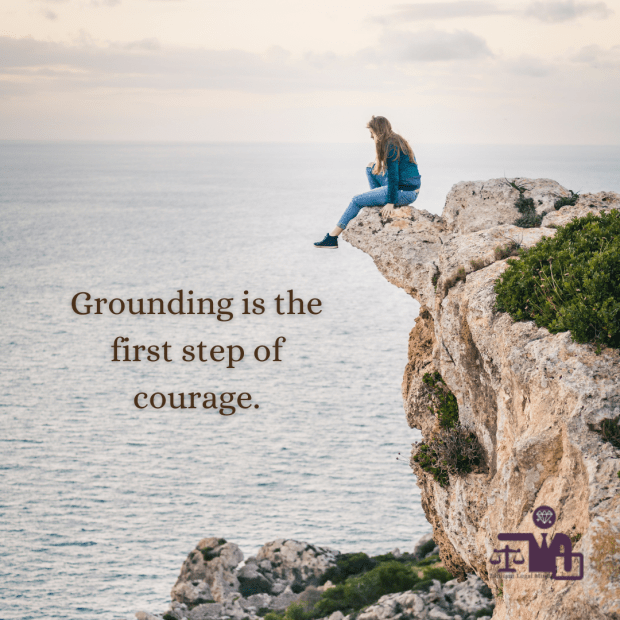
That’s what grounding can do for us lawyers in times of stress. Grounding is a practice of feeling the physical sensations of the body and most commonly emphasizes the sensations of being rooted to the earth. Most grounding practices suggest feeling the weight of one’s body or the contact that one’s body (such as the rear end, back, or feet or even hands on a podium) with the earth or other stable object. When emotions are high, this strategy works on a practical level because it helps us find stability when things seem beyond our control. It also helps us minimize the impact of a mind churning with thoughts that usually only serves to increase our anxiety. On a psychological level, though, grounding is the first step of courage.

When we root into our physical experience, we say “yes” to it on a fundamental level. We make a conscious choice to stay with whatever experience arises instead of retreating into the dark recesses of our mind. By rooting into our experience and feeling whatever is going on in our body, we implicitly tell ourselves that we can handle whatever uncomfortable emotions may come as we do.

In doing this, we open our minds up to what is actually happening in the situation, rather than merely seeing our preconceived judgments or being blinded by the things we fear. In a situation like an oral argument, where a single question could change the course of a case, clear awareness is critical. But the same is true for so many other areas of our law practices and lives. To be sure, our ability to be fully present affects the way we interact with clients so that they learn to trust and rely on us. It affects our ability to care for ourselves as we deal with the risk, time pressure, and stresses of law practice. And, it affects our ability to show our loved ones that we care for and support them in life.

So, if you experience a time in law practice when you feel unsteady, resist the urge to judge yourself or panic. Instead, it may be more effective to just find steadiness. Fortunately, no matter where you go (on earth at least) the force of gravity is always connecting you to your bodily experience as a human. Look for that sensation by feeling the weight of your body in the chair or your feet on the floor. Pause for a moment and rest in the feeling. Though it may seem like a small thing, this first, tiny act of courage may be all that you need to stay present, see clearly, and react with wisdom and skill to whatever life sends your way.

Want to learn more about mindfulness and compassion? Check out my new book, How to Be a Badass Lawyer, for a simple guide to creating a meditation practice of your own in 30 days. And to share mindfulness with your little one, check out my new children’s book, Mommy Needs a Minute.

Like this post? Subscribe to the blog here or follow us on social media: