After almost 14 years with my former firm, I made a change to a new firm this May. As excited as I was by the new opportunity, it was a hard process. There were many thoughts swirling in my mind and there was a ton of emotion. My reasons for making the change will remain private out of respect for everyone involved, but I have already said publicly that I was grateful for the start my former firm had given me. In this way, the goal when I left was not just to pursue a new opportunity but to do it while causing as little pain as possible.
Experience tells me that I am not alone in this. Even when a job is no longer right for us, we may feel loyalty to and genuinely want the best for the team we are leaving. We may need to maintain good relationships since lawyers in some jurisdictions might all know each other. Or maybe we just don’t want the personal baggage of knowing we made a hard situation worse with nasty behavior.
With all of those things in mind, here are the steps I took that helped me make my decision and leave with as much grace as possible.
1. Pick a new firm with good values.
Most of us would like to think that we are perfect angels and would always do the right thing no matter what. But, the truth is that we are social beings and are heavily influenced by those around us. Thus, if you want to live your values, it really helps to work at a firm aligned with them. One of the best things you can do to make a good transition is to pick a firm with good people who can support and guide you and will not put inappropriate pressure on you. In other words, the first step towards leaving well is to be sure that you are joining a team with good people.
2. Don’t gossip before you give notice.
This may be one of the hardest things for lawyers to do because we are incredibly social. Yet, this is why you should be cautious about sharing information about your plans too soon. Word spreads quickly among lawyers and the rise of social media has made that phenomenon even faster. To honor the feelings of your colleagues and allow for a planned message to clients, it is best to avoid discussing your plans publicly before you give notice to your firm.
3. Don’t play games with client relationships.
This one should be a no-brainer since the ethical rules prohibit it, but the temptation to get a competitive advantage in retaining clients is always there. Don’t give in. Following the rules when it comes to client relationships in the midst of attorney transitions is essential. Not only does it avoid putting clients in an awkward position, it also avoids behavior that will all but guarantee an acrimonious relationship with your former firm.
4. Talk to calmer and wiser people.
Though you should be discrete about it, life change necessitates seeking counsel from a wise and stable person. Ideally, this person can listen to you and remind you to take the long view and walk in the other person’s shoes. They can help you to focus on your future instead of getting embroiled in issues from the past. They can help you avoid becoming defensive or combative because you feel frustrated or unsure.
In the best case, they can even help you prepare for the difficult conversations that await you and help you plan out how you are going to give notice. Taking the time to talk out your concerns and plan out your course of action with a trusted advisor will help you stay true to your values even in the midst of difficult circumstances.
5. Manage your emotions.
Leaving a law firm is not just a business transaction. It also means changing or perhaps terminating some relationships. Emotions are likely to arise on all sides. It doesn’t work to fight them, so your best bet is to care for them. Expect that you may have to deal with a range of potentially conflicting emotions both in yourself and others. Plan in time to write or talk these issues out with interested parties or trusted friends and relatives. Move as much as possible to discharge excess energy and relieve stress. Give yourself grace as your emotions fluctuate from elation about the future to sadness and even grief about the past.
When you change jobs or think about changing jobs, guilt may be one of the first emotions you feel. Our work as attorneys and roles in our firms can serve as a foundational part of our identities. The idea of changing these roles can cause us to feel like we are being disloyal or doing something wrong. Or it can just cause fear about what the future might bring.
At the core of many of these emotions, you may often find judgment. When you can move past the judgment or at least hold it a little less tightly, another opportunity opens up. Instead of focusing on whether you or your decision is good or bad, you can focus with more precision on how to execute your decision the right way. If you make ethics and values the cornerstone of your transition plan and balance the emotions of yourself and others, you can change your law firm without losing your soul.
Want to learn more about mindfulness and compassion? Check out my new book, How to Be a Badass Lawyer, for a simple guide to creating a meditation practice of your own in 30 days. And to share mindfulness with your little one, check out my new children’s book, Mommy Needs a Minute.
Like this post? Subscribe to the blog here or follow us on social media:
This month, I decided to write on the theme of “humanity in the legal profession.” When I settled on this theme, it seemed at first like an easy concept to impart. But, as I sometimes realize when I sit down to write a brief, the writing process quickly reveals the gaps in my understanding. There are lots of things I love about writing but this aspect, humbling as it can be sometimes, is one of my favorites. It forces you to drill down on small things you might have otherwise overlooked.
In this case, the small thing I had overlooked was what does “humanity in the legal profession” really mean? Sure, I’d used the term “human lawyer” many times. I had considered to myself, if not said aloud, that I strived to show what it means to be a human lawyer. Still, I’d never thought about defining the term. When you write about a subject (especially as a lawyer) that’s usually a good starting point.
In this case, though, a dictionary definition was not helpful because I wasn’t trying to understand what the word “humanity” meant. Instead, I was trying to understand what it meant to demonstrate one’s humanity as a lawyer. To be sure, I had witnessed this in several ways in my own life. My family is filled with lawyers and so I was blessed to see regular examples of heartfelt care and concern expressed through legal guidance growing up. As a practicing attorney myself, I’ve benefitted from humanity from my colleagues and opposing counsel. And, on my better days at least, I have employed it too.
But still, the idea of humanity in law implies that it can’t be limited to just one lawyer’s lived experience. Fortunately for me, I happen to have a pretty robust LinkedIn network. So, I asked my lawyer friends there to tell me what being a human lawyer meant to them. Here are some of their answers.
Several respondents told me that humanity as lawyers had to do with how we show up in the world:
I think we are all human lawyers at heart. But we learn to muzzle our humanity to show up as who we think our clients want to see. Ironically, I think this is the exact opposite of what most clients crave. They want real, raw, empathy, humor, relationship. More transparency is the answer.
Still, it’s hard to swim upstream against the prevailing norms. I often encounter attorneys who are very reticent to share anything personal in their bio or express their personality in their content. This is a missed opportunity to stand out from the crowd. For the most part, clients choose you because of who you are and what you stand for. Not who you clerked for, your class rank, or the last case you won.
I actually say this just about every day! Human-first lawyering is a huge part of in-house practice. Lawyers (just like other humans) like jokes, and play fantasy football, and have interests outside of work and listen to punk rock. We’re just humans who went to law school and we learned some things there that can help you.
I am a human lawyer because I can speak of practical solutions not just legal ones and advise people to take pathways that are less disruptive to their mental health if they can still meet their basic goals.
Some lawyers even suggested that our humanity is essential for counseling clients, even when that means admitting to the limitations of the law:
As lawyers, our role involves “counseling” sometimes more than providing legal advice. Talking your client down from the ledge or from pursuing a vendetta or burning bridges or to encouraging the client to cut all ties and have a “divorce” from the opposing party. I handle probate, trust, and fiduciary litigation, which involves blended family situations or sibling discord. I remind people that sometimes, to be there for yourself, you have to “divorce” or disengage from that toxic or opposing party family member and maybe someday you might be able to see each other at Christmas but not this year. I believe in acknowledging our feelings and then, asking what can you do to feel that again or not feel that again. Acknowledge the client is stressed but also encourage them to concentrate on the next step, not the end result.
I think what can set you apart as “human” with clients is to be humble and admit when “the” answer isn’t clear or straightforward. I work in a science heavy area of law, with cases that are often full of unanswered questions of law. It’s hard sometimes for clients to understand that, but I have had many tell me they appreciate my honest and forthright answers… often after having talked to or worked with other attorneys prior. Sometimes a humble attitude is surprising to clients but it’s also earned loyalty and referrals.
Now, if like me, you have struggled with your humanity at times, don’t worry. A few of the respondents shared that you can remember or relearn your humanity even if, litigation for example, causes you to lose track of it for a while:
I bring humanity compassion and kindness to all my matters. I used to be a litigator and was becoming a jerk I switched to transactional work 17 years ago doing estate planning and business law. I now enjoy helping people set things up for the present and the future. I also perform about 240 hours of pro bono work every year. If there is anything that can be said for wisdom instilled by the elderly, it is treat people how you want to be treated and create memories because they are all you take with you and no one gets out alive.
I learned to be a human lawyer after experiencing the personal tragedy of one of my clients. I finally saw the true terrible price of a legal malpractice claim and realized that to help my clients (and myself) I needed a more holistic approach. I took a step back from just defending legal mal lawsuits and now attempt to address lawyers’ problems before disaster strikes.
So, there we have it. Humanity in the legal profession is about showing up as ourselves. It’s about honoring our emotions and those of others. It shines through brightest, perhaps, when we counsel with practical as well as legal advice. And it can even serve as our north star to get ourselves back to goodness if we lose our way in the difficulties of law practice.
Maybe there’s no unifying definition of what it means to demonstrate humanity in the legal profession, but it’s good that there are many examples of it. If you want more, check out The Human Lawyer Podcast. I was a guest on this podcast a few years ago and it curates the stories of some fantastic human lawyers across the country.
How do you show your humanity in your life and work?
Want to learn more about mindfulness and compassion? Check out my new book, How to Be a Badass Lawyer, for a simple guide to creating a meditation practice of your own in 30 days. And to share mindfulness with your little one, check out my new children’s book, Mommy Needs a Minute.
Like this post? Subscribe to the blog here or follow us on social media:
There are so many resources, websites, books, and teachers of meditation out there now that it is very likely that, at some point, you may come across one you don’t like. You know what? That’s not really a problem.
There are many different meditation techniques from numerous disciplines. Even though many meditation practices have been studied in a clinical setting, the practice can be deeply personal and spiritual. In this way, it’s a good thing that there are lots of different teachers out there because there is bound to be one or more who speak to your experience.
In this interview, our founder, Claire Parsons, talks with her friend, Talar Heculian Coursey about influential teacher, Eckhart Tolle. Claire isn’t a superfan but Talar is. Check it out to learn more about Tolle’s teachings and style and to consider how teaching style can affect the way you’ve learned mindfulness.
Not into video? No problem. Scroll on down for a full transcript of the video with some links to Talar’s profile and website, as well as the past blog posts and other resources we mentioned.
Claire Parsons (“CP”): All right. Hey, everyone. This is Claire Parsons from the Brilliant Legal Mind blog and we are trying something new this week. We are trying one of our first ever video blog series. So I have with me to Talar Herculian Coursey. And if I said her name wrong, I’m sorry. She’s a good friend of mine from LinkedIn.
I am debunking myths this month on the blog. And so one of the myths that I wanted to debunk in this series is to talk about the idea that what happens when you come across a meditation teacher, you maybe don’t care for that much. If you saw a few weeks ago, I did a post about Kendrick Lamar, his new album and men’s mental health. And in that album, Kendrick Lamar name drops, Eckhart Tolle quite a bit. Eckhart Tolle had been on my reading list for a long time and when Kendrick Lamar you know, mentioned him so much I was kind of intrigued.
So I listened to The Power of Now and my honest opinion, is it it wasn’t amazing to me. I didn’t think it was bad. I didn’t think you said anything wrong. But it just didn’t speak to me. But my friend Talar loves Eckhart Tolle, and so I wanted to have her here to talk about why, just to sort of point out that maybe you don’t like a meditation teacher, but maybe somebody else does and that there’s a lot of different opinions out there about meditation teachers and what works. So we can talk about this so Talar, can you first of all, give me just an overview, a quick snapshot of who you are.
Talar Herculian Coursey (“TC”): Hi Claire. I am a wife, a mom to four kids, a dog mom, general counsel for an auto dealership during the day, children’s book author by night, and now a new life coach with my certification pending, among other things.
CP: Yeah, congratulations. on that. I just saw that. So that’s amazing. Talar. I know in addition to all of those things, you you have been certified to teach yoga and I know you do have an interest in mindfulness. Can you talk about that? Just a little bit.
TC: Definitely. My, my first introduction to mindfulness was through yoga. And I, I used to refer to it as my moving meditation. And while I do meditate, I use the calm app, and I try to meditate at least 10 minutes every day through the daily 10 minute meditation. I am not very consistent. I do enjoy it, but not as much as yoga so for me, the mindfulness practice of yoga that includes both not just both mind, body and breath, the connection is what really works for me and what I look forward to doing as opposed to sitting down to meditate which confession, even when I do my 10 minute meditations, I do it lying down. I know she tells you straight back, sit up, stay alert. I don’t do it. I don’t follow those instructions. But it works for me.
CP: And yeah, I usually sit up because I don’t want to fall asleep. But I sometimes lay down to meditate and it’s generally okay to find a posture that works for you. She’s probably just telling you to try to be alert on that app, so I wouldn’t worry too much about it. So I asked you here to talk about Eckhart Tolle, and I know at some point on LinkedIn, like you had like Eckhart Tolle, like fan girl or devotee or something on your LinkedIn profile. So what is it about Eckhart Tolle that you like so much?
TC: It’s groupie. I am a self proclaimed Eckhart Tolle groupie. I don’t think that group these are just for musical bands. I think that authors can have them too and I and I’m one of his. I would like to think I’m his number one groupie. It’s really hard to say it’s kind of like obscenity you know, when you see it you know, and I guess for Eckhart toll, it’s, it’s when you listen to it, or when you read it. And it’s funny, you mentioned that, you know, you’re not a fan.
My first introduction to Eckhart Tolle was actually in Dan Harris’s book 10% Happier. I don’t know if you’ve read that or if you’re Dan Harris, and he wasn’t a fan either. But I went down that rabbit hole, and actually started with listening to Oprah Winfrey’s interview with Eckhart Tolle. She did you know, I think it was a 10 part series, one podcast episode, per chapter where she interviewed at cart. So I listened to that before I read the book, and I don’t know if perhaps that helped me. Get you know more comfortable with the book. But I have the book in print. I have multiple copies that I gift to people, whether they want it or not. Some people return that gift. It does happen because he’s not for everyone. It’s kind of like caviar. You know, I don’t like caviar, but apparently some people do. I also have the power of now and a new earth on audio.
And so I like going to various chapters on the audio when I’m taking a walk and need to recenter myself. I just I just the way that he explains concepts and what he talks about, really works for me, and specifically, this concept of us being the watcher of the ego. You know, for me when I am trying to practice mindfulness, and not just because I’m trying to meditate or do yoga, really in interpersonal relationships. And conflict, even in communications on LinkedIn. After reading a Eckhart’s work, I will literally take a step back and watch my ego my ego might want to trash talk and complain and and argue but I will take a step back to watch my ego and recognize that it’s my ego that’s having that reaction. And in my opinion, I think most of the time, when we are reactive, you know, that is the ego at work as opposed to your you no mindful, true self. I can’t remember the question, but hopefully somewhere in there I answered.
CP: I think you did. You might have gotten into some of my later questions too, but no worries I can adjust. So, one of the things that in when you say when you talked about this think the thing that I like about Eckhart Tolle was the fact that I think he does explain concepts with a lot of clarity. The thing about his story that I think is the hardest for me is that in everything that I’ve learned about meditation and Buddhism, the enlightenment piece is the thing I struggle with most like I can’t necessarily conceive of it. You know, I’ve read about it, and I understand like, what in general it means, but I think his story is the hard part for me to understand how that just happens.
And so I think, he doesn’t get into the method as much like how to actually do these things. You know, he talks about concepts, but he doesn’t as much explain how to do it. He does get into meditation a little bit. I do like that. He talks about the importance of the body and meditation because I agree that that is very central. But like, that’s the piece that I have a disconnect with. He tells me where what the goal is. And he explains it very clearly. He doesn’t as much tell me how to get there. So when you say that you can watch yourself and your ego because you listen to him. Like can you connect those dots for me at all like in a practical way how his his work helped you do that?
TC: Like, you know, it’s hard to explain and I don’t you know, I don’t disagree with you. I don’t know that. His work. I don’t necessarily think of it as a you know, handbook guide for how to meditate and how to go about life. I think I think of it is more conceptual. And that you know, if you want to really hone in your mindfulness practice, you need to go deeper. You need to, you know, subscribe to your blog and listen to people like you to get the how, I don’t think he necessarily talks about how. I think he’s just painting the picture of where you can get to, and you know.
It’s interesting. I’m gonna go to something else you just said about the enlightenment piece. So I in addition to being Eckhart groupie, I’m also a Jesus groupie. And one of the things that I like about the way Eckhart describes his concepts he does pull in these great teachers, including Jesus, including Buddha, and Muhammad and all these other people. And his point as these concepts already exist and beliefs that you may already have you don’t have to choose one or the other. They’re not mutually exclusive. And he I feel like he describes it in different ways that different members of the audience might be able to understand it and for me as a Jesus groupie his reference to the Holy Spirit resonates with me in terms of enlightenment. So that’s what you know, my goal Nirvana, enlightenment that I’m trying to get to is access to the Holy Spirit within me, and stay true to that rather than the ego of my human form.
And for some people, you know, who don’t follow Jesus there that you know, maybe something else will. I, you know, I don’t think I’m fooling myself. I have had these moments where I feel like I’m back there. I’m literally having this out of body experience. And when I say back there, because I feel like I consider, you know, the ego being the outer shell of my body, not necessarily just in physical form, but the, you know, the animal part of me, and and when I think about having my out of body experience or tapping into the Holy Spirit, I literally envision myself stepping back. You know what I mean?
And watching this other person that happens to be me having this human experience, and that’s what I think that’s one of the other things he says is, he describes us as the spirit having a human experience, you know, and I just, I don’t know for me, it. I really enjoy the kinds of visuals that he represents, and especially as it relates to how much emphasis he puts on connection of all of us, that we are all connected by one Spirit, one energy, you know, and it each one of us is just having a human experience of that energy. So I like that concept and and because I do believe that we are all connected, and I think it’s just not just in our own personal best interests to support that mission. But also for the greater good as well.
CP: So you got a little mystical on me there. And I’m not necessarily I don’t think that’s bad or unimportant because I think those pieces of life matter a lot, but in practical terms, because honestly, the reason I love meditation so much is because it’s practical, and it’s useful. So, you know, for our readers, who are lawyers and professionals, I mean, what are the practical things that his teachings have helped you, you know, do in your life, what are the practical benefits, and you can just list them if it’s easier.
TC: Well, you know, I think it just comes down to one general term. And, and it’s avoiding being reactive. You know, and I think that that’s part of the goal in meditation, as mindfulness is to be able to take that pause and be responsive instead of being reactive. And after reading his work several times and listening to it. I’ve gotten better and better at doing it both in my personal relationships work on LinkedIn in any situations where like, I can feel the fire of reactive, you know, bubbling up, but I’m able to step back and pause. And my personal method, like I said, is questioning you know, the reactivity that I want to deliver, questioning whether that’s my ego or my true self. So that’s, that that’s been how I’ve been able to adopt it. So
CP: Basically, my next question was going to be that, you know, I read the power of now and what other resources would you look to but it sounds to me that you maybe already answered that earlier when you said that interview with Oprah, to kind of go through that and listen to Eckhart talk about his book and what it means maybe in a more personable setting, since Oprah is a miracle worker in terms of her interviews.
TC: Yeah, it was phenomenal. And like I said, I don’t know if I would be such a fan had I not listened to that first because it made work so much more accessible. Okay, great. That’s a good tip. Definitely that one and for anybody who hasn’t read 10% Happier. You know, that was my introduction to mindfulness work, I think, but I really enjoyed that. He’s a good storyteller too.
CP: Well, on that note, I am a fan of Tara Brach and in 10% Happier Dan Harris actually is kind of critical of Tara Brach, too. And I referenced one of this on one of our earlier blog posts, but there’s a later interview of Tara Brach on Dan Harris’s podcast and they discuss that and they have a real nice conversation about how they both learn from that. So I definitely, I think for that reason, I’m probably like not wanting to go after Eckart Tolle and say bad things about him because like, I got really mad at Dan Harris. I was like “really?”
So I try I understand that there’s a lot of differences with respect to how people react to teachers, and that every teacher isn’t for everybody. So that’s kind of why I wanted to do this. So on that note, like if there is someone out there who finds a meditation teacher or reads a book or listens to some guided meditations or whatever, and they just don’t like the teacher, what would you tell them to do? If they were still interested in mindfulness?
TC: Keep looking. Absolutely keep looking. You know what, what I would analogize it to is food. We we all like different things. Just because you like fish and I don’t doesn’t make the fish bad. And you don’t stop eating. You keep searching for what works for you. And, I mean, personally, it’s been suggestions from friends and of course, my husband is also a certified meditation teacher, and he’s the one who first introduced me to Dan Harris and 10% Happier and he’s had a great practice for many years, but I would take suggestions from different people don’t hold it against them if you don’t like it.
I mean, Claire, you and I can still be friends even though you don’t understand how wonderful Eckhart is. He’s not for everyone, and that’s fine. But I think with the amazing amount of literature and people who are available in the mindfulness realm right now, you will find people that you love. It’s the same for yoga teachers with me. There’s, I love yoga, but if I don’t have a teacher, whose voice I like to hear, like if it’s cringy I’m gonna have a terrible practice the same with a meditation teacher, or if I don’t like the way that they are describing the poses or if they’re going too fast, whatever the case.
You know, I, I absolutely think it’s worth the effort to find someone that you like and you enjoy and it doesn’t have to be just one person you can find several. If there’s one thing I could tell my younger self, have a mindfulness practice sooner. In fact, one of my goals is to start a yoga practice at my son’s middle school like once a week 10 minutes to start getting them familiar and use us to mindfulness at a younger age because, you know, I didn’t learn about it until I was in my 40s.
CP: Okay, so Talar I really appreciate you talking to me today and explaining some things that I may have missed with respect to Eckhart, so thank you very much. So just so people can find you. If people do want to find you, where should they look? You can find
TC: Find me most days at the LinkedIn coffee shop, which is just the platform but it’s kinda like a coffee shop, Talar Herculian Coursey. I also have a website, which is wwwtalaresq.com. And if you’re in Salt Lake City where I live, give me a shout just don’t be creepy and follow me home or anything like that. That’s where you can find me.
CP: All right, follow on LinkedIn. Do not follow home. All right, everyone. This is our interview blog with Talar and I really appreciate you taking a watch and checking out the blog. So I hope we’ll have some new stuff up next month including we might have a guest post from to Talar’s husband Bob so stay tuned for that. And we will see you later. Bye.
Want to learn more about mindfulness and compassion? Check out my new book, How to Be a Badass Lawyer, for a simple guide to creating a meditation practice of your own in 30 days. And to share mindfulness with your little one, check out my new children’s book, Mommy Needs a Minute.
Like this post? Subscribe to the blog here or follow us on social media:
I spent a lot of time this summer thinking and writing about compassion. For much of the summer, I was writing my forthcoming book on mindfulness and compassion for lawyers (more details on that to follow). I also completed the Compassion Educator Certification course with the Compassion Education Alliance. In the midst of all this writing and learning, I realized a gray area existed in my understanding of the subject.
Most of the time, teachers instruct self-compassion separately from compassion for others. But as I wrote about it and thought about it more I realized something unexpected: they weren’t separate at all. This was kind of surprising to me, so I asked my teacher and the founder of the Compassion Education Alliance, Aly Waibel (full bio below), to clarify. Her answer was so good that I asked her for an interview so I could share it with you here.
Q. Self-compassion is fortunately getting more attention lately, but is it any different from compassion for everyone else? If so, can you explain how?
AW: Compassion is the awareness of another’s suffering coupled with a willingness to take action to relieve it. Compassion is relational and so always includes self and other, by definition. The suffering we’re aware of may be in ourselves or another, and the compassionate response or the desire to relieve the suffering is similar, regardless of who is suffering.
Self-compassion is a new term, and was originated by Kristin Neff as an antidote to self-esteem, which is based on social comparison. The self component of compassion is important to develop as many of us are inclined or conditioned to offer compassion to others and we can forget about ourselves. We can forget that we are just as deserving of compassion as others, or forget to include ourselves in the circle of compassion.
Most of us have a negative critical voice in the head that is constantly narrating our experience with judgments, criticisms and preferences. This voice in the head can be like a bully or cruel tyrant. Self-compassion is a way to bring awareness to this negative self-talk in order to shift it toward more kindness. It helps connect us to our core values and strengths so we are more resourceful and available to others.
Q. So, why are we hearing about all these studies that say self-compassion is good for us? Why would we want to build self-compassion at all? Shouldn’t we just focus on building compassion overall?
AW: There are three RCT studies on the Mindful Self-Compassion training program and over 4000 published studies on self-compassion in other forms. This growing body of research suggests that self-compassion is a primary factor in predicting resilience, decreasing stress, and increasing wellbeing.
The benefits of recognizing our common humanity and offering ourselves the kindness we’d offer a friend are many. However, it’s one component of the bigger process we call compassion. Compassion is relational and our concepts of self and other arise simultaneously. Any time we practice compassion for another, we are the primary beneficiary, and when we practice compassion for ourselves, others in our lives benefit.
Q. Are you saying that self-compassion and compassion for others aren’t in opposition to each other? Do they actually work together/help each other?
AW: They must go together, like two wheels of a bike. We can’t have one without the other. If we go too far into compassion for others we run the risk of becoming codependent and if we go too far into self-focused compassion we run the risk of becoming narcissistic or indulging in unhealthy self regard at the expense of others.
It’s all about balance. When I’m attending to my own needs, for example, I’m less of a burden on my loved ones. When I practice self-inquiry to question the thoughts I’m believing that cause my own stress, I feel more freedom and peace. And then I’m more aware and available to others who may need support or help. When I’m overly self-focused, I miss opportunities to help others. When I’m overly other-focused I run the risk of becoming burned out and then, again, less helpful to others. Most of us have experienced going through a really difficult time or life event and how offering compassion to someone else in the midst of that can feel really good. In other words, shifting focus away from me and my suffering to be there for you can support us both.
So the caution around self-compassion, for me, is that it may sound like it’s separate from compassion for others, or compassion in itself. Compassion is one process – it flows through individuals and helps each one who is involved — the giver and the receiver. Eventually, the distinction between the giver and the receiver of compassion becomes much less relevant. So regardless of where the suffering originates (in me or in you) the response to it is the same — an awareness of it and a willingness to relieve it, to reduce overall suffering in the system or in the world.
Q. Wait, if there is no dividing line between compassion for self and compassion for others, how do I protect myself and set appropriate boundaries?
AW: My experience is that with compassion practice, boundaries naturally arise. I don’t need to calculate, plan or think about boundaries as much. The ‘yes’ and the ‘no’ are more natural and intuitive and flow more naturally. There’s less obligation to say ‘yes’ and less guilt when ‘no’ is the answer.
Q. If compassion is a natural response for most humans, why do we need to do practices to cultivate it? What’s the best way to get started?
AW: It’s sort of like working out. If we’re fortunate enough to have healthy bodies, we can work out and build our muscles to become stronger, or not. The body is innate and what we choose to do with it, or how we train it, is a choice. Compassion is like a muscle we’re born with that we can build with practices (meditation and visualization practices), so when we’re confronted with suffering in and around us, the compassionate response and capacity to relieve the suffering will be more likely to arise. Similar to how athletes will visualize their race or the game before going out to the field, remembering or imagining moments of compassion in a visualization or meditation can have a similar effect on our performance out on the field of daily life.
One of the best places to start practicing compassion is with mindfulness. Mindfulness is being with what is in the moment without judgment. You share great resources for getting started with mindfulness on your blog!
Most of us are very caught up in thinking – thinking about the past, planning for the future, judging others or circumstances, comparing ourselves to others, etc. We can get so caught up in and distracted by our thinking that we miss the present moment. And compassion requires our presence.
Aly Waibel has taught mindfulness and compassion courses and workshops since 2012 and she is a Senior Certified Teacher of the Compassion Cultivation Training course developed at Stanford University. Aly received her PhD in Teaching, Learning and Sociocultural Studies at the University of Arizona College of Education in 2015 and has served in nonprofit leadership roles since 2015. She is currently the Associate Executive Director of Professional Training and Operations at the Center for Mindful Self-Compassion. In 2021, Aly founded the nonprofit organization Compassion Education Alliance (CEA), a global collective that offers courses and support to compassion practitioners, educators and social change agents. She works closely with her fiancé, James Wood, author of Ten Paths to Freedom: Awakening Made Simple.
Want to learn more about mindfulness and compassion? Check out my new book, How to Be a Badass Lawyer, for a simple guide to creating a meditation practice of your own in 30 days. And to share mindfulness with your little one, check out my new children’s book, Mommy Needs a Minute.
Like this post? Subscribe to the blog here or follow us on social media:
I never ask anyone to explain themselves to me when it comes to meditation. Even so, I give talks about mindfulness a lot and people tend to volunteer why it can’t/won’t work for them. I never mind this because it’s an opportunity for both of us to learn something. The number one reason that people, especially other lawyers, tell me they can’t meditate is insufficient time.
For lawyers, this is surely a believable excuse. We are a notoriously time poor profession. There are significant financial incentives for using any extra time we have to bill hours or market and network to get the next client in the door. And then we might want to actually, hey, have a life to do things besides bill too. Trust me. I get it. I have no intentions here of telling lawyers that they have more time than they think.
Here’s the thing, though. Meditation is not a time suck. It’s a time-saver.
I’m a lawyer, a community leader, a blogger, and a mom. Do you really think I sit around meditating because I’m just bored? Even if you thought that, do you really think I’d pick the single most boring activity on the planet to fill my time? Of course not.
I don’t meditate because I have nothing better to do. I meditate because I have tons of other better things to do besides overthinking, reacting to every little thing in life with anger and hostility, and rushing so much that I miss those tiny joyous moments that creep into life unexpectedly.
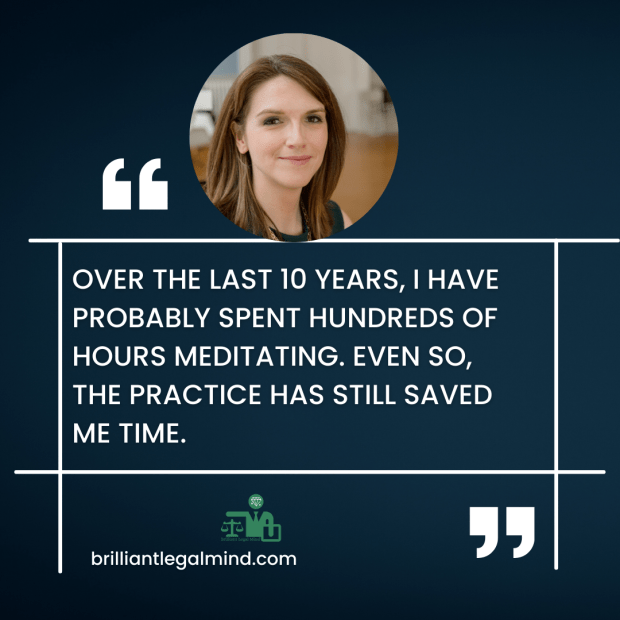
Sure, over the last 10 years, I have probably spent hundreds (if not thousands) of hours meditating. That’s a lot. But what I have not done or done far less is spend hours agonizing over some thing in the future I am worried about that never transpires. Or fretting for days about something awkward I said at a happy hour last week. Or scheming endlessly about the best way to handle a situation.
Instead, now I see when I am stuck in thought mode, regret mode, or perfectionist planning mode and I disrupt the loop. I make a decision to write down a few notes to get the idea out of my brain, talk to a friend, apologize, or just let it go by doing something else. The hours saved alone here is enough ROI for my practice, but the impact on my life by remaining engaged in the world rather than lost in thought is even more significant.
And can we talk about the sleep that I haven’t lost when I am dealing with a stressful situation? Or the fatigue or frustration that didn’t derail my work because I had a quick and reliable way of resting and recharging? Or the physical signs of stress I recognized early on and knew how to care for so I could avoid a disaster?
Look, I don’t write this piece to make you feel bad if you tried meditation and struggled with it because you are busy. The truth is that I have too. I have missed a ton of sessions over the last ten years. I have had to restart and reenergize my meditation habit multiple times. Sometimes it feels like a slog when I do.
I keep coming back to it though, not because I magically find extra minutes, but because I want to be present and content in the minutes I have. So, if time is the thing that sticks in your mind when it comes to meditation, maybe try thinking about time in a new way. Don’t just focus on the few minutes that it will take to meditate. Focus instead on the minutes that meditation might save you and the minutes of your life that meditation might improve.
Want to learn more about mindfulness and compassion? Check out my new book, How to Be a Badass Lawyer, for a simple guide to creating a meditation practice of your own in 30 days. And to share mindfulness with your little one, check out my new children’s book, Mommy Needs a Minute.
Like this post? Subscribe to the blog here or follow us on social media:
This month I am focusing on debunking myths relating to mindfulness, compassion, and mental health. After all my years of meditation, I still find myself holding onto a few myths every now and then. One of those myths is that stress is bad for you.
As a lawyer, I have been informally trained to know that stress is a scary thing. The lawyer mental health crisis tells me I have to “manage” my stress. Family, friends, and doctors will tell me to “limit” my stress. And even in my training to become a meditation, yoga, and compassion teacher, I learned that stress can impede us physically and mentally.
But, then I came upon a book by Kelly McGonigal with a title that proclaims that stress is good for me. Her book The Upside of Stress: Why Stress Is Good for You, and How to Get Good at It seemed to fly in the face of everything I thought I knew. The thing is, though, that I adore Kelly McGonigal’s work.
She explains scientific concepts in a simple and engaging way that shows she really understands them. She does this so well that, in turn, I feel like I really understand the concepts too. I thoroughly enjoyed The Willpower Instinct and The Joy of Movement and, despite it being only in audio form, learned a ton from her course on compassion.
So, even though the title made me skeptical, I decided to give The Upside of Stress a try. Guess what? It totally changed my mind. And when I say “changed” I don’t mean that it made me suddenly welcome and enjoy all the stress in my life. Instead, it refined my understanding of what stress meant and how it actually worked.
Most of us know the “fight/flight/freeze” reaction as the stress response, as if it was the only response to stress. In Upside, however, McGonigal explains that this is only one possible response to stress and it usually occurs in dire threat situations. This is when stress can harm us physically, impede our performance, and even lead to bad behavior and aggression.
On the other hand, humans can respond to stress in other ways, including the “tend and befriend” or “challenge” responses. In other words, we can learn to care for and forge connections to deal with stress or see a stressful situation as a challenge that can present opportunities. When we respond to stress in these ways, research shows that it can improve performance, cause us to behave more ethically and collaboratively, and create courage, motivation, and energy.
Now, of course, the skeptics out there are likely to wonder why we hear so many dire warnings about stress if it is good for us. McGonigal acknowledges that stress can be bad, even devastating for some of us, but she explains that the popular discourse of stress is often misleading.
One thing that is often left out of these discussions is that our reactions to and mindset about stress can determine how it affects us. That is why so much of The Upside of Stress is devoted to changing the audience’s mind about stress, because just acknowledging that stress can have an upside is the first step to healthy stress management.
When I read this part of the book, I was ever more surprised because I realized I already knew it or had at least experienced it. I had not officially accepted the idea that stress could be good for me, but I had learned through meditation to respond to stress differently.
Rather than ignore, evade, or fight stress, I had learned to regard it as a normal part of life, to accept it as human, and to treat it with care. In other words, meditation had helped me more frequently invoke a challenge or tend-and-befriend response to stress. As McGonigal argues, it didn’t make the stress go away but it made it easier to bear.
If, like most lawyers, you want some help managing stress, consider checking out The Upside of Stress by Kelly McGonigal. If the only thing it does is change your mind about stress, that alone could be enough to change your life for the better.
Want to learn more about mindfulness and compassion? Check out my new book, How to Be a Badass Lawyer, for a simple guide to creating a meditation practice of your own in 30 days. And to share mindfulness with your little one, check out my new children’s book, Mommy Needs a Minute.
Like this post? Subscribe to the blog here or follow us on social media:
How would it feel to be fully present at home, without a thought or worry about any work-related issue?
How would you feel if you could experience that same presence while at work?
If that sounds appealing, would you ever consider a procedure that could create complete work/life separation?
That’s the premise of Severance, a sci-fi series set in a fictional town in which employees undergo a surgical procedure to separate their thoughts about work and home. Employees who are “severed” can’t think about work once they leave the office and they can’t carry their home stressors into the workplace.
I binge watched the series this summer and I can’t stop thinking about it, both because of its stellar cast and the thought-provoking questions it presents.
The first season focused on Mark, an office worker who undergoes the severance procedure as a way to deal with the loss of his wife. The procedure enables him to shed his grief each day as he rides the elevator to his office. Once the elevator doors open, Mark has no awareness of his life outside the office, which enables him and his colleagues to focus solely on their work.
At least that’s the intention. The reality is that the severed employees spend a tremendous amount of time thinking about their “outies,” their selves outside the workplace. They wonder if they have families, whether they are good people and if they are happy. And when they need support, the severed employees are treated to stories about their “outies,” which suggests that the company understands how important it is for the workers to understand all aspects of their lives.
Although the show provides an extreme example of corporate culture and the quest for work/life balance, it presents some fascinating questions like:
What does it mean to be fully present? Is it necessary to clear our mind from distracting thoughts in order to focus on the present moment? If you’ve studied or practiced mindfulness, you know how unrealistic that is. And even in the fictional world of Severance, the goal of having a singular focus is not achieved, despite surgical intervention.
Is there an expectation that we can (or should) be able to compartmentalize our lives? In the show, the severance procedure is touted as a way to be more productive at work and to be more present at home. But is separating these parts of our lives a good thing? Do we want coworkers who can’t draw on life lessons, ambitions and beliefs formed outside the workplace? Is it good for them to be severed from the connections that ground them and the commitments that provide the motivation to tackle hard things? Conversely, don’t we want people to apply lessons learned on the job in their lives outside the workplace? And don’t we want coworkers to build connections and support networks outside the office?
Do we sometimes use work as an escape? Mark’s choice to undergo the severance procedure to escape his grief is not unlike the choices many people make to keep themselves busy and avoid feeling difficult emotions. [Spoiler alert] In the show, as in real life, that doesn’t really work.
What happens when we can’t find meaning, purpose or a reasonable amount of autonomy in our work? Mark and his team work in the Department of Macrodata Refinement sorting numbers. Aside from being told that their jobs are “mysterious and important,” they don’t understand the purpose of their work or how it fits into the larger picture. Instead, they are given rigid instructions, kept under constant surveillance and given meager incentives like company branded finger traps and team photos. Not surprisingly, this creates discontent, makes them less invested in their work and [another spoiler alert] sets them on a journey to change things. It is not that hard to see how this part of the series is an example of the disconnect that often exists between what employers think will lead to job satisfaction and what employees need or want.
My takeaway from Severance is that a complete separation of thoughts about your work and home life is neither achievable nor desirable. Although you may view the person you are at work as different than the person you are to your family and friends, the reality is that we bring our whole selves to the workplace – our experiences, our biases, our feelings, our thoughts, our hopes – all of it. And when we leave the job at the end of the day, a piece of that work self comes home with us.
The story of Mark and his severed coworkers also shows what can happen when we are stuck in a life that exists solely for work. It demonstrates how connection is a powerful motivator and that even surgically induced-work life separation or carefully curated employee incentives are no match for the human need for community and purpose.
Laura Anthony is a lawyer who is fascinated by the intersection of law and human behavior. She is an education lawyer as well as a mediator, investigator and hearing officer and often draws upon her background and interest in psychology in her practice. She is also a not-so-regular practitioner of yoga and meditation and brings her real-world struggles making healthy choices to her role as the chair of her firm’s Wellness Committee. Laura can be found posting about her practice and her love of chocolate and libraries on Twitter and on LinkedIn.
This blog usually encourages you to meditate, but in this post I’m going to make a recommendation that you may not expect: watch some Korean TV. You may have heard or watched Squid Game, but if that’s your only frame of reference you are missing out. Kingdom was a great political period drama but also with zombies. Rookie Historian was a great political period drama but also with the most deliciously awkward romantic subplot I have ever seen. Inspector Koo was a great mystery show but with a female detective so unruly she might make Veronica Mars laugh out loud and blush at the same time.
Even though I don’t really love legal TV dramas, this background compelled me to take note when my lawyer friends started to talk about Extraordinary Attorney Woo, now streaming on Netflix. I’m a school lawyer and have extensive experience with special education matters. One of the neat things I’ve seen evolve during the last decade is the increased attention to disability issues and neurodiversity in popular culture. As the show tells us, Attorney Woo is about a young attorney starting her practice in Korea but she’s an attorney who was diagnosed with an autism spectrum disorder.
The show is entertaining and it definitely has some of that delicious awkward romantic tension I loved from Rookie Historian. Critically, though, it also educates and advocates at the same time. When I saw this, Haley Moss immediately came to mind.
I have never met Haley, but I was supposed to in March, 2020 when we were both honored by Ms. JD. Unfortunately, the awards ceremony was the same week that states of emergency relating to COVID-19 began rolling out and so I never met Haley. Fortunately, though, I stayed connected with her and watched her work progress.
I reached out to Haley to get her thoughts on the show. Here’s my brief interview with her:
Q: You’ve expressed a favorable reaction to Extraordinary Attorney Woo in past interviews, what about the show is exciting to you?
A: The show definitely pushed some boundaries in a good way, although it isn’t enough and it’s a trend that needs to continue. I love how Attorney Woo has “main character energy” and gets to grow and learn and be her best self like many nondisabled characters do. She isn’t a prop for someone else’s growth. She has friends, hobbies, family – very “typical” things like any other young lawyer should have.
There is a pivotal moment to me where she represents an autistic person and comments on autism perceptions throughout history and how 80 years ago we weren’t worthy of life apparently and casting doubt on Hans Asperger’s legacy (if you didn’t know: he’s problematic – and Woo calls it out!). The show has slowly pushed boundaries, especially by showing someone in the legal field, a woman no less, and that monologue really got me.
Q. Most of us know that lawyer TV shows aren’t always the most realistic, but was there anything about Attorney Woo that spoke to your experience as an attorney?
A: I can’t even comment on the realism too much since we know the Korean legal system and American legal system are not the same! But, how Attorney Woo approaches problem solving and is creative with a different thought process than her colleagues is most similar to what my experiences have been.
Q. In this blog, we focus on mindfulness and mental health topics for lawyers and professionals. What role, if any, does the representation of neurodiversity in popular media have on mental health?
A. Neurodiversity and mental health go hand in hand. I think that’s something that gets lost a lot in both the mainstream neurodiversity conversation and the mainstream mental health conversation – especially for lawyers.
Mainstream neurodiversity has an overarching focus on autism, ADHD, and learning disabilities that may require less workplace support or perceived as superpowers; traditionally this focuses on who society perceives as being more “desirable.” But what media representation we get out of autism, especially in popular media, is limited and often damaging; think Rain Man, a movie that is older than me and lives on in peoples’ minds about what autism is.
Lawyer mental health almost exclusively focuses on depression, anxiety, and substance use – which leaves out people with more highly stigmatized mental health conditions, and ignores the fact that nearly all of these conditions are forms of neurodivergence. In addition, most “traditional” forms of neurodivergence (for lack of a better word; i.e., autism, ADHD, learning disabilities) more often than not do have co-occurring mental health conditions.
Q: If the streaming higher powers bring us an American remake of Attorney Woo, what would you like to see done differently and why?
A: Well, I’d like to consult on it! There are known autistic attorneys in the U.S., so not inviting our perspective would be a massive faux pas. There are also no autistic actors, writers, directors, or creatives involved in the show, which is disheartening. Disability (and autism) representation in Hollywood has always been an inclusion issue that’s poorly addressed. How we’re portrayed also matters.
Q. What other shows, movies or other media (besides your own books which I already plugged) do you recommend for lawyers who want to learn more about neurodiversity at work?
A: I love some of the resources from Genius Within CIC, Victoria Honeybourne’s “The Neurodiverse Workplace,” (although it is a little UK-centric), and some big company employee resource groups are really doing great stuff. Unfortunately there isn’t a lot solely dedicated to lawyers but I am working hard to change that!
Have you watched Extraordinary Attorney Woo? What did you think about it? Leave us a comment to let us know.
Want to learn more about mindfulness and compassion? Check out my new book, How to Be a Badass Lawyer, for a simple guide to creating a meditation practice of your own in 30 days. And to share mindfulness with your little one, check out my new children’s book, Mommy Needs a Minute.
Like this post? Subscribe to the blog here or follow us on social media:
You might wonder why a post about Kendrick Lamar appears on a blog about mindfulness for lawyers. Maybe you haven’t listened to it yet. Even if rap isn’t a part of your musical mainstay, you should be familiar with Kendrick Lamar’s work.
Lamar took the musical world by storm in the last decade. He racked up Grammys, a Pulitzer, and a Super Bowl appearance. He also achieved huge commercial success. For a time during that period, though, Lamar was quiet. The public may not have understood why until the release of his album, Mr. Morale and the Big Steppers.
Lamar Offers Hits and Mental Health Insights on Mr. Morale
In the opening track, Lamar shares that he has been “going through something” for the last “1855 days.” As you listen on, you realize he’s discussing a mental health journey. He undertook this while managing the pressures of being a world musical superstar and a family breadwinner.
Now, I imagine, you probably understand what this has to do with your life as a lawyer. If, like me, you’ve experienced mental health challenges, you’ll relate to Mr. Morale. Many of us have faced inner demons while trying to keep up public appearances. All the while, we have to do our jobs and manage our families. If this sounds familiar, you’ll hear a lot in Mr. Morale to which you can relate.
1. Lamar Tells the Truth about Mental Health.
So, what is it that makes me enthusiastic about this album? First, I am thrilled that someone in Lamar’s position is using his voice to tell the truth about his experience. Awareness of mental health is better than it once was, but stigma and fear about mental health issues remain. As lawyers, we also may feel pressure to hide our experiences for fear of hurting how others perceive us.
Lamar has been honest in the past about his life, but Mr. Morale includes descriptions of his personal failings and childhood trauma. It takes courage to face those things, let alone share them publicly. By doing so, Lamar helps his fans feel a little less shame about their own struggles.
2. Lamar Doesn’t Pretend One Can Manage Mental Health Alone.
Second, it’s also significant that Lamar doesn’t pretend that he faced his demons alone. The voice of his partner, Whitney, is sprinkled throughout Mr. Morale. She instructs Lamar to tell his listeners “the truth” in the opening songs of the album. Then she celebrates with him and their children at the conclusion for ending a “generational curse.”
References to therapy, mentors, and spiritual teacher, Eckhart Tolle, are replete on the album as well. Why is this important? It’s important because it’s real. For many of us, shame can be a part of mental health challenges. This can make it harder for us to seek out the help we need. Lamar honestly describes the help he received to heal from his past. This shows how even the most powerful people need and deserve help.
3. Lamar Talks about Mental Health as a Human Issue and Not Just a Personal One.
Finally, Lamar tells his story not just as a personal one but as a human one. I’ve talked before about how self-compassion is critical for healing, including the essential element of “common humanity”. The story that Lamar tells on Mr. Morale is deeply personal and unique to him, but in telling it he links it with a broader community.
Lamar integrates musical elements throughout the album. He references black musical artists throughout the decades. He even goes back to the era of jazz. He also speaks directly of the broader trauma that institutional racism in the United States has caused. In doing so, Lamar honors his own experience, while inspiring and giving voice to others who have shared it.
Lamar Brings Needed Awareness to Mental Health
Like any pop musician, Lamar does not shy away from provocation in Mr. Morale. There is some justifiable and well-reasoned criticism of the album. This criticism is based on some of his comments and lyrical choices, including his claims about “cancel culture.” Still, though, Mr. Morale tells a story about mental health.
This is a story that the public needs to hear. It demonstrates how personal accountability is part of the healing process. It reveals that extreme fame, wealth, and talent aren’t necessarily a shield against past trauma. These attributes do not counter the influence of race and class.
Conclusion: Mr. Morale Offers a Soundtrack for a Mental Health Journey
If you listen to the entire album, you’ll see the full story take shape. You will understand what it can feel like when you do the inner work needed to move forward in life. At the end, you will not just have a soundtrack to supplement the movie of your own journey. You’ll also have some ideas that any powerful person in the public eye can use to face their own demons to live a better, happier life.
Have you listened to Mr. Morale and the Big Steppers? Leave us a comment to let us know what you thought.
Want to learn more about mindfulness and compassion? Check out my new book, How to Be a Badass Lawyer, for a simple guide to creating a meditation practice of your own in 30 days. And to share mindfulness with your little one, check out my new children’s book, Mommy Needs a Minute.
Like this post? Subscribe to the blog here or follow us on social media:
I was watching Better Call Saul with my husband as Howard Hamlin, the law firm partner with perfectly quaffed blonde hair and a toothpaste commercial grin, appeared on screen. After meeting with the title character, Saul Goodman, Howard gets into an expensive vehicle and drives away to reveal a vanity plate that reads “NAMAST3”. We already knew that Howard had been struggling with his past and had turned to yoga and new-found spirituality to tame his inner demons. Unfortunately, as the audience eventually learns, Howard’s inner peace is much like the spelling on his vanity plate: not quite right.
My husband smirked, turned to me and said, “Does that irritate you?” He was mocking me, but I was nerding out far too hard to acknowledge it. Instead of rolling my eyes at him, I replied “No, this is a great example about how easy it is to gaslight ourselves with spirituality.” Indeed it was, but it turned out to be a tragic one too. In Better Call Saul, Howard had turned to yoga and mindfulness to soothe his tortured soul after the downfall and death of his mentor and Saul’s brother, Charles McGill.
Despite this new-found ethos, however, there is little evidence of reflection on Howard’s part about his preoccupation with appearing perfect or the practices of his own law firm. Tragically, Howard’s obsession with his reputation left him vulnerable to Saul’s tricks, and it ultimately lead to his own death and the implosion of his firm.
I talk about the power of mindfulness all the time, so it may seem strange that I would draw attention to Howard Hamlin. If anything, he shows us that mindfulness has limits, right? And, to be sure, the characters on Better Call Saul are generally examples of what not to do as attorneys. So why talk about them?
I talk about them because, of course, there are limits to mindfulness practices. As Howard demonstrates, one of the dangers of mindfulness practice is that it can help you feel better temporarily or on a surface level without achieving the clarity needed for real peace. If you don’t have other supports to ground you, you may end up deluding yourself instead of growing and understanding yourself better.
The show doesn’t tell us what practices and teachers Howard relied on to develop his mindfulness practice, though his license plate suggests he went for yogic practices. The show offers clues, however, that Howard is otherwise intent on appearing serene when his life in many ways seems to be falling apart. Though he experienced the death of his law partner, strife in his firm, and an impending divorce, Howard seems intent on showing everyone how happy and at ease he is. There’s also no mention of Howard trying additional strategies, like therapy for example, to support himself.
I don’t say these things to suggest that Howard was a bad guy. He really wanted to be a good guy. He wanted to be a mentor to young lawyers. He wanted to be a good leader and build a law firm that lasted. The problem is that Howard was not an aware guy because he was afraid to see himself as he really was. In this way, Howard Hamlin was entirely human, but his obsession with looking at peace tragically got in the way of him ever finding it.
Research is clear that mindfulness practices, including yoga, can help you reduce stress and feel more at peace. They do that, though, by helping you face yourself as you are and life as it is. Part of that means accepting your own imperfections and learning how to share them with others. As Howard Hamlin shows us, your so-called inner peace can get torn apart very easily when you can’t allow yourself to do this.
The legal profession certainly needs more law firm leaders who are willing to be examples about leading a good life, including the practices that help them do it. So, if you are a serious yogi, go ahead and talk about it and keep that yoga mat in your office. But, don’t just talk about it and throw a vanity plate on your car. You also need to act on the values that have served you well. You need to be real in a way that Howard Hamlin never let himself be about the struggles you’ve had rather than merely trying to convey an illusion of spiritual purity. Not only do you deserve all the support you can get when you deal with hardships in life, your law firm may need you to get it.
Indeed, research suggests that emotional intelligence and relationship-building are essential leadership traits. Even the best lawyers would struggle to do either of these things without being honest with themselves and others about who they really are. Law firm leaders who embrace mindfulness to help stabilize themselves can certainly use the practices to become better leaders for their firms.
But they shouldn’t do so with the objective of always looking calm and serene, especially not when real crises in life or law practice are happening. Instead, the practices are there to help you accept and face what is there–in yourself or in life–and greet it with compassion. When you can do this, there will be no need to tell people how at peace you are because you’ll show it with your life, law practice, and leadership every day.
Want to learn more about mindfulness and compassion? Check out my new book, How to Be a Badass Lawyer, for a simple guide to creating a meditation practice of your own in 30 days. And to share mindfulness with your little one, check out my new children’s book, Mommy Needs a Minute.
Like this post? Subscribe to the blog here or follow us on social media: