For most of the pandemic, I was good about working out but struggled with motivation to do strength training. I kept trying to incorporate strength into my routine but inevitably fell out of the habit. This was until last year when I finally cracked the code of inconsistency and developed a pattern of doing 3 days focusing on strength, and 3 days focusing on cardio. Fortunately, the realities of math and my calendar led to me designating Friday as my day of rest.
And you know what? I loved it. It was nice to mix things up. It was nice to get back to a practice I hadn’t done for a while. It was nice to remind myself that my practice was mine and I could tailor it to suit my needs. After a long work week, it was nice to emphasize rest and my body more and my mind little bit less.
I have touted consistency on this blog before and I won’t depart from that wisdom any time soon. But meditation is a practice for life and it will come with ebbs and flows. At times, it may also come with boredom and malaise. Variety is one way to stave those things off or recover from them. In this way, even if the “rest day” is slightly less consistent, it is conducive overall to preserving mindfulness as a habit long-term.
Now, you may wonder how to incorporate a mental rest day if you aren’t a fan of restorative yoga. In truth, the name of a “mental rest day” is a bit of a misnomer because many mindfulness practices may include a rest for the mind. This is actually a good thing, though, because it means options for mixing up your meditation practice are myriad.
Here are some ideas beyond restorative yoga for trying your own mental rest day:
Try a guided meditation if you usually use silence. Try silence if you usually use guiding. Play some relaxing music while you meditate in place of either.
Try mindful movement, including walking meditation, qi gong, or tai chi.
Try a new kind of meditation practice. If you usually do breath practice, incorporate body scan, loving-kindness or a new kind of noting practice such as mindfulness of sounds.
When it comes to physical fitness, the idea of a “rest” day is so standard that it’s almost a no-brainer. The reason for this is clear: our bodies need time to recover from physical training and exertion. This same idea often holds true for our minds too. If you need a break or just want to try something new, consider incorporating a mental rest day into your mindfulness practice.
Want to learn more about mindfulness and compassion? Check out my new book, How to Be a Badass Lawyer, for a simple guide to creating a meditation practice of your own in 30 days. And to share mindfulness with your little one, check out my new children’s book, Mommy Needs a Minute.
Like this post? Subscribe to the blog here or follow us on social media:
People curious about my decision to quit drinking alcohol usually ask me (privately) some version of the same two questions: Why? and How?
THE “WHY”
The “Why” is different for everybody.
My “Why” was like an everything bagel – a really stale one.
Some people quit out of necessity. They get in legal trouble, their spouse threatens divorce, the doctor (or priest) says “it’s time,” they develop an allergy (that’s a real thing), they “accidentally” say something that incinerates a most-cherished relationship, their boss threatens them with termination, etc.
Others quit because they see the effects of alcohol around them and they just want to do things differently. They’re tired of the drama, the missed deadlines, the prurient behavior, the disappointments, the dishonesty, the worrying, etc. Alcohol weighs them down – indirectly, but in a powerful way. And it’s just plain exhausting.
Some quit for financial reasons. Regular boozing is expensive. I did the math for myself, and I figure (conservatively) that if I had never started drinking in the first place, I would have saved enough money to pay cash for law school.
Look: 21 years of drinking (I’m 42 and it actually started way earlier than that) x $25 (average) per day = $191,625. My law school charged me a whopping $120,000 (plus a boatload of compounding interest).
If that math sounds wonky to you, try this one: I quit 981 days ago. My sobriety tracker app estimates I’ve saved myself $24,425 since quitting. Think about what that means moving forward. I’m hoping to get another 50 years out of this ride!
Even moderate drinking drains the bank. A 6-pack of beer costs $6 – $10. If I bought one every other day (no more than three beers a day): that’s $18 – $40 a week; $936 – $2,080 a year; $46,800 – $104,000 in 50 years.
The numbers above don’t even account for lost productivity or the healthcare costs associated with regular or prolonged drinking. When I started my journey, I estimated I spent one hour a day drinking (it was way more). I’ve earned back almost 1,000 hours of my life – but it feels like a million. My productivity now is threefold what it was when I quit. I have three active boys, a busy law practice with my spouse, and a side-gig as an artist and marketer. I need all the energy I can get. And I love all of the energy that I have!
Truth is: there are a million different reasons to quit. No matter what yours are, have been or will be, keep a few things in mind:
1. Your “why” is the most important “why” for you, even if someone else tells you it is silly, stupid, meaningless, an overreaction etc. Nobody knows you like you. DO YOU. All the rest of it is just noise.
2. No one else’s “why” is better or worse than yours. Playing the comparison game will not – I repeat – will not help you. Compare yourself only to yourself and keep moving! It’s a game of progress not perfection.
3. Your “why” is not a point of shame – no matter how bad you think it is. YOUR WHY IS YOUR SUPERPOWER. Own it. Love it. Remember it. Honor it. Your “Why” got you where you are. And that, my friends, is a blessing – even if it hurts in the beginning. It won’t hurt forever, I promise!
4. You are allowed to share your “why” with others, but you don’t have to, especially if you’re not ready. Take your time. You may not even really understand your “why” fully until you’ve had some time to clear your mind and think about the impact of your choices and actions. Be patient with yourself and with others. Growth takes time. A lot of it. You’re allowed a little privacy in this process.
First,talk kindly to yourself. When you quit drinking, you are going to have feelings. Lots of them. Some may be painful or uncomfortable. And some may be wonderful beyond your wildest expectations. Positive self-talk is absolutely essential to riding this roller coaster. If you’re lucky, your parents taught you how to do this and you’re already good at it. But lots of folks are clueless when it comes to self-soothing. So, try this simple exercise: Imagine yourself 20 years into the future. Close your eyes and picture what you look like, how you feel and all of the wisdom you’ve earned over the years. Picture yourself happy, content, fulfilled and proud. Now, ask that future version of you to talk to the current you. Do it out loud. And keep it simple: “You can do this.” “I’m proud of you.” “This will pass.” “Just breathe.” Do this every. single. day. Keep in mind, there is no such thing as a right way or a wrong way. Just do your best and thank yourself for the effort!
Second, if you’re going to quit drinking, you’ve got to replace old habits with new ones. Use your hands. Try knitting, whittling, braiding leather, stringing beads, weaving. Get yourself a cheap sketchbook, a pocket-sized watercolor set, a notebook, a camera (your smart phone works!). Paint, write, draw, photograph, write poetry, imagine. Whatever you use, it needs to be portable, it needs to be mind-numbing and it needs to be with you all the time. Something you can carry through airport security (okay, maybe not a whittling knife). Every time you feel the old habit creep up, grab your “thing” and get those hands busy. Don’t stop until the urge passes. It will pass.
Third, there will be plenty of days when you want to drink. Have a plan. When I first decided to quit drinking, I took all the alcohol out of the house. We were in Covid lockdown so there was really no place for me to go to drink, so that made it easy (easier). But, if you know that going to Happy Hour on Thursdays with your coworkers will be a temptation for you, don’t go. Go see a movie instead or check out your local park or nature trail. If you do socialize with drinking friends, ask the bartender in advance to make you a fancy, refillable “mocktail.” I kept a pretty glass, soda water and fresh lemon and lime on hand at all times for the first year. Hot tea is a great sippy cup substitute also.
Fourth, sweat out that stress. You absolutely have to exercise. Make time. If you had time to drink yesterday, you have time to sweat today. At my drinking peak, I used alcohol daily to blunt a fairly heavy level of work/parenting stress. So when I quit, that energy had to go somewhere. I literally felt like I was going to explode. The first 60 days were the worst. Then my mom and sisters insisted we do remote cardio classes together. I cursed them for days. But it worked. With their help, I started a new habit, and prevented what I thought was sure to be a case of premature death by spontaneous combustion. Remember, exercise doesn’t have to be expensive. Cleaning house counts. Yard work counts. Just move. And make sure you’re sweating when you do it.
Fifth, ask for help if you need it. Everybody’s circumstances are different. You may have an unsupportive roommate or partner. Maybe you’re feeling overwhelmed and don’t know where to start (or how to stop). Maybe you feel trapped or ashamed or like you’re just not strong enough to weather the next storm. There are people who are ready to help you. Ask a doctor, a priest, a family member, a close friend, a local non-profit or a support group. Reach out to someone you trust. Loving arms will catch you.
Finally, think about how you see alcohol in your life. Look around. We are bombarded with advertising encouraging alcohol consumption in every one of life’s most glorious occasions: weddings, anniversaries, birthdays, the Super Bowl. We use it for celebration and in moments of sorrow. Did you get dumped? Blow that big presentation? Fail your final exam? There’s a concoction for that!
Alcohol. Is. Literally. Everywhere. I never really noticed this until I decided to quit. And then I asked myself, why do they want me to drink so much? It’s an odd thing, really.
I often wonder how things would be if, instead of asking “How” and “Why” a person quits drinking, we were to ask “How” and “Why” we all start drinking in the first place. The answer, of course, does not matter. All that matters is what you do today. And I have a question for you: What have you got to lose?
Author Bio: Christina T. Mazaheri is Managing Partner at Mazaheri & Mazaheri where she practices primarily in the areas of Employment & Civil Rights Law. She is a native South Carolinian and met her husband and law partner, Bernie, while working at the nation’s largest plaintiffs’ firm in Florida. Christina and her family (Bernie, their three boys and their Great Danes) moved to their “forever home” in the Bluegrass region of Kentucky in 2018. Christina handles cases in several states, and she has published articles and spoken on topics dealing with Wage & Hour, Age Discrimination, Arbitration and Family Medical Leave issues in the workplace. When she’s not practicing law, Christina takes an active role in educating her children, who are full-time practitioners of the Art of Fencing. Christina also enjoys creative urban agriculture, historic renovation, painting, music & textile arts, raising and showing Great Danes, and remaining active with her church.
This week, we offer a guest post from a friend and supporter of the blog who is doing great work out in the world. Joseline Jean-Louis Hardrick found me and the blog on LinkedIn and she’s been an active supporter of it. We love her work to promote diversity, inclusion, and wellness in the legal profession and want to support her back here. Welcome Joseline to Brilliant Legal Mind!
Many lawyers and other professionals are experiencing burnout. Are you going through a hard time in your life and career and are constantly struggling with chronic stress that leaves you feeling exhausted to the core and helpless to the extent where you think nothing can ever go right?
No job in this world is easy. Every task, every goal, and every journey has its fair share of struggles and obstacles. That said, being a lawyer has its troubles on another level. It is certainly not easy to tackle difficult cases, prepare strategies for your client, and stand strong in the grueling atmosphere of the courtroom. This job and your daily routine certainly take a toll on your well-being and can easily produce a state of complete burnout.
What Burnout Does to You
Burnout is a traumatizing state of mental, physical, and emotional exhaustion that makes you feel swamped and shattered. It is normal to have occasional or even routine bouts of stress, particularly in this line of work. However, things take an unexpected, undesirable turn when you do not manage your stress on time and soothe it daily.
When you don’t address the routine stress, it grows bigger and more monstrous. There then comes the point when you become so emotionally drained and overwhelmed that your body and mind keep you from going any further. You lose the motivation to take on any case; you feel withdrawn from even the activities you once found incredibly enjoyable, and you simply let go of the will to push yourself any harder.
You become cynical, hopeless, pessimistic, lethargic, exhausted, and even highly resentful. You do not wish to progress in life because you feel you don’t have that spark anymore. Burnout manifests itself in many different symptoms, including feeling drained, emotionally and physically, all the time; having muscular pain frequently, drastic changes in appetite, insomnia, lowered immunity, and a very low sense of self-esteem, among other things. If you experience any of these daily, it is clear you are not in a healthy physical, emotional, and mental state.
Whether you work as a litigator or as a transactional attorney, or you’re in academia or government, if you find yourself overwhelmed and cynical often, that’s because of burnout. Fortunately, a creative way out of this rut is a unique approach to soothe burnout and reclaim your energy, motivation, and life for good.
A Creative Solution to Handle Burnout
Having struggled with burnout excessively and frequently myself, I realized that I would have to find a unique fix for the problem to turn things around. When we are stuck in a bad rut, often, our go-to approach to get ourselves out of the problem is to push past the walls. We keep pushing ourselves forward to end the problem, but we only exhaust ourselves more in the process.
The right way to turn the tables around in your favor is to look for a new angle, just like you do in a deposition. Instead of beating around the bush, you bring up a completely new and creative perspective on the table and turn the odds in your favor. Similarly, to soothe your burnout, you need to adopt an innovative approach.
This approach is about finding joy in the journey by engaging yourself in useful activities that help you channel your stressful energy into something positive, meaningful, and productive. I call this approach “RENEWAL.”
What is Renewal?
The RENEWAL process involves the following:
R: Review your strengths, priorities, and talents and review your schedule to understand everything better.
E: Energize yourself by eating healthily, sleeping well, and taking care of your body.
N: Noticing things peacefully and becoming more mindful of yourself and your surroundings.
E: Expressing gratitude for everything you have to attain contentment from within.
W: Withdrawing yourself from the digital world to give yourself a break from the online media and different technological tools.
A: Assess your routine and responsibilities and prioritize things that matter to you.
L: Love is an essential requirement to live happily, so you need to infuse meaningful relationships and connections in your life.
This approach helps you change your thinking and behavior to modify your current state of life. Understand that nothing always happens as you plan it, but you need to let go of your former ideas and create a new you to improve on things.
While doing that, understand that you must have a clear goal moving forward, especially in the study and practice of law.
In case you’re wondering if any of these ideas are backed by research – they are! The anecdotal evidence and your personal lived experience tell you that being a law student and lawyer is stressful. But so do all the studies. The studies also show that the techniques can lead to lawyer satisfaction in their personal and professional lives.
One thing they noticed is that most law students and lawyers focus almost exclusively on external factors. These factors include money and status-such as earnings, partnership in a law firm, law school debt, class rank, law review membership, and U.S. News & World Report’s law school rankings. But the study shows almost no correlation between those external factors and lawyer well-being.
But they found that internal and psychological factors correlate to “happiness” and “satisfaction.” But unfortunately, focusing on the internal factors, such as autonomy, interest, freedom, a sense of worth, choices regarding family and personal life, erode in law school.
Interestingly, money and status factors and demographic differences were least important in lawyer happiness. Different practice types and settings further exemplified the issues that arise with a misplaced focus between internal and external factors. For example, lawyers in large firms and other prestigious positions were not “as happy” as public service attorneys. This held true even though the latter had much better grades and pay than the former group. And junior partners in law firms show no significant improvement in happiness than senior associates. Even with the higher pay, benefits, and prestige of a partner, there was no actual increase in the sense of satisfaction.
The bottom line is, lawyers are like everybody else. Despite specialized cognitive training and the common perception that lawyers are fundamentally different, we are people first and lawyers second.
So do yourself a favor, practice RENEWAL regularly to prevent and overcome burnout because the world needs and deserves, well-balanced attorneys.
If you’ve followed the blog, you probably know by now that I am a fan of Peloton. Historically, however, I haven’t really used the Peloton platform to support my meditation practice because I prefer unguided meditation. Late last year, however, one of my favorite yoga instructors Aditi Shah announced the new intro to meditation program. As a maven of meditation, I did the program myself so I could tell you about it here.
Here’s an overview of the program, a summary of what I liked and didn’t like, and a bottom line conclusion for those of you considering it for yourself.
Program Structure
The Intro to Meditation Program structure is available on the Peloton app or any Peloton device. You don’t need any equipment to use it, though some headphones and a meditation spot or cushion sure help. The program is designed to be completed over the course of 3 weeks and consists of short (5-minute) instructional videos to explain basic concepts and 5 or 10-minute guided meditations for practice. The concepts covered include mindfulness of thoughts, mindfulness of body, metta (loving-kindness), and them mindfulness of emotions.
What I Like About the Program
Overall, I think the Intro to Meditation is a good start for those new to meditation and mindfulness. Here’s what I liked most.
It Has the Right Stuff.
In my new book, I created a structure for creating a mindfulness practice in 30 days. It included basic mindfulness, body awareness, reconnecting with joy (i.e. mindfulness of emotions) and loving-kindness. The Intro to Meditation program has these same concepts, though the order is different and it is presented in a different way. Thus, in terms of essential ingredients, I think Aditi and the Peloton team ticked the right boxes for the program.
I don’t normally do guided meditations because I enjoy silence, so I was pleasantly surprised that the program meditations actually included some silent spaces. I have done some Peloton meditations in the past that I wouldn’t even call meditations because they were so infused with imagery or storytelling that there was no space for my own awareness. These were comparatively less filled with words and allowed some space to experience the concepts taught in the program.
Even though I am a fan of Peloton and adore Aditi, I have to admit that the program is not perfect. Here are the things that I didn’t love about it.
Aditi Sounds Rehearsed at Times.
Aditi sounds pretty natural when I take her yoga classes, but she sounded rehearsed for most of the explanation videos. And, though I understand that Peloton sells fitness apparel, I thought it was silly that Aditi was wearing a sports bra with no shirt or sweatshirt when she was teaching the passive activity of meditation. To be fair, this was likely the result of a new format and the fact that Aditi was teaching in a new way. In order to get the content delivered in a time efficient way, she almost certainly had to be reading from a script. In other words, the experience of watching the explanation videos lacks the connection you might get even from other prerecorded Peloton classes.
Information Was Conveyed But Real Teaching Was Rare.
Along the same lines as the point above, the Intro to Meditation program provides information about meditation but it doesn’t really teach the subject. Clearly, this is a result of the forum and the intent for the program to only be an introduction to meditation. Even so, the explanation videos could have provided a few more stories or examples to give the content more life. The few that Aditi offered in the videos appeared heartfelt and were effective, so I hope future Peloton programs will dig a bit deeper on this point.
The Order of the Program Felt Scattered.
As I experienced when writing my book, it can be hard to identify the “best” starting point when teaching meditation. Though meditation practices often select a single focal point, our experience is rarely so isolated and usually includes a mishmash of sensory information, body sensations, thoughts, emotions, and external stimuli. Though I like that the Program included the right topics, I found the order somewhat confusing and scattered.
The Structure May Not Be the Best Tool for Establishing a Habit.
The Intro to Meditation Program is an accessible tool to help the millions of Peloton users worldwide learn the basics of meditation practice. Though the Program doesn’t stand on its own to support a long-term meditation practice, that may not be a bad thing. It will likely leave users wanting more but meditation practice is to some degree about exploration. Because the Program makes trying meditation simple and easy, it is a good start for anyone new to meditation but hopefully not a final destination.
Want to learn more about mindfulness and compassion? Check out my new book, How to Be a Badass Lawyer, for a simple guide to creating a meditation practice of your own in 30 days. And to share mindfulness with your little one, check out my new children’s book, Mommy Needs a Minute.
Like this post? Subscribe to the blog here or follow us on social media:
This month, I am talking and thinking a lot about possibilities. It’s a fitting theme for me because a totally new possibility opened up for me when I published my first book How to Be a Badass Lawyer. No, the world didn’t stop and it wasn’t an international bestseller overnight, though I was ecstatic when it attained #1 New Release status on Amazon.
Still, I have wanted to write a book for years. When you achieve a long-term goal like that, it causes you to reconsider who you are and what you can do. I have a lawyer friend, Christon Halkiotis, who recently did something that caused the same reflection. She’s a lawyer in North Carolina and climbed Mt. Kilimanjaro this September to raise money for Multiple Myeloma Research. All told, her group raised $200,000.00.
It’s a pretty amazing story and Christon has some others to share too. She started her law practice just before the pandemic started, she learned to market her practice on social media, and she is one of my awesome co-authors for the bestselling book Networked.
I had Christon join me on Instagram Live for one of the blog’s Easy Like Sunday chats. She shared her story and dropped some knowledge, badassery, and inspiration. What I loved most was that Christon explained that mindfulness helped her get through the toughest parts of the climb. Check out the interview here.
The first question I ever asked a mindfulness teacher showed how uncomfortable I used to be with my emotions. In the Zen tradition, you get an opportunity for an interview with the teacher when you go on retreat. I was totally unprepared for this on my first one so I asked the question at the top of my mind: is it okay if I cry when I meditate?
In not so many words, the teacher kindly explained that, yes it was perfectly healthy for emotions to came up during meditation. She wisely didn’t push me too hard to examine why I had asked the question at all and let me figure out that more fundamental issue for myself. In retrospect, I now know that the question isn’t whether it is okay to cry during meditation.
The better question is why did I ever think it was a problem in the first place?
Emotions Are a Part of Healthy Life and Mindfulness Practice.
As I eventually discovered, I had been making some assumptions about my mindfulness practice and myself. I had assumed that meditation was about being calm. To dive a bit deeper, I had generally assumed that I should be in control of my emotions. When I reacted in ways that I didn’t expect, it didn’t feel healthy. Instead, it seemed to signal a problem.
In years of practice, I have come to learn that mindfulness is not about being calm. Instead, it is about being as you are. A perceived lack of control over emotions isn’t the problem either. Usually, the problems arise when we fight against that lack of control.
Even so, lawyers are in the position where we often must modulate and monitor our emotions to do our jobs. How can we do this in a healthy way? Here are the five strategies rooted in mindfulness and compassion that I use.
1. Give Your Emotions time.
Emotions sometimes have deeper meanings and sometimes they don’t. One of the best ways to tell the difference is to give yourself a moment to watch them and see what happens. The first thing you will notice if you can let emotions be is that they don’t last very long. In themselves, the bodily sensations often last about 90 seconds before resolving or changing to something else.
So, if you can pause for a few breaths, let your body settle, and give your brain a chance to catch up, you may understand better what your emotions are trying to tell you. If nothing else, you’ll be present for yourself in an authentic way and remember for a moment that you are a human being who is affected by the world and that’s not entirely a bad thing.
2. Give Your Emotions Space.
As you give your emotions time, it also helps to give them space. What I mean by this is a few things. First, don’t force a conclusion right away. Don’t immediately put your emotions under the microscope. Don’t demand an explanation. Remember that emotions are feelings and they are not necessarily logical, so don’t judge or add on extra baggage that doesn’t need to be there.
Second, it also means to let yourself expand around the emotions. Sometimes big emotions can feel overwhelming. In those times, I find the breath helpful as a tool to help me feel a sense of expansion as I make space for emotions. Strong emotions can also push us to contract around them, so the practice of allowing them to float (not pushing them away or reacting to them) is a way to honor our emotions while avoiding rash and potentially harmful actions.
3. Move to Release Your Emotions.
Meditation is excellent for some emotions, but I find movement more helpful for dealing with the energetic ones like anger, frustration, or nervousness. After years of practice, I can sense when I am too keyed up to meditate. In those situations, I take a walk, do a strenuous workout, or put my energy to good use by doing yard or housework.
Even if short, I take walks or do some stretching or yoga the weeks I am in trial. At their heart, emotions are sensations which is energy. Movement can make you feel physically better and discharge some of that extra energy, so it is a great response to emotional surges.
4. Share Your Emotions.
Lawyers sometimes must remind ourselves that we don’t have to handle everything on our own. As an introvert, this is true for me. When things are awkward, I tend hide them or try to fix them before anyone notices. Eventually I learned, though, that all the self-care strategies in the world are no match for the loved ones in my life.
The reason is that our emotions can easily get mixed up with shame. Sharing our experience with those we trust is the most effective way to counteract shame. In many cases, our loved ones or trained professionals can’t change the situation or even offer wise advice. They can, however, remind us that we aren’t alone and our feelings matter and that is valuable.
5. Care for Your Emotions.
The first few strategies emphasized some distance from one’s emotions to build stability in the midst of turbulence. Ultimately, though, practice with your emotions may reveal the truth that you can’t and shouldn’t try to become aloof from them.
One amazing thing I have seen repeatedly is that compassion emerges when we feel suffering, whether it is our own or someone else’s. This isn’t to say you should always take on suffering or never use strategies to help yourself get distance when needed. It is to say that feeling our emotions and treating them like they matter is essential.
This means being present for and accepting of ourselves even when our emotions are inconvenient, irrational, or uncomfortable. This doesn’t mean we always act based on our emotions, but it does require dropping the pretense that we can somehow rise above them.
Law practice is a rational, logical, and competitive. If we are honest, though, it’s also highly emotional, intuitive, and relationship based. Emotional intelligence is not merely about recognizing emotions in ourselves and others. Because of the toll that law practice can take on legal professionals, it is also essential to learn strategies to honor and care for our own emotions. This is not just true because it can help you maintain or improve solid performance at work, but also because you are a human being and your lived experience matters.
In short, the healthy way to deal with emotions as a lawyer isn’t treating your emotions as a problem, but instead embracing them as a part of the human experience. Coming from someone who used to struggle mightily with this, I know that this takes patience, trust, and effort but these strategies derived from mindfulness and compassion can help.
Want to learn more about mindfulness and compassion? Check out my new book, How to Be a Badass Lawyer, for a simple guide to creating a meditation practice of your own in 30 days. And to share mindfulness with your little one, check out my new children’s book, Mommy Needs a Minute.
Like this post? Subscribe to the blog here or follow us on social media:
I was watching Better Call Saul with my husband as Howard Hamlin, the law firm partner with perfectly quaffed blonde hair and a toothpaste commercial grin, appeared on screen. After meeting with the title character, Saul Goodman, Howard gets into an expensive vehicle and drives away to reveal a vanity plate that reads “NAMAST3”. We already knew that Howard had been struggling with his past and had turned to yoga and new-found spirituality to tame his inner demons. Unfortunately, as the audience eventually learns, Howard’s inner peace is much like the spelling on his vanity plate: not quite right.
My husband smirked, turned to me and said, “Does that irritate you?” He was mocking me, but I was nerding out far too hard to acknowledge it. Instead of rolling my eyes at him, I replied “No, this is a great example about how easy it is to gaslight ourselves with spirituality.” Indeed it was, but it turned out to be a tragic one too. In Better Call Saul, Howard had turned to yoga and mindfulness to soothe his tortured soul after the downfall and death of his mentor and Saul’s brother, Charles McGill.
Despite this new-found ethos, however, there is little evidence of reflection on Howard’s part about his preoccupation with appearing perfect or the practices of his own law firm. Tragically, Howard’s obsession with his reputation left him vulnerable to Saul’s tricks, and it ultimately lead to his own death and the implosion of his firm.
I talk about the power of mindfulness all the time, so it may seem strange that I would draw attention to Howard Hamlin. If anything, he shows us that mindfulness has limits, right? And, to be sure, the characters on Better Call Saul are generally examples of what not to do as attorneys. So why talk about them?
I talk about them because, of course, there are limits to mindfulness practices. As Howard demonstrates, one of the dangers of mindfulness practice is that it can help you feel better temporarily or on a surface level without achieving the clarity needed for real peace. If you don’t have other supports to ground you, you may end up deluding yourself instead of growing and understanding yourself better.
The show doesn’t tell us what practices and teachers Howard relied on to develop his mindfulness practice, though his license plate suggests he went for yogic practices. The show offers clues, however, that Howard is otherwise intent on appearing serene when his life in many ways seems to be falling apart. Though he experienced the death of his law partner, strife in his firm, and an impending divorce, Howard seems intent on showing everyone how happy and at ease he is. There’s also no mention of Howard trying additional strategies, like therapy for example, to support himself.
I don’t say these things to suggest that Howard was a bad guy. He really wanted to be a good guy. He wanted to be a mentor to young lawyers. He wanted to be a good leader and build a law firm that lasted. The problem is that Howard was not an aware guy because he was afraid to see himself as he really was. In this way, Howard Hamlin was entirely human, but his obsession with looking at peace tragically got in the way of him ever finding it.
Research is clear that mindfulness practices, including yoga, can help you reduce stress and feel more at peace. They do that, though, by helping you face yourself as you are and life as it is. Part of that means accepting your own imperfections and learning how to share them with others. As Howard Hamlin shows us, your so-called inner peace can get torn apart very easily when you can’t allow yourself to do this.
The legal profession certainly needs more law firm leaders who are willing to be examples about leading a good life, including the practices that help them do it. So, if you are a serious yogi, go ahead and talk about it and keep that yoga mat in your office. But, don’t just talk about it and throw a vanity plate on your car. You also need to act on the values that have served you well. You need to be real in a way that Howard Hamlin never let himself be about the struggles you’ve had rather than merely trying to convey an illusion of spiritual purity. Not only do you deserve all the support you can get when you deal with hardships in life, your law firm may need you to get it.
Indeed, research suggests that emotional intelligence and relationship-building are essential leadership traits. Even the best lawyers would struggle to do either of these things without being honest with themselves and others about who they really are. Law firm leaders who embrace mindfulness to help stabilize themselves can certainly use the practices to become better leaders for their firms.
But they shouldn’t do so with the objective of always looking calm and serene, especially not when real crises in life or law practice are happening. Instead, the practices are there to help you accept and face what is there–in yourself or in life–and greet it with compassion. When you can do this, there will be no need to tell people how at peace you are because you’ll show it with your life, law practice, and leadership every day.
Want to learn more about mindfulness and compassion? Check out my new book, How to Be a Badass Lawyer, for a simple guide to creating a meditation practice of your own in 30 days. And to share mindfulness with your little one, check out my new children’s book, Mommy Needs a Minute.
Like this post? Subscribe to the blog here or follow us on social media:
Lots of people tell me that they can’t meditate because they can’t sit still. I usually tell them that they don’t have to sitstill to meditate. Strangely, people also tell me with a similar frequency that they can’t do yoga because they can’t do the poses. Sometimes they say that they can’t balance. Sometimes they say that they aren’t flexible. Sometimes they express a concern that they look silly. In other words, these people tell me the inverse of what the people who can’t sit still during meditation say: that they can’t move the right way during yoga.
When I hear these concerns, one of the first things I say is to acknowledge that I used to struggle with yoga too, but that letting go of the idea that there was a “right way” to move was what helped me learn to love it. One of the practices that helped me do this was restorative yoga. When I finally tried yoga for real, I already had an active meditation practice but it helped me realize I had to develop some ways of caring for my body in addition to my mind.
Though I’d been athletic growing up, I had not worked out consistently in years, so I started with yoga as a way to ease back into movement even though my earlier attempts with it had not been successful. Because I needed time to build up cardio endurance, I had to start with slow and gentle classes first. That’s when I found restorative yoga. Lucky for me, it was enough like meditation that I could enjoy it but different enough that it could serve as a segue into more yoga exploration.
Restorative yoga is a restful kind of yoga. Poses are part of the process, but the poses are supported rather than held. You don’t build strength and balance with the poses. You practice rest instead and you practice letting yourself be supported. In most cases, the poses are done lying on the floor, reclined on props, including blankets, blocks, or bolsters, or resting against the wall or a chair for support. This is because yogis hold the poses in restorative class for at least 5 and often as much as 15 or 20 minutes at a time.
So, why is this good for lawyers? It’s good for a lot of reasons. Restorative yoga practices rest and being supported. Most of us lawyers are in the habit of being active all of the time and doing many things on our own. For this reason, practicing another way of being is a way to offer balance to our lives. In addition, the poses themselves are beneficial to the body. Poses that help open the chest or arch the back may counteract the effects of sitting at a desk all day and inversions may balance hormones and offer relief from the effects of gravity and wearing uncomfortable shoes.
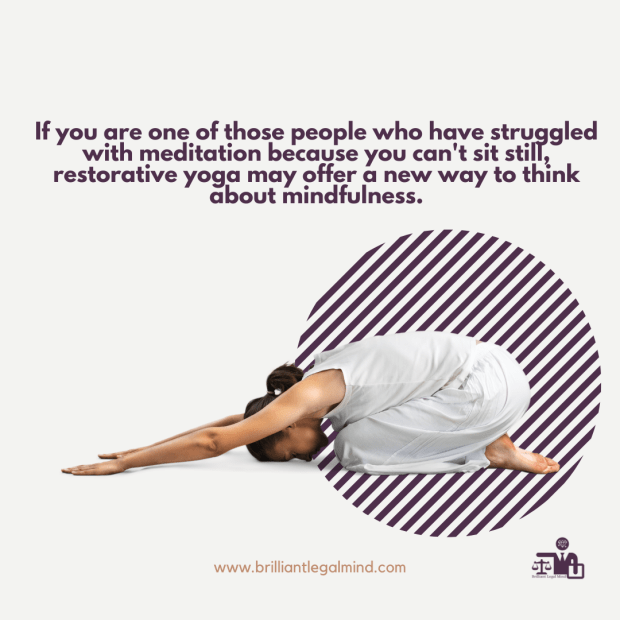
Finally, if you are one of those people who have struggled with meditation because you can’t sit still, restorative yoga may offer a new way to think about mindfulness. The instruction in most restorative classes is just to be in the experience of the pose, to feel oneself resting, and not to drift off in thought.
This is similar to the practice of sitting meditation, but it has some additional physical and restful components that may help you relax into and tolerate the experience more. Even if you enjoy meditation like I do, you may find that restorative yoga is a nice way to mix things up or can offer a chance to find mindfulness when life makes meditation seem a bit too intense.
If you are interested in learning more about restorative practice, you can find it at many yoga studios. Some fitness apps and online platforms, such as Peloton offer it too. In addition, you can easily start a home practice by finding a set of restorative props online.
You can also check out some of the work of Judith Hanson Lasater, Ph.D., P.T. Her book, Relax and Renewoffers pictures and explanations of poses and full sequences to help you do the practices on your own at home.
Just as you don’t have to sit still to meditate, you don’t have to move to do yoga. Restorative yoga offers lawyers the chance to practice rest so that they can find peace in stillness and pay closer attention to how their bodies feel. It is a beautiful practice that offers people in stressful jobs many benefits. Giving you the chance to experience how expansive yoga can be is just one of them.
Want to learn more about mindfulness and compassion? Check out my new book, How to Be a Badass Lawyer, for a simple guide to creating a meditation practice of your own in 30 days. And to share mindfulness with your little one, check out my new children’s book, Mommy Needs a Minute.
Like this post? Subscribe to the blog here or follow us on social media:
I previously wrote about how much I love Power Zone training and shared the lessons it taught me that could easily apply to life and meditation practice. Interval training, such as Power Zone, is an effective way to train the body and build physical fitness because it taps into the benefits of both high intensity efforts and periods of rest.
For this reason, it might actually help you to think about incorporating some rest periods into your meditation practice. I first learned about this idea years ago on a meditation retreat I attended. During one of the afternoon sessions (which are the the toughest for me because that’s when sleepiness sets in), the teacher reminded us to rethink our approach to meditation.
When I heard this, I instantly thought of all the HIIT (high-intensity interval training) cardio classes I’d done. With this style of exercise, you do short bursts of high impact exercise followed by lower impact, active recovery periods.
Of course, what the teacher at the retreat was proposing was actually “LIIT” or “low-intensity interval training.” I soon discovered that it was, indeed, quite LIIT. After several long periods of meditation that day, it was a breath of fresh air just to try a new way.
Sometimes it helps to keep going if you free yourself of the mental constructs you’ve created as to the “way” you are “supposed” to do it. As one example, I usually try to get 30 minutes of meditation a day.
When I ran into a bad patch a while back where I just didn’t feel like it, I committed to 5 minutes a day. I often ended up sitting for longer because, by the end of the 5 minutes, my resistance had passed. More significantly, though, I still have a practice today.
Sometimes a Meditation Practice Needs Adjustment
On the other hand, I have also had times where I needed more than my normal 30 minutes a day to work through particular stresses in my life. The problem, though, as I have learned with years of practice is that I tend to have diminishing returns when I practice for longer than 30 minutes.
My feet fall asleep, my knees and back hurt, and I tend to be so low on energy that I am almost asleep. In those times, I have instead broken up my long sit into two shorter sessions of 20 minutes with a few minutes to stretch in between. The results were much better and more helpful for me than trying to power through just 1 session of 45 minutes.
Meditation Should Work for Your Life
And that’s the point, isn’t it? The point isn’t to have an ideal practice. It isn’t to have a practice that competes with anyone else’s. The point is to have a practice that serves your life.
So, while discipline is certainly part of any good practice, don’t put your practice in a box. If there is one thing my practice has given me, it is an awareness of the dangers of all or nothing thinking.
Sure, 4 minutes of meditation may not be as “good” as 5 minutes, but it is way better than 0. More significantly, recognizing that 4 minutes might serve me better than 5 minutes on a given day is practicing self-compassion and self-awareness which, as a lawyer, I constantly need to practice.
Consider Trying Intervals in Your Meditation Practice
That’s what the meditation teacher was saying when he told us to try intervals: don’t let your mind get in the way of your meditation practice. To do this, you have to factor in your body and heart along the way. Low intensity interval training for meditation is just one way that you could balance your practice to help your mind, while acknowledging the whims and needs of your body and heart.
Want to learn more about mindfulness and compassion? Check out my new book, How to Be a Badass Lawyer, for a simple guide to creating a meditation practice of your own in 30 days. And to share mindfulness with your little one, check out my new children’s book, Mommy Needs a Minute.
Like this post? Subscribe to the blog here or follow us on social media:
I am not really a golfer, but I owe a lot to the game. Despite being a lawyer, I have only played at the occasional outing during my practice and even then have not been serious about it. In high school, however, I took up the game because my basketball teammate was an excellent player and needed another girl to round out my school’s newly formed team.
Knowing right off the bat that I would have no obligation to be any good, it seemed like a low-pressure compliment to the physically demanding and lengthy basketball season, so I gave it a shot.
Golf is a mental game.
While playing golf was certainly a change of pace, I quickly found that “low-pressure” was not the word to describe it. Yes, I got to hang out on a beautiful golf course in the rolling hills of Northern Kentucky and chat with my teammates and competitors. No, I wasn’t obligated to run suicides or fight for position on the court.
Though my surroundings and relationships with competitors were comparatively more peaceful with golf, I soon learned that my relationship with myself was far more difficult. Suddenly, I had to learn to coach myself to focus acutely, deal with setbacks, and use my judgment to try to make the best of hard circumstances.
After 3 years of high school golf, I never became a great player, though my team generally used my score and won some matches, but the game helped me start the process of becoming a decent adult.
Zen Golf was recommended to me first.
So, when a lawyer who had seen one of my mindfulness seminars reached out to me this year and suggested I read Zen Golf (paid link) it was almost like a blast from the past. I have no ambitions for rejuvenating my own golf game, but having played, I knew immediately how mindfulness might help anyone who wanted to do so.
Zen Golf is written by Dr. Joseph Parent, a sports psychologist who has worked with some of the world’s best golfers and a long-time meditator. In the book, he offers some basic instruction in mindfulness practice and describes strategies that he uses to help golfers struggling with various aspects of the mental game of golf.
Zen Golf isn’t new but it stands the test of time.
The book is now 20 years old, so some of the references to golfers may seem a little bit dated. In the same way, knowledge and awareness of mindfulness meditation has skyrocketed since that time, so some of Parent’s sayings and references such as “Today is a gift. That’s why we call it the present,” may sound a bit hackneyed.
Overall, though, Parent’s analysis of the many ways that the mind can block even the best golfer’s success and his recommendations for a path out are ones that I don’t think can get old.
Who doesn’t want unlimited confidence?
For example, one of my favorite parts of Zen Golf was when he describes the concept of “unconditional confidence.” While at first this sounded like business-book drivel and made me skeptically wonder how one could expect to be confident all of the time, I quickly realized that Parent wasn’t talking about cocky bluster or promising 100% good results.
Instead, Parent was explaining the Buddhist concepts of essential goodness and self-compassion. According to Parent, unconditional confidence didn’t come from results, but instead from a player’s acceptance of their own intrinsic goodness and choice, time and time again, to treat themselves with kindness regardless of the circumstances.
How to “make” every putt.
This concept came through best when Parent talked about his approach to teaching putting, which for many players can be the most maddening and heart-wrenching aspect of golf. Parent explained that golfers, much like Happy Gilmore, usually define a successful putt as getting the ball in the hole.
But Parent suggests a different approach that defines success with the process rather than the result. He says that a golfer has “made” a putt when they have a clean, steady stroke, use the appropriate force, keep their head down, and select and execute the right strategy.
For golfers who play regularly, this makes sense because it emphasizes and rewards the process of putting, which are within the player’s control, and lets the player off the hook for result, which (despite our frequently recurring delusions) is not.
Zen Golf extends beyond the course.
Clearly, this utility of this advice may extend well beyond the golf course. As a lawyer, it is often tempting to judge ourselves based on the results we get in our cases. Despite our best efforts and even when the law seems to favor us, we just cannot entirely control the results we get.
In short, Zen Golf(paid link) is a good read for golfers or anyone who wants to understand the practical benefits of mindfulness. The book explains in easy-to-understand language how the mind-body connection works and the many ways mental states and assumptions can ensnare us and impede performance.
It also offers many lessons for not just playing the game of golf better, but also enjoying it more and treating yourself better as you play. In this way, even if Zen Golf doesn’t make you a better golfer, it offers strategies and advice that may make you better at dealing with life.
The link to the book mentioned in this review is an affiliate link. The review is unsponsored and sincere but the link to Amazon is paid.
Want to learn more about mindfulness and compassion? Check out my new book, How to Be a Badass Lawyer, for a simple guide to creating a meditation practice of your own in 30 days. And to share mindfulness with your little one, check out my new children’s book, Mommy Needs a Minute.
Like this post? Subscribe to the blog here or follow us on social media: