What Kendrick Lamar’s New Album Gets Right about Mental Health

Cover image for blog post entitled "what Kendrick Lamar's new album gets right about mental health"

You might wonder why a post about Kendrick Lamar appears on a blog about mindfulness for lawyers. Maybe you haven’t listened to it yet. Even if rap isn’t a part of your musical mainstay, you should be familiar with Kendrick Lamar’s work.

Lamar took the musical world by storm in the last decade. He racked up Grammys, a Pulitzer, and a Super Bowl appearance. He also achieved huge commercial success. For a time during that period, though, Lamar was quiet. The public may not have understood why until the release of his album, Mr. Morale and the Big Steppers. 

Lamar Offers Hits and Mental Health Insights on Mr. Morale

In the opening track, Lamar shares that he has been “going through something” for the last “1855 days.” As you listen on, you realize he’s discussing a mental health journey. He undertook this while managing the pressures of being a world musical superstar and a family breadwinner.

Now, I imagine, you probably understand what this has to do with your life as a lawyer. If, like me, you’ve experienced mental health challenges, you’ll relate to Mr. Morale. Many of us have faced inner demons while trying to keep up public appearances. All the while, we have to do our jobs and manage our families. If this sounds familiar, you’ll hear a lot in Mr. Morale to which you can relate. 

Image that says "awareness of mental health is better than it once was but stigma and fear about mental health issues remain."

1. Lamar Tells the Truth about Mental Health.

So, what is it that makes me enthusiastic about this album? First, I am thrilled that someone in Lamar’s position is using his voice to tell the truth about his experience. Awareness of mental health is better than it once was, but stigma and fear about mental health issues remain. As lawyers, we also may feel pressure to hide our experiences for fear of hurting how others perceive us.

Lamar has been honest in the past about his life, but Mr. Morale includes descriptions of his personal failings and childhood trauma. It takes courage to face those things, let alone share them publicly. By doing so, Lamar helps his fans feel a little less shame about their own struggles. 

2. Lamar Doesn’t Pretend One Can Manage Mental Health Alone.

Second, it’s also significant that Lamar doesn’t pretend that he faced his demons alone. The voice of his partner, Whitney, is sprinkled throughout Mr. Morale. She instructs Lamar to tell his listeners “the truth” in the opening songs of the album. Then she celebrates with him and their children at the conclusion for ending a “generational curse.”

References to therapy, mentors, and spiritual teacher, Eckhart Tolle, are replete on the album as well. Why is this important? It’s important because it’s real. For many of us, shame can be a part of mental health challenges. This can make it harder for us to seek out the help we need. Lamar honestly describes the help he received to heal from his past. This shows how even the most powerful people need and deserve help.

Image with quote that says "as lawyers, we may feel pressure to hide our experiences for fear of hurting how others perceive us."

3. Lamar Talks about Mental Health as a Human Issue and Not Just a Personal One.

Finally, Lamar tells his story not just as a personal one but as a human one. I’ve talked before about how self-compassion is critical for healing, including the essential element of “common humanity”. The story that Lamar tells on Mr. Morale is deeply personal and unique to him, but in telling it he links it with a broader community.

Lamar integrates musical elements throughout the album. He references black musical artists throughout the decades. He even goes back to the era of jazz. He also speaks directly of the broader trauma that institutional racism in the United States has caused. In doing so, Lamar honors his own experience, while inspiring and giving voice to others who have shared it.

Lamar Brings Needed Awareness to Mental Health

Like any pop musician, Lamar does not shy away from provocation in Mr. Morale. There is some justifiable and well-reasoned criticism of the album. This criticism is based on some of his comments and lyrical choices, including his claims about “cancel culture.” Still, though, Mr. Morale tells a story about mental health.

This is a story that the public needs to hear. It demonstrates how personal accountability is part of the healing process. It reveals that extreme fame, wealth, and talent aren’t necessarily a shield against past trauma. These attributes do not counter the influence of race and class.

Image of man hiding face with quote that says "For many of us, shame an be a part of mental health challenges. This can make it harder for us to seek out the help we need."

Conclusion: Mr. Morale Offers a Soundtrack for a Mental Health Journey

If you listen to the entire album, you’ll see the full story take shape. You will understand what it can feel like when you do the inner work needed to move forward in life. At the end, you will not just have a soundtrack to supplement the movie of your own journey. You’ll also have some ideas that any powerful person in the public eye can use to face their own demons to live a better, happier life.

Have you listened to Mr. Morale and the Big Steppers? Leave us a comment to let us know what you thought.

Image with quote from Kendrick Lamar that say "I hope I'm not too late to set my demons straight."

Want to learn more about mindfulness and compassion? Check out my new book, How to Be a Badass Lawyer, for a simple guide to creating a meditation practice of your own in 30 days. And to share mindfulness with your little one, check out my new children’s book, Mommy Needs a Minute.

Like this post? Subscribe to the blog here or follow us on social media:

What Law Firm Leaders Can Learn from Better Call Saul

I was watching Better Call Saul with my husband as Howard Hamlin, the law firm partner with perfectly quaffed blonde hair and a toothpaste commercial grin, appeared on screen. After meeting with the title character, Saul Goodman, Howard gets into an expensive vehicle and drives away to reveal a vanity plate that reads “NAMAST3”. We already knew that Howard had been struggling with his past and had turned to yoga and new-found spirituality to tame his inner demons. Unfortunately, as the audience eventually learns, Howard’s inner peace is much like the spelling on his vanity plate: not quite right. 

My husband smirked, turned to me and said, “Does that irritate you?” He was mocking me, but I was nerding out far too hard to acknowledge it. Instead of rolling my eyes at him, I replied “No, this is a great example about how easy it is to gaslight ourselves with spirituality.” Indeed it was, but it turned out to be a tragic one too. In Better Call Saul, Howard had turned to yoga and mindfulness to soothe his tortured soul after the downfall and death of his mentor and Saul’s brother, Charles McGill. 

Despite this new-found ethos, however, there is little evidence of reflection on Howard’s part about his preoccupation with appearing perfect or the practices of his own law firm. Tragically, Howard’s obsession with his reputation left him vulnerable to Saul’s tricks, and it ultimately lead to his own death and the implosion of his firm.

I talk about the power of mindfulness all the time, so it may seem strange that I would draw attention to Howard Hamlin. If anything, he shows us that mindfulness has limits, right? And, to be sure, the characters on Better Call Saul are generally examples of what not to do as attorneys. So why talk about them? 

I talk about them because, of course, there are limits to mindfulness practices. As Howard demonstrates, one of the dangers of mindfulness practice is that it can help you feel better temporarily or on a surface level without achieving the clarity needed for real peace. If you don’t have other supports to ground you, you may end up deluding yourself instead of growing and understanding yourself better.

The show doesn’t tell us what practices and teachers Howard relied on to develop his mindfulness practice, though his license plate suggests he went for yogic practices. The show offers clues, however, that Howard is otherwise intent on appearing serene when his life in many ways seems to be falling apart. Though he experienced the death of his law partner, strife in his firm, and an impending divorce, Howard seems intent on showing everyone how happy and at ease he is. There’s also no mention of Howard trying additional strategies, like therapy for example, to support himself.

I don’t say these things to suggest that Howard was a bad guy. He really wanted to be a good guy. He wanted to be a mentor to young lawyers. He wanted to be a good leader and build a law firm that lasted. The problem is that Howard was not an aware guy because he was afraid to see himself as he really was. In this way, Howard Hamlin was entirely human, but his obsession with looking at peace tragically got in the way of him ever finding it. 

Research is clear that mindfulness practices, including yoga, can help you reduce stress and feel more at peace. They do that, though, by helping you face yourself as you are and life as it is. Part of that means accepting your own imperfections and learning how to share them with others. As Howard Hamlin shows us, your so-called inner peace can get torn apart very easily when you can’t allow yourself to do this. 

The legal profession certainly needs more law firm leaders who are willing to be examples about leading a good life, including the practices that help them do it. So, if you are a serious yogi, go ahead and talk about it and keep that yoga mat in your office. But, don’t just talk about it and throw a vanity plate on your car. You also need to act on the values that have served you well. You need to be real in a way that Howard Hamlin never let himself be about the struggles you’ve had rather than merely trying to convey an illusion of spiritual purity. Not only do you deserve all the support you can get when you deal with hardships in life, your law firm may need you to get it. 

Indeed, research suggests that emotional intelligence and relationship-building are essential leadership traits. Even the best lawyers would struggle to do either of these things without being honest with themselves and others about who they really are. Law firm leaders who embrace mindfulness to help stabilize themselves can certainly use the practices to become better leaders for their firms.

But they shouldn’t do so with the objective of always looking calm and serene, especially not when real crises in life or law practice are happening. Instead, the practices are there to help you accept and face what is there–in yourself or in life–and greet it with compassion. When you can do this, there will be no need to tell people how at peace you are because you’ll show it with your life, law practice, and leadership every day.

Want to learn more about mindfulness and compassion? Check out my new book, How to Be a Badass Lawyer, for a simple guide to creating a meditation practice of your own in 30 days. And to share mindfulness with your little one, check out my new children’s book, Mommy Needs a Minute.

Like this post? Subscribe to the blog here or follow us on social media:

A Socratic Dialogue with Thor about Anger in Meditation

If you went to see Thor: Love and Thunder last month, you probably spent less time focused on Thor’s discussion of meditation with genius scientist and lost love, Jane Foster. As the two discuss their past, they confided that they each had tried meditation to heal from their losses. Rather hilariously, Thor proclaimed that it didn’t work for him because it “just made him angrier.” It was a relatable quip that most people in the audience may have heard, laughed about, and moved on from to the rest of the movie. 

When I heard it, though, the biggest “well actually” line of dialogue began streaming through my mind. Obviously, I had to restrain myself from announcing this in the theater, but that only made me think about it more later. Because Thor’s misconceptions about meditation and anger are likely shared by many of us mere mortals, I offer this imagined dialog with Thor. Not sure it’s truly a Socratic method but what we experienced in law school probably wasn’t either, so close enough. 

Camera pans out to reveal a strange light in the sky. The light grows into a bright white circle. From it, emerges a woman never before seen in the movie and who does not rightfully belong in it. Thor stands back from the light and reaches for his weapons in alarm. When he sees it is just a woman who clearly has no martial arts training beyond the occasional Peloton shadow boxing class, he stands confused but at ease. 

Thor: Who are you and what are you doing here? 

Claire: Hey, Thor, I am a human from earth. You and Jane are doing a great job showing vulnerability to address some unresolved issues. I don’t want to derail that but you said something about meditation that isn’t quite right. 

Thor: How did you get here? Did Gorr the God Butcher send you?

Claire: I have no idea but no, Gorr is clearly the bad guy here. If only he had learned how to hold his grief, we wouldn’t be in this mess. That’s why I am here to talk about meditation and anger. 

Thor: You don’t appear to be one of Gorr’s monsters, but I’d really like to get back to talking to Jane. 

Claire: We all want you to get back to talking with Jane, so I’ll get to the point. That thing you said about meditation just “making you angrier” it’s not really true. 

Thor: Now I am concerned that you are Loki trying to trick me. Are you trying to tell me you know my experience better than I do?

Claire: Not at all. I also don’t know what kind of meditation you were doing. But, I’m guessing you tried to sit and focus on your breath or something? Did you try Headspace or 10% Happier?

Thor: I have an app called ZenGod. It’s specifically for gods but similar. Yes, I tried to focus on my breath, but I couldn’t because I just became filled with rage. 

Claire: Got it. And yes, that is totally normal. It happens to the best of us. What did you do when the rage came up?

Thor: I immediately stopped meditating and went to kill monsters with my ax.  

Claire: Did that help you feel less angry?

Thor: It felt pretty good to kill those monsters, but the feeling didn’t last. 

Claire: That’s really good too. Not good that you felt that way, but that you noticed it. 

Thor: What do you mean? How could it possibly be good that I noticed this?

Claire: Well, the reason we meditate is to notice what’s there. When we notice what’s there, over time that becomes wisdom and we are in a better position to know what to do about what’s there. Sometimes the only thing we can do is to let things be, but the wisdom is seeing this. 

Thor: I am a god. I don’t “let things be.” I hit bad things with my ax and summon power from the universe to destroy them. 

Claire: Well, how did that approach work for your anger?

Thor: It didn’t work at all and I can tell because I am getting very angry right now. 

Claire: That’s okay. It’s perfect actually. There’s nothing wrong with anger. You have every right to be angry. You’ve lost a lot. You’ve taken on a lot for other people. Your anger has helped you to protect others several times. Can you just let it be there now?

Thor: It’s hard. I don’t like it. I am very powerful and it makes me nervous to feel like I can’t control it. 

Claire: Excellent. You are doing so great. Anger does scare a lot of us because it makes us feel out of control. The more powerful we are the harder it can be because we are responsible for a lot and we don’t want to do something bad. But, remember, you are holding it now. What exactly does your anger feel like now?

Thor: Feel like? It’s anger. Why do I need to explain it?

Claire: Great job again. You are so good at this. You don’t need to explain it to me or anyone else. What I’m saying is to feel it. Where in your body do you feel the anger? What sensations are there that tell your brain you are angry?

Thor: My jaw is clenched. My hands are gripping my ax. My shoulders are tight. I feel like I am holding my breath. My neck and cheeks feel hot. I want to hit something. 

Claire: Wonderful. You are doing great. All of those things are normal. That feeling of wanting to hit is energy. We may not like it, but the function of anger is to make it clear to us when something is wrong and motivate us to act. Because you are a superhero, your habit is to discharge angry energy by hitting things. That can be good sometimes, but it can also be good to just learn to hold it for the times when you aren’t fighting monsters. 

Thor: So what do I do when I need to hold it? I still feel angry now. 

Claire: The first thing is to do what you just did. Notice what’s there. Recognize it as anger. Allow yourself to feel how you feel. After that, the most common way to come back to neutral is to breathe. 

Thor: Breathe? That’s so basic. I’m a superhero. Can’t you do better than that?

Claire: You are a god but you have enough human in you such that the breath is the way you can calm down the body. Think of your breath as the ax you use to fight the monster of anger? Does that help? When you focus on your breath, specifically the exhale, it sends a signal to the body that things are okay, that you’re safe. Try it out. Take a deep breath in, feeling what sensations happen as your lungs expand. Hold it for a moment. Then exhale and sense what it feels like to let go. 

Thor: *Rolls eyes but tries breathing* 

Claire: Let’s try that one more time. This time see if you can make that exhale just a beat longer than the inhale. 

Thor: *Continues on and then opens eyes*

Claire: Great job. How was that?

Thor: It helped. I still feel a little angry but I no longer wish to hit anything. But, I’m confused. I thought I was supposed to be calm when I meditated. You told me to feel angry. 

Claire: Excellent question. Meditation isn’t about just feeling calm. Many people do it to learn how to get calm or get back to it. But the real object of meditation is to learn to be present with whatever comes up. If that’s anger, then it’s practicing presence with anger. The reason this helps you get calm is that eventually you learn that when you are angry, you can just be angry and you don’t always have to act based on it. 

Thor: But what if I screw it up when things are too much?

Claire: You are going to screw things up. Meditation doesn’t make you perfect. It just gives you a new tool to use. The next part is forgiving yourself but I think the rest of the movie is going to cover that, so I will let you and Jane be. 

Thor: Movie? What? 

Claire: Ummm, errr . . . I just mean that I know you will figure that one out. But, if not, feel free to DM me @BrilliantLegalMind and we can talk again. Good luck with Gorr! 

Thor: Goodbye, strange woman from Earth! 

A bright light emerges again in the sky and a white circle enshrouds Claire. Thor and Jane return to talking and Claire continues watching from her seat in the theater. 

Don’t get me wrong, this post is not intended to tell you to meditation-splain to random people out in the world, particularly not if they are large superheroes with magical axes. But, if you have ever struggled with anger in meditation, at least you know you are in good company. Best of luck in your practice, fighting whatever monsters in life you have to fight, and I hope you enjoy the summer blockbuster movies as much as I have.

If you struggle with anger in meditation or otherwise, you aren’t alone. Check out this article I wrote for Above the Law which shared my experience with it and what helped me. If you have any strategies or practices that have helped you, leave us a comment to share your wisdom with others.

Want to learn more about mindfulness and compassion? Check out my new book, How to Be a Badass Lawyer, for a simple guide to creating a meditation practice of your own in 30 days. And to share mindfulness with your little one, check out my new children’s book, Mommy Needs a Minute.

Like this post? Subscribe to the blog here or follow us on social media:

What Is Restorative Yoga and Why Should Lawyers Try It?

Lots of people tell me that they can’t meditate because they can’t sit still. I usually tell them that they don’t have to sit still to meditate. Strangely, people also tell me with a similar frequency that they can’t do yoga because they can’t do the poses. Sometimes they say that they can’t balance. Sometimes they say that they aren’t flexible. Sometimes they express a concern that they look silly. In other words, these people tell me the inverse of what the people who can’t sit still during meditation say: that they can’t move the right way during yoga.

When I hear these concerns, one of the first things I say is to acknowledge that I used to struggle with yoga too, but that letting go of the idea that there was a “right way” to move was what helped me learn to love it. One of the practices that helped me do this was restorative yoga. When I finally tried yoga for real, I already had an active meditation practice but it helped me realize I had to develop some ways of caring for my body in addition to my mind.

Though I’d been athletic growing up, I had not worked out consistently in years, so I started with yoga as a way to ease back into movement even though my earlier attempts with it had not been successful. Because I needed time to build up cardio endurance, I had to start with slow and gentle classes first. That’s when I found restorative yoga. Lucky for me, it was enough like meditation that I could enjoy it but different enough that it could serve as a segue into more yoga exploration.

Restorative yoga is a restful kind of yoga. Poses are part of the process, but the poses are supported rather than held. You don’t build strength and balance with the poses. You practice rest instead and you practice letting yourself be supported. In most cases, the poses are done lying on the floor, reclined on props, including blankets, blocks, or bolsters, or resting against the wall or a chair for support. This is because yogis hold the poses in restorative class for at least 5 and often as much as 15 or 20 minutes at a time.

So, why is this good for lawyers? It’s good for a lot of reasons. Restorative yoga practices rest and being supported. Most of us lawyers are in the habit of being active all of the time and doing many things on our own. For this reason, practicing another way of being is a way to offer balance to our lives. In addition, the poses themselves are beneficial to the body. Poses that help open the chest or arch the back may counteract the effects of sitting at a desk all day and inversions may balance hormones and offer relief from the effects of gravity and wearing uncomfortable shoes.

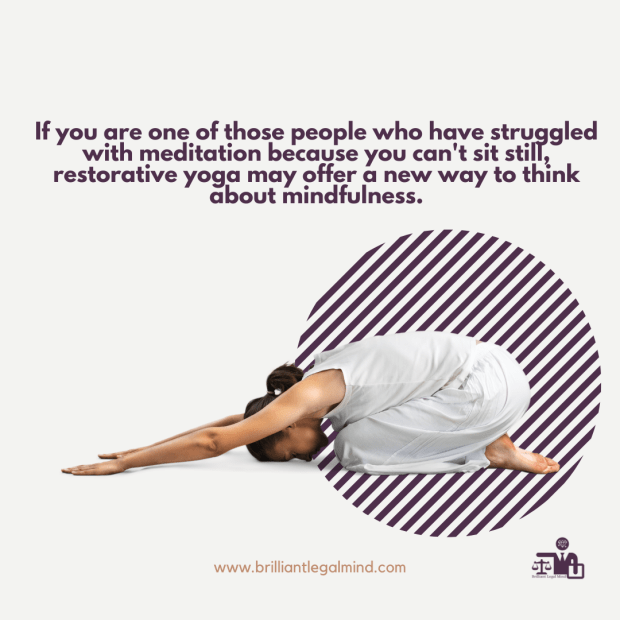
Finally, if you are one of those people who have struggled with meditation because you can’t sit still, restorative yoga may offer a new way to think about mindfulness. The instruction in most restorative classes is just to be in the experience of the pose, to feel oneself resting, and not to drift off in thought.

This is similar to the practice of sitting meditation, but it has some additional physical and restful components that may help you relax into and tolerate the experience more. Even if you enjoy meditation like I do, you may find that restorative yoga is a nice way to mix things up or can offer a chance to find mindfulness when life makes meditation seem a bit too intense.

If you are interested in learning more about restorative practice, you can find it at many yoga studios. Some fitness apps and online platforms, such as Peloton offer it too. In addition, you can easily start a home practice by finding a set of restorative props online.

You can also check out some of the work of Judith Hanson Lasater, Ph.D., P.T. Her book, Relax and Renew offers pictures and explanations of poses and full sequences to help you do the practices on your own at home.

Just as you don’t have to sit still to meditate, you don’t have to move to do yoga. Restorative yoga offers lawyers the chance to practice rest so that they can find peace in stillness and pay closer attention to how their bodies feel. It is a beautiful practice that offers people in stressful jobs many benefits. Giving you the chance to experience how expansive yoga can be is just one of them.

Do you want to try restorative yoga? Check out our Supported Fish Pose with Self-Kindness Guided Mediation. Or you can try our Legs Up the Wall Guided Meditation even if you don’t have any props. All you need are your legs and a wall.

Want to learn more about mindfulness and compassion? Check out my new book, How to Be a Badass Lawyer, for a simple guide to creating a meditation practice of your own in 30 days. And to share mindfulness with your little one, check out my new children’s book, Mommy Needs a Minute.

Like this post? Subscribe to the blog here or follow us on social media:

Pause Patrol: How My Apple Watch Helps Me Avoid Fights with My Stubborn Child

If you are a lawyer, you may be the kind of person who doesn’t back down from a fight. I am such a lawyer and not just because I am a litigator. Rather, I think I was drawn to litigation because I am one of the most pigheaded and stubborn people to ever walk the earth. I have to qualify this claim, of course, because I now have children. Having shared my genes with them, I also shared my stubbornness.

My six-year-old, in particular, will fight me about literally everything. She will fight about putting on her shoes, or eating her dinner, or going to bed, or brushing her teeth. She will cry and scream and yell and just become a general nightmare of a human being. Even worse, the more you try to encourage her to remain calm and make good choices, the angrier she gets.

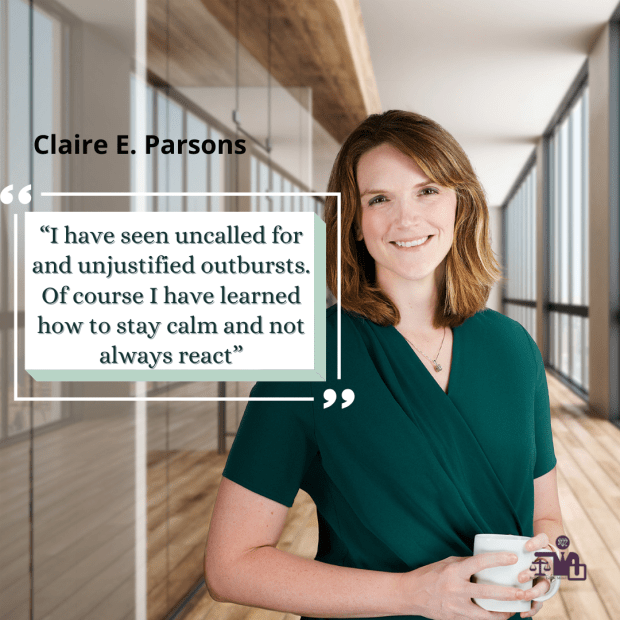
As a lawyer, it’s not like I am not accustomed to outbursts of this nature. Of course, I have seen uncalled for and unjustified outbursts. Of course I have learned how to stay calm and not always react. Still, there is no way around the fact that it is exhausting and frustrating to have every request of the person you are trying to care for and raise into a responsible, productive citizen greeted with a tantrum.

So, what can you do? This is where the lawyer part of my brain had to learn to relax and let the meditation teacher part take over. The lawyer part of my brain wants to establish rules, monitor for compliance, and take immediate action to achieve my objective. I tried this lots of times and the meditation teacher part of my brain watched, smirked, and said “how’s that working out for you?” Eventually, the lawyer part of my brain got disgusted when her reasonable requests devolved into arguments and yelling and told the meditation teacher part “I’m done. You give it a shot.”

What did meditation teacher brain come up with? She told me to use available tools and leave a space. In a stroke of genius one day when my beautiful, darling girl was transformed into a vicious troll when I asked her to finish up her lunch instead of running around the kitchen, I heard myself say “I’m going to set a timer on my watch for 5 minutes. I want you to finish your lunch. I am not going to fight with you or say anything else. But if your lunch is not finished in that time there will be consequences.”

Now, the lawyer brain was shocked when I said this. She was like, “are you kidding me? That will never work. She’s already had 30 minutes to eat. What good will another 5 do?” At first, it seemed like she was right. My little one raged and cried and complained for about 30 seconds. Meditation teacher me sat like patience on a monument and said nothing. She just watched. Then, without prompting and almost as if by magic, the little one stopped complaining, sat down, ate, and even cleaned up her plate by herself. Lawyer brain and meditation teacher brain joined in unison to tell her good job.

Maybe you are thinking that this is just a fluke. At first, I thought so too. But my study has been tried and tested and replicated. The pattern is always the same: I give a command, my child resists, I set a timer and reiterate my command, she resists even harder, I don’t react, and she complies. The pattern is so predictable that I can actually laugh a little to myself while the comedy unfolds. She hates the timer, but it works so well and the irony is now just part of the fun.

So why does this work? Because my little one is not a bad girl. Despite all outward appearances, she’s not even trying to drive me crazy. Instead, she’s just got big emotions and big reactions and wants to do things her way. Go figure. She’s my child. I want things to go my way too. I, too, have big emotions and big reactions. So, when we both have them at the same time in opposite directions, it just leads to a fight.

As much as my daughter claims to hate it, the timer on my watch is good for both of us because it creates a space. This space lets her have her reaction without interruption or prompting from me to focus on the goal. Once she’s reacted and gotten it out of her system, she can focus again and do what she needs to do.

Let’s be honest here. Who isn’t like this? Who doesn’t occasionally need the chance just to say “ugh!” while raising one’s hands to the sky in frustration before they accomplish a task they don’t like? We all need this sometimes. To allow for it, the best thing we can do is pause to create a safe space for it to happen. Thankfully, the handy little timer on my Apple Watch is there to help me take a pause when dealing with my stubborn girl.

Has mindfulness helped you with your kids? Leave us a comment to tell us how.

Want to learn more about mindfulness and compassion? Check out my new book, How to Be a Badass Lawyer, for a simple guide to creating a meditation practice of your own in 30 days. And to share mindfulness with your little one, check out my new children’s book, Mommy Needs a Minute.

Like this post? Subscribe to the blog here or follow us on social media:

Noticing “Why” Questions Can Help You Be More Present in Life

Nonjudgmental awareness is the goal of most meditation sessions and cultivating it is the goal of most meditators. Teachers will tell us to “just notice what’s there” instead of getting lost in our reactions. But, for us lawyers, this is not an easy feat. We are trained to judge, evaluate, and appraise. Clients pay us and specifically ask for our reactions. This means that our jobs incentivize us to automatically react to any situation we encounter.

If we could easily restrain this tendency to our work lives, we perhaps wouldn’t have any need for meditation. Most of us are not that fortunate, however, and we may find ourselves lost in judgments instead of present in our lives, whether in or outside of work. Even so, the habit of reacting to our experiences in life rather than experiencing life directly is deeply ingrained. How on earth can we start to undo it?

For most of us, this will be a gradual process and it won’t do much good to simply resolve to stop reacting so much. But, in my years of meditation practice, I have found one simple thing that has helped me: being watchful of “why” questions. You may have never thought about this before. Asking “why” questions as a kid probably helped make you the smart, talented person that you are. And, to be sure, a sense of curiosity is actually a good thing for most of us trying to make meditation a habit.

When I tell you to watch out for “why” questions, I’m not saying to dispense with your inclination to explore. I’m actually saying the opposite. I’m recommending that you notice how the “why” questions come up for you. In many cases, you may find that they aren’t questions at all, but instead are implicit judgments about your situation.

For example, if you can’t focus on your breath in meditation, you may ask yourself “why is this so hard for me?” Implicit in that question are several latent assumptions: (a) that meditation shouldn’t be hard; (b) that meditation shouldn’t be hard for you; (c) that things in general shouldn’t be hard for you; and (d) that failing to focus on the breath means you are doing something wrong in your meditation practice. With questions like this, the word “why” is an illusion that suggests that there is an easy answer out there that we are missing, but in most cases in life there isn’t one. When we notice this pattern of speech, it can help us see a pattern of our mind to judge.

Even when we are using “why” in the exploratory sense, paying attention to how it arises for us can help us uncover less obvious judgments. Let’s shift the example above to a less overtly judgmental question like “why do I do this?” That may seem fairly innocuous, but even here the question still implies that (a) the thing you keep doing is wrong or a problem to be solved; (b) the thing you are doing is part of a pattern with a singular cause; and (c) the solution to the problem can be discovered through logical reasoning. Sometimes things fit those descriptions, but often in life they don’t. When we narrow the focus of inquiry too much with a pointed “why” question, we can miss some of what life experience is trying to show us.

So, what’s the answer here? It is literally in the question. Once we have started to become aware of all the “why” questions we ask about our lives and our practices, we can then start to ask something more fundamental: what. Instead of asking ourselves “why” things are the way they are, we drill down on the facts of what is actually taking place. Much like refocusing our attention on the breath when the mind wanders, the “what” question brings our mind back to reality instead of getting lost in theories about causation.

My experience with this shift has produced a paradoxical result. The more I have learned to ask “what” in my life and meditation practice, the more that the “why” questions became irrelevant. When I focused with more intention, clarity, and precision on the facts and situation before me, I implicitly understood the “why” or realized that the “why” wasn’t as important as I had previously believed it to be.

Not only did becoming skeptical of “why” questions help me become aware of my judgments, it also helped me understand that I couldn’t take a short cut to get to understanding about myself or the world. Instead, the only way to get that understanding and all the peace and happiness that came with it was to stay rooted in the realities of what life and the world really was.

There isn’t a quick and easy way to become less judgmental in life. It’s a deeply ingrained habit for most of us and it will take time and practice to change. Even so, noticing how we use the word “why” may be one small thing we can do to bring awareness to our habits of judging and reacting to life. Training ourselves to ask “what” instead–even when we think we already know–may help us come back to presence with life exactly as it is.

Want to learn more about mindfulness and compassion? Check out my new book, How to Be a Badass Lawyer, for a simple guide to creating a meditation practice of your own in 30 days. And to share mindfulness with your little one, check out my new children’s book, Mommy Needs a Minute.

Like this post? Subscribe to the blog here or follow us on social media:

How My Long-Term Goal of Writing a Book Became a Reality

I have been quiet on the blog for the last few months, but I promise I have some pretty good excuses. One reason for the break is that, after several years with the same firm, I decided to transition to a new firm. Though I am thrilled with the new role and looking forward to expanding my practice, it was an emotional and complicated process and I needed some time to rest. The other excuse is also pretty awesome: I am writing a book. Actually, I am finishing up writing the book and should send a manuscript to my editor this week.

I have thought about writing a book for many years. I know I first had the idea for it in 2015 after I won two big awards in the span of a few months for community leadership and career success. I had already written how, in 2012 and 2013, I struggled with my first pregnancy, the birth of my daughter, and my transition into life as a working mom. In a few years, though, things changed drastically for me and I remember reflecting at the time that I wanted to write about it.

Of course, not much happened on the writing front for a few years, but in 2018 I decided to try to the Writers in Residence program for Ms. JD. That was the first time I had written about things that weren’t purely legal topics, including mindfulness. It went well and some of my posts were republished and got some kudos from people other than my best friends and mom.

After that, I started to think more seriously about the book and began talking to friends and contacts who had written books to gather information. Late in 2018, I attended a friend’s CLE and she did an exercise where she asked us to take a Jenga block from a symbolic brick wall and write our stretch goal on it to help make the world and legal profession better. I wrote the word “BOOK” on it and kept the block in my office.

Still, a clear idea of what to write about and the way to do it did did not emerge. So, I started writing on LinkedIn regularly. At the same time, I started speaking about mindfulness and compassion. I was nervous about that at first but it, too, went much better than I expected. The LinkedIn writing helped me build a network, allowed me to experiment with writing styles, and let me gather feedback about what people really wanted and needed. The pandemic gave me the time to focus on this writing, to speak a lot about mindfulness and compassion, and to get training so that I could better explain why mindfulness and compassion worked.

This blog was one of the fruits of that experience. I launched it the week I finished my meditation teacher certification as a celebration. The other fruit was that I realized that lawyers were fairly knowledgeable and comfortable with mindfulness but they knew a lot less about compassion. Lawyers like mindfulness because we like the idea of calm and we like the idea that we can get a handle on our thinking. But, compassion cultivation can give us emotional intelligence, resilience, greater happiness, and better relationships. It is the stuff we need when we are not calm and lawyers are often dealing with situations that are not calm.

Then, last year the idea for my book finally hit me. I texted a friend about how I want to write about how compassion is badass. I wanted to explain to lawyers how the soft, gooey, touchy feely side of compassion is actually really powerful. I wanted to write about mindfulness and compassion in a way that was real, funny, and let those of us with messy lives see how good we are. And, so the idea for my book was born in a text message to my friend. I still didn’t know what to do at that point, but at least a vision was starting to emerge.

Shortly thereafter, I met a fellow meditation teacher on LinkedIn who told me about a guy who ran a coaching program that helped people write mindfulness books. I was too busy at the time to act on it but made contact with the coach via email. At about the same time, I recorded an episode of the Legally Blissed Conversations podcast with Suzi Hixon, Esq. and said I planned to write a book “one of these days.”

I promptly forgot about that comment and episode because my law practice became incredibly busy. I dodged the emails from the writing coach and kept apologizing for being too busy. Then, late in 2021, I realized something interesting: I was turning 39 soon. I’m bad at math but even I could figure out what that meant. It meant I would be turning 40 in 2023. So, I reached back out to the writing coach, apologized for the semi-ghosting antics, and set up a call. Ten minutes into that I was convinced it was what I needed, so I signed up.

I got started with the process thinking it would be smooth sailing from there, but then out of nowhere I got the urge to make some changes in my law practice. That totally took over my life for a few months and I was able to write nothing. I even had to stop writing for the blog for a while because my creative energy totally faded away. I eventually decided to just pause the blog posts for while so I could recover and focus on the book.

My patience for myself was rewarded. I started writing the book in May and wrote more than 45,000 words in 12 chapters by the end of June. My coach guided me to scale this back and focus more directly on one topic, so I ultimately revised, removed chapters, and wrote a few more. Now the book is 30,000 words and 10 chapters but I have some extra content for a second book. In addition, as an added bonus, a strange little poem creeped out of my brain that I have turned into a children’s book (Mommy Needs a Minute which should be released in 2023) with my talented friend who draws pictures. Now, I will have my book published by the time I turn 40, have another on the way, and the beginnings of a third.

What is the lesson from all of this? The lesson is to follow your instincts and trust yourself. If something is important to you, a path will emerge. That may mean you have to keep coming back to the path when you get sidetracked. It may mean you have to be patient with yourself as ideas start to form and you learn the skills needed to make the project work. I have been thinking about writing a book for seven years now, but in that time I have not only been thinking. I see now that that steps I took along the way weren’t wasted time or distractions because they helped me build skills, create a community, and find my voice.

If you have a long-term goal, say it to yourself. Then say it to your friends. Even if the timing isn’t right to get started on the goal immediately, don’t let it go and don’t discount the impact that play and experimentation along the way can have for you. I have noticed in my meditation practice that the best ideas tend to come back to me again and again. This can be true in life too. Sometimes life can get in the way of our big goals, but the best ones for us, the most meaningful ones, may come back to us again and again until we are ready to act on them.

Update: the book is now here and available on Amazon, Barnes & Noble, and BookShop!

Like this post? Subscribe to the blog here or follow us on social media:

Mindfulness Basics: How to Find Your Breath

Breath practice is what many people think of when they think of meditation. The instructions seem simple. You are supposed to focus on your breath and return–ideally without mentally flagellating yourself–to the feeling every time your mind wanders. But as soon as you sit down to get started, you may be greeted by the somewhat disturbing recognition that you have no idea how to find your breath.

This may be shocking since, presumably, you’ve been breathing your whole life. You may think, “how can I not find my breath? I just had it a minute ago.” You may feel as foolish as that time (or in my case all those times) you rushed into the grocery store for a quick purchase and realized you didn’t pay attention to where you parked your car. Sigh.

In truth, this may be a collective sigh. Many of us have trouble finding our breath, or at least settling on a focal point that works for us, at first. In my view, if you notice that you aren’t quite sure what it means to focus on your breath, that’s actually a good sign.

It means you are starting to slow down and you’re noticing things you never noticed before. It means you are starting to ask questions about experiences you previously ignored or overlooked. That’s one of the critical benefits a meditation practice can offer, so you should be encouraged by it instead of discouraged.

Reading not your thing? Listen to our video here.

Beyond this, the reason it might be hard to find your breath is that there isn’t any right answer. When you are told to focus on your breath, most teachers mean to focus your attention on the sensations of the breath coming in and going out. The sensations are the thing and not the thoughts or judgments about it.

Different teachers, however, recommend different focal points. Some traditions instruct students to focus on the tip of one’s nose to feel the flow of air in and out. Others recommend focusing on the feeling of rising and falling in the chest or belly as the air fills your lungs. Which should you choose?

My recommendation is to start with the place that calls out to you the strongest and stick with it. When I started meditating, I focused on my nose because one of the first books I read about meditation recommended that. I struggled immensely with this. For me, the sensations of the breath just weren’t very strong at the tip of my nose.

When I finally went to a Zen retreat, I asked the teacher and she said she focused on her belly because she wanted “to get as far away from her head as she could.” I liked that answer a lot and tried focusing on my belly. Voila! Problem solved. My practice got much easier and my mind started unconsciously settling on my breath as I went about my daily tasks.

Does this mean that the belly is a better focal point than the nose? Not in my opinion. What it means is that the belly is a better focal point than the nose for me. For anyone new to meditation, I recommend focusing on the area that is strongest so you can get your practice started without much struggle. In the early stages, the important thing is to establish a habit and do what helps you focus and doesn’t discourage you.

Once your habit is established and you know your mind and body a little bit better, you can branch out and explore. In fact, if you use guided meditations, you will probably end up doing this automatically because some teachers will direct you to focus on different aspects of the breath.

Breath practice is an excellent place to start when you are first learning to meditate. It is infinitely scalable so you can start with sessions as short as 1 to 2 minutes and grow your practice to lengthier sessions over time. In addition, the breath is an ideal focal point for meditation because it is always “with” you.

Lawyers today lead busy, active, and mobile lives, but no matter where you are or what you are doing, you can pause for a bit of mindfulness during your day to calm yourself and refocus on the most important issues in any given moment. Once you have developed a comfort level with breath practice, you can use it to begin exploring other types of mindfulness practices that can help you in your practice and in your life.


Want to learn more about mindfulness and compassion? Check out my new book, How to Be a Badass Lawyer, for a simple guide to creating a meditation practice of your own in 30 days. And to share mindfulness with your little one, check out my new children’s book, Mommy Needs a Minute.

Like this post? Subscribe to the blog here or follow us on social media:

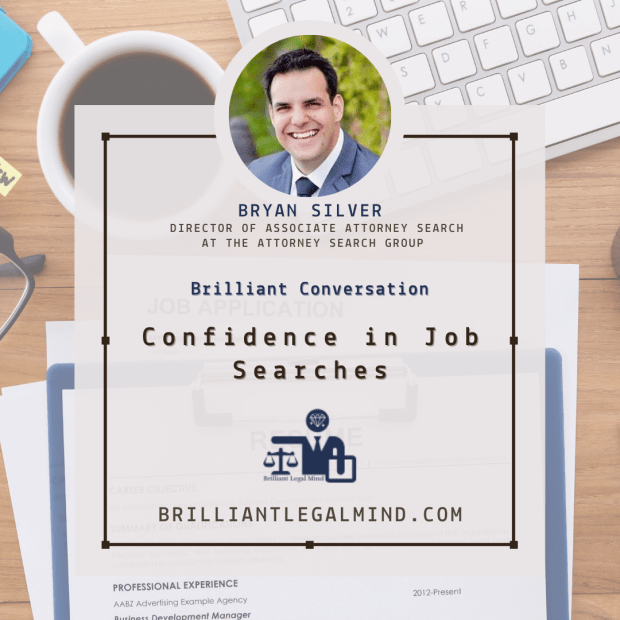
Confidence in Job Searches: Interview with Legal Recruiter Bryan Silver

We are talking about confidence this month on the blog. What does that term mean to you as it relates to the work you do for attorney recruitment?

In terms of my work, confidence means trusting my experience and skills enough to do the work involved in building rapport quickly with the best and brightest BigLaw Mid-Level Associates, and getting them to trust me with their careers.  I have confidence in my communication style that I’ve built over the years that allows me to get along stupidly well with smart attorneys.  I get confidence when I think about the ways in which what I do has significantly helped people. 

I’ve had a candidate get a $110K boost in his base salary.  Others get the mentoring or the adjustment in responsibilities they’re looking for.  Some move to a place where the billable hourly requirement offers an improvement in work-life balance.  I know these things give people meaningful change that they feel both in their careers but also in their lives outside of work. 

The job market for lawyers is really active right now. Does that mean confidence doesn’t really matter or matters less?

It always matters.  Having confidence allows someone to do their best work. Whether they are on an interview, or doing attorney work.  Even if there is an increased demand for talent, the firms and businesses who hire attorneys are still interested in working with the best people.  

Confidence tends to be important for lawyers, but how important is it when searching for a job or transitioning to a new role? Why do you think it is important?

I think it’s very important to appear confident when job searching or starting somewhere new.  The reason that it’s so important is because there is competition for each role.  All that law firm or business cares about is their needs and how to fill them.  They’re interested in hiring the candidate who makes the very best business sense.  The margin between the candidate who gets an offer and the one who doesn’t could be razor-thin. 

I often compare it to the Mr. Olympia Bodybuilding competition.  Can you tell the difference between who wins first and second place?  Me neither.  Your interview might come down to a “photo finish.”  Feeling and appearing as confident as possible will help you achieve your peak performance and make the best possible presentation in an interview.  

Do attorneys looking for new roles care about how confident prospective firms appear? If so, in what ways?

Absolutely.  Attorneys are looking for firms that can help them achieve their goals and solve their limitations.  I deal with candidates who get multiple offers.  They select the firm that best checks their important boxes.  The one that can best be the aspirin to their headache.  The main boxes are money, responsibilities, hours, lifestyle, environment and future career growth. 

How does one effectively project confidence while searching for a job without looking like an arrogant jerk or overselling their abilities? 

Your interview is a sales presentation.  Zig Ziglar said, “selling is caring, and if you care you must sell.”  I think adopting a more positive outlook on sales helps.  Instead of looking at it as something that you do TO somebody, look at it as something you do FOR and WITH somebody.” You don’t want to sell ice to an Eskimo.  You want to sell HEAT to an Eskimo.  You can confidently present that your experience and skills are the solution to the company’s problems.  This is not arrogance.  It’s exactly what the interviewer is hoping to see.  I always remind people before interviews to turn the volume up on their strength and what is unique about them. 

Recently I presented a candidate who mostly did Toxic Tort Defense work to a firm that did more sophisticated complex commercial litigation.  He was worried that his experience wouldn’t be very highly regarded.  I reminded him that they wouldn’t be interviewing him if there wasn’t a serious chance that he could win.  Then I remember saying, “maybe you haven’t worked on Cryptocurrency matters yet, but I bet you’re the only candidate they’re going to meet who speaks English, Spanish and Chinese.”  I learned that the team was divided between him and one other candidate and the final decision came down to the Practice Group lead. 

What practical tips do you offer the attorneys you work with to help them boost confidence to prepare for interviews?

I tell people to do their homework on the firm and the interviewers.  Think of their best skills and plan to tell stories that demonstrate these skills.  I tell people to prepare good questions for the interviewers because asking questions shows interest.  I always suggest that people try to relax and trust their experience.  I liken it to Tiger Woods teeing off on the first hole at Torrey Pines.  When he walks to the tee, he’s not thinking about every little nuance of his swing.  He’s not thinking about his foot position or club-head speed.  Because he’s so well prepared by all of his experience, he’s able to simply approach the ball and swing.  I tell people that no one is going to be able to talk about their experience better than they can, so just approach the ball and swing. 

Bryan Silver leads the national associate division for the Attorney Search Group. In this role, he helps law firms build the best teams and helps associate attorneys accelerate their careers. Bryan grew up in the Philadelphia suburbs. He is an Eagles fan and aims to prove that it is possible to be a decent human being at the same time. After pivoting from a career in digital animation and visual effects in movies, Bryan spent years in a niche sales role, aimed at the legal industry. Outside of work, he enjoys stand-up comedy, baseball games, movies, playing guitar, trivia nights, barbecuing and scuba diving. He lives in San Diego with his Wife, Marie and 5-year-old Twins, Lily and Joey. Bryan has an interest in mindfulness and that’s what led me to connect with him on LinkedIn. He’s a good follow and you should find him there too.

Want to learn more about mindfulness and compassion? Check out my new book, How to Be a Badass Lawyer, for a simple guide to creating a meditation practice of your own in 30 days. And to share mindfulness with your little one, check out my new children’s book, Mommy Needs a Minute.

Like this post? Subscribe to the blog here or follow us on social media:

How Do You Know Which Inner Voice to Follow?

Recently, I came to a startling recognition: I have a somewhat inconsistent view about life choices. On the one hand, I have railed against succumbing to the voice in one’s head so many times that I cannot account for them all. Yet, on the other, I have also said that my life transformed and became much happier when I started to listen to that little whisper inside that told me to try something new. A few weeks ago, it came to me in a flash that perhaps I was speaking out of both sides of my mouth on this one. How could one both ditch the voice in one’s head and yet feel compelled to listen to it to follow one’s bliss?

For me, this flash revealed a paradox more than a cognitive dissonance. I knew from experience that both things were true. The trouble was, though, that I couldn’t quite distill the factors that made them both true. So, I left the question open for a while and sat with it for a few weeks. Ultimately, I concluded that the answer had been staring me in the face all along: life experience was the only real way to tell the difference between the voices in one’s head because experience tells us not just how those voices manifest and feel but also shows us the results of heeding them.

Experience has told me that I have more than one kind of inner voice: the doubt voice and the childlike urge to explore. My doubt voice usually appears in the form of words. It is like a parent that comes to keep me safe and in line. It tries to present itself as the voice of reason but can quickly become abusive at the slightest hint that I may ignore it. The other voice, however, usually isn’t a voice at all. It rarely manifests for me as anything so organized as a sentence. At most, I might get a single word that echoes in my mind for too long. More often, though, I get a sense—just a sense—that I want to try something. It’s like the urge to touch a soft fuzzy blanket just to see what it feels like. If it lasts long enough, my mind may start to offer scenes and imaginings of how this newfangled idea might work. Sometimes my doubt voice may push the idea away as irrational or impractical, but the most powerful ideas come back to me repeatedly when my mind relaxes when I am driving, or exercising, or meditating.

Following the divergent paths my inner voices have offered has produced insights too. The doubt voice invariably tells me to take the road more traveled. In some cases, there is an initial sense of relief when I have decided to let an idea go. What ultimately caused me to stop listening to this voice every time, however, was the recognition that listening to it often led me not to feel safe, but instead cloistered and stuck. Where the voice told me staying with the familiar would help me feel secure, it regularly left me feeling insecure because I kept failing to trust myself. On the other hand, following the childlike urge to explore usually felt more like play. Most of the time I have followed this voice, I would think “I have no idea what I’m doing or why I’m doing it.” I can’t say that this necessarily felt good. In many cases, it felt bad as I worked to create or try something new while my doubt voice stormed in the background of my mind. But the thing was that I didn’t care. It was like I knew I would be proud of myself just for trying even if whatever I did was a total failure and a waste of time.

Unfortunately, I can’t offer anyone a line in the sand that can tell you which inner voice to listen to at any given moment in your life. I can say, however, that awareness of those voices, including how they feel and where they lead, can provide the experience needed to distinguish between the two (or more) inner voices for yourself. A sense of balance and proportion may also serve as a guiding principle for many of us. Lawyers often find themselves guided by the voice of doubt since it is so closely associated with the logic that is our stock and trade. We may, therefore, benefit from time to time in letting another part of our selves take the reins and following those less rational and teleological notions to explore, experiment, and create.

Ultimately, though, the desire to really know the difference between the voices in our head and to have unshakable confidence that we are listening to “the right one” may point to something more fundamental: the reality that we can’t predict the future or totally control our lives. Noting the differences between our inner voices may give us signs to help us make decisions in life, but eventually we just have to let go and give ourselves the grace to make mistakes. Thus, while it may be a challenge to have these competing voices in our heads pulling us in opposite directions, it is not entirely a bad thing.

When we listen to our childlike voice and seek adventure, we may find challenges and a life we never imagined. When those choices lead to mistakes and mishaps, and you can bet that they will, our inner voice of reason may offer us a path to safety and security so that we can heal and recover until we are ready for adventure once again. Perhaps, then, these varying inner voices don’t represent a cognitive dissonance or a fracturing of our psyche at all. Instead, they may just represent the fact that a complete life has many facets and many seasons. In the end, it may not be so important to know which inner voice to listen to in any given moment, as much as it matters that we listen to our inner voices at all.

Want to learn more about mindfulness and compassion? Check out my new book, How to Be a Badass Lawyer, for a simple guide to creating a meditation practice of your own in 30 days. And to share mindfulness with your little one, check out my new children’s book, Mommy Needs a Minute.

Like this post? Subscribe to the blog here or follow us on social media: