Bulldog lawyer. I hear this term all of the time. Clients say that they want a bulldog lawyer. Sometimes I even hear other lawyers request referrals to bulldog lawyers for friends or other contacts. As a mindfulness teacher, I try to remember nonjudgment and that sometimes people use a term without thinking much about all of its implications.
The best lawyers, in my experience, are the ones that fight hard when its appropriate but are otherwise focused on solving problems. This is what I talked about recently with host, Joe Bravo, on the show Candid Conversations with Get Staffed Up.
But I didn’t shy away from this in my response either because I know that mindfulness and compassion don’t get in the way of being an effectively aggressive lawyer at all. To the contrary, as I explain in the interview and in more detail in my book, How to Be a Badass Lawyer, compassion is foundational to this.
To break this down as simply as I can, I offer this logical syllogism.
If you want to check out the full interview, you can find it shared on our YouTube channel or watch it here:
Want to learn more about mindfulness and compassion? Check out my new book, How to Be a Badass Lawyer, for a simple guide to creating a meditation practice of your own in 30 days. And to share mindfulness with your little one, check out my new children’s book, Mommy Needs a Minute.
Like this post? Subscribe to the blog here or follow us on social media:
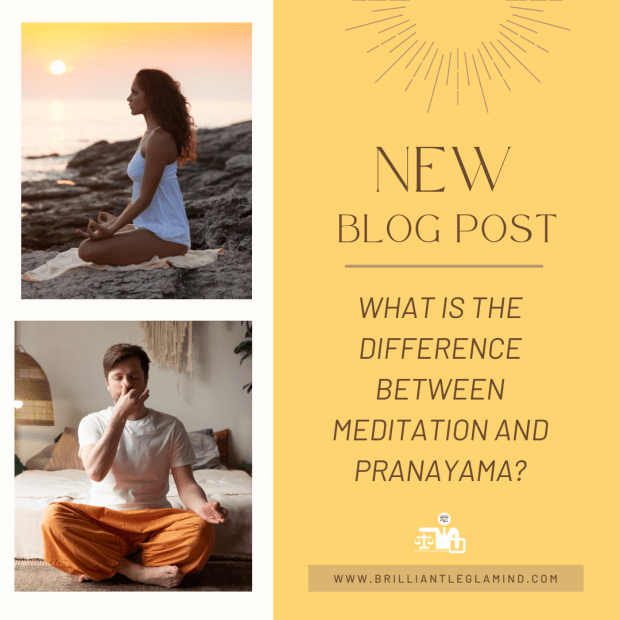
Having taught meditation now for nearly 5 years, I commonly get comments in my sessions with comments about practices that aren’t, strictly speaking, meditation. They will rave about the benefits of box breathing or mention that their therapist/coach/yoga teacher taught them 4-7-8 breathing and it changed their life. I always welcome these comments and express agreement with their efficacy, since getting into technical differences of the practices is not always beneficial.
Even so, questions like these have made me curious about the differences between pranayama and meditation. Because my experience with meditation has primarily been based on practices derived from Buddhism and yoga has never been my first love, I used pranayama very little in my own practice. This summer, I decided to change that and obtained a certification to teach pranayama to expand my knowledge on the subject.
In truth, there are distinct differences between meditation and pranayama and these differences matter. That is not to say, however, that the practices cannot be effectively combined. This blog post will explore the differences to give you context so that you can decide how best to use them both to support your own practice.
Differences
The first notable difference between pranayama and meditation is origin. This issue can be a little tricky, of course, since there are many types of pranayama and many types of meditation. The secular study of both yogic and Buddhist practices and concepts has also led to a the development of further practices that may intertwine some of these ideas further.
The first fundamental difference between meditation and pranayama is breath. Though meditation very commonly involves the breath, focus on the breath is not required for meditation. Practices like loving-kindness or body scan, for instance, don’t use the breath as a focal point and numerous other focal points (such as a mantra, candle flame, sounds, or mental images) can be used in place of the breath. Pranayama, on the other hand, is the practice of working with the breath.
A less obvious difference is that pranayama derives from yogic practices and most of the most popular forms of meditation (Vipassana, Zen, loving-kindness, tonglen, etc.) derive from Buddhist philosophy. This distinction may not matter so much for practitioners who just want relief or a good support, but the different origins shed light on the different focuses of the practices.
Clearly, different teachers and schools of thought can modify this idea, but yogic philosophy is much more concerned with clearing the mind while Buddhist meditation is more intended to make peace with the mind. Thus, Vipassana or Zen meditators are usually encouraged to observe the breath and allow the mind to calm on its own. With pranayama, however, the breath is used as a tool and often manipulated for the purpose of clearing the mind, balancing energy, and creating physical benefits.
Similarities
Though there are differences between pranayama and meditation, they are not entirely distinct and need not always be kept separate. The first thing that pranayama and meditation share are the potential benefits. Because they both address the fundamentals of human life, both meditation and pranayama can result in mental and physical benefits. Done correctly, both practices can help the mind and body sync up and calm down.
Another similarity is that pranayama and meditation go very nicely together. Yogic philosophy deems meditation as one of its eight limbs and so it is not uncommon for yoga classes to feature breath work and meditation. In the same way, many meditation teachers brought up in the Buddhist tradition (myself included) often incorporate pranayama into their guided meditation.
For instance, one way that I began experimenting with pranayama recently is to use it at the beginning of my meditation sessions as a way to quickly ground and relax myself. I have found ujayi breath to be a great tool for reconnecting with the breath due to its physical and auditory enhancements of the breath.
In short, pranayama and meditation are not the same. They have different origins and in many cases the purposes of the practices are distinct. Even so, they both have benefits for mental and physical health and they can complement each other nicely. Now that you understand how the practices are different but similar, the next step is to explore them both and determine what combination of practices work best for you.
Want to learn more about mindfulness and compassion? Check out my new book, How to Be a Badass Lawyer, for a simple guide to creating a meditation practice of your own in 30 days. And to share mindfulness with your little one, check out my new children’s book, Mommy Needs a Minute.
Like this post? Subscribe to the blog here or follow us on social media:
If you start a blog hoping for instant recognition, you are bound to experience disappointment. Even so, it’s nice when recognition comes along.
In 2022, Feedspot named the blog on the 25 Best Lawyer Mom Blogs. The list was recently updated for 2023 and the blog made the list again. You can check out the full list here.
Now, is the blog really a “lawyer mom” blog? Though I didn’t intend that classification when I launched the blog in 2020, I think it’s close enough. The sub-subtitle of my book, How to Be a Badass Lawyer, is “Written by a Lawyer Mom from Kentucky.” That’s because, as I write in the book, my experience with early motherhood is what prompted me to start meditating in the first place.
So, although I consider this blog a “mindfulness blog” first, I will proudly claim the title of lawyer mom blog too. Thanks to Feedspot for the continued recognition and to all the readers who have followed and supported the blog.
Want to learn more about mindfulness and compassion? Check out my new book, How to Be a Badass Lawyer, for a simple guide to creating a meditation practice of your own in 30 days. And to share mindfulness with your little one, check out my new children’s book, Mommy Needs a Minute.
Like this post? Subscribe to the blog here or follow us on social media:
My friend, Tahmina Watson, is one of the most accomplished lawyers I know. She’s an immigration lawyer, mom, community leader, podcaster, as of today, the author of three books, and an avid birdwatcher and photographer. Like me, meditation has been part of what helps her balance all of these demands and interests. In celebration of her latest book, which is released appropriately today on July 4th, I offer this interview to share information about a different style of meditation and a new story showcasing the benefits of meditation for lawyers.
Q. Tahmina, can you tell me a little bit about yourself?
A. I’m an immigration attorney in Seattle, Washington. My firm, Watson Immigration Law, is a boutique firm that focuses on business immigration law, which primarily serves small to mid-size businesses. And within business immigration I have a specific focus on startups and visas. We do a little bit of family-based immigration (parents, spouses, children) and some citizenship work as well. I don’t normally do defense in immigration court, but as a community leader I have volunteered to serve humanitarian interests relating to immigration. I’m also the author of three books, a podcaster, a columnist for Above the Law, a bar leader, and an avid birdwatcher.
Q. How did you become interested in immigration law?
It was very random. I moved from the United Kingdom to be with my American husband, and I really didn’t want to practice immigration law. When I moved from the UK, my UK law degree and experience as a barrister did not mean I could obtain a license to practice in the U.S. I took the New York bar exam because it was the one that I could take without going to law school again. But that limited my practice options to federal law since I lived in Washington State. Immigration matters kept coming my way, even though I said no to it about four times. And then the fifth time I said, Okay, well, let’s just do this.
The first day of practicing immigration law made me realize I wanted to keep going. It’s fast paced and intellectually challenging. I’m touching people’s hearts and minds and lives very tangibly. I can see the results of the work and I’m really helping people’s lives for generations to come. It allows me to work with intelligent people who have ambitious goals of changing the world every day, and that really fulfills me in trying to make their dreams come true.
Q. I know you had a really positive experience with meditation. Can you tell me a little bit about your practice and how you got started with it?
Political turmoil over the last several years has created a lot of stress in my law practice. It was overwhelming to be able to practice law, serve my community, be a mother and a wife, and do all the things I do. I was stressed and the stress kept building. And I didn’t really know what the answer was, but I considered meditation even though I wasn’t really sure what it was. I used the Insight Timer app on my phone informally and as needed for a while and that was an entry point for me. But, I had a few incidents where I realized I really needed to have a more robust meditation practice.
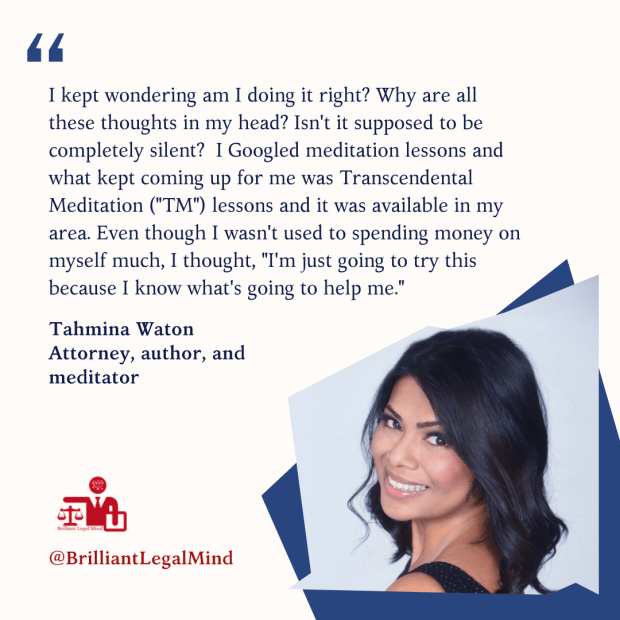
I kept wondering am I doing it right? Why are all these thoughts in my head? Isn’t it supposed to be completely silent? I Googled meditation lessons and what kept coming up for me was Transcendental Meditation (“TM”) lessons and it was available in my area. Even though I wasn’t used to spending money on myself much, I thought, “I’m just going to try this because I know what’s going to help me.” And I also realized that if I didn’t do something about it for me, I would not be able to help my children learn how to manage their own stress.
One of the things that initially concerned me was how do I even find time to go to this training? Because I think one of the things that we all think about is we don’t have time to do extra things, but I put it on the calendar and I attended all of the classes. The TM method recommends two 20-minue meditation sessions a day. Though I confess that I still don’t have that second meditation block, but my first meditation block has served me very well.
Now, once I went through the training, I had to find that 20-minute block of time for practice through trial and error and trial and error. It took me about nine months, believe it or not, to find that practice time. Where was my space? Where was my time? Where was the moment that I could actually have that block without somebody bothering me or a kid jumping in and saying I need this or a client calling or an email popping up? Where was that? I eventually found solace in my parking garage, where it was dark but I have come to cherish that time. So it became my practice of doing TM 20 minutes a day, first thing in the morning after dropping my child off at school.
Q. For those of us who don’t do TM, can you explain procedurally what the practice consists of and how you use the practice in your life?
TM starts with completing a questionnaire with the trained teachers. Based on your answers, they assign a mantra (word or small phrase) that is unique to you. You’re not supposed to share it. When you sit down to meditate you’re supposed to repeat that mantra over and over again. It doesn’t mean that the monkey mind won’t wander, but when it does you come back to your mantra. The mantra is almost like the guiding force for you. The practice method is very simple; you sit down for 20 minutes and repeat that mantra in your head.
Q. What did you do to bring your meditation practice back or shift it to make it work for your life as it is now?
I think what happened during COVID, and we all experienced it, was that suddenly our lives changed. Suddenly there were two kids having school in my house and my husband and I figuring out how to practice law at home. This made it challenging to find a quiet time in the house again. At first, I actually started to stand on my deck and just be outside and we take a few moments to take some deep breaths and that allowed me to really be out in nature. Eventually, I began waking up earlier in the day before the kids woke up so I could resume formal meditation practice. I have gone through various iterations, but I had been able to finally incorporate meditation back into my life with a daily practice of 20 minutes or getting outside. Sometimes my meditation is walking outside in nature and sometimes I do TM for 20 minutes.
Q. How does meditation help you balance everything?
When I was working on one of my books, I was already waking up early to meditate and had to get up even earlier to get in some time for writing. Once I got on this routine established, I didn’t want to break the chain that developed. I continued with that early morning rising and that’s how I would incorporate my meditation first and then my writing. This was never a perfect schedule and sometimes I slept in, but meditation for me was a constant.
Even if it was only a few minutes, meditation became the foundation to continue to be calm and proactive and not reactive, but reflective. And that helped with everything around me. It helps me stay steady when the clients are anxious because their lives or their livelihoods are at stake. Like me, they are often high achievers who are naturally anxious people. And I didn’t really realize how much anxiety I was taking on with each anxious client. But then I realized this meditation was my shield, but also my mirror for them. And so the meditation is really the beginning and end of everything I do, because it’s the foundation to be able to handle as much as you know, that life throws at me all you when I believe that’s how you are able to deal with everything.
Want to learn more about mindfulness and compassion? Check out my new book, How to Be a Badass Lawyer, for a simple guide to creating a meditation practice of your own in 30 days. And to share mindfulness with your little one, check out my new children’s book, Mommy Needs a Minute.
Like this post? Subscribe to the blog here or follow us on social media:
As you might imagine, I am a disciplined person. I’m a lawyer. I meditate regularly. I work out every day. And I have managed to keep this blog going for nearly three years. Strangely, though, I have not written a single post extolling the virtues of discipline when it comes to meditation.
Why this blog doesn’t emphasize discipline for meditation
Even so, I have not outright talked about discipline itself. Why? It’s not that I don’t think discipline has a place in mindfulness practice or in life. Far from it. In fact, I love the thrill of building things over time through daily work and commitment. It’s the way I have built my law practice, mindfulness practice, this blog, and wrote my book.
To be sure, discipline is important. I don’t talk about it on this blog much, however, because this blog is directed at lawyers and professionals. Most lawyers and professionals have plenty of self-discipline. In general, my readers are motivated, self-directed, and hard-working. Therefore, if I wrote frequently about self-discipline, I would be preaching to the choir.
So what traits are important for meditation?
In doing so, I would not be offering what I think my audience really needs. Many of us who start exploring mindfulness do so because we want change or maybe balance. Quite often, when we start to seek like this, we have no clue what we really need. We start looking and we hope a new practice might expand our horizons.
If you want more ease in life, is discipline the way to get it?
If change is our goal, this doesn’t really make sense. And, if balance is the object, why would we keep leaning so heavily on a skillset that is already so robust? Now you may be seeing my point. This is why I don’t talk a lot about self-discipline. You have self-discipline. You have tons of it. Trust me.
Don’t try to tell me you don’t just because you haven’t been able to make meditation a habit yet. Based on my experience meditating for a decade and teaching mindfulness for five years, too much self-discipline is the impediment—and not the key—to a long-term meditation practice for many lawyers.
To get something new, try something new.
You read that right the first time but go back and read the preceding line again if you don’t believe me. Lawyers and professionals have loads of self-discipline. They explore mindfulness and meditation because they are looking for something else. They are looking for a new way of living life and practicing law.
This way of life doesn’t throw self-discipline out the window. Instead, what mindfulness can do for lawyers is counterbalance their self-discipline with wisdom, self-compassion, real honest to goodness rest, and a newfound connection to their bodies and emotions. Sure, to find these things, some level of self-discipline is needed but most lawyers and professionals have more than they need to get started with and maintain a mindfulness practice.
Okay, of course some level of discipline is needed for meditation.
By now, though, your lawyer brain may be kicking in and you may be thinking that I’m full of it because isn’t deciding to learn a new skill and committing to it long enough to really try it out discipline? Sure, some of it is discipline. As I said, discipline is involved. But it’s not the most important thing you need to maintain practice.
Do you know why? One reason is that self-discipline (willpower) gets tired. It is easily worn out. That’s why people often struggle to get motivated to meditate. Because sticking to a plan takes energy and energy quickly wears out. This is why other human traits are more important for a solid meditation practice. These include an open mind, courage to face pieces of yourself you have long overlooked, and self-compassion.
Why is too much discipline be a bad thing in meditation?
Next you may be wondering why I bring this up at all? Why would I devote a blog post to tell you what you don’t need to start or keep meditating? I wrote this post because discipline or the alleged lack thereof is what many lawyers complain about when they tell me that they struggle to meditate. In reality, I don’t believe a lack of discipline is really the issue.
Instead, self-judgment and unrealistic expectations about a how a practice is “supposed” to be are more often the real culprit. Since discipline alone can’t be relied on to get you to the cushion or yoga mat, why not try something else instead? How about curiosity? Or kindness? What about hope for a better life or deeper connections with yourself and others? These are the real reasons many lawyers start meditating in the first place even if they don’t know it when they start.
Bottom line: lawyers may benefit from other traits more
Lawyers don’t start meditating to cultivate more discipline because they don’t need more discipline. They explore mindfulness in pursuit of a happier life with more freedom, deeper connections, and less stress. If this is your aim with meditation, then consider it as an opportunity to practice new skills and cultivate new habits.
You get plenty of practice with self-discipline in your daily life. For greater peace, balance, and ease, let go of your grip on self-discipline a little bit and consider practicing skills like patience, self-kindness, the capacity to rest, and joy in your meditation practice instead.
Want to learn more about mindfulness and compassion? Check out my new book, How to Be a Badass Lawyer, for a simple guide to creating a meditation practice of your own in 30 days. And to share mindfulness with your little one, check out my new children’s book, Mommy Needs a Minute.
Like this post? Subscribe to the blog here or follow us on social media:
If you do guided meditations or yoga, you are bound to be instructed to “check in with yourself” at some point. Most commonly, teachers use this as a starting point for a mind-body practice because it makes sense to start the practice where you are. The only problem is, of course, that not all teachers offer additional guidance to tell us how to check in with ourselves. This post is offered to clear up that mystery.
For those who know about interoceptive awareness, checking in with yourself may be the norm. But if you have never heard the word “interoceptive” before, then some additional explanation may be needed. The term interoceptive means awareness of your inner experience. While this might be second nature to many of us, it may feel weird and new to those of us accustomed to living busy and worldly lives. When someone instructs you to “check in with yourself”, they are telling you to activate and note your interoceptive awareness.
This gives you a general idea about how to begin checking in with yourself, but you may still need to know specifically where to focus. Ideally, when you check in with yourself, you can scan your mental, emotional, and physical states. First, this would require a pause and then a simple acknowledgement of the physical sensations, emotions, and thoughts that may arise for you.
Now, if you are new to this process, it may be challenging at first to interpret what you note in your interoceptive awareness. You may not immediately be able to put words to sensations or clearly identify all emotions. That’s okay. The point isn’t to self-diagnose on a deep level, but instead just to touch in with your inner experience and see what’s there. If you stay open-minded and make the practice of checking in a habit, you’ll soon notice patterns that will help you understand more about what your mind, body, and emotions are telling you.
Why is checking in important? If you are using it at the start of your meditation or yoga practice, it may help you understand what kind of practice you need. Do you need a rigorous practice or a gentle one? Do you need to stretch yourself or give yourself a break? Do you need a specific focal point or can you just rest in open experience? When you can more regularly note where you are, you are more likely to give yourself what you need and have a better experience with practice.
In much the same way, making a habit of checking in with yourself throughout your day is a great way to manage your energy levels and needs so you can be proactive about self-care. This may help you head off emotional reactivity caused by fatigue or hunger or notice the signs of loneliness, anxiety or growing anger. You can do this by briefly pausing for a few breaths, scanning through your body, asking yourself “how do I feel,” and listening to what arises.
My favorite way to check in with myself is first to look for rushing or pushing forward. If I notice it, I try to pause or intentionally slow down. Then I do a quick body sweep by scanning for sensations in the most emotionally reactive parts of my body: eyes, brow, jaw, neck, shoulders, hips, and hands. If there’s tension, I scan my mind and emotions for clues about what’s going on with me. This usually takes about twenty to thirty seconds at most but it’s enough time to change the way I’m relating to my day and myself.
The important thing about checking in with yourself, however, is not the procedure you follow but the habit of checking in regularly. One of the reasons that mindfulness practices can be so transformational is that they create mental space to check in with your inner experience regularly. Now you know what the teachers mean when they tell you to “check in with yourself” at the beginning of your guided meditation or yoga practice. You can now use these steps to check in with yourself to improve your meditation experience and bring more awareness to your life.
Want to learn more about mindfulness and compassion? Check out my new book, How to Be a Badass Lawyer, for a simple guide to creating a meditation practice of your own in 30 days. And to share mindfulness with your little one, check out my new children’s book, Mommy Needs a Minute.
Like this post? Subscribe to the blog here or follow us on social media:
On a blog about mindfulness, the title for this post may be surprising. I have touted the benefits of meditation for more than two years now and explained myriad meditation practices. Nevertheless, I seem to be admitting here that meditation is not a solution for all problems.
To be perfectly clear, I am not merely seeming to make this admission; I am freely and fully admitting it. Meditation is not always the answer. Over the last ten years, meditation has served so many purposes in my life that I probably couldn’t account for them all if I tried to compile a list. It was foundational to personal growth and healing and it has served as the hub for developing other useful habits, like exercise.
Even so, one of biggest power moves I made in my meditation practice was learning when meditation wasn’t the answer. Ironically, this happened because cultivating mindfulness helped me pay more attention to what I needed and what practices supported me best in different situations.
To help support your own discernment in this manner, here is the list of situations in which meditation is not my first go-to practice.
1. Too Much Energy.
If I am feeling physically energetic, the last thing I want to do is sit for an extended period of time. This could be because I am experiencing stress or anger or even excitement. When you pay attention, you may notice that all of these states create physical energy in the body. My experience has taught me that it works better to go with the energy rather than fight against it. For me, this usually means I need some form of movement.
So, when I feel too jittery, I don’t push meditation. Instead, I take it as an opportunity to get my workout done for the day. If I am strapped for time, I may take a brief walk or do a quick stretch. This is not a hard and fast rule, but using up energy when I feel amped up is using mindfulness as self-care even if I choose not to meditate in that moment.
But when the energy is high–signified by the volume, amount, or quality of the thoughts–I don’t meditate first. Instead, I have experienced greater relief and clarity from letting the thoughts go in other ways. The option that is most convenient and fully within my control is writing. I will write or type out any thoughts that come to mind for a few minutes just to get them out. If you aren’t a writer, you can also just say the thoughts out loud or do a voice memo if you don’t like talking to yourself.
If you’re lucky, you may end up writing something pretty darn good. Regardless, there’s no need for you to show what you write to anyone or even look at it again yourself. The point here isn’t to create a perfect monologue but just to get some distance from the thoughts. When the thoughts are spiraling hard, I use this strategy first before I meditate.
I have struggled with this in the past because I had the seemingly logical but misleading idea that talking about a situation wouldn’t help. While sadly true in many cases, this thought is misleading. There is more than one way to address a problem. You can address the root cause or the symptoms. Even if talking with a confidant won’t solve the problem, it may help you handle the symptoms.
Meditators may also have the idea that they need to learn to handle their emotions by themselves. This too is misleading. While it’s empowering and commendable to develop skills for emotional self-care, knowing when to seek support from others is part of that skill set. Sitting in meditation is one great part of your toolkit, but when emotions approach overwhelm seeking social support may serve you better.
4. It’s Time for Action.
Meditation helps you get clarity about a lot of things, but the practice in itself won’t create any change unless conduct follows. Sometimes in mediation practice, you may experience difficulty because you recognize things that need to change. Perhaps you feel regret or guilt because of something you did. Or perhaps you notice real hurt or difficulty in your life that being busy in life had allowed you to overlook.
Meditation practice is intended to cultivate present moment awareness, but if we let it, it can also cultivate wisdom too. Sometimes that wisdom is trying to tell us we need to take action out in the world. If I recall a recent situation and feel strong feelings of guilt, self-compassion may help me in my meditation practice. But in my life, a conversation with the affected person and an apology will serve me better.
If you are reeling from a personal loss, mental health challenge, or major life decision, meditation may also not be ideal (at least on its own). For those new to the practice, trying meditation in such circumstances may just add stress to life. Even very experienced meditators may struggle with the practice in challenging life circumstances. In short, sometimes it makes more sense to focus on cultivating stability in our lives before or instead of cultivating mindfulness in meditation practice.
In short, though I stand by my years of proclaiming the benefits of meditation, I admit that the practice is no panacea. If you practice meditation long enough, you are bound to see that other supports may be more helpful to you in certain situations. Thus, as you work to cultivate mindfulness in your life, never forget to develop self-compassion and wisdom too. Meditation is there as a practice to support a good life and it’s a good thing that it’s not the only one.
Want to learn more about mindfulness and compassion? Check out my new book, How to Be a Badass Lawyer, for a simple guide to creating a meditation practice of your own in 30 days. And to share mindfulness with your little one, check out my new children’s book, Mommy Needs a Minute.
Like this post? Subscribe to the blog here or follow us on social media:
It’s World Meditation Day today, a day to raise awareness about the practice of meditation and its benefits. To honor the day, I’m sharing four new guided meditations with a variety of practices and a range of times. These meditations are the recorded companions to the practices offered in my book, How to Be a Badass Lawyer.
As the book explains in more detail, these practices are offered to help you build a regular meditation practice. They offer a variety of practices so that, over time, you can better understand your body, mind, and emotions. With this foundation, you should have the basic skills needed to do the dynamic and transformational practice of loving-kindness. In addition, they range in time so that you can gradually build up your tolerance for meditation practice.
Keep reading to learn more about and try each practice.
Breath Focus Practice
Most meditation practitioners and teachers start with the breath and there’s good reason for that. It’s always with you and the breath is the link between body and mind that can reliably help you calm down. This means that getting comfortable with your breath and being able to use it as a tool is not just helpful as a resource for meditation practice but also a good tool for life. If you need help finding your breath, read more here.
But if you are ready to go, check out this 5-minute practice to get started.
Body Scan
One thing that can get overlooked when it comes to mindfulness is that the body is an essential part. Mindfulness of thoughts is only one aspect, but the body is a link that can help us cultivate awareness even of thoughts. Why? Because contemporary life invites us so frequently to reside in our heads and ignore our bodies.
Body scan is a practice that can help us get reacquainted with our bodies. It is a simple practice that many consider deeply relaxing. You systematically feel the sensations in the body. This is a practice that can help you understand how to take better care of your body (i.e. recognizing signs of stress or physical needs), relax and rest, and understand your emotions better.
To try this 10-minute practice, check it out here.
Joy Practice
Now, I bet you are wondering why I would tell you to practice joy. I have good reason. Did you know that, from a stress standpoint, the body doesn’t necessarily differentiate between what we consider positive emotions versus negative emotions? Thus, if we get more understanding and tolerance for positive emotions, we can understand all of our emotions better.
For many lawyers and professionals, though, positive emotions are the easiest ones to overlook. We are busy and expect good results so we may gloss over accomplishments and peaceful times because we are habituated to handle crisis situations. When we focus on joy, we heal and nourish ourselves and we cultivate emotional understanding at the same time.
Try this 15-minute practice, which incorporates breath and body work as well here.
Loving-Kindness
The final practice in the book is my favorite: loving-kindness. It is a practice where meditators focus on the body, usually the area around the heart, and wish others well. Though you may not think wishing will do a lot, research says otherwise. This practice is associated with reduced stress, improved relationships, and may even lead to more ethical conduct.
You can modify the practice to support your needs and goals and I have a guide here that can help you do that. This 20-minute practice, however, includes the traditional people, groups, and phrases. You can check it out here.
To learn more about the practices and how they fit together, check out my book, How to Be a Badass Lawyer. Good luck with the practices and please reach out if you have any questions.
Like this post? Subscribe to the blog here or follow us on social media:
The American way to start any new healthy habit is to scour the internet for the best gear. When it comes to meditation, this isn’t really necessary. As I have explained before, you can meditate in any position that makes you feel safe, supported, and comfortable.
This means you can meditate sitting, standing, lying down, or even walking. You can use a comfy chair, your bed, the floor, some nice cushions you have around the house, including some you use for restorative yoga, a porch swing or rocking chair, a parked car, or my personal favorite, the bath tub.
Though I have meditated in a variety of settings, it has been supportive to my practice to designate a particular spot as the one I use for regular practice. My spot is a little corner in my bedroom tucked away behind a large wardrobe. In it, I have my meditation cushion, a light blanket, and access to an outlet so that I can use my phone for guiding or sounds when I need it.
If you look on Pinterest, however, you can quickly overwhelm yourself with images of decked out meditation spots chock full of Mandalas, smiling Buddhas, incense, and LED lights. To the extent that this makes your practice more pleasant and you enjoy decorating, go for it. But a meditation space that would make an influencer blush is not really necessary, especially if nobody will see it but you.
Assuming you are into utility like me, what you really want from a meditation spot is something that offers support, creates comfort, and engenders focus. In general, then, you’ll want a large, flat layer to provide warmth and cushion for your ankles and knees in the sitting position. Then you will want something on top to lift the hips and support the natural curve of your back. This is to ensure that you have a clear airway to make breathing as easy and restful as possible.
This is the point of the meditation cushion, which commonly includes the zafu and zabuton. The zabuton is the large flat cushion, typically filled with a cotton-like substance and the zafu is a smaller pillow (often round or crescent-shaped) that is usually filled with seeds, beans, or buckwheat hulls. If you feel more comfortable in a kneeling position, you can get a similar result from using a meditation bench with a mat or blanket under your legs and knees.
These days, it is easy to find meditation cushions and benches online in a variety of colors, materials, and shapes. If, like me, you hate scouring the internet for products, I bought my zafu and zabuton from Still Sitting about 10 years ago and I can report that their name is accurate: I’m still using it. I went for the crescent-shaped zafu with a buckwheat fill because it fits my body better. Due to an old knee injury, I also added an extra mini zafu for some support under my right knee.
Can you achieve the same level of comfort with items you have around the house? Very likely. A few layers of old blankets, a folded yoga mat, or flat pillows could double for a zabuton. A sturdier and smaller cushion, a bolster, or yoga blocks could work for a zafu.
In short, you don’t truly need a meditation cushion or bench to start a meditation practice. Ideally, meditation is something you bring into your life and don’t only use in one spot in your home. Even so, a designated spot is a great way to turn meditation into a habit and a quality meditation cushion can support the body to help your mind focus and relax.
Thus, if you are really new to meditation, I would not recommend spending a lot of money on new gear. Once your practice becomes regular and you can sit for more than a few minutes each session, a cushion may be a great way to support your meditation practice and invest in it long-term.
Want to learn more about mindfulness and compassion? Check out my new book, How to Be a Badass Lawyer, for a simple guide to creating a meditation practice of your own in 30 days. And to share mindfulness with your little one, check out my new children’s book, Mommy Needs a Minute.
Like this post? Subscribe to the blog here or follow us on social media:
It was a busy week but a great week for me. I got to celebrate Well-Being Week in Law in several different ways.
First, I got to present on mindfulness and confidence for a law firm. The session was well-attended and the engagement from the audience was excellent. I shared how mindfulness can help build confidence because it can help you break down fear and doubt into component parts and learn strategies to care for each aspect.
Well-Being Week in Law Event Number 1
On Wednesday, I connected with Kristin Tyler, a founder of LAWCLERK Legal and a long-time friend of the blog, and coach and one of my co-authors from the book #Networked, Olivia Vizachero, to discuss mental health in the legal profession.
We discussed everything from strategies for time management and reducing decision fatigue to the practices that support our personal and professional well-being. It was a fun conversation and I was so proud that LAWCLERK chose my book, How to Be a Badass Lawyer, as a giveaway item to support attorney wellness.
You can watch the recording of event here on YouTube:
Well-Being Week in Law Event Number 2
For my last event of the week, I came back home. Specifically, I did a brief talk and guided meditation for my local bar association. I’m a proud member of the Northern Kentucky Bar Association Lawyers Living Well Committee. I talked about how to manage the early phases of meditation practice when you may not immediately feel calm and relaxed. In the guided meditation, I focused on ways to learn to practice relaxation and rest.
To listen to the talk and try the meditation, check out the recording of the event here:
Did you do any special activities this week? Leave a comment to let us know what you tried.
Want to learn more about mindfulness and compassion? Check out my new book, How to Be a Badass Lawyer, for a simple guide to creating a meditation practice of your own in 30 days. And to share mindfulness with your little one, check out my new children’s book, Mommy Needs a Minute.
Like this post? Subscribe to the blog here or follow us on social media: