5 Healthy Ways to Handle Emotions as a Lawyer

Cover image for blog post with title "Five Healthy Ways to Handle Emotions as a Lawyer"

The first question I ever asked a mindfulness teacher showed how uncomfortable I used to be with my emotions. In the Zen tradition, you get an opportunity for an interview with the teacher when you go on retreat. I was totally unprepared for this on my first one so I asked the question at the top of my mind: is it okay if I cry when I meditate?

In not so many words, the teacher kindly explained that, yes it was perfectly healthy for emotions to came up during meditation. She wisely didn’t push me too hard to examine why I had asked the question at all and let me figure out that more fundamental issue for myself. In retrospect, I now know that the question isn’t whether it is okay to cry during meditation.

The better question is why did I ever think it was a problem in the first place?

Emotions Are a Part of Healthy Life and Mindfulness Practice.

As I eventually discovered, I had been making some assumptions about my mindfulness practice and myself. I had assumed that meditation was about being calm. To dive a bit deeper, I had generally assumed that I should be in control of my emotions. When I reacted in ways that I didn’t expect, it didn’t feel healthy. Instead, it seemed to signal a problem.

In years of practice, I have come to learn that mindfulness is not about being calm. Instead, it is about being as you are. A perceived lack of control over emotions isn’t the problem either. Usually, the problems arise when we fight against that lack of control.

Even so, lawyers are in the position where we often must modulate and monitor our emotions to do our jobs. How can we do this in a healthy way? Here are the five strategies rooted in mindfulness and compassion that I use.

Image listing the five healthy ways to handle emotions with mindfulness as shared in the blog post

1. Give Your Emotions time.

Emotions sometimes have deeper meanings and sometimes they don’t. One of the best ways to tell the difference is to give yourself a moment to watch them and see what happens. The first thing you will notice if you can let emotions be is that they don’t last very long. In themselves, the bodily sensations often last about 90 seconds before resolving or changing to something else.

So, if you can pause for a few breaths, let your body settle, and give your brain a chance to catch up, you may understand better what your emotions are trying to tell you. If nothing else, you’ll be present for yourself in an authentic way and remember for a moment that you are a human being who is affected by the world and that’s not entirely a bad thing.

2. Give Your Emotions Space.

As you give your emotions time, it also helps to give them space. What I mean by this is a few things. First, don’t force a conclusion right away. Don’t immediately put your emotions under the microscope. Don’t demand an explanation. Remember that emotions are feelings and they are not necessarily logical, so don’t judge or add on extra baggage that doesn’t need to be there.

Second, it also means to let yourself expand around the emotions. Sometimes big emotions can feel overwhelming. In those times, I find the breath helpful as a tool to help me feel a sense of expansion as I make space for emotions. Strong emotions can also push us to contract around them, so the practice of allowing them to float (not pushing them away or reacting to them) is a way to honor our emotions while avoiding rash and potentially harmful actions.

Image from blog post sharing quote about mindfulness practice that says "meditation is not about being calm. It is about being as you are in any given moment."

3. Move to Release Your Emotions.

Meditation is excellent for some emotions, but I find movement more helpful for dealing with the energetic ones like anger, frustration, or nervousness. After years of practice, I can sense when I am too keyed up to meditate. In those situations, I take a walk, do a strenuous workout, or put my energy to good use by doing yard or housework.

The movement helps me to avoid ruminating about the situation and, even if I don’t get full clarity by the end of the activity, at least I did something good for myself or completed a chore. I also use this strategy when my calendar or case load give me reason to anticipate strong emotions. I make a point of working out before difficult depositions or important presentations.

Even if short, I take walks or do some stretching or yoga the weeks I am in trial. At their heart, emotions are sensations which is energy. Movement can make you feel physically better and discharge some of that extra energy, so it is a great response to emotional surges.

4. Share Your Emotions.

Lawyers sometimes must remind ourselves that we don’t have to handle everything on our own. As an introvert, this is true for me. When things are awkward, I tend hide them or try to fix them before anyone notices. Eventually I learned, though, that all the self-care strategies in the world are no match for the loved ones in my life.

The reason is that our emotions can easily get mixed up with shame. Sharing our experience with those we trust is the most effective way to counteract shame. In many cases, our loved ones or trained professionals can’t change the situation or even offer wise advice. They can, however, remind us that we aren’t alone and our feelings matter and that is valuable.

Image of blog post post author with quote that says "The healthy way to deal with emotions as a lawyer isn't treating them as a problem, but instead embracing them as a part of the human experience."

5. Care for Your Emotions.

The first few strategies emphasized some distance from one’s emotions to build stability in the midst of turbulence. Ultimately, though, practice with your emotions may reveal the truth that you can’t and shouldn’t try to become aloof from them.

One amazing thing I have seen repeatedly is that compassion emerges when we feel suffering, whether it is our own or someone else’s. This isn’t to say you should always take on suffering or never use strategies to help yourself get distance when needed. It is to say that feeling our emotions and treating them like they matter is essential.

This means being present for and accepting of ourselves even when our emotions are inconvenient, irrational, or uncomfortable. This doesn’t mean we always act based on our emotions, but it does require dropping the pretense that we can somehow rise above them.  

Law practice is a rational, logical, and competitive. If we are honest, though, it’s also highly emotional, intuitive, and relationship based. Emotional intelligence is not merely about recognizing emotions in ourselves and others. Because of the toll that law practice can take on legal professionals, it is also essential to learn strategies to honor and care for our own emotions. This is not just true because it can help you maintain or improve solid performance at work, but also because you are a human being and your lived experience matters.

Image with quote from the blog post that says "Emotions help us remember that we are human beings affected by the world and that's not entirely a bad thing."

In short, the healthy way to deal with emotions as a lawyer isn’t treating your emotions as a problem, but instead embracing them as a part of the human experience. Coming from someone who used to struggle mightily with this, I know that this takes patience, trust, and effort but these strategies derived from mindfulness and compassion can help.    


Want to learn more about mindfulness and compassion? Check out my new book, How to Be a Badass Lawyer, for a simple guide to creating a meditation practice of your own in 30 days. And to share mindfulness with your little one, check out my new children’s book, Mommy Needs a Minute.

Like this post? Subscribe to the blog here or follow us on social media:

Noticing “Why” Questions Can Help You Be More Present in Life

Nonjudgmental awareness is the goal of most meditation sessions and cultivating it is the goal of most meditators. Teachers will tell us to “just notice what’s there” instead of getting lost in our reactions. But, for us lawyers, this is not an easy feat. We are trained to judge, evaluate, and appraise. Clients pay us and specifically ask for our reactions. This means that our jobs incentivize us to automatically react to any situation we encounter.

If we could easily restrain this tendency to our work lives, we perhaps wouldn’t have any need for meditation. Most of us are not that fortunate, however, and we may find ourselves lost in judgments instead of present in our lives, whether in or outside of work. Even so, the habit of reacting to our experiences in life rather than experiencing life directly is deeply ingrained. How on earth can we start to undo it?

For most of us, this will be a gradual process and it won’t do much good to simply resolve to stop reacting so much. But, in my years of meditation practice, I have found one simple thing that has helped me: being watchful of “why” questions. You may have never thought about this before. Asking “why” questions as a kid probably helped make you the smart, talented person that you are. And, to be sure, a sense of curiosity is actually a good thing for most of us trying to make meditation a habit.

When I tell you to watch out for “why” questions, I’m not saying to dispense with your inclination to explore. I’m actually saying the opposite. I’m recommending that you notice how the “why” questions come up for you. In many cases, you may find that they aren’t questions at all, but instead are implicit judgments about your situation.

For example, if you can’t focus on your breath in meditation, you may ask yourself “why is this so hard for me?” Implicit in that question are several latent assumptions: (a) that meditation shouldn’t be hard; (b) that meditation shouldn’t be hard for you; (c) that things in general shouldn’t be hard for you; and (d) that failing to focus on the breath means you are doing something wrong in your meditation practice. With questions like this, the word “why” is an illusion that suggests that there is an easy answer out there that we are missing, but in most cases in life there isn’t one. When we notice this pattern of speech, it can help us see a pattern of our mind to judge.

Even when we are using “why” in the exploratory sense, paying attention to how it arises for us can help us uncover less obvious judgments. Let’s shift the example above to a less overtly judgmental question like “why do I do this?” That may seem fairly innocuous, but even here the question still implies that (a) the thing you keep doing is wrong or a problem to be solved; (b) the thing you are doing is part of a pattern with a singular cause; and (c) the solution to the problem can be discovered through logical reasoning. Sometimes things fit those descriptions, but often in life they don’t. When we narrow the focus of inquiry too much with a pointed “why” question, we can miss some of what life experience is trying to show us.

So, what’s the answer here? It is literally in the question. Once we have started to become aware of all the “why” questions we ask about our lives and our practices, we can then start to ask something more fundamental: what. Instead of asking ourselves “why” things are the way they are, we drill down on the facts of what is actually taking place. Much like refocusing our attention on the breath when the mind wanders, the “what” question brings our mind back to reality instead of getting lost in theories about causation.

My experience with this shift has produced a paradoxical result. The more I have learned to ask “what” in my life and meditation practice, the more that the “why” questions became irrelevant. When I focused with more intention, clarity, and precision on the facts and situation before me, I implicitly understood the “why” or realized that the “why” wasn’t as important as I had previously believed it to be.

Not only did becoming skeptical of “why” questions help me become aware of my judgments, it also helped me understand that I couldn’t take a short cut to get to understanding about myself or the world. Instead, the only way to get that understanding and all the peace and happiness that came with it was to stay rooted in the realities of what life and the world really was.

There isn’t a quick and easy way to become less judgmental in life. It’s a deeply ingrained habit for most of us and it will take time and practice to change. Even so, noticing how we use the word “why” may be one small thing we can do to bring awareness to our habits of judging and reacting to life. Training ourselves to ask “what” instead–even when we think we already know–may help us come back to presence with life exactly as it is.

Want to learn more about mindfulness and compassion? Check out my new book, How to Be a Badass Lawyer, for a simple guide to creating a meditation practice of your own in 30 days. And to share mindfulness with your little one, check out my new children’s book, Mommy Needs a Minute.

Like this post? Subscribe to the blog here or follow us on social media:

Mindfulness Basics: How to Find Your Breath

Breath practice is what many people think of when they think of meditation. The instructions seem simple. You are supposed to focus on your breath and return–ideally without mentally flagellating yourself–to the feeling every time your mind wanders. But as soon as you sit down to get started, you may be greeted by the somewhat disturbing recognition that you have no idea how to find your breath.

This may be shocking since, presumably, you’ve been breathing your whole life. You may think, “how can I not find my breath? I just had it a minute ago.” You may feel as foolish as that time (or in my case all those times) you rushed into the grocery store for a quick purchase and realized you didn’t pay attention to where you parked your car. Sigh.

In truth, this may be a collective sigh. Many of us have trouble finding our breath, or at least settling on a focal point that works for us, at first. In my view, if you notice that you aren’t quite sure what it means to focus on your breath, that’s actually a good sign.

It means you are starting to slow down and you’re noticing things you never noticed before. It means you are starting to ask questions about experiences you previously ignored or overlooked. That’s one of the critical benefits a meditation practice can offer, so you should be encouraged by it instead of discouraged.

Reading not your thing? Listen to our video here.

Beyond this, the reason it might be hard to find your breath is that there isn’t any right answer. When you are told to focus on your breath, most teachers mean to focus your attention on the sensations of the breath coming in and going out. The sensations are the thing and not the thoughts or judgments about it.

Different teachers, however, recommend different focal points. Some traditions instruct students to focus on the tip of one’s nose to feel the flow of air in and out. Others recommend focusing on the feeling of rising and falling in the chest or belly as the air fills your lungs. Which should you choose?

My recommendation is to start with the place that calls out to you the strongest and stick with it. When I started meditating, I focused on my nose because one of the first books I read about meditation recommended that. I struggled immensely with this. For me, the sensations of the breath just weren’t very strong at the tip of my nose.

When I finally went to a Zen retreat, I asked the teacher and she said she focused on her belly because she wanted “to get as far away from her head as she could.” I liked that answer a lot and tried focusing on my belly. Voila! Problem solved. My practice got much easier and my mind started unconsciously settling on my breath as I went about my daily tasks.

Does this mean that the belly is a better focal point than the nose? Not in my opinion. What it means is that the belly is a better focal point than the nose for me. For anyone new to meditation, I recommend focusing on the area that is strongest so you can get your practice started without much struggle. In the early stages, the important thing is to establish a habit and do what helps you focus and doesn’t discourage you.

Once your habit is established and you know your mind and body a little bit better, you can branch out and explore. In fact, if you use guided meditations, you will probably end up doing this automatically because some teachers will direct you to focus on different aspects of the breath.

Breath practice is an excellent place to start when you are first learning to meditate. It is infinitely scalable so you can start with sessions as short as 1 to 2 minutes and grow your practice to lengthier sessions over time. In addition, the breath is an ideal focal point for meditation because it is always “with” you.

Lawyers today lead busy, active, and mobile lives, but no matter where you are or what you are doing, you can pause for a bit of mindfulness during your day to calm yourself and refocus on the most important issues in any given moment. Once you have developed a comfort level with breath practice, you can use it to begin exploring other types of mindfulness practices that can help you in your practice and in your life.


Want to learn more about mindfulness and compassion? Check out my new book, How to Be a Badass Lawyer, for a simple guide to creating a meditation practice of your own in 30 days. And to share mindfulness with your little one, check out my new children’s book, Mommy Needs a Minute.

Like this post? Subscribe to the blog here or follow us on social media:

Grounding Practices Can Catch You When You Feel Untethered

When I was preparing for my first ever appellate oral argument, I remember a swirl of questions flurrying through my mind. What if the panel is hostile to my position? What if they don’t like my presentation? What if they ask the dreaded question that exposes the fatal weakness in my case? What if they ask a question that I just can’t answer? When you prepare for oral argument, these questions are normal and can even be a healthy part of preparation. But, ideally, they settle down before you walk up to the podium and say “may it please the court.”

I love oral argument and always have. Answering questions on the fly is fun for me. I did 3 moot courts in law school because I loved it so much. Today, when I have an argument or present to an audience, I fear a cold panel much more than an active one. So, it came with some surprise when I did my first oral argument years ago and I was more nervous than I expected. It was a straightforward argument, and my brief was strong. But still, standing in the lush but austere chambers of the Sixth Circuit made me feel shaky and out of control. So, what did I do?

I walked to the podium and placed my hands down. As I was awaiting a cue from the bench, I felt my feet on the ground and let the weight of my body stabilize me. Having made a conscious choice not to mentally flee the experience, I began my argument and gathered momentum along the way. A few minutes in, I got questions from the judges that made it clear to me that I had already won so I made the best choice I could in that situation: to quit while I was ahead. I made a conclusion, ceded my time, and sat down to watch opposing counsel try to fight off blows from the panel on rebuttal.

In retrospect, I now see that I had little reason to feel nervous. We got a favorable ruling days later that indicated that the judges had no trouble accepting my arguments. But I was still super proud of my work and not just because it was my first victorious appellate oral argument. Instead, I was proud that I stayed present for the whole experience and didn’t let my nerves get in the way of seeing facts in the moment so I could react skillfully to them. If I had not been paying attention, I could easily have plowed onward in my argument, unnecessarily risking raising dangerous issues or annoying the judges. Because I had managed my nerves, this didn’t happen and I didn’t lose any of the ground I had gained with my brief.

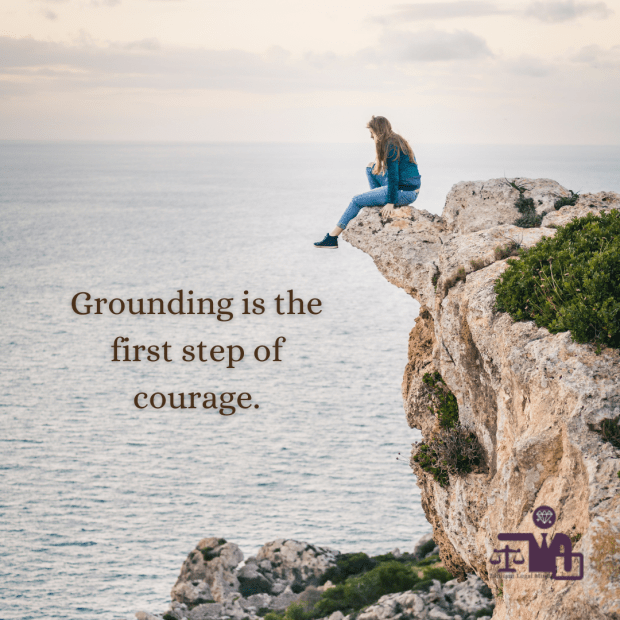
That’s what grounding can do for us lawyers in times of stress. Grounding is a practice of feeling the physical sensations of the body and most commonly emphasizes the sensations of being rooted to the earth. Most grounding practices suggest feeling the weight of one’s body or the contact that one’s body (such as the rear end, back, or feet or even hands on a podium) with the earth or other stable object. When emotions are high, this strategy works on a practical level because it helps us find stability when things seem beyond our control. It also helps us minimize the impact of a mind churning with thoughts that usually only serves to increase our anxiety. On a psychological level, though, grounding is the first step of courage.

When we root into our physical experience, we say “yes” to it on a fundamental level. We make a conscious choice to stay with whatever experience arises instead of retreating into the dark recesses of our mind. By rooting into our experience and feeling whatever is going on in our body, we implicitly tell ourselves that we can handle whatever uncomfortable emotions may come as we do.

In doing this, we open our minds up to what is actually happening in the situation, rather than merely seeing our preconceived judgments or being blinded by the things we fear. In a situation like an oral argument, where a single question could change the course of a case, clear awareness is critical. But the same is true for so many other areas of our law practices and lives. To be sure, our ability to be fully present affects the way we interact with clients so that they learn to trust and rely on us. It affects our ability to care for ourselves as we deal with the risk, time pressure, and stresses of law practice. And, it affects our ability to show our loved ones that we care for and support them in life.

So, if you experience a time in law practice when you feel unsteady, resist the urge to judge yourself or panic. Instead, it may be more effective to just find steadiness. Fortunately, no matter where you go (on earth at least) the force of gravity is always connecting you to your bodily experience as a human. Look for that sensation by feeling the weight of your body in the chair or your feet on the floor. Pause for a moment and rest in the feeling. Though it may seem like a small thing, this first, tiny act of courage may be all that you need to stay present, see clearly, and react with wisdom and skill to whatever life sends your way.

Want to learn more about mindfulness and compassion? Check out my new book, How to Be a Badass Lawyer, for a simple guide to creating a meditation practice of your own in 30 days. And to share mindfulness with your little one, check out my new children’s book, Mommy Needs a Minute.

Like this post? Subscribe to the blog here or follow us on social media:

Love Interval Training? Why Not Try It with Your Meditation Practice.

I previously wrote about how much I love Power Zone training and shared the lessons it taught me that could easily apply to life and meditation practice. Interval training, such as Power Zone, is an effective way to train the body and build physical fitness because it taps into the benefits of both high intensity efforts and periods of rest.

When it comes to meditation, intervals may not be the first thing we think about because we may view the entire practice of meditation as a rest period. But, for new meditators especially, meditation can be challenging since most of us aren’t accustomed to relaxing and because it may put feelings and thoughts that we’d rather avoid front and center. Thus, while meditation is a practice that can ultimately help you deal with stress in life more skillfully, the truth is that it takes effort and discipline.

Why Intervals in Meditation Are a Good Idea

For this reason, it might actually help you to think about incorporating some rest periods into your meditation practice. I first learned about this idea years ago on a meditation retreat I attended. During one of the afternoon sessions (which are the the toughest for me because that’s when sleepiness sets in), the teacher reminded us to rethink our approach to meditation.

He explained that, while we often designate a time period to meditate due to our busy schedules, we can play with the structure of our practice. In particular, he had us try a period of 4 minutes of meditation with alternating 1-minute stretch/movement breaks.

Interval Training in Contexts Besides Meditation

When I heard this, I instantly thought of all the HIIT (high-intensity interval training) cardio classes I’d done. With this style of exercise, you do short bursts of high impact exercise followed by lower impact, active recovery periods.

Of course, what the teacher at the retreat was proposing was actually “LIIT” or “low-intensity interval training.” I soon discovered that it was, indeed, quite LIIT. After several long periods of meditation that day, it was a breath of fresh air just to try a new way.

Why Does This Matter for a Meditation Practice?

It matters because, as with fitness, meditation practice is destined to run into roadblocks if you do it long enough. You may have injuries or illnesses. You may have mental resistance. You may just not feel like it. You may still be developing the skills needed to support a practice.

Sometimes it helps to keep going if you free yourself of the mental constructs you’ve created as to the “way” you are “supposed” to do it. As one example, I usually try to get 30 minutes of meditation a day.

When I ran into a bad patch a while back where I just didn’t feel like it, I committed to 5 minutes a day. I often ended up sitting for longer because, by the end of the 5 minutes, my resistance had passed. More significantly, though, I still have a practice today.

Sometimes a Meditation Practice Needs Adjustment

On the other hand, I have also had times where I needed more than my normal 30 minutes a day to work through particular stresses in my life. The problem, though, as I have learned with years of practice is that I tend to have diminishing returns when I practice for longer than 30 minutes.

My feet fall asleep, my knees and back hurt, and I tend to be so low on energy that I am almost asleep. In those times, I have instead broken up my long sit into two shorter sessions of 20 minutes with a few minutes to stretch in between. The results were much better and more helpful for me than trying to power through just 1 session of 45 minutes.

Meditation Should Work for Your Life

And that’s the point, isn’t it? The point isn’t to have an ideal practice. It isn’t to have a practice that competes with anyone else’s. The point is to have a practice that serves your life.

So, while discipline is certainly part of any good practice, don’t put your practice in a box. If there is one thing my practice has given me, it is an awareness of the dangers of all or nothing thinking.

Sure, 4 minutes of meditation may not be as “good” as 5 minutes, but it is way better than 0. More significantly, recognizing that 4 minutes might serve me better than 5 minutes on a given day is practicing self-compassion and self-awareness which, as a lawyer, I constantly need to practice.

Consider Trying Intervals in Your Meditation Practice

So, if you are struggling to find the time to meditate or have a hard time sitting still for very long, perhaps you should consider adjusting the way you are doing it. Think about where you are in your life and, with kindness and generosity towards yourself, try a new way.

That’s what the meditation teacher was saying when he told us to try intervals: don’t let your mind get in the way of your meditation practice. To do this, you have to factor in your body and heart along the way. Low intensity interval training for meditation is just one way that you could balance your practice to help your mind, while acknowledging the whims and needs of your body and heart.


Want to learn more about mindfulness and compassion? Check out my new book, How to Be a Badass Lawyer, for a simple guide to creating a meditation practice of your own in 30 days. And to share mindfulness with your little one, check out my new children’s book, Mommy Needs a Minute.

Like this post? Subscribe to the blog here or follow us on social media:

Meditation Is About the Practice and Not the Session

New meditators commonly worry whether their practice is doing anything for them. They often say that they struggle to sit still, experience a deluge or thoughts and emotions, and do not feel calm at all. Most teachers (including me) would say that this is normal and that the practice gets easier over time. But new meditators may wonder how this could be? How could it be that meditation sessions can feel so difficult–even painful at times–but can still be expected to impart the benefits of peace and calm over time?

I struggled with this initially too, until I remembered one important thing: the goal of meditation was not to get “good” at meditation, but rather to help me build a better life. When you are new to meditation, the practice can be alarming because it is likely your first close encounter with your mental chatter, bodily sensations, and emotions. Most lawyers today have active schedules and numerous demands on our time and attention. This means that we can easily just not notice what is really going on in our minds, hearts, and bodies.

Meditation can be so disorienting because all those distractions are removed, so we can experience our inner lives more directly. While this can be scary at first, over time we can learn to be watchful of judgment and harshness with ourselves. We can train our minds to rest in the sensations of the body and use the breath as a tool to focus and calm ourselves. And, we can watch and learn how a flurry of thoughts, emotions, and feelings can subside if we give ourselves enough time.

In this way, the struggles in early practice may actually be skill-building exercises. This is not to say that all struggles in practice should be handled on one’s own or that more sitting is always the answer. Individuals who have experienced trauma or who experience severe emotional or physical pain should always care for themselves first and seek out help from a trained professional, teacher, or loved ones. But, for many new meditators, the struggles in some meditation sessions are where the benefits of awareness, compassion, equanimity, and calm originate.

As an example, I experienced a great deal of physical pain on my first retreat because I had been accustomed to sitting only for minutes, as opposed to hours a day. My body hurt and that, in turn, made me sullen, irritable, and doubtful of myself and the practice. Eventually, the pain got so bad that I had no choice but to skip a sitting session so I could do some yoga in my room to try to feel better.

On the next session, I found myself much improved and I not only completed the retreat but was mentally present for the instruction and benefitted from it. The lesson from this, of course, was that I couldn’t expect my mind to grow when my body hurt. To be sure, this is a basic insight, but how often do we lawyers ignore the demands of our bodies because some other demand seems more important? Over the years, this lesson has helped me remember to care for myself first instead of always pushing through it and this has drastically improved my life.

This is why famed teacher Joseph Goldstein directs students not to evaluate one’s practice by one’s experience while meditating. Instead, he tells students to consider whether their lives are improving by considering whether they are rushing less, ruminating less, aware of their feelings and the feelings of others more, experiencing fewer physical signs of stress, and are happier. Even though I still experience difficulty in my meditation practice, I continue to meditate because all of these things have been true for me.

In short, the value of meditation comes from the practice itself and is not dependent on one’s experience in any single meditation session. While struggles during mediation are difficult to experience, those difficulties can help us build critical skills or examine detrimental habits, including judgment and harshness. Just like law, meditation is a practice because it never really gets easy. There is always room to grow, room to learn, grow, build skills, and better understand life and oneself. If you don’t get discouraged by poor experiences in individual sessions, the practice of meditation can help you create that room in your own life.

Want to learn more about mindfulness and compassion? Check out my new book, How to Be a Badass Lawyer, for a simple guide to creating a meditation practice of your own in 30 days. And to share mindfulness with your little one, check out my new children’s book, Mommy Needs a Minute.

Like this post? Subscribe to the blog here or follow us on social media:

Scrooge, “Not Self”, and the Holiday Lesson It Offers Us All

If you are interested in meditation or have studied Buddhism, you may know the concept of “not self”, but I bet you’ve never considered what that has to do with Ebenezer Scrooge. Of course you haven’t, but bear with me because they are connected and there’s a holiday lesson in it for you. “Not self” or anatta as it is called in Pali is an intractable idea to understand and, at first, can even be disturbing. The idea generally posits that there is no permanent, lasting self. So when you first hear or read about it, you may react “wait, is this saying I don’t exist?” and start to spiral in doubt like Descartes.

But, with practice, you see the concept isn’t so scary. I remember on one of my first retreats thinking to myself how the experience of being on a retreat—where I was discouraged from talking or engaging with others—was a chance to put my identity down for a while. A little while later, I noticed that I could do the same thing—even if for only a few minutes—any time I meditated. And then, with a bit more practice, I saw the real truth: I could put my identity—or the story surrounding it—down any time I was sufficiently aware and made the choice.

In truth, I always had the ability to see a story created by my reaction to a life event and wiggle my way out of it. It’s just that, most of the time, things moved too fast (or I moved too fast) to see it. On those occasions where I saw it and chose how to respond instead of merely reacting, it felt like magic. So the concept of “not self” when we start to experience it, is actually not as scary as it sounds. Instead, it can be extremely liberating and empowering. And this is what brings us to Scrooge.  

I’ve never been the biggest Dickens fan, but I have a soft spot in my heart for A Christmas Carol. Dickens’ stock characters can make you cringe and his love of describing scenes can be overbearing. But Scrooge has been special to me for the last few years because I feel like I am one or at least was one. No, I’ve never proclaimed “Are there no workhouses?” (except ironically) and I’ve historically supported nonprofits, rather than hold onto my gold like a dragon in a cave.

But I had my own bad habits that I let calcify into an identity and one that was not very happy. Early in my law practice and as I was starting my family, I was plagued by overthinking and doubt. I wasn’t sure I could make it as an attorney. I wasn’t sure of my ability to network and make friends. For a few years, I basically hid out. I billed my hours and focused on myself and didn’t engage as much with the world as I really wanted to. I didn’t hoard my money from the world, but I hoarded my heart and personality and talents because I didn’t believe in them all the way and didn’t trust the world to accept me.

Amazingly, I was visited by some ghosts in the form of a difficult pregnancy, post-partum depression, the anxiety of never moving my career forward, and crippling loneliness. Those challenges forced me to learn to take care of myself, be compassionate with myself and others, and examine how I was living my life. When I did that, I changed what I did. Rather than withdraw, I started showing up, figuratively and literally. I joined (and even led) some organizations. I showed up to events. I reached out to old friends and invited new ones on adventures. I followed the things I thought were fun and learned to do things just because I enjoyed them. All of this happened after I started a meditation practice which helped me to become aware of my thoughts and learn which ones to follow and which ones to let go.

As this was happening, I heard someone mention A Christmas Carol at a business event and the idea took root in my mind. I bought the audiobook at Thanksgiving that year and have made it my personal tradition to listen to it every year to prepare for the holidays. Each year I listen, I notice something new. But this year, I listened and immediately thought “Oh, this is a great example of ‘not self.’”

And it is. What else could show us better that there is no permanent self than a story about a man who was dead inside one day, but brimming with life the next? How else are we to reconcile the potential for a man to ignore the needs of his assistant, Bob Cratchet, and buy him the prize turkey the very next day? We tell ourselves “people don’t change” and that may often be true. But stories like A Christmas Carol say they can. And so do stories like mine and I know I am not alone.

Of course, we all know the reality that people don’t change easily, but the fact that we can is a miracle. Our identities can sometimes feel solid and make us feel powerless and stuck. But we can examine our past and bring in compassion. We can explore the impact of our actions in the present and face the hard truths of where we are going wrong. And we can consider the paths that our present behavior may be leading us to in the future. When we do those things, we can get off the train tracks of identity and take the road less traveled to choose our steps more wisely.

We often think of A Christmas Carol as a man learning not to think about himself so much, but that only captures a part of the magic in that story. Yes, Scrooge did indeed become less selfish, but he did it only after he became more self-aware. When Scrooge finally started (with prompting from the ghosts) to think about himself, and to examine all of his self’s permutations over time with clarity and compassion, he was finally able to break out of the mold of identity. He was no longer a “squeezing, wrenching, grasping, scraping, clutching, covetous, old sinner”. He was no longer as dead inside as Jacob Marley. He was alive and ready to walk among the living again because, through exploration, he saw that his conception of the self was an illusion and he could just start living a different life—one that was not full of thin gruel, perpetual cold, solitude, and “Bah! Humbug!” And I can tell you from experience that when you see this in your own life, you will definitely feel “as merry as a school boy” and as “giddy as a drunken man.”

So as we go about looking for holiday miracles, it’s always great to think of ways to be less selfish and more focused on others. But don’t neglect the other piece of the puzzle. Routines turn quickly into habits. Habits turn over time into identities. And identities—these selves we make in our mind—can sometimes block us off from the good and prevent us from doing good out in the world. So don’t just ignore your “self” at the holidays, explore it a little too. Reflect with compassion on who you’ve been, who you are, and where you’re going and don’t ignore those demons who may be there to prompt you along. By seeing the limits of the “self”, the boundaries between you and the rest of the world may start to fade away and your spirit can reemerge. And that would be a holiday miracle indeed.

Want to learn more about mindfulness and compassion? Check out my new book, How to Be a Badass Lawyer, for a simple guide to creating a meditation practice of your own in 30 days. And to share mindfulness with your little one, check out my new children’s book, Mommy Needs a Minute.

Like this post? Subscribe to the blog here or follow us on social media:

Discomfort Is the Food of Meditation Practice

I know you started meditating because you want more calm in your life. I know you are looking for peace. You want to not fight things in life so much. You want to stop overthinking everything. You want to be kinder, gentler, and just better. But there’s this problem.

You don’t feel calm when you meditate. Your mind won’t shut up. Your knee hurts. You keep thinking of painful memories or, worse, frightening fantasies of things that will never happen. You fall asleep. You can’t sit still. You think that you and your meditation practice are doomed.

Discomfort Is Not a Sign You Are Doing Meditation Wrong

Guess what? All that stuff doesn’t mean you can’t meditate or benefit from meditation. Instead, all that stuff is meditation practice. At least, it’s the food of meditation practice. Yes, you read that right. The nasty, uncomfortable, and sometimes even gut-wrenching crap that comes up during meditation practice is all part of it. While this may be disappointing news, at least you know you aren’t doing something wrong.

Sometimes when people talk about meditation they can convey the idea that it’s magic. We see people sitting calmly and we want that calm ourselves. So, we think that if we just do the thing they are doing we will get calm too. What we don’t see is all the crap and inner shenanigans that person had to wade through to find that calm.

Meditation Is Not Magic; It’s Practice.

Meditation isn’t magic; it’s practice. Tell me something. How do those basketball players sink game-clenching free throws in the final seconds of the NCAA tournament? Do you have some illusion that they are just naturally calm?

Clearly not. They have practiced free throws so much that even the situation can’t shake them. In the same way, you aren’t going to find real calm and stability in meditation practice until you work on your free throws. Those free throws are learning some skills as you encounter the unpleasant bits of life. 

Image with quote that says "meditation isn't magic. It's a practice."

Dealing with Discomfort Is Part of Meditation Practice

It works like this. You get distracted and, instead of getting mad or disgusted with yourself, just focus back on the breath. Right there, you practiced restraint, self-kindness, and persistence. Or maybe your knee hurts and you feel the pain for a moment and watch how it affects you. In that case, you practice mindful awareness, holding space, and patience.

If a painful memory arises and you can let yourself sit with it, you practice self-compassion, awareness, and courage. And maybe you just fall asleep or are lost in thought the whole meditation session and you laugh it off. You know what that’s practicing? It’s practicing being human and imperfect and still being worth the effort to try again.

The Hard Stuff Is How You Build Skills in Meditation

Do you see my point here? All the so-called “bad” stuff that happens during your practice is not a distraction from the practice. It feeds the practice because it forces you to build the skills you need to handle the hard parts of life. It doesn’t mean there’s something wrong with you or your practice. It means that life is imperfect and so are we.

The practice of mediation can help you experience, though, that perfection isn’t required for a good life. Instead, it can help you learn how to create a good life by bringing joy and kindness to even the hard parts of life.

Image of a person meditating with a quote that says "Sometimes meditation is practicing being human and imperfect and still being worth the effort to try again."

Self-Kindness Is Essential to Meditation Practice

Don’t get me wrong. I am not telling you here that any problems in meditation practice should simply be powered through or that you can manage all turmoil that arises in your practice on your own. Sometimes you have to give yourself permission to move during your practice, to take a break, or to rely on your community, teachers, or trained professionals for help.

But I am saying that struggle in meditation is a normal part of the practice. If you give yourself time, patience, and kindness as you encounter those struggles, they can teach you and help you build the skills to live a calmer, gentler, happier life.

Discomfort in Meditation May Be a Sign You Are Doing Meditation Right

So, when you start to meditate, and you find too many thoughts, physical discomfort, and all the judgment your mind can muster, don’t be surprised. The struggles of human life don’t magically disappear when you sit for a few moments and focus on your breath.

But, if you can learn to sit long enough and watch those struggles arise and fade away, you can start to see them as the very substance from which calm, happiness, kindness, and presence can grow. The challenges that arise during meditation aren’t problems in your practice; they feed your practice.

Image with quote that says "perfection isn't required for a good life."

Want to learn more about mindfulness and compassion? Check out my new book, How to Be a Badass Lawyer, for a simple guide to creating a meditation practice of your own in 30 days. And to share mindfulness with your little one, check out my new children’s book, Mommy Needs a Minute.

Like this post? Subscribe to the blog here or follow us on social media:

5 Ways to Rethink Meditation If You’re Worried That It’s Woo-Woo

Image of lawyer struggling to meditate with title of blog post: 5 Ways to Rethink Meditation If You're Worried That It's Woo-Woo

As someone who writes and speaks publicly about meditation, it may surprise you to learn that I did not tell anyone—anyone—when I started meditating. At first, I didn’t know whether the practice would work for me or what I hoped it would help me find.

It was a weird little thing I did because I’d read some books and articles and I was so stressed and bogged down with overthinking that I was willing to try anything. But meditating seemed like a break from my personality—driven, logical, intense, goal-oriented—and so, I suppose, it seemed like a deviation even for a few minutes to do nothing with no particular goal at all.

Why would I risk people thinking I was weird or worse woo-woo for something that was admittedly out of my character and might not even work?

If You Worry about What People Might Think about Your Meditation Practice, You Aren’t Alone.

Of course, for me, it did work and that’s when I started to tell other people in my life about it. I first admitted to my husband that I wasn’t actually “napping” but instead meditating when I asked him to mind our daughter so I could have some quiet for a few minutes.

I then raved to a few friends and family members I could trust about how much it helped. Some had questions but nobody responded with judgment. So, eventually, I started writing and speaking about it and I was astounded to find that other professionals, colleagues, and even clients supported me and shared their own struggles with mental health or experience with meditation.

My experience has shown me that meditation isn’t woo-woo at all (or at least it doesn’t have to be) but many people tell me that it remains a stumbling block for them. With that in mind, here are my tips for processing the issue if you want to meditate but are nervous about being woo-woo.

Image of lawyer meditating in her office with a graphic of a social media post that says "You don't have to explain your meditation practice to anyone."

1. You Don’t Have to Explain Your Meditation Practice to Anyone.

I write and speak about meditation because it helped me and I think it could help others. But you have no obligation to talk to anyone else about your self-care practices. In fact, you may find benefits from keeping your practice to yourself. Meditation is about learning to be with yourself, so it stands to reason that keeping your practice to yourself may give you the space to let the practice work its magic. In addition, letting your practice be your own little secret for a while may make it more appealing because either it can serve as your own haven from the world or it may make you feel like some secret, rebel, meditating badass. In short, you don’t have to share your meditation practice with anyone else until you are ready, which includes fully processing your concerns about it being woo-woo.

2. Drop the Baggage about Meditation Being Woo-Woo.

To be fair, some people think meditation is woo-woo because there are so many ways to meditate. Religious traditions can attach practices like chanting and incense that can make some people feel excluded.

Some secular figures have used the practice of meditation as an affectation to virtue signal or demonstrate their own spiritual superiority. And some others for their own personal reasons like to add things like crystals or intense affirmations to a meditation practice and those things might not appeal to you.

Guess what? There is no monopoly on meditation. Just because some people do their practice in one way doesn’t mean that you can’t do it in your own way.

Image with quote from blog post that says "Many symbols and images that you associate with meditation and make you think it's woo-woo are not essential to the practice."

There Are Many Ways to Create a Meditation Practice.

While I consider myself a spiritual person, I am also a deeply practical one. I frankly don’t have time for crystals and incense. My brain rejects affirmations, flowery language, and theatrical voices with great fervor. And, though I find chanting builds a sense of community when meditating in groups, it feels awkward to do it on my own. So generally, my practice is straightforward: I sit, I breathe, I notice sensations in the body, and I let the thoughts and feelings and distractions come as they may.

When done in this way, the practice of meditation isn’t weird at all. It’s simple, practical, and has been shown by research to be effective. So, one way to get over the worries about meditation being woo-woo is to consider what images, symbols, or cultural influences you think are intertwined with the practice of meditation. When you remember that the practice of meditation can be very simple, you may be able to drop some of the baggage that makes you feel it is mystical or strange.

3. Change Is a Little Bit Woo-Woo.

If you are exploring meditation, the odds are that you want some kind of change in your life. Though new things can scare us a little, it’s hard to get change without being open to new things.

Even though meditation might scare you because it is different, that different approach, outlook, or way of thinking may be exactly what you need. In other words, the fact that meditation may seem strange to you at first is not necessarily a bad thing.

Image of notebook with writing that says "Is meditation woo-woo? Change is a little bit woo-woo."

Remember that it is normal and common to feel uncomfortable at first when you start any new practice or learn any new skill. This doesn’t mean you can’t or shouldn’t do it.

Doubt Is Normal in Meditation and with Change.

Though your mind is bound to ask questions like “Is this right for me?” or “do I really want to get myself into this?”, you don’t have to answer those questions right away. Only experience can give the answers to those questions.

The good thing about meditation is that it encourages you to take note of your present activities, the thoughts in your mind, and the feelings in your body. If it’s not right for you, you’ll know. But if it is, you might just get the change you set out to find.

4. Is Woo-Woo Really the Issue?

Sitting and watching my mind for a number of years has taught me that the mind is a tricky thing. It won’t always be straight with you about what it’s trying to do. Sometimes the mind comes up with stories or doubts to keep you from looking at things that scare it.

As human beings, we don’t always want to get up close and personal with our habits and patterns. Those things can make us feel pain, regret, or even shame. They can push us into new situations and raise feelings we’d long since buried. Cleary, I can’t tell you whether that is true for you. But, it’s at least worth it to consider whether the whole “woo-woo” issue is even the issue at all.

Image of incense and candle with a definition of "woo-woo" from the post which says "A word used to describe something as weird or strange which may be unjustified and could be covering for a fear about a totally different issue."

Are you really worried about the practice being weird or looking weird to others? Or is your mind a little afraid of losing control? Are you a little afraid of changing or seeing that you need to change some things in your life? None of those fears deserve judgment.

They are all deeply human and normal. Most of us know, of course, that making life decisions based on fear usually doesn’t make us happier. So, if the concerns about meditation being woo-woo are coming up for you, one thing to ask yourself is whether that concern is masking something else.

5. So What If Meditation Is Woo-Woo?

If all of these strategies still don’t help, there’s always the catch-all line from grade school: so what? Let’s say you give meditation a try and you end up loving it. You go crazy with it and you woo-woo it up. You chant, burn incense, add crystals, bells, and mandalas and you love every bit of it. You learn that you’ve had a secret woo-woo persona lying in wait your whole life just dying to get out.

So what?

Do these new tendencies mean you can’t be a good lawyer? Do they mean you will no longer be a tax-paying productive member of society? Do they mean you will have no choice but to grow your hair long, find a drum circle, and go live on a commune? I really doubt that they do.  

Image with quote that says "What if meditation is woo-woo? So what? What does that mean?"

Explore the Doubts about Meditation Being Woo-Woo

This isn’t to say that your concerns about meditation and questions about your identity don’t matter. They matter a lot. But, by asking “so what” to the concerns about being woo woo, you are not letting the label of woo-woo and the attempt to avoid it decide what you do in your life. Instead, you are considering the meaning of that label for yourself, assessing its veracity, considering whether it fits you and what you are doing, and deciding if it’s a deal-breaker or not.

Isn’t that the way we lawyers handle problems every day? Our clients present us with a set of facts and raise concerns and we don’t throw up our hands and give up. We study the facts, try to uncover and root out assumptions, and then we decide what approach to take.

Decisions about what practices might serve our mental and physical well-being deserve at least that much attention.  So don’t let labels or vague worries get in your way if you want to meditate, instead ask what those labels and worries are about and you may just learn something interesting about yourself in the process.

Conclusion: Don’t Let Doubts about Meditation Being Woo-Woo Get in Your Way.

In the end, I can’t tell you whether meditation is woo-woo or not. Meditation practices are varied and unique and what qualifies as woo-woo to one person may just be normal to another. My point here, though, is only to demonstrate that the concerns about whether the practice of meditation is woo-woo, weird, or strange are really a starting point instead of a dead end.

Doubts are a normal part of life, especially for us lawyers who are habituated to valuing our time highly and trained to think critically about everything. Though the practice of meditation may seem new and different to many, research indicates that it could offer your life and law practice many benefits.

The only way to know for sure, of course, is to try it out with an open mind and heart. So don’t let doubts about being woo-woo get in the way. Examine that label and your doubts and focus instead on building a life that you want to live with whatever practices serve you best.


Want to learn more about mindfulness and compassion? Check out my new book, How to Be a Badass Lawyer, for a simple guide to creating a meditation practice of your own in 30 days. And to share mindfulness with your little one, check out my new children’s book, Mommy Needs a Minute.

Like this post? Subscribe to the blog here or follow us on social media:

Mindfulness Can Help You Stop Rushing and Feel Like You Have More Time

The first book on meditation that I ever read was Mindfulness in Plain English by Bhante Gunaratana. The book had lots of practical tips that served me well when I started a meditation practice in earnest, but the text wasn’t quite as plain as it claimed to be. Gunaratana kept talking about how meditation can help you create space between you and your thoughts. I understood this as a concept but I had no clue what it meant in practice. In fact, the idea itself seemed counterintuitive, since my initial experience with meditation felt like being smothered by my thoughts, instead of creating space around them.

Even so, I pressed on because my mind had been running for so long that it felt like a relief even to take a brief pause just to watch the wheels spin. By the time I worked my way up to 10 minutes of meditation a day, I noticed a variety of spaces emerge in my life that I had never set out to find: I stopped rushing so much. In particular, I noticed my tendency to rush regardless of whether I was dealing with real time constraints.

For example, I used to be in a big hurry every time I went to the grocery store, racing around and grabbing items as if I were on a game show. Rather than prizes, this habit had usually only given me frustration when I had to stand in line or got caught behind someone walking too slowly. Soon after I started meditating, however, a magical voice from nowhere said “What’s your rush?” as I was briskly walking past the gliding doors. At the time, my daughter was just over a year old so time to myself—even running errands—was a rare and precious thing. I slowed down, strolling through the store with ease, gazing with interest at the lovely produce, and even chatting at check out with the clerk. I came home in a good mood, rather than a bad one.

Now, this isn’t to say that my tendency to rush doesn’t come back. It comes back to me all of the time. On one meditation retreat, I realized that I was rushing even in my meditation because I would force myself back to focusing on the breath the second I noticed my thinking. In addition to making me laugh heartily at myself, this also helped me realize that giving myself the time to see what thoughts had emerged would let me have the insights that vipassana (aka “insight meditation”) was supposed to produce.

Not only can rushing make us less aware of our lives, it can also cause us to behave less ethically. This was demonstrated by a famous study of seminary students who were told that they had to give a lecture across campus on, of all things, the Good Samaritan story from the Bible. Some of the students were told that they were late and others that they had plenty of time to get to their talk. The students were set up to pass a victim in need of assistance and, by a wide margin, the students with time to spare stopped more often to help. The conclusion from this is clear: time constraints—even pretend ones—can cause us to forget our higher ideals (and perhaps be totally oblivious to irony too).

This truth of this study is borne out by my life experience. In my small grocery store example, one of the other things that happened was that a petite woman asked me (I’m 5’11’’) to grab a product off a high shelf for her. Do you think she would have felt comfortable doing so if I looked stressed out and grumpy? Probably not. In that case, the absence of rushing on my part freed me up not just to feel better myself but also help someone else. This happened to me in more significant ways as my practice evolved. I was more likely to ask how other people were doing, to check in on friends I hadn’t seen in a while, or to plan ahead so that I had the ability to work fun and meaningful events with friends and family into my schedule. Over time, the reduction in my rushing made me feel less like I had no time, so I realized that, in fact, I had the time to do things I enjoyed, such as writing, or cooking or going to meditation retreats, even while practicing law and raising a family.

Now, if you are a litigator like me, you may think that rushing is somewhat predestined by the aggressive and deadline-ridden nature of our law practice. But, even here, I have found that being mindful of rushing is beneficial too. I try not to delay responding to emails to keep cases moving, but I give myself time if I need to craft a response. I definitely give myself time if the email is at all aggressive and irritating, as emails from lawyers can sometimes be.

I also take the time to be sure clients are on board with case management and that they feel supported and like their voice is being heard in the process. In addition, because I am more aware of how stressful time constraints can be, I am more proactive about managing cases and deadlines with clear communications so that the work gets done with as little human misery as possible. Sometimes there is no way around a hard deadline and you just have to work like hell to get the project done, but that only makes it all the more necessary to develop a habit of paying attention so that you don’t fall into the all too human habit of treating all deadlines that way.

In the years since I started meditating, I have experienced the space that Gunaratana promised in numerous different ways. Though it seemed to have little to do with my copious thoughts, reducing my tendency to rush may have been one of the most important. It provided me with the space that only time can provide to notice how I was living my life, and I was shocked to see that a small adjustment in how I behaved could produce such a significant change in my law practice, personal happiness, and relationships.

If, like me, you are someone who tends to rush, the first step is to notice when it arises. Notice what it feels like in your body when you rush. Notice the thoughts that emerge. Over time, you will see patterns and then the next step is to start to ask yourself whether the perceived time constraints are real. If they are, you can learn to take a deep breath and offer yourself compassion as you face the task. If they are not, take several deep breaths and offer yourself care by slowing down. Then simply repeat these steps over and over again for the rest of your life, congratulating yourself for crises averted and forgiving yourself for any mistakes. We cannot control how much space or time life gives us, but we have some control over how we perceive it. Meditation can help us remember this and that is one way it can make us free.

If you need a quick reminder to help you watch the rushing, check out our quick mini video here:

Want to learn more about mindfulness and compassion? Check out my new book, How to Be a Badass Lawyer, for a simple guide to creating a meditation practice of your own in 30 days. And to share mindfulness with your little one, check out my new children’s book, Mommy Needs a Minute.

Like this post? Subscribe to the blog here or follow us on social media: