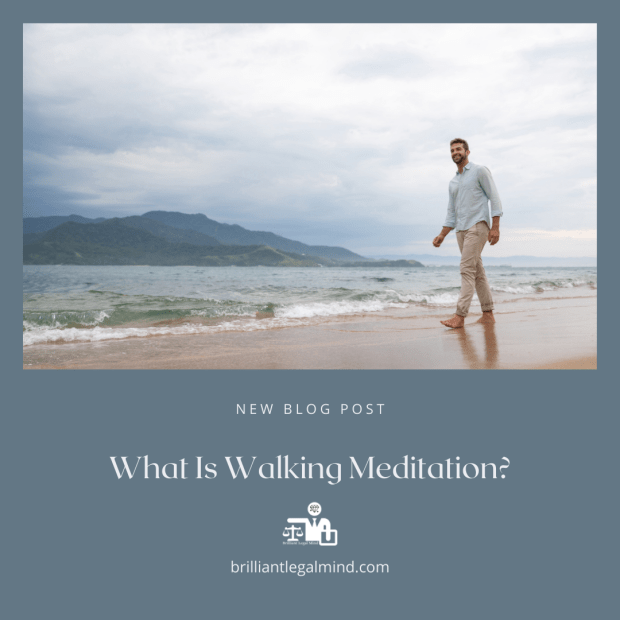
What Is Walking Meditation?

Cover image for blog post entitled "What is walking meditation?"

Friends tell me all the time that they like to go out for a “walking meditation.” My automatic reaction internal is this: “No, you’re not, but good for you.” Of course, I would never say this to someone unless asked but walking meditation is not the same thing as a walk outside.

One reason I would never offer this advice unsolicited in normal social circumstances is that I will never discourage anyone from (a) moving; or (b) getting outside. Taking a walk outside is awesome for you in every way. It’s good exercise and being outside is good for your mentally, emotionally, and spiritually. In the right circumstances, a walk outside can slow the mind and elicit mindfulness and calm.

Walking Meditation Is Not Just Taking a Walk

In short, walking meditation and a walk may overlap in some ways but they aren’t the same. The most prominent distinction is speed. With walking meditation, you don’t walk at your normal pace. You walk in slow motion.

The point of walking meditation isn’t exercise or enjoying the scenery. Rather, much like with sitting meditation, the point of walking meditation is to cultivate mindfulness by focusing very closely on what you are doing.

Image comparing walking meditation and simply taking a walk

If you have done a practice where you focused on your breath, I bet you noticed all sorts of things about breathing you had never noticed before. You may have noticed that a breath cycle affects various parts of your breath. You may have noticed that it feels kind of good. You may have noticed that you needed to learn to let yourself take deep, full breaths.

Walking Meditation Is Mindfulness with Movement

Walking meditation is similar. As you slow down the process of walking and pay attention to each step, you notice how much of your body is involved with walking.

You’ll notice your feet on the floor. You’ll notice the push forward, lifting and rotation of your foot, and then landing it firmly on the group. As you do this, repeatedly, you’ll learn that it can settle your mind just like sitting meditation.

Why Is Walking Meditation Helpful?

Now, you may be wondering why anyone would do this practice. To be sure, if you actually did walking meditation out in your neighborhood, your neighbors would probably come check on you to be sure you were okay. It looks funny and feels awkward.

A quote about walking meditation that contrasts it to sitting meditation and explains the benefits of the practice

The most likely place that you would experience walking meditation is on retreat and for a very practical reason: one cannot sit comfortably for hours on end. Many retreat centers will structure the program to include intervals of sitting and walking meditation to allow movement and keep the mind from becoming too dull.

The other great benefit of walking meditation, though, is that it can help you bring mindfulness into your life. Walking meditation may feel strange but it is a bridge between sitting meditation and real life. It encourages you to continue your mindfulness practice even as you move and go about your daily activities.

Walking Meditation Offers an Option for People Who Struggle to Sit Still

In addition, if you struggle with fidgeting during meditation or have pain associated with sitting for long periods, walking meditation may be a great alternative. My preferred way to use it at home is to do a few minutes of walking meditation to break up periods of sitting so that I can meditate for a longer period of time overall.

If you want to learn more about walking meditation, you can check the two-minute instructional video and presentation on our Learn to Meditate in Less than 2 Minutes page and YouTube channel.

Want to learn more about mindfulness and compassion? Check out my new book, How to Be a Badass Lawyer, for a simple guide to creating a meditation practice of your own in 30 days. And to share mindfulness with your little one, check out my new children’s book, Mommy Needs a Minute.

Like this post? Subscribe to the blog here or follow us on social media:

What Does Compassion Feel Like?

As a teacher of mindfulness and compassion, I have learned that a big part of the job is addressing assumptions. When it comes to compassion, this is even more critical since it tends to get less attention than mindfulness. In addition, though compassion is essential and can be incredibly powerful, many people assume it’s just like empathy or no different from being warm, soft, and nice. Even those who have felt the power of a compassionate response may think it’s impossible to cultivate it or show it when needed because we can’t train ourselves to feel a certain way on cue.

I get these concerns because I struggled with them in the past. That’s why I am writing this post to help you identify the things to look for when you practice compassion in your own life. In truth, compassion is not an emotion and does not require a specific bodily response. With time and experience, however, you can identify the experience more clearly so you can understand it better and cultivate it.

A common area of confusion when it comes to compassion is the idea that it is an emotional reaction. The reason that this presents a problem is that people often assume that compassion requires them to respond with certain emotions. In reality, the clinical definition of compassion is the response to suffering coupled with the willingness to help. This means that emotions that are often involved but they don’t have to manifest in any specific way.

In fact a common sign of compassion is not emotional volatility at all, but rather calm and stability. Since compassion is the response to suffering, this calm is something that can aid in producing a response that can help the suffering individual. After all, if we are to help a person in need (including ourselves) it helps to really understand what’s going on, doesn’t it? Thus, what might seem like a lack of emotional response can be a beneficial and profoundly compassionate reaction to suffering.

Even when physical sensations and emotions are present, you may also find that they don’t stay the same throughout the compassion response. Since compassion is about suffering, the first reaction may be one of pain, discomfort, or concern. In many cases, though, these difficult emotions can shift or transform into something closer to love or connection. This means a variety of bodily sensations are likely to occur, including sensations in the belly and chest and changes to breath and heart rate.

At the end of a compassion response, many people report (and I have personally experienced) feelings of wellbeing and serenity. This is because the compassion response causes the release of the hormones oxytocin, dopamine, and serotonin which are associated with love, rewards, and satisfaction. The most common place to look for these sensations is in the area of the heart, but those can range from feelings of fullness to a sense of expansion or lightness or even warmth or tingling throughout the body.

So, what does all of this tell us about what compassion feels like? First, compassion includes present and embodied awareness. Critically, this is an awareness rooted in your own experience that is not entirely absorbed by the situation of a suffering third party. In addition, the compassion response may not be a singular response at all but could by a dynamic unfolding from discomfort and concern into opening and, where necessary and appropriate, action.

For all these reasons, I can’t tell you what compassion feels like because compassion is not merely a feeling and the details of its manifestation may vary. Because compassion is a response to suffering, the particular suffering at issue may affect how it appears. The way to understand compassion best is to pay attention to how it manifests in you as you cultivate it. In short, the big question isn’t how compassion is supposed to feel, but instead how it tends to feel for you.

Want to learn more about mindfulness and compassion? Check out my new book, How to Be a Badass Lawyer, for a simple guide to creating a meditation practice of your own in 30 days. And to share mindfulness with your little one, check out my new children’s book, Mommy Needs a Minute.

Like this post? Subscribe to the blog here or follow us on social media:

Book Review: The Upside of Stress by Kelly McGonigal

This month I am focusing on debunking myths relating to mindfulness, compassion, and mental health. After all my years of meditation, I still find myself holding onto a few myths every now and then. One of those myths is that stress is bad for you.

As a lawyer, I have been informally trained to know that stress is a scary thing. The lawyer mental health crisis tells me I have to “manage” my stress. Family, friends, and doctors will tell me to “limit” my stress. And even in my training to become a meditation, yoga, and compassion teacher, I learned that stress can impede us physically and mentally.

But, then I came upon a book by Kelly McGonigal with a title that proclaims that stress is good for me. Her book The Upside of Stress: Why Stress Is Good for You, and How to Get Good at It seemed to fly in the face of everything I thought I knew. The thing is, though, that I adore Kelly McGonigal’s work.

She explains scientific concepts in a simple and engaging way that shows she really understands them. She does this so well that, in turn, I feel like I really understand the concepts too. I thoroughly enjoyed The Willpower Instinct and The Joy of Movement and, despite it being only in audio form, learned a ton from her course on compassion.

So, even though the title made me skeptical, I decided to give The Upside of Stress a try. Guess what? It totally changed my mind. And when I say “changed” I don’t mean that it made me suddenly welcome and enjoy all the stress in my life. Instead, it refined my understanding of what stress meant and how it actually worked.

Most of us know the “fight/flight/freeze” reaction as the stress response, as if it was the only response to stress. In Upside, however, McGonigal explains that this is only one possible response to stress and it usually occurs in dire threat situations. This is when stress can harm us physically, impede our performance, and even lead to bad behavior and aggression.

On the other hand, humans can respond to stress in other ways, including the “tend and befriend” or “challenge” responses. In other words, we can learn to care for and forge connections to deal with stress or see a stressful situation as a challenge that can present opportunities. When we respond to stress in these ways, research shows that it can improve performance, cause us to behave more ethically and collaboratively, and create courage, motivation, and energy.

Now, of course, the skeptics out there are likely to wonder why we hear so many dire warnings about stress if it is good for us. McGonigal acknowledges that stress can be bad, even devastating for some of us, but she explains that the popular discourse of stress is often misleading.

One thing that is often left out of these discussions is that our reactions to and mindset about stress can determine how it affects us. That is why so much of The Upside of Stress is devoted to changing the audience’s mind about stress, because just acknowledging that stress can have an upside is the first step to healthy stress management.

When I read this part of the book, I was ever more surprised because I realized I already knew it or had at least experienced it. I had not officially accepted the idea that stress could be good for me, but I had learned through meditation to respond to stress differently.

Rather than ignore, evade, or fight stress, I had learned to regard it as a normal part of life, to accept it as human, and to treat it with care. In other words, meditation had helped me more frequently invoke a challenge or tend-and-befriend response to stress. As McGonigal argues, it didn’t make the stress go away but it made it easier to bear.

If, like most lawyers, you want some help managing stress, consider checking out The Upside of Stress by Kelly McGonigal. If the only thing it does is change your mind about stress, that alone could be enough to change your life for the better.

Want to learn more about mindfulness and compassion? Check out my new book, How to Be a Badass Lawyer, for a simple guide to creating a meditation practice of your own in 30 days. And to share mindfulness with your little one, check out my new children’s book, Mommy Needs a Minute.

Like this post? Subscribe to the blog here or follow us on social media:

What Is Restorative Yoga and Why Should Lawyers Try It?

Lots of people tell me that they can’t meditate because they can’t sit still. I usually tell them that they don’t have to sit still to meditate. Strangely, people also tell me with a similar frequency that they can’t do yoga because they can’t do the poses. Sometimes they say that they can’t balance. Sometimes they say that they aren’t flexible. Sometimes they express a concern that they look silly. In other words, these people tell me the inverse of what the people who can’t sit still during meditation say: that they can’t move the right way during yoga.

When I hear these concerns, one of the first things I say is to acknowledge that I used to struggle with yoga too, but that letting go of the idea that there was a “right way” to move was what helped me learn to love it. One of the practices that helped me do this was restorative yoga. When I finally tried yoga for real, I already had an active meditation practice but it helped me realize I had to develop some ways of caring for my body in addition to my mind.

Though I’d been athletic growing up, I had not worked out consistently in years, so I started with yoga as a way to ease back into movement even though my earlier attempts with it had not been successful. Because I needed time to build up cardio endurance, I had to start with slow and gentle classes first. That’s when I found restorative yoga. Lucky for me, it was enough like meditation that I could enjoy it but different enough that it could serve as a segue into more yoga exploration.

Restorative yoga is a restful kind of yoga. Poses are part of the process, but the poses are supported rather than held. You don’t build strength and balance with the poses. You practice rest instead and you practice letting yourself be supported. In most cases, the poses are done lying on the floor, reclined on props, including blankets, blocks, or bolsters, or resting against the wall or a chair for support. This is because yogis hold the poses in restorative class for at least 5 and often as much as 15 or 20 minutes at a time.

So, why is this good for lawyers? It’s good for a lot of reasons. Restorative yoga practices rest and being supported. Most of us lawyers are in the habit of being active all of the time and doing many things on our own. For this reason, practicing another way of being is a way to offer balance to our lives. In addition, the poses themselves are beneficial to the body. Poses that help open the chest or arch the back may counteract the effects of sitting at a desk all day and inversions may balance hormones and offer relief from the effects of gravity and wearing uncomfortable shoes.

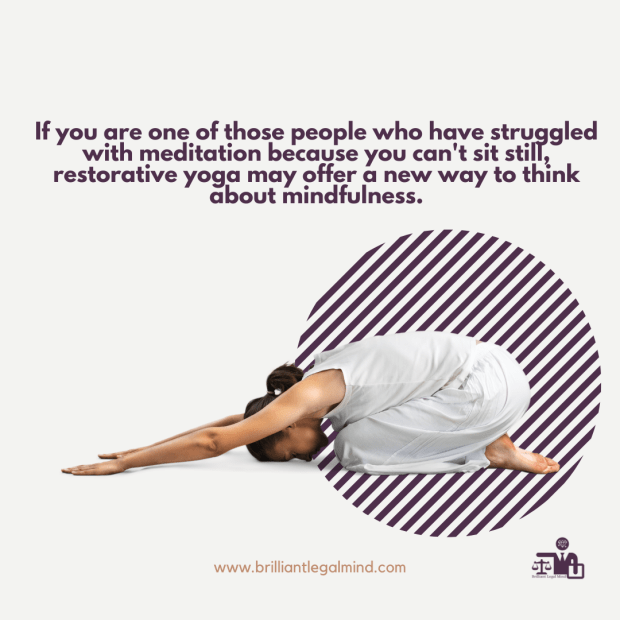
Finally, if you are one of those people who have struggled with meditation because you can’t sit still, restorative yoga may offer a new way to think about mindfulness. The instruction in most restorative classes is just to be in the experience of the pose, to feel oneself resting, and not to drift off in thought.

This is similar to the practice of sitting meditation, but it has some additional physical and restful components that may help you relax into and tolerate the experience more. Even if you enjoy meditation like I do, you may find that restorative yoga is a nice way to mix things up or can offer a chance to find mindfulness when life makes meditation seem a bit too intense.

If you are interested in learning more about restorative practice, you can find it at many yoga studios. Some fitness apps and online platforms, such as Peloton offer it too. In addition, you can easily start a home practice by finding a set of restorative props online.

You can also check out some of the work of Judith Hanson Lasater, Ph.D., P.T. Her book, Relax and Renew offers pictures and explanations of poses and full sequences to help you do the practices on your own at home.

Just as you don’t have to sit still to meditate, you don’t have to move to do yoga. Restorative yoga offers lawyers the chance to practice rest so that they can find peace in stillness and pay closer attention to how their bodies feel. It is a beautiful practice that offers people in stressful jobs many benefits. Giving you the chance to experience how expansive yoga can be is just one of them.

Do you want to try restorative yoga? Check out our Supported Fish Pose with Self-Kindness Guided Mediation. Or you can try our Legs Up the Wall Guided Meditation even if you don’t have any props. All you need are your legs and a wall.

Want to learn more about mindfulness and compassion? Check out my new book, How to Be a Badass Lawyer, for a simple guide to creating a meditation practice of your own in 30 days. And to share mindfulness with your little one, check out my new children’s book, Mommy Needs a Minute.

Like this post? Subscribe to the blog here or follow us on social media:

Book Review: Zen Golf by Dr. Joseph Parent

Cover image for blog post with book review of Zen Golf by Joseph Parent which discusses benefits of mindfulness in sports

I am not really a golfer, but I owe a lot to the game. Despite being a lawyer, I have only played at the occasional outing during my practice and even then have not been serious about it. In high school, however, I took up the game because my basketball teammate was an excellent player and needed another girl to round out my school’s newly formed team.

Knowing right off the bat that I would have no obligation to be any good, it seemed like a low-pressure compliment to the physically demanding and lengthy basketball season, so I gave it a shot.

Golf is a mental game.

While playing golf was certainly a change of pace, I quickly found that “low-pressure” was not the word to describe it. Yes, I got to hang out on a beautiful golf course in the rolling hills of Northern Kentucky and chat with my teammates and competitors. No, I wasn’t obligated to run suicides or fight for position on the court.

Though my surroundings and relationships with competitors were comparatively more peaceful with golf, I soon learned that my relationship with myself was far more difficult. Suddenly, I had to learn to coach myself to focus acutely, deal with setbacks, and use my judgment to try to make the best of hard circumstances.

After 3 years of high school golf, I never became a great player, though my team generally used my score and won some matches, but the game helped me start the process of becoming a decent adult.

An image with quote about how playing golf offers benefits for personal development including mindfulness and compassion

Zen Golf was recommended to me first.

So, when a lawyer who had seen one of my mindfulness seminars reached out to me this year and suggested I read Zen Golf (paid link) it was almost like a blast from the past. I have no ambitions for rejuvenating my own golf game, but having played, I knew immediately how mindfulness might help anyone who wanted to do so.

Zen Golf is written by Dr. Joseph Parent, a sports psychologist who has worked with some of the world’s best golfers and a long-time meditator. In the book, he offers some basic instruction in mindfulness practice and describes strategies that he uses to help golfers struggling with various aspects of the mental game of golf.

Zen Golf isn’t new but it stands the test of time.

The book is now 20 years old, so some of the references to golfers may seem a little bit dated. In the same way, knowledge and awareness of mindfulness meditation has skyrocketed since that time, so some of Parent’s sayings and references such as “Today is a gift. That’s why we call it the present,” may sound a bit hackneyed.

Overall, though, Parent’s analysis of the many ways that the mind can block even the best golfer’s success and his recommendations for a path out are ones that I don’t think can get old.

A cover image about how confidence emerges with mindfulness and compassion by learning trust in one's goodness

Who doesn’t want unlimited confidence?

For example, one of my favorite parts of Zen Golf was when he describes the concept of “unconditional confidence.” While at first this sounded like business-book drivel and made me skeptically wonder how one could expect to be confident all of the time, I quickly realized that Parent wasn’t talking about cocky bluster or promising 100% good results.

Instead, Parent was explaining the Buddhist concepts of essential goodness and self-compassion. According to Parent, unconditional confidence didn’t come from results, but instead from a player’s acceptance of their own intrinsic goodness and choice, time and time again, to treat themselves with kindness regardless of the circumstances.

How to “make” every putt.

This concept came through best when Parent talked about his approach to teaching putting, which for many players can be the most maddening and heart-wrenching aspect of golf. Parent explained that golfers, much like Happy Gilmore, usually define a successful putt as getting the ball in the hole.  

But Parent suggests a different approach that defines success with the process rather than the result. He says that a golfer has “made” a putt when they have a clean, steady stroke, use the appropriate force, keep their head down, and select and execute the right strategy.

For golfers who play regularly, this makes sense because it emphasizes and rewards the process of putting, which are within the player’s control, and lets the player off the hook for result, which (despite our frequently recurring delusions) is not.

A cover image with a quote about kindness and mindfulness in golf or other competitive activities

Zen Golf extends beyond the course.

Clearly, this utility of this advice may extend well beyond the golf course. As a lawyer, it is often tempting to judge ourselves based on the results we get in our cases. Despite our best efforts and even when the law seems to favor us, we just cannot entirely control the results we get.

Thus, as Parent suggests, it may make a lot more sense and be a whole lot kinder to ourselves if we judge success based on the things we can control: doing our best, putting client’s interests first, complying with ethical rules, and advising, assessing risk, and counseling along the way.

Zen Golf by Joseph Parent is a worthwhile read.

In short, Zen Golf (paid link) is a good read for golfers or anyone who wants to understand the practical benefits of mindfulness. The book explains in easy-to-understand language how the mind-body connection works and the many ways mental states and assumptions can ensnare us and impede performance.

It also offers many lessons for not just playing the game of golf better, but also enjoying it more and treating yourself better as you play. In this way, even if Zen Golf doesn’t make you a better golfer, it offers strategies and advice that may make you better at dealing with life.

An image that includes a quote about the role of mental states on our pastimes implying why mindfulness can be essential for lawyers.

The link to the book mentioned in this review is an affiliate link. The review is unsponsored and sincere but the link to Amazon is paid.


Want to learn more about mindfulness and compassion? Check out my new book, How to Be a Badass Lawyer, for a simple guide to creating a meditation practice of your own in 30 days. And to share mindfulness with your little one, check out my new children’s book, Mommy Needs a Minute.

Like this post? Subscribe to the blog here or follow us on social media:

Brilliant Attorney Profile: Hale Stewart Insurance Lawyer and Moving Meditator

One of the most common complaints I hear from new meditators is that they “can’t sit still.” My common refrain is that “you don’t have to sit still; you don’t even have to sit!” I’ve written about this before, but I am not sure I am the best emissary of this message. Stillness has never been the problem with my practice. Instead, I’ve craved it and relished every bit of silence I could get because my problems were excessive thoughts, doubt, and self-judgment. 

So this week, I am going to let the story of my friend Hale Stewart, an insurance lawyer and moving meditator, make the point. I have never met Hale in person but became acquainted with him on LinkedIn. He is the Vice-President of Recapture Insurance, an alternative risk financing wholesaler and he posts regularly on insurance topics. Because that area is adjacent to my own, which includes some insurance defense work, I became connected with Hale and his posts started showing up in my feed. Hale’s knowledge of insurance so vastly exceeds my own that I often couldn’t contribute in a meaningful way to his content, but he had a good sense of humor and always had a joke or funny GIF to offer on my posts about mindfulness. 

I never expected Hale to tell me that he was interested in meditation. His sense of humor told me he was a pretty no-nonsense type of guy and I know he told me outright at least once that he wasn’t the type to sit and do nothing. But, one day, out of the blue, Hale messaged me to say that he appreciated my blog posts because they were practical, simple, and had helped him. This made me super curious, so I asked Hale to talk about his mindfulness practice. Despite Hale’s prior intimations that meditation wasn’t for him, I found out that he had created a unique, effective, and robust practice for himself.

Hale told me that he meditated during his daily cardio workouts on the treadmill. He had started this after thinking about spirituality and stress management for a while. In addition to being an insurance lawyer, Hale is also a former professional musician. While that experience exposed him to and made spirituality a part of his life, the steady march of time and the stresses of the current day caused him to begin exploring meditation as a new way to take care of himself.

After searching the internet, Hale found some guided meditations to pair with exercise. Hale said he enjoyed them because the teacher didn’t use a wispy, mystical, yoga teacher voice, so he could just do the practices without distraction. By doing those practices for a while, Hale learned to guide himself through the practice and he now meditates on the treadmill for nearly an hour most days. His practice includes body scan to get into his body as he begins his workout, breath focus to stay present with his experience, and visualizations of rainbow (“ROYGBIV” as Hale called them) colors. 

Hale, it seemed, didn’t know or care that this was impressive. He didn’t seem to notice that a daily practice of that length of time was incredibly robust for a new meditator. He also wasn’t too focused on the fact that his practice ticked some important mindfulness boxes (mental focus, body awareness, and breath work) or that rainbow colors have traditionally been associated with the chakra bodies from yoga philosophy. Instead, what Hale cared about was feeling better, enjoying the workout, and getting benefits. Though his practice is not yet a year old, Hale reports that he is already reaping those benefits, including feeling more present and focused and rushing less.  

Several things impressed me about this story. First, Hale’s willingness to explore and try something new is commendable. People new to meditation can take the practice and themselves too seriously at first, which can impede the curiosity and playfulness needed for the practice to offer its benefits. Hale didn’t do that and instead explored to see what was out there and played with the practice to make it work for him.

As someone who took way too much time reading and thinking about meditation before I tried it, I was also impressed that Hale didn’t need a lot of theory to get started because he trusted himself. Many people new to meditation worry initially about doing the practice “right” but Hale built a practice based on what felt good to him. This isn’t to say that theory is unimportant or that teachers and books are useless. On the other hand, though, it demonstrates that there are many paths to mindfulness and that we don’t have to know the path perfectly to walk it well. 

When we talked, Hale confided that he had never thought of himself as the type to meditate because he wasn’t someone who could just sit there. Rather than let this idea hold him back, he paid attention to what he needed and embedded the practice into his life, rather than conforming himself to what meditation was “supposed” to be. So, now when people tell me that they struggle with meditation because they “can’t sit still”, I don’t have to convince them. I’ll just remind them that there are lots of ways to meditate and suggest that they go talk to my friend, Hale.

F. Hale Stewart JD, LL.M. is a Vice President of Recapture Insurance, an alternative risk financing wholesaler.   Hale has been involved in alternative risk for 12 years.  He has written two books on the topic (U.S. Captive Insurance Law and Captive Insurance in Plain English) and provides periodic commentary for IRMI.  A former professional musician, he remains an enthusiastic amateur jazz guitarist. You can learn more about or follow him on LinkedIn.

Want to learn more about mindfulness and compassion? Check out my new book, How to Be a Badass Lawyer, for a simple guide to creating a meditation practice of your own in 30 days. And to share mindfulness with your little one, check out my new children’s book, Mommy Needs a Minute.

Like this post? Subscribe to the blog here or follow us on social media:

Four Ways Mindfulness Can Help You Recover When You Struggle with Goals

Cover image for blog post with title "Four Ways Mindfulness Can Help You Recover When You Struggle with Goals"

January is a time for resolutions, and for some of us, that can also mean a time for disappointment, reality-checking, and self-flagellation. It’s easy to set goals, but much harder to keep them. It’s also simple to see how a habit change might improve our lives, but very difficult to change our engrained habits. I commonly see friends and acquaintances lose steam with their goals or lose faith in themselves when they struggle with keeping resolutions. To avoid that, here are some mindfulness-based strategies that may help you get back on track.

1. Notice how you feel.

Setting a goal is likely to inspire feelings of empowerment and hope. That feels great. But struggling or failing to meet a goal feels terrible. When you encounter setbacks or failures, it is normal to feel hopeless, powerless, and worthless. While, in the moment, this really sucks, these feelings can over time serve as motivation for wiser action if you don’t resist them or push them away.

Mindfulness can help us in times like this in many ways. First and foremost, it can help us stay with and acknowledge these feelings, which in essence are sensations in the body. In times of struggle and failure, it can be easy to ignore or numb the uncomfortable, even painful, feelings that arise. If you can allow yourself to notice them, however, they may help guide you to care for yourself better and learn from your mistakes.

Image of a person starting to run with quote that says "setting a goal is likely to inspire feelings of empowerment and hope."

2. Be your own best friend.

If you can be mindful of your feelings, thoughts, and emotions as you deal with struggle or failure, you are bound to notice some rather nasty internal talk. Though this is normal, it won’t help you learn or get back on a personal growth track. Nevertheless, we humans tend to be much harder on ourselves than we are with other people.

The solution to this is to develop a habit of treating ourselves like we do our best friends so that we can activate self-compassion. Just ask yourself the following question: “If my best friend set a goal and failed to achieve it, what I would tell them?” Most likely, you wouldn’t be judgmental, critical, or mean. Instead, you’d be supportive, understanding, and caring. While this may feel strange at first, it will become natural over time and it will make failure and struggle a lot less scary.

Image of stones stacked in balance with quote that says "Sometimes, we can set goals for ourselves that are really geared towards improvement, though we can implicitly add in an unstated standards of perfection."

3. Be aware of “all or nothing” thinking.

Once you’ve experienced and cared for your emotions, it may be appropriate and helpful to consider next steps. In particular, you may consider whether you should abandon or revise your goals or just get back to them. In doing this, watch out for all or nothing thinking. Sometimes, but especially in January, we can set goals for ourselves that are really geared towards improvement, though we can implicitly add in an unstated standard of perfection.

For instance, if you set a goal to exercise every day in January, you may be discouraged when you miss a day in the first week. Does this mean the goal is impossible and you should quit? Not in my view. The goal wasn’t really about the streak. The goal was about establishing the habit. If you exercise 30 or 28 or 26 days out of January instead of 31, it seems to me you’d be pretty darn close to that. As you heal and learn from struggles with your goals, therefore, be aware of all or nothing thinking because accomplishing some of your goals can still represent amazing progress.

Image of person jumping between two cliffs with quote that says "The best kinds of goals are specific, actionable, and measurable."

4. Remember your values.  

The best kind of goals are specific, actionable, and measurable. The dangerous part of this, though, is that goals can make us so laser-focused on one thing so that we forget the bigger picture. When I struggle with goals, I find it helpful to zoom out to get more perspective. I do this by considering not just the reasons I set the goal, but also my long-term goals for life. For many of us, we’d probably say that our goals for life include happiness, health, connection, and meaning.

Those kinds of goals aren’t necessarily dependent on achieving particular objectives in life. Rather, they are achieved by living our deepest values in life. The beautiful thing about values is that you can live them in failure as much as you can in success. When I remember my values in this way, I remember what motivated me to set the goal in the first place and, in turn, that motivates me to be gentle with myself and start again.

Image of woman sitting by window with quote that says "Achieving goals is not just about discipline but also about accepting like the way it is and caring for ourselves along the way."

Professionals and lawyers accustomed to meeting goals every day at work can easily forget that achieving personal goals and changing habits is really hard. Doing hard things becomes much more doable, however, when you use practices and develop habits that help you build resilience. Mindfulness practices can help with this because they help us remember that achieving goals is not just about discipline, but also about accepting life the way it is and caring for ourselves along the way. This January and this year, I wish you luck in achieving your goals but I wish even more that you care for yourself as you do it.


Want to learn more about mindfulness and compassion? Check out my new book, How to Be a Badass Lawyer, for a simple guide to creating a meditation practice of your own in 30 days. And to share mindfulness with your little one, check out my new children’s book, Mommy Needs a Minute.

Like this post? Subscribe to the blog here or follow us on social media:

Cooking Is My Antidote to Languishing

I did not know that “languishing” had a clinical meaning until I listened to Adam Grant’s interview on the Ten Percent Happier podcast the other day. According to Grant, it’s the state between wellness and depression. As a busy lawyer and mom, I immediately recognized this description. As Grant put it, it’s a state where you might say that you “aren’t sick but aren’t well.” We’ve all been there, but Grant suggests that too many of us stay there and allow ourselves to progress on into depression.

So, what do we do when we find ourselves in this not quite great state, in that place where we are uncomfortably abiding but not thriving? My experience with meditation tells me that the first step might be to avoid panicking and to understand that all things, including nasty feelings, don’t last forever. My life experience also tells me that we need rest phases in our lives to grow. But, when you notice the feelings persist or take a turn for the worse, some action might be needed. Grant gives us a clue as to what might help.

He suggests that we ought to look for an activity that offers us the 3 m’s:

  • Mindfulness
  • Mastery
  • Matters

In the interview, Grant explained that playing Mario Kart with his family really helped him during the pandemic. Why? Because it required mindfulness by totally occupying his mind. It engendered in him a sense of mastery or prowess in playing the game and improvement as he progressed. And, it mattered. It was a fun thing to do with his kids and a way to connect with family that he couldn’t see in person.

I’m not a video game person and, historically, I have been extra terrible at driving games. Even so, as I listened to Grant, I knew what my Mario Kart was: cooking. I love cooking. I have loved it since I was a kid and outgrew my Easy Bake Oven in a matter of weeks because the small light bulb inside was insufficient to properly bake my cakes. This pushed me to start making recipes from old kids’ cookbooks that I’d scrounged from yard sales by age 7. By middle school (much to the delight of my parents), I was cooking family dinners by myself.

After 30 years of cooking, I can now walk into the kitchen and come up with dishes on the fly to either make a classic dish I’ve been craving or use up what I have on hand. It’s a thrill to reuse leftovers in inventive ways and a game to transform one dish into something else entirely. During the pandemic, it offered me the practical benefit of forcing me to stop my work for a while and get away from my computer because my family and I had to eat (and my husband is a terrible cook). So, instead of using my brain to find answers, I got to take a break and use my senses and creativity to come up with something good. And, of course, it mattered that I ate something good and decently healthy, that my kids experienced some new kinds of foods, and that I could offer us something that we couldn’t get delivered from takeout.

As a litigator, there are many days and weeks that I don’t have the time to cook or have to come up with something super easy, like tossing meatballs and marinara in a crockpot. Even so, cooking during these times helps me find little pockets of play in the midst of the grind. When my calendar opens up again, it’s like coming home when I get to cook something that requires more thought, planning, skill, and attention. After some time in the kitchen, I usually find myself ready to dive back into work again because letting my senses drive the bus in the kitchen gave my rational brain a much-needed chance to rest.

I know that cooking isn’t for everyone, but I think everyone should have an activity that they can rely on the same way I rely on cooking and Adam Grant relies on Mario Kart. Look for something that fills up your mind and appeals to your senses, helps you feel a sense of mastery, and, for whatever reason, matters to you or someone else. If you find this activity and keep coming back to it, you may find that it is a powerful antidote against languishing and part of a happy life.

Want to learn more about mindfulness and compassion? Check out my new book, How to Be a Badass Lawyer, for a simple guide to creating a meditation practice of your own in 30 days. And to share mindfulness with your little one, check out my new children’s book, Mommy Needs a Minute.

Like this post? Subscribe to the blog here or follow us on social media:

Can Mindfulness Help You Eat More Intuitively?

I spoke on a panel a few weeks ago about wellness for professionals with Kathryn Riner, a nutritionist and intuitive eating coach. I thought Kathryn sounded pretty down-to-earth and human as she spoke, and a lot of what she said rang true from my own experience with mindfulness. The timing was also too perfect to pass up, since the theme for the blog this month is food. If you want to learn more about intuitive eating and how it intersects with mindfulness and compassion, check out this interview with Kathryn below.

Q. What is intuitive eating?

A. Intuitive eating is an evidenced based approach to health and wellness that has ten guiding principles to help people have a positive relationship with food, mind and body. Intuitive eating was created by two dietitians, Evelyne Tribole and Elyse Resch. Their book was first
published in 1995, and the fourth edition came out last year. Over the last roughly ten years or so, there has been a lot of research supporting the positive outcomes related to intuitive eating, which support both mental and physical health. Intuitive eating is also very much so aligned with Health at Every Size (HAES), again promoting health and wellness without focusing on weight loss.

Q. What drew you to focus on intuitive eating in your work with clients?

A. Once I was a little over ten years into my career, I had enough experience to know that diets don’t work. And when it comes to kids especially, I recognized how promoting weight loss causes harm. I saw firsthand how the pursuit of weight loss damaged one’s relationship with food and their body, and that dieting was a predictor for weight gain and risk factor for eating disorders in adolescents. About the same time, I was starting my private practice, and I kept coming across the topic of intuitive eating in the area of nutrition entrepreneurship. The more I learned, the more it resonated with me, both personally and professionally. I truly believe intuitive eating can be life changing.

Q. What makes intuitive eating stand out from other practices or strategies for managing nutrition?

A. Intuitive Eating respects an individual’s lived experience and honors their health goals without focusing on weight. Intuitive eating allows people to focus on health promoting behaviors, without the pursuit of weight loss. It also has over 125 research studies supporting its efficacy.

Q. Many mindfulness practices emphasize paying attention to and honoring thoughts, feelings and body sensations, could those practice support intuitive eating?

Definitely! One of my favorite strategies is to encourage my clients to check in with their bodies midway through the meal and take notice. Whether they notice they are still hungry or are comfortably full, it doesn’t matter. Being in tune with your body is essential to being an intuitive eater. Honoring hunger and feeling fullness are just two of the principles of intuitive eating, but they are very important to the practice.

Q. Is self-compassion important to intuitive eating or managing nutrition in general? If so, can you explain why?

Yes, absolutely! There is no judgement when it comes to intuitive eating. You can’t fail at being an intuitive eater. It is a practice that takes a lot of self-compassion and exploration. I always encourage my clients to evaluate their eating experiences with curiosity, not judgment. And self-compassion has a significant role in that process.

Q. Are there any other practices that you recommend for people who are interested in intuitive eating?

I would encourage anyone that is interested in intuitive eating to experiment with viewing food as emotionally neutral. So many clients come to me using the language that food is “good” or “bad”, or “healthy” vs “unhealthy”. All food offers some nutritional benefit, and I think if we can trust ourselves and our bodies, we will realize food holds no moral value. It is so liberating to know that all foods fit. I like to encourage a diet with enough nutrition, variety, and satisfaction because to me, that is what is healthiest.

About Kathryn Riner: Kathryn Riner is a masters level educated, pediatric dietitian living in St. Louis, MO. She has 14 years of experience working both in her community and at a local US News and World Reports nationally ranked children’s hospital. In 2016 she opened her private practice, Healthy Kids Nutrition, LLC providing compassionate, individualized nutrition therapy to families. In 2019, Kathryn trained with Evelyn Tribole, a co-author of Intuitive Eating and became a Certified Intuitive Eating Counselor. Her mission is to help parents and kids have a positive relationship with food, so everyone can feel happy, healthy and confident around the table. You can follow her on Instagram @intuive.eating.for.moms.

Want to learn more about mindfulness and compassion? Check out my new book, How to Be a Badass Lawyer, for a simple guide to creating a meditation practice of your own in 30 days. And to share mindfulness with your little one, check out my new children’s book, Mommy Needs a Minute.

Like this post? Subscribe to the blog here or follow us on social media:

Is Meditation a Spiritual Practice?

Cover image for blog post entitled "Is Meditation a Spiritual Practice?"

A friend shared a meme recently which listed 4 buckets of self-care strategies, including physical, social, emotional, and spiritual. I was glad to see that it included meditation, but my lawyer brain fired up when I saw it listed meditation only in the spiritual bucket.

Literally starting with the phrase, “Well, actually” my mind began drafting a response to my friend’s social media post to explain that meditation was not just a spiritual practice. Rather than alienate my friend, however, I decided that a blog post would probably be a better forum for these thoughts. So, here it goes.

Meditation Has Roots in Religious Practice

Is meditation a “spiritual practice?” Undoubtedly it is, since various forms of meditation have overtly been part of numerous spiritual and religious traditions throughout history. Meditation also may be a spiritual practice for many individuals outside of the context of religious and spiritual traditions.

In my view, spirituality establishes or promotes a sense of connection between an individual and other beings or the universe. Mindfulness practice has clearly offered that for me and the importance of that cannot be overstated.

Image with a quote from the blog post which says "Meditation is a spiritual practice that can promote a sense of connection to oneself, others, and the universe."

Why Does This Question Matter?

But I rail against putting meditation only in one bucket for a few reasons. The biggest is that, as a lawyer, I am a super practical person. Emphasizing just one set of characteristics can be problematic when it is done to the exclusion of other practical benefits.

Sure, meditation can connect you with the universe. It can also help you not be troubled by your thoughts. In my case, it consistently reduces or abates my headaches and other physical signs of stress.

And, it routinely helps me get over myself by letting me see that I need to apologize/ask for help/forgive myself/ease up/just let something go. Having experienced all of these practical benefits firsthand, I can’t put meditation into the “spiritual” bucket alone because it contributes regularly to my mental/emotional/physical/social wellbeing.

Image showing the benefits of meditation that include awareness of thoughts, healing stress, improving relationships and focus

Meditation Can Affect Multiple Aspects of Well-Being

But maybe that really takes me to a different point altogether. Maybe the problem isn’t with categorizing practices at all. Instead, perhaps the issue is that all of these aspects of personal well-being – spiritual, emotional, physical, and social – are actually intertwined.

As a pedagogical tool, it may be helpful to separate out these needs so that us wayward humans who often stray from the path of health and happiness can find our breadcrumb trail to stumble back to sanity.

But the truth, as my meditation practice regularly reveals to me, is that these human needs are intertwined and interdependent. Thus, most wholesome activities can’t be put into one bucket alone, but rather support, cycle, and flow into all the others.

Meditation Is a Spiritual Practice and a Human One

So, am I telling you to stop sharing that meme and others like them that separate out human needs into categories? Of course not. But as you share or view memes like these, it may help to just consider for a moment if they are 100% true and, more significantly, whether they are true for you.

It may be even more eye-opening for you to think about the personal practices that you rely on to keep yourself well and whether they fit in just one, multiple or all of the “human needs” buckets.

Considering this myself, I can’t agree that meditation is only a spiritual practice any more than I could agree that exercise is just a physical one. In the end, I think meditation is a human practice made for human needs, including those that are spiritual, physical, social, and mental.

image showing various aspects of well-being with quote that says "our physical, emotional, spiritual, and social needs are often intertwined and interdependent."

Want to learn more about mindfulness and compassion? Check out my new book, How to Be a Badass Lawyer, for a simple guide to creating a meditation practice of your own in 30 days. And to share mindfulness with your little one, check out my new children’s book, Mommy Needs a Minute.

Like this post? Subscribe to the blog here or follow us on social media: