5 Ways to Decompress and Look After Your Mental Health When Applying to Law School

Image of student sorting through application with title for blog post "5 Ways to Decompress and Look After Your Mental Health When Applying to Law School"

It’s no secret that law students are seriously struggling—over 75% report increased anxiety, and over 50% experience depression. Other stats say a staggering 96% face significant stress—far more than medical students or other graduate students. 

But the stress doesn’t start in law school—it begins long before. With admissions growing more and more competitive, students must craft applications that are both deeply personal and meticulously calculated. 

They’re expected to be both authentically themselves and exactly what hard-to-impress admissions committees want to see. Balancing vulnerability with strategy, storytelling with structure, and passion with polish is exhausting.

And that’s only one hurdle. Students also juggle time-consuming extracurriculars designed to impress, competitive internships, near-perfect GPAs, months of LSAT prep, and applying to a dozen or more schools—all under the looming fear of rejection.

But it’s not all doom and gloom. While the pressure is real, there are ways to manage stress, protect your mental health, and set yourself up for success—strategies that can help you not just survive the process but maybe even beat the stats.

Prioritize Movement While Applying to Law School

It’s well-documented that regular exercise improves mental health, boosts emotional well-being, and lowers rates of anxiety and depression. It may sound too simple, but something as basic as walking around your neighborhood can help you decompress

The science behind this link is complex. Some studies suggest exercise affects brain chemicals like serotonin, stress hormones, and endorphins, while others point to the connection between inactivity and mental health struggles. Whatever the reason, the bottom line is that movement helps!

But this isn’t about forcing a strict workout routine into your already packed schedule. Exercise shouldn’t feel like another obligation—it should be something you enjoy. Whether it’s walking, yoga, pilates, or light stretching, find what lets you take a breath and quiet your mind. You can pair it with binaural beats or calming music for added effect! 

Express Your Emotions During the Law School Application Process

The emotions you experience during this process—stress, anxiety, frustration, self-doubt—are valid. Bottling them up will only make them feel heavier. Finding an outlet to release these emotions can help prevent them from spiraling into overwhelming anxiety or burnout.

Talking to someone—a friend, family member, or mentor—can be incredibly helpful. If speaking to someone isn’t for you, consider journaling. Writing your thoughts down, even if no one ever reads them, can be a cathartic way to process your emotions. The simple act of transferring your worries from your mind onto paper can create a sense of relief and perspective!

Image of Jesse Wang, guest contributor, with quote from the blog post "While the pressure is real when applying to law school, there are ways to manage stress, protect your mental health, and set yourself up for success—strategies that can help you not just survive the process but maybe even beat the stats."

Take a nap—Without Guilt to Support Your Mental Health

You don’t need me to tell you how important sleep is, but when you’re buried under deadlines and LSAT prep, it’s easy to sacrifice rest in the name of productivity. 

While getting a full eight hours every night might not always be realistic, ignoring your body’s need for rest only makes the process harder in the long run. Instead of running on fumes (or another cup of coffee), give yourself permission to take a nap if you need one. 

Even a short 20-minute reset can improve focus, memory, and mood. And if you need a full hour or two? Take it. The time you “lose” to sleep won’t make or break you, but being well-rested will make everything else feel a little more manageable.

If you are the kind of person who struggles to nap during the day, a quick meditation or a restful practice like restorative yoga might be great alternatives. Remember, rest isn’t a luxury—it’s a necessity.

Get Outside for a Mental Health Break

We’ve all heard the joke of telling people who are chronically online to “touch grass” as a reminder that there’s a real world beyond their screen. But it’s more than just a joke—literally walking barefoot on grass is a common grounding technique that can help reduce stress, lower anxiety, and bring you back to the present. 

Studies have shown that spending even a few minutes in nature can lower cortisol levels and improve overall well-being. Even if going outside barefoot isn’t your forte, just getting outside—feeling the sun on your face, taking a deep breath of fresh air, or going for a quick walk—can do wonders for your mental health. 

When stress keeps you stuck at your desk, a few minutes outside can be the reset you need to clear your mind, refocus, and feel a little more human again.

Zoom Out to Remember that Law School Application Is Just the First Step

It’s easy to get tunnel vision when applying to law school. Your success starts to feel like it hinges entirely on getting the right grades, getting into the perfect program, and getting that coveted job. However, defining success solely through academic and professional achievements can set you up for more stress and disappointment.

Creating a vision board that extends beyond law school can be a great way to maintain perspective. Think about what else makes you feel fulfilled—hobbies, travel, personal goals, new skills you want to learn. 

By diversifying your definition of success, you remind yourself that your worth isn’t solely tied to your legal career. Plus, updating your vision board with small wins along the way can help you feel a sense of accomplishment throughout the journey, not just at the finish line!

Image sharing the 5 ways to manage stress and support mental health while applying to law school that were shared in the post

Final Thoughts

Stress is an unfortunate but inevitable part of the law school journey. You’re entering one of the most demanding careers, and the path to getting there isn’t any easier. But you don’t have to do it alone. 

Juris Education can help shoulder the burden—guiding you through applications, essays, and interviews—so you can focus on putting your best foot forward without burning out.

At the same time, small habits can make a big difference. Moving your body, expressing your emotions, resting when needed, getting outside, and maintaining perspective can help you manage stress in a healthier way. 

Law school will come with its own challenges, but building these habits now will set you up for success—both in your application process and in your future career!


Author Bio: Jesse Wang is a published author and attorney based in New York City. He completed a JD/MBA from the USC Gould School of Law, where he was Secretary of the Student Bar Association, Co-President of the Diversity Committee, and Founder and President of Gould’s Legal Technology Association. Prior to law school, Jesse graduated magna cum laude from Emory with a Bachelor’s in business administration with dual concentrations in information systems and operations management and marketing and Chinese language and literature. In 2020, he published a novel titled “Underdog” about his law school experience, as well as the experiences of classmates, professors, law school deans, and startup founders within the USC Gould legal community. Jesse has a strong track record of supporting students in their writing processes, having tutored both undergraduate and graduate students across various subjects. Jesse excels at providing comprehensive strategies for the admissions process. He helps students craft persuasive narratives, optimally structure their arguments, and leverage their unique qualities to make an impression on top-tier law schools. He is committed to helping students reach their goals and become part of the nation’s elite legal community. Having faced and overcome the challenges of applying to law school himself, he understands the stress and pressure students experience and works diligently to give them the best chance of success.


Want to learn more about mindfulness and compassion? Check out my new book, How to Be a Badass Lawyer, for a simple guide to creating a meditation practice of your own in 30 days. And to share mindfulness with your little one, check out my new children’s book, Mommy Needs a Minute.

Like this post? Subscribe to the blog here or follow us on social media:

Book Discussion with Yoga Specialists This Saturday

Join me on Saturday afternoon for a discussion of my book How to Be a Badass Lawyerht and Q&A session. This session is perfect for anyone interested in learning more about mindfulness and compassion, writing, or the process of crafting a book.

In particular, I will explain the title for the book and discuss the four practices I teach in it, including: breath, body awareness, joy, and loving-kindness.

This session is done in partnership with Yoga Specialists. It is free for anyone to join. Lawyers, professionals, students, yoga and mindfulness teachers, and anyone is welcome.

You can register here.


Like this post? Subscribe to the blog here or follow us on social media:

Want to learn more about mindfulness and compassion? Check out my new book, How to Be a Badass Lawyer, for a simple guide to creating a meditation practice of your own in 30 days. And to share mindfulness with your little one, check out my new children’s book, Mommy Needs a Minute.

Reading for Reflection on Martin Luther King Jr. Day

Cover image for blog post entitled reading for reflection on Martin Luther King Jr. Day

Today, you are going to see a lot of quotes shared on social media from Dr. Martin Luther King Jr.’s famous “I Have a Dream” speech. You may see a few people urging you to read his prior “Letter from a Birmingham Jail.” I urge you to go and read both of them in full.

In all the discussion of dreams and ideals today, it’s important to remember that real work, effort, risk, and hardship is necessary to make real change. One of the biggest criticisms leveled against mindfulness practices (and maybe the mindfulness community) is that it advocates “doing nothing” when so much work needs to be done.

In truth, though, meditation and other mindfulness practices aren’t just about doing nothing. Sure, formal practice calls on you to do nothing for a period of time, but that inactivity is (or should be) serving a purpose. In my life, I have seen how meditation has made me more courageous, more circumspect and ethical in dealing with others, and more engaged with my life and community.

Over the last three years, I have shared several posts from others in the mindfulness community that tell me I am not alone in this. In case you need any help reflecting today about how mindfulness can lead to change and brave action in the world, these posts may help.

Cover image from review of The Inner Work of Racial Justice by Rhonda Magee

I read and reviewed The Inner Work of Racial Justice by Rhonda V. Magee last year. It is ideal for those interested in exploring racial justice or curious about how mindfulness and compassion practices can help us build a better world.

Cover image from past blog post about mindfulness and social change

If you aren’t sure how mindfulness and social change are connected, check out this interview with Chris Punangbayan yoga teacher and the Executive Director of California Changelawyers.

Cover image from book review of Happiness by mindfulness and meditation teacher Thich Nhat Hanh

Happiness may not be the first thing that comes to mind today, but the author, famed meditation teacher, Thich Nhat Hanh, had a direct link to Martin Luther King Jr. He educated him about the realities of the Vietnam War and is attributed with helping King change his advocacy on that topic. You can read about Hanh’s simple, elegant, and wise book, Happiness, here.

Image from profile of mindfulness and meditation teacher Sharon Salzberg

Meditation teachers, Sharon Salzberg, (pictured to the left) and Tara Brach have each authored books about mindfulness, courage, and social change. Check out the posts for each to learn more.

Cover image from blog post about stress management for lawyers from attorney who works to promote diversity in the legal profession

Joseline Jean-Louise Hardrick offered a guest post for us last year. Outside of writing about wellness, Hardrick also works to encourage diversity in the legal profession. She shows how our own wellness is related to our work to improve the world.

Image from post about yoga teacher Chelsea Jackson Roberts

We have shared posts from two teachers who aim to make yoga more open and inclusive to all. Peloton instructor Chelsea Jackson Roberts has worked for years to make yoga accessible to black communities. Teacher and social media icon, Jessamyn Stanley, has focused on making yoga accessible to all body types.

If you want a meditation to motivate continued work even amidst difficulty, check out our Look for the Helpers Guided Meditation inspired by Mr. Rogers. It’s a self-compassion practice to help you recognize the common humanity of facing adversity.


Want to learn more about mindfulness and compassion? Check out my new book, How to Be a Badass Lawyer, for a simple guide to creating a meditation practice of your own in 30 days. And to share mindfulness with your little one, check out my new children’s book, Mommy Needs a Minute.

Like this post? Subscribe to the blog here or follow us on social media:

How Mindfulness Can Help Lawyers Make Social Change

1. Tell me about yourself and your work, both as a lawyer and yoga teacher.

I remember my law school admissions essay clear as day, although it was 23 years ago when I wrote it. I wanted to be a lawyer because I wanted to start a Filipino American Legal Defense Fund. I was living in New York City at the time and saw there was a great need for lawyers for community members on issues like immigration and employment, especially for domestic workers. But there were very few lawyers who looked like me and who came from my background who wanted to serve those who could not afford a lawyer.

So, I went to law school with a strong public interest focus. It was there at UCLA Law School that I also discovered Critical Race Theory. I’ve never looked back. In 2003, I received a scholarship from the California Bar Foundation. I am proud to say that now, 20 years later, I am leading that very same organization as its Executive Director. We are now called California ChangeLawyers. Our mission is to build a better justice system for all Californians. 

I’ve always had an interest in yoga, but it was purely from a physical vantage point. I thought of it more as stretching than anything else. In 2016, I decided to take it to another level. I took a sabbatical from the civil rights nonprofit I was working for at the time, and decided to do an intensive immersion training program. 

I crammed 200 hours into one month. This decision changed the course of my life. I learned so much more about what the true purpose of yoga is, how the physical is a doorway into a much deeper experience of self. I learned how to truly be a student. I love teaching yoga today, as well as mindfulness, because of the inherent benefits of practices that invite us to truly wake up and be fully present.  

2. Politics and policy are challenging now on almost every level and may affect those doing any kind of social change work acutely. How have you been able to stay engaged as a citizen and lawyer? 

What I try to do is be mindful in the everyday sense of being mindful, not just through seated meditation. I am aware of how I consume media and the torrent of bad news, and notice if I am starting to doom scroll. I feel like I have a strong North Star and so I try to keep looking up, rather than getting stuck in the energy of fear, worry, and doubt.

I pay attention to my words and what type of conversations I am having. I am trying more and more to show appreciation and gratitude for things that are easy to take for granted, like not having a toothache, or are neutral, like having a chair to sit on or a bed to lie in. 

When I pay attention to these ways of being in the present moment, I am able to enter into “the real world” with more calm and understanding, and less judgment and feelings of being wronged or overwhelmed. I find that when others are in a fervor, I am, more often than not, level-headed. This allows me to have a clearer vision about the nature of injustices and discover more skillful ways of addressing the suffering caused by discrimination and exclusion

3. What helps you manage your emotions, energy, and spirit as you engage in the challenging work of social change? 

Being in nature is a top priority for my well-being. Sometimes I take a walk in a park, sit down, and place my hands on the grass. Feeling the direct contact with the earth through the palms of my hand reminds me of what connection is. Doing social change work, especially as the leader of an organization, can be lonely. I have found that touching the ground works wonders

Second, being in a community of mindfulness practitioners who are also advocates for social change helps address not only loneliness, but also the sadness, anger, frustration, and sorrow that is part and parcel of fighting for a change to the status quo. There is power in numbers

4. What role can mindfulness practices play in helping lawyers to create positive social change? 

Mindfulness can help lawyers become more kind. Our profession can be brutal and, in fact, being ruthless is often preferred in comparison to being vulnerable. Can you imagine being vulnerable in a legal setting? As lawyers, we are taught to put on our armor and our masks. And yet, vulnerability is an undeniable human experience.

Imagine if we saw each other, even as adversaries, through the lens of kindness. Perhaps it will start to make shifts at the margins in terms of how we interact with each other. And perhaps, even more profound shifts may cascade over time. If the profession were just 10% more kind, this would be a positive social change.

For lawyers who are already dedicated to social change work, mindfulness can help us become aware of how much stress we hold when we work with traumas of our clients who are facing deportation, wage theft, discrimination, or environmental toxins. When we are aware of these vicarious traumas, we can take steps to metabolize and then release these stresses so that we can again be the best advocates we can be

5. What resources, practices, or groups have been particularly helpful to you in your work or life? (this can be about mindfulness practices but it doesn’t have to be)

Right now, I am taking the online course, Zen and the Art of Saving the Planet. It is a global community practicing in the Plum Village tradition of Zen master, Thich Nhat Hanh. We are coming together to address the issue that binds us all together, the fate of the planet. The teachings are beautiful and the sangha (community) is equally potent. The book that it is based on is also poignant. 

I also recently joined the ARISE Sangha listserv. ARISE stands for Awakening through Race, Intersectionality, and Social Equity. They regularly examine issues of our day through the dharma (teachings) and offer very relevant practices and skillful insight that aren’t part of the mainstream discourse on race in the United States.

The last resource I would offer is Home is Here: Practicing Anti-Racism with the Engaged Eightfold Path by Lien Shutt. The book offers an important perspective on  racism that exists in the mindfulness community against Asian Americans. It is also an excellent refresher on the Eightfold Path in the context of fighting against racism in its various forms, from the individual level to the institutional level.

Chris’s Bio: Christopher Punongbayan is the Executive Director of California ChangeLawyers, a community foundation that empowers the next generation of legal changemakers through grants and scholarships totaling $1.5M+ annually. A native of Massachusetts and the son of immigrants from the Philippines, Chris graduated cum laude from Brown University with a degree in Asian American Studies and UCLA School of Law where he completed the Critical Race Studies concentration and the Epstein Program in Public Interest Law and Policy. Chris is a 500 hour certified yoga teacher and completed the Mindfulness for Lawyers training with Warrior One in 2022. He lives in San Francisco with his husband, 2 adopted sons, and 3 adopted cats. 


Want to learn more about mindfulness and compassion? Check out my new book, How to Be a Badass Lawyer, for a simple guide to creating a meditation practice of your own in 30 days. And to share mindfulness with your little one, check out my new children’s book, Mommy Needs a Minute.

Like this post? Subscribe to the blog here or follow us on social media:

Supported Fish Pose with Self-Kindness Guided Meditation

Cover image of woman doing restorative yoga with title of blog post "Supported Fish Post with Self-Kindness Guided Meditation"

It’s a long holiday weekend. If you’re lucky, that means some extra time for rest and relaxation and enjoying the last days of summer. Some of us have no trouble resting when we get the chance, but if you are anything like me it can be a struggle. That’s why I am sharing this guided meditation.

It’s really easy to get caught in habits, whether they support the life we want or not. For lawyers, the habit that can impede quality rest is that of being busy. We have jam-packed schedules, numerous obligations, and full lives. This can make it hard to spot the nooks and crannies in our schedule for ease and rest and take advantage of them when they come.

Some of Us Need Help Resting and This Guided Meditation Can Help

The other problem for lawyers, of course, is that even physical rest can feel uncomfortable because our minds don’t stop. As a long-time overthinker, I know that this struggle is very real.

So what’s my answer? First, it is important to learn to just stop and take a few minutes for oneself. Second, though, it helps a lot to honor and connect with the body. In general, it’s the quickest way to feel better both physically and mentally. Third, I really like playing with my mindfulness practice to find what works just for me. As someone trained to teach meditation, yoga, and compassion, this has often meant combining practices.

A Guided Meditation Combined with Restorative Yoga

I used all of these ideas in the new guided meditation I am offering today. In the practice, there is a guided reflection on rest and it’s role in our lives. This practice is not merely a mental exercise but also incorporates a classic restorative yoga pose: supported fish to help the body relax and rest. And third, it’s certainly a playful exploration of the intersection between meditation and yoga.

Labor Day is about honoring the American worker with a day of rest. I’m sharing this meditation with you today as an additional support in your quest to rest this long weekend. If you want to try it out, check it out here or on the YouTube channel.

Another Guided Meditation Option to Help You Rest

If you like this practice and want another, you might check out my most popular video, the Legs Up the Wall Guided Meditation too. This one uses another classic restorative yoga pose: legs up the wall. You can use a cushion to support your back and hips but in truth no props are required at all. This meditation teaches a variety of ways to focus on the breath so you can learn while you rest.


Want to learn more about mindfulness and compassion? Check out my new book, How to Be a Badass Lawyer, for a simple guide to creating a meditation practice of your own in 30 days. And to share mindfulness with your little one, check out my new children’s book, Mommy Needs a Minute.

Like this post? Subscribe to the blog here or follow us on social media:

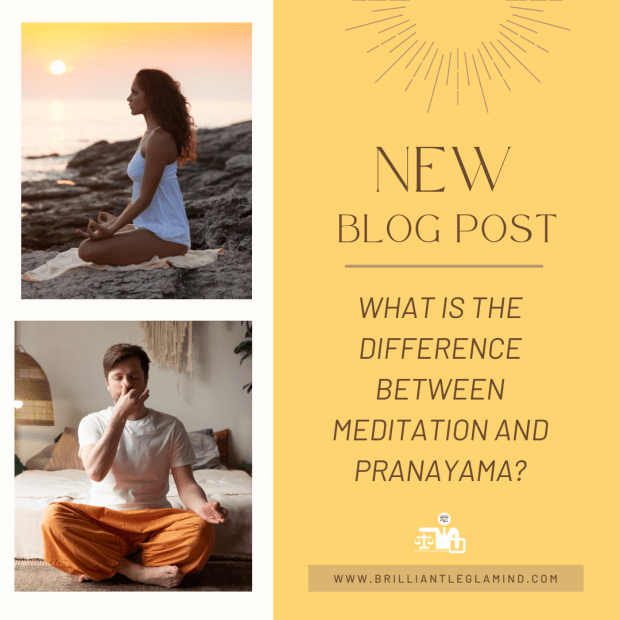
What Is the Difference Between Pranayama and Meditation?

Having taught meditation now for nearly 5 years, I commonly get comments in my sessions with comments about practices that aren’t, strictly speaking, meditation. They will rave about the benefits of box breathing or mention that their therapist/coach/yoga teacher taught them 4-7-8 breathing and it changed their life. I always welcome these comments and express agreement with their efficacy, since getting into technical differences of the practices is not always beneficial.

Even so, questions like these have made me curious about the differences between pranayama and meditation. Because my experience with meditation has primarily been based on practices derived from Buddhism and yoga has never been my first love, I used pranayama very little in my own practice. This summer, I decided to change that and obtained a certification to teach pranayama to expand my knowledge on the subject.

In truth, there are distinct differences between meditation and pranayama and these differences matter. That is not to say, however, that the practices cannot be effectively combined. This blog post will explore the differences to give you context so that you can decide how best to use them both to support your own practice.

Differences

The first notable difference between pranayama and meditation is origin. This issue can be a little tricky, of course, since there are many types of pranayama and many types of meditation. The secular study of both yogic and Buddhist practices and concepts has also led to a the development of further practices that may intertwine some of these ideas further.

The first fundamental difference between meditation and pranayama is breath. Though meditation very commonly involves the breath, focus on the breath is not required for meditation. Practices like loving-kindness or body scan, for instance, don’t use the breath as a focal point and numerous other focal points (such as a mantra, candle flame, sounds, or mental images) can be used in place of the breath. Pranayama, on the other hand, is the practice of working with the breath.

A less obvious difference is that pranayama derives from yogic practices and most of the most popular forms of meditation (Vipassana, Zen, loving-kindness, tonglen, etc.) derive from Buddhist philosophy. This distinction may not matter so much for practitioners who just want relief or a good support, but the different origins shed light on the different focuses of the practices.

Clearly, different teachers and schools of thought can modify this idea, but yogic philosophy is much more concerned with clearing the mind while Buddhist meditation is more intended to make peace with the mind. Thus, Vipassana or Zen meditators are usually encouraged to observe the breath and allow the mind to calm on its own. With pranayama, however, the breath is used as a tool and often manipulated for the purpose of clearing the mind, balancing energy, and creating physical benefits.

Similarities

Though there are differences between pranayama and meditation, they are not entirely distinct and need not always be kept separate. The first thing that pranayama and meditation share are the potential benefits. Because they both address the fundamentals of human life, both meditation and pranayama can result in mental and physical benefits. Done correctly, both practices can help the mind and body sync up and calm down.

For this very reason, both meditation and pranayama can be important and beneficial supports for individuals. They both deserve a place in a regular self-care regimen and they both can be used in the moment to maintain balance during difficult times. As one example, I really enjoy using alternate nostril breath during the day as a quick break to refresh myself and take a pause.

Another similarity is that pranayama and meditation go very nicely together. Yogic philosophy deems meditation as one of its eight limbs and so it is not uncommon for yoga classes to feature breath work and meditation. In the same way, many meditation teachers brought up in the Buddhist tradition (myself included) often incorporate pranayama into their guided meditation.

For instance, one way that I began experimenting with pranayama recently is to use it at the beginning of my meditation sessions as a way to quickly ground and relax myself. I have found ujayi breath to be a great tool for reconnecting with the breath due to its physical and auditory enhancements of the breath.

In short, pranayama and meditation are not the same. They have different origins and in many cases the purposes of the practices are distinct. Even so, they both have benefits for mental and physical health and they can complement each other nicely. Now that you understand how the practices are different but similar, the next step is to explore them both and determine what combination of practices work best for you.

Want to learn more about mindfulness and compassion? Check out my new book, How to Be a Badass Lawyer, for a simple guide to creating a meditation practice of your own in 30 days. And to share mindfulness with your little one, check out my new children’s book, Mommy Needs a Minute.

Like this post? Subscribe to the blog here or follow us on social media:

Review of Peloton’s Intro to Meditation Program

Image with title of blog post and picture of woman meditating with support of mobile device.

If you’ve followed the blog, you probably know by now that I am a fan of Peloton. Historically, however, I haven’t really used the Peloton platform to support my meditation practice because I prefer unguided meditation. Late last year, however, one of my favorite yoga instructors Aditi Shah announced the new intro to meditation program. As a maven of meditation, I did the program myself so I could tell you about it here.

Here’s an overview of the program, a summary of what I liked and didn’t like, and a bottom line conclusion for those of you considering it for yourself.

Program Structure

The Intro to Meditation Program structure is available on the Peloton app or any Peloton device. You don’t need any equipment to use it, though some headphones and a meditation spot or cushion sure help. The program is designed to be completed over the course of 3 weeks and consists of short (5-minute) instructional videos to explain basic concepts and 5 or 10-minute guided meditations for practice. The concepts covered include mindfulness of thoughts, mindfulness of body, metta (loving-kindness), and them mindfulness of emotions.

What I Like About the Program

Overall, I think the Intro to Meditation is a good start for those new to meditation and mindfulness. Here’s what I liked most.

It Has the Right Stuff.

In my new book, I created a structure for creating a mindfulness practice in 30 days. It included basic mindfulness, body awareness, reconnecting with joy (i.e. mindfulness of emotions) and loving-kindness. The Intro to Meditation program has these same concepts, though the order is different and it is presented in a different way. Thus, in terms of essential ingredients, I think Aditi and the Peloton team ticked the right boxes for the program.

I Love that It Includes Loving-Kindness.

This is a bit redundant from the point before, but it bears repeating: loving-kindness is a powerful practice that doesn’t get nearly enough attention. I was thrilled that the program devoted significant attention to the practice of loving-kindness. I was also glad that the program exposed those new to meditation to the practice because compassion is something that can make establishing a consistent meditation practice much easier.

Meditations Are Less Wordy.

I don’t normally do guided meditations because I enjoy silence, so I was pleasantly surprised that the program meditations actually included some silent spaces. I have done some Peloton meditations in the past that I wouldn’t even call meditations because they were so infused with imagery or storytelling that there was no space for my own awareness. These were comparatively less filled with words and allowed some space to experience the concepts taught in the program.

It Teaches Basic Concepts.

Peloton programs in my experience have instructed through the exercises themselves. I was pleasantly surprised when the Intro to Meditation Program included instructional talks to explain the basics of meditation and the science supporting it. In my experience, understanding the science of the practice has always helped me understand the “why” of what I was doing. As a result, I was glad that the Intro to Meditation program provided a context so that users could understand the practices as well as experience them.

Image with an overview of the 4 essential styles of meditation practice mentioned in the post: breath focus, body scan, loving-kindness, and mindful awareness of thoughts and emotions

Drawbacks of the Program

Even though I am a fan of Peloton and adore Aditi, I have to admit that the program is not perfect. Here are the things that I didn’t love about it.

Aditi Sounds Rehearsed at Times.

Aditi sounds pretty natural when I take her yoga classes, but she sounded rehearsed for most of the explanation videos. And, though I understand that Peloton sells fitness apparel, I thought it was silly that Aditi was wearing a sports bra with no shirt or sweatshirt when she was teaching the passive activity of meditation. To be fair, this was likely the result of a new format and the fact that Aditi was teaching in a new way. In order to get the content delivered in a time efficient way, she almost certainly had to be reading from a script. In other words, the experience of watching the explanation videos lacks the connection you might get even from other prerecorded Peloton classes.

Information Was Conveyed But Real Teaching Was Rare.

Along the same lines as the point above, the Intro to Meditation program provides information about meditation but it doesn’t really teach the subject. Clearly, this is a result of the forum and the intent for the program to only be an introduction to meditation. Even so, the explanation videos could have provided a few more stories or examples to give the content more life. The few that Aditi offered in the videos appeared heartfelt and were effective, so I hope future Peloton programs will dig a bit deeper on this point.

The Order of the Program Felt Scattered.

As I experienced when writing my book, it can be hard to identify the “best” starting point when teaching meditation. Though meditation practices often select a single focal point, our experience is rarely so isolated and usually includes a mishmash of sensory information, body sensations, thoughts, emotions, and external stimuli. Though I like that the Program included the right topics, I found the order somewhat confusing and scattered.

The Structure May Not Be the Best Tool for Establishing a Habit.

I am adamantly anti-perfectionist when it comes to meditation. I admit that I miss practice all the time and regularly have to revamp my own habits. Even so, when I do, the tried and true approach for me is getting back to a daily practice. My recommendation for those starting is to strive for a daily practice, even at shorter intervals, to put the habit on autopilot. The Peloton Program is not set up for daily practice, perhaps to avoid the “perfection trap.” While I respect that tactical choice, the drawback is that users of the Program may have a bit more difficulty establishing a practice.

Image of founder meditating with overlay of social media quote with conclusion from blog post

Overall Conclusion

The Intro to Meditation Program is an accessible tool to help the millions of Peloton users worldwide learn the basics of meditation practice. Though the Program doesn’t stand on its own to support a long-term meditation practice, that may not be a bad thing. It will likely leave users wanting more but meditation practice is to some degree about exploration. Because the Program makes trying meditation simple and easy, it is a good start for anyone new to meditation but hopefully not a final destination.

Want to learn more about mindfulness and compassion? Check out my new book, How to Be a Badass Lawyer, for a simple guide to creating a meditation practice of your own in 30 days. And to share mindfulness with your little one, check out my new children’s book, Mommy Needs a Minute.

Like this post? Subscribe to the blog here or follow us on social media:

What Law Firm Leaders Can Learn from Better Call Saul

I was watching Better Call Saul with my husband as Howard Hamlin, the law firm partner with perfectly quaffed blonde hair and a toothpaste commercial grin, appeared on screen. After meeting with the title character, Saul Goodman, Howard gets into an expensive vehicle and drives away to reveal a vanity plate that reads “NAMAST3”. We already knew that Howard had been struggling with his past and had turned to yoga and new-found spirituality to tame his inner demons. Unfortunately, as the audience eventually learns, Howard’s inner peace is much like the spelling on his vanity plate: not quite right. 

My husband smirked, turned to me and said, “Does that irritate you?” He was mocking me, but I was nerding out far too hard to acknowledge it. Instead of rolling my eyes at him, I replied “No, this is a great example about how easy it is to gaslight ourselves with spirituality.” Indeed it was, but it turned out to be a tragic one too. In Better Call Saul, Howard had turned to yoga and mindfulness to soothe his tortured soul after the downfall and death of his mentor and Saul’s brother, Charles McGill. 

Despite this new-found ethos, however, there is little evidence of reflection on Howard’s part about his preoccupation with appearing perfect or the practices of his own law firm. Tragically, Howard’s obsession with his reputation left him vulnerable to Saul’s tricks, and it ultimately lead to his own death and the implosion of his firm.

I talk about the power of mindfulness all the time, so it may seem strange that I would draw attention to Howard Hamlin. If anything, he shows us that mindfulness has limits, right? And, to be sure, the characters on Better Call Saul are generally examples of what not to do as attorneys. So why talk about them? 

I talk about them because, of course, there are limits to mindfulness practices. As Howard demonstrates, one of the dangers of mindfulness practice is that it can help you feel better temporarily or on a surface level without achieving the clarity needed for real peace. If you don’t have other supports to ground you, you may end up deluding yourself instead of growing and understanding yourself better.

The show doesn’t tell us what practices and teachers Howard relied on to develop his mindfulness practice, though his license plate suggests he went for yogic practices. The show offers clues, however, that Howard is otherwise intent on appearing serene when his life in many ways seems to be falling apart. Though he experienced the death of his law partner, strife in his firm, and an impending divorce, Howard seems intent on showing everyone how happy and at ease he is. There’s also no mention of Howard trying additional strategies, like therapy for example, to support himself.

I don’t say these things to suggest that Howard was a bad guy. He really wanted to be a good guy. He wanted to be a mentor to young lawyers. He wanted to be a good leader and build a law firm that lasted. The problem is that Howard was not an aware guy because he was afraid to see himself as he really was. In this way, Howard Hamlin was entirely human, but his obsession with looking at peace tragically got in the way of him ever finding it. 

Research is clear that mindfulness practices, including yoga, can help you reduce stress and feel more at peace. They do that, though, by helping you face yourself as you are and life as it is. Part of that means accepting your own imperfections and learning how to share them with others. As Howard Hamlin shows us, your so-called inner peace can get torn apart very easily when you can’t allow yourself to do this. 

The legal profession certainly needs more law firm leaders who are willing to be examples about leading a good life, including the practices that help them do it. So, if you are a serious yogi, go ahead and talk about it and keep that yoga mat in your office. But, don’t just talk about it and throw a vanity plate on your car. You also need to act on the values that have served you well. You need to be real in a way that Howard Hamlin never let himself be about the struggles you’ve had rather than merely trying to convey an illusion of spiritual purity. Not only do you deserve all the support you can get when you deal with hardships in life, your law firm may need you to get it. 

Indeed, research suggests that emotional intelligence and relationship-building are essential leadership traits. Even the best lawyers would struggle to do either of these things without being honest with themselves and others about who they really are. Law firm leaders who embrace mindfulness to help stabilize themselves can certainly use the practices to become better leaders for their firms.

But they shouldn’t do so with the objective of always looking calm and serene, especially not when real crises in life or law practice are happening. Instead, the practices are there to help you accept and face what is there–in yourself or in life–and greet it with compassion. When you can do this, there will be no need to tell people how at peace you are because you’ll show it with your life, law practice, and leadership every day.

Want to learn more about mindfulness and compassion? Check out my new book, How to Be a Badass Lawyer, for a simple guide to creating a meditation practice of your own in 30 days. And to share mindfulness with your little one, check out my new children’s book, Mommy Needs a Minute.

Like this post? Subscribe to the blog here or follow us on social media:

What Is Restorative Yoga and Why Should Lawyers Try It?

Lots of people tell me that they can’t meditate because they can’t sit still. I usually tell them that they don’t have to sit still to meditate. Strangely, people also tell me with a similar frequency that they can’t do yoga because they can’t do the poses. Sometimes they say that they can’t balance. Sometimes they say that they aren’t flexible. Sometimes they express a concern that they look silly. In other words, these people tell me the inverse of what the people who can’t sit still during meditation say: that they can’t move the right way during yoga.

When I hear these concerns, one of the first things I say is to acknowledge that I used to struggle with yoga too, but that letting go of the idea that there was a “right way” to move was what helped me learn to love it. One of the practices that helped me do this was restorative yoga. When I finally tried yoga for real, I already had an active meditation practice but it helped me realize I had to develop some ways of caring for my body in addition to my mind.

Though I’d been athletic growing up, I had not worked out consistently in years, so I started with yoga as a way to ease back into movement even though my earlier attempts with it had not been successful. Because I needed time to build up cardio endurance, I had to start with slow and gentle classes first. That’s when I found restorative yoga. Lucky for me, it was enough like meditation that I could enjoy it but different enough that it could serve as a segue into more yoga exploration.

Restorative yoga is a restful kind of yoga. Poses are part of the process, but the poses are supported rather than held. You don’t build strength and balance with the poses. You practice rest instead and you practice letting yourself be supported. In most cases, the poses are done lying on the floor, reclined on props, including blankets, blocks, or bolsters, or resting against the wall or a chair for support. This is because yogis hold the poses in restorative class for at least 5 and often as much as 15 or 20 minutes at a time.

So, why is this good for lawyers? It’s good for a lot of reasons. Restorative yoga practices rest and being supported. Most of us lawyers are in the habit of being active all of the time and doing many things on our own. For this reason, practicing another way of being is a way to offer balance to our lives. In addition, the poses themselves are beneficial to the body. Poses that help open the chest or arch the back may counteract the effects of sitting at a desk all day and inversions may balance hormones and offer relief from the effects of gravity and wearing uncomfortable shoes.

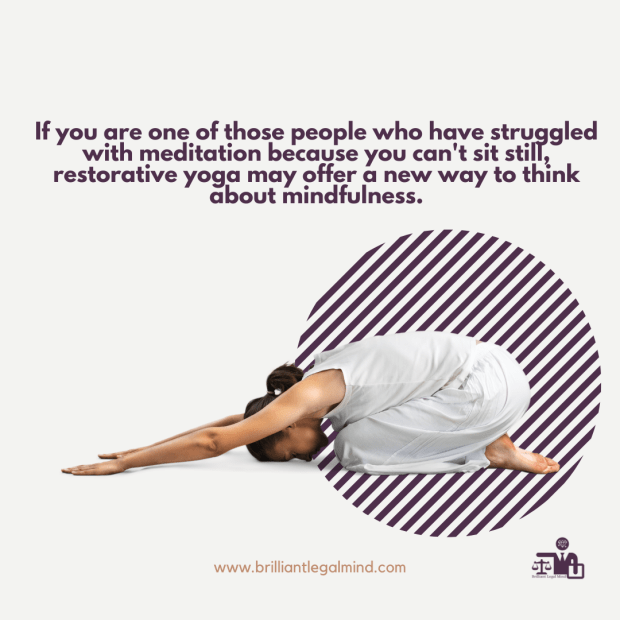
Finally, if you are one of those people who have struggled with meditation because you can’t sit still, restorative yoga may offer a new way to think about mindfulness. The instruction in most restorative classes is just to be in the experience of the pose, to feel oneself resting, and not to drift off in thought.

This is similar to the practice of sitting meditation, but it has some additional physical and restful components that may help you relax into and tolerate the experience more. Even if you enjoy meditation like I do, you may find that restorative yoga is a nice way to mix things up or can offer a chance to find mindfulness when life makes meditation seem a bit too intense.

If you are interested in learning more about restorative practice, you can find it at many yoga studios. Some fitness apps and online platforms, such as Peloton offer it too. In addition, you can easily start a home practice by finding a set of restorative props online.

You can also check out some of the work of Judith Hanson Lasater, Ph.D., P.T. Her book, Relax and Renew offers pictures and explanations of poses and full sequences to help you do the practices on your own at home.

Just as you don’t have to sit still to meditate, you don’t have to move to do yoga. Restorative yoga offers lawyers the chance to practice rest so that they can find peace in stillness and pay closer attention to how their bodies feel. It is a beautiful practice that offers people in stressful jobs many benefits. Giving you the chance to experience how expansive yoga can be is just one of them.

Do you want to try restorative yoga? Check out our Supported Fish Pose with Self-Kindness Guided Mediation. Or you can try our Legs Up the Wall Guided Meditation even if you don’t have any props. All you need are your legs and a wall.

Want to learn more about mindfulness and compassion? Check out my new book, How to Be a Badass Lawyer, for a simple guide to creating a meditation practice of your own in 30 days. And to share mindfulness with your little one, check out my new children’s book, Mommy Needs a Minute.

Like this post? Subscribe to the blog here or follow us on social media:

Riopy Crafts Music for Meditation and the Spirit

I have already written that I prefer to meditate in silence, so it had not really occurred to me to ever seek out music to support my meditation practice. Indeed, before hearing Riopy, I would have assumed that music would impede meditation, since it could churn up emotions or thoughts and make it harder for the mind to focus. But when I heard Riopy for the first time and learned about his story, I instantly understood how music and meditation could work very well together.

I had never heard of French pianist and composer, Riopy, until last year. As a chronically uncool person, I am always the last person to hear about any new kind of music. So, I rely on friends or the media I consume to tip me off about new things I might enjoy. Since I have already discussed my love of Peloton multiple times on the blog, it won’t surprise you that it’s what led me to Riopy too. Last year, I took Peloton’s Riopy slow flow class one night when I wanted some nice evening yoga. I was just looking to move a little after sitting at a desk all day, but I ended up being moved in a totally unexpected way.

As the class went on, the instructor, Aditi Shah, explained that Riopy had a past history with anxiety, depression, and substance abuse. Though music had offered him solace over the years, he found a peace in meditation that helped him heal and keep creating. This helped him realize that he didn’t need mind-altering substances or unhappiness to fuel his craft. When he tried meditation, he found his muse in stillness and peace and began creating music for meditation.  His music, which is primarily piano instrumentals, sounds like it. Indeed, several of Riopy’s pieces are called “meditations” including his most well-known (and my favorite) piece, “Meditation No. 22”, which is made to support a 22-minute meditation session. 

Now, you may think that piano music crafted by a man with a history of depression and fondness of meditation might be morose, heavy, or even dark. But it’s not. Though Riopy’s works do not shy away from the heavy or dark, they are light, delicate, and intimate. Overall, the tone of the pieces is playful and sounds like a flow state and the beauty that derives from it. Some, like “Caught in Infinity” from Breathe, can capture joy and sorrow in the same piece and not just in certain movements but, at times, in the same moment. While the pieces don’t tell stories the same way popular songs might, they seem to tell stories about past states of mind. Listening to them, each note seems to represent a moment in meditation and you can almost envision the very meditation from which the melody was born.

I have little musical talent and even less training and knowledge, but Riopy’s music reminded me in the strangest way of my own life. I don’t hear music when I meditate, but I can see how somebody trained in music might. When I sit, all the words in my mind get a chance to spread out. Like kids in a bouncy house, they jump around and play and come up with all kinds of combinations and notions that I would never be able to appreciate if I were doing something else. This is why I loved Riopy right away: because his music reminded me of how meditation helps me write. His music sounds like my mind taking a breath, letting itself dance, and sweeping words and ideas into their proper places in the process, without the well-meaning but unhelpful meddling of my ego. 

Since I like the space that silence gives my meditation, I usually don’t listen to Riopy when I meditate, but I frequently listen to his music when I work or write or do yoga. The calming tone of the music aids relaxation and the absence of words means it doesn’t distract or clash with other mental processing. His music is available on most major outlets, like Spotify, Apple Music, and Amazon. He has a new album out currently, Bliss, as well as a collection of many others. You can also find an extended, hour-long, version of his “Meditation 22” on the Calm app.

You may not meditate at all or need music to support your meditation practice. You also may not be drawn to Riopy’s music for the peculiar reason that I have come to love it. But, if you want some beautiful music to bring calm and peace into your life or help you appreciate the value of fleeting, delicate moments, check Riopy’s music out.

Want to learn more about mindfulness and compassion? Check out my new book, How to Be a Badass Lawyer, for a simple guide to creating a meditation practice of your own in 30 days. And to share mindfulness with your little one, check out my new children’s book, Mommy Needs a Minute.

Like this post? Subscribe to the blog here or follow us on social media: