Mindfulness vs. Ego: Finding Balance in a Digital World

Image of pawns with social media graphics with title "Mindfulness v. Ego: Finding Balance in a Digital World"

I spoke to a group of new law students this week and someone asked the best question about mindfulness and ego. I loved it because it showed a lot of courage and insight. The student asked me if mindfulness practice and blogging or social media are at odds because they contribute to ego.

The short answer I gave him is that this certainly can be a problem but it doesn’t have to be. I explained that anyone who writes or uses social media must learn some skills with managing their ego. And I explained how mindfulness practice can help with that.

After leaving the session, though, the question was still in my mind. It pointed to some fundamental questions about mindfulness and ego that I thought others might be asking. So in this post, I will explore mindfulness and ego a bit more deeply.

What Is the Ego?

Many of us use the word “ego” in conversation but we may not take the time to define the term. A common dictionary definition is “a person’s sense of self-esteem or self-importance.” Most of us wouldn’t argue that a healthy sense of self-esteem is a good thing.

But when I hear the phrase “ego” uttered, it usually has a pejorative connotation. This is because, as most lawyers have observed, it is very easy to get an inflated sense of self-importance. In fact, our hyper-individualistic culture can contribute to this.

This is why it may be helpful to look at the psychological and clinical meaning of the ego. The Cleveland Clinic explains that it is the “part of your personality that helps you make practical, rational decisions.” It also supports your ability to:

  • adapt to your environment;
  • regulate your emotions; and
  • feel like yourself.

Viewed in this more neutral light, you can see that ego is a part of the human psyche that may serve an important function.

Image of dictionary definition of ego as stated in the post which is "a person's sense of self-esteem or self-importance"

You Need a Healthy Sense of Self-Esteem

Given this, it would be a misunderstanding in my opinion to say that the goal of mindfulness practice is to overcome or eliminate the ego. In truth, as I have written before, I would be cautious about setting any specific goal for mindfulness practice at all.

Intention can be a wonderful guiding force to help motivate practice. Goals, however, often add a level of expectation that can undermine the cultivation of mindfulness.

In addition, high achievers like lawyers are encouraged to be cautious about pushing themselves too hard when it comes to self-improvement. If you are anything like me, you may need to learn to be kinder to yourself in meditation rather than more disciplined.

Along the same lines, some people may benefit from a more robust sense of self rather than a diminished one. This can include people with particular sensitivities, including histories of trauma or neurodivergence.

But It Helps to Get Clear about Your Life

With that said, mindfulness practices can help you explore the role of ego in your own life. As I have explained before, mindfulness practices are likely to help you explore the very concept of the self. Practicing mindfulness can help you see that “the self” to which you have grown accustomed is not a stable or static thing at all.

Taking time in your day to be present with your thoughts and feelings can give you an opportunity to become aware of patterns in your life. This can give you greater ability to notice, check, or even change some patterns that may not be ideal for you. It may also help you see the ways in which you are not separate from, but instead integrally connected with, others.

In many cases, you are bound to find (much like I have) that the ego is a present driving force in life. You may notice when a need to feel important or especially loved or better than others pushes you in ways that are not wholesome for you or other people. And even better, you may see ways that you can take care of your feelings and find greater connection with others in your life.

In all of these ways, mindfulness can help you understand yourself better, including the role of ego in your life. It can help you become clearer about your place in the world, so that you can navigate relationships more ethically. This can be a truly wonderful and life-changing part of the practice, but it is important to balance this inquiry with self-compassion.

Image of blog post author Claire E. Parsons with quote "Mindfulness practice doesn't mean we have to drop out of the world. It doesn't mean we can't pursue goals or things we love. It doesn't mean we have to change who we are."

Mindfulness, Ego, and Social Media

Given this clearer understanding, I want to return to the law student’s question to illustrate the concepts more clearly. The student asked whether things like blogging and social media are contrary to mindfulness practice because they can contribute to ego.

The operative word in this question is “can”. Most of us know that social media can certainly contribute to one’s sense of self-importance. We know that, depending on how it is used, social media is also associated with adverse mental health consequences and sometimes abhorrent conduct. Even if you aren’t a blogger, you may see how that can have the same effect. But I will say from experience that those things aren’t universally true.

For some people, blogging and social media might lead to unhealthy states of mind, like social comparison or perfectionism. I’d be lying if I didn’t admit that those struggles sometimes happened for me. But I have learned to recognize when a striving attitude is taking hold and to give myself a break. I have adopted an attitude of fun and play when it comes to writing and the use of social media. I’ve also let go of expectations. If I have a goal, it is to share ideas and connect with others.

And in truth, I have had to learn how to navigate the negative aspects of social media too. I have had to learn how to not fight with strangers on the internet. I have hard to learn to state my opinions with humility and respect for the viewpoints of others.

In addition, I will be honest that blogging and social media have inspired a lot of humility in me. I have written so many things that never get read. I have had times where people criticize my writing. I have faced imposter syndrome so many times when I see talented people who do things better than me. In all these ways, blogging and social media have provided at least as many checks on my ego as they have provided temptations for it.

What Does This Tell Us about Mindfulness, Ego, and Pursuing Goals?

The big conclusion from all of this that most lawyers will care about is that I don’t think mindfulness practice means we have to get rid of our egos. Mindfulness practice doesn’t mean we have to drop out of the world. It doesn’t mean we can’t pursue goals or things we love. It doesn’t mean we have to change who we are.

Instead, mindfulness practice is really more about understanding ourselves more clearly so that we can engage in the world with greater kindness and skill. In this way, mindfulness practice is not inherently antithetical to the use of social media or to creating a robust body of work in the world.

The caveat here is that, of course, mindfulness practice should inspire you to watch the way you go about pursuing goals and crafting your body of work. It should cause you, at every turn, to consider the impact of these things on you as well as on the community around you.

If you practice mindfulness long enough, you inevitably will question yourself at times just like the law student questioned me. This part of the practice can sometimes be a gut check – or maybe an ego check – but it is one that has changed my life. And it is one that helps me stay honest on this blog and when I use social media. If you learn to make space for questions like these in your own mindfulness practice, they can change your life too.


Want to learn more about mindfulness and compassion? Check out my new book, How to Be a Badass Lawyer, for a simple guide to creating a meditation practice of your own in 30 days. And to share mindfulness with your little one, check out my new children’s book, Mommy Needs a Minute.

Like this post? Subscribe to the blog here or follow us on social media:

4 Key Traits of Effective Anchoring Practices

Cover image for blog post entitled "4 Key Traits of Effective Anchoring Practices"

I have had a busy few months and it doesn’t look like things are going to slow down any time soon. When things get like this for me, I really appreciate the anchoring practices in my life to keep me steady. In case you don’t know what that means, this post will explain it and help you identify the practices that may serves as anchors for you.

What Is An Anchoring Practice?

Anchoring practices are the things we do in daily life that help us feel steady, nourished, focused, and in a state of flow. The practices that serve this purpose for me most frequently are meditation, exercise, writing, and cooking. You would think that in busy or turbulent times, these practices would be the first to go.

Over the years, though, I have noticed that the opposite is true. Rather than let these habits go when I am too busy, I rely on them even more. This is how the practices serve as anchors. They keep me grounded, steady, and calm enough to face life, busy and crazy as it is.

How to Identify Anchoring Practices for Your Life?

If you have practices in your life that serve the same purpose, you may be able to identify them very quickly. Many lawyers and professionals, though, don’t have time or reason to think this through. I find it helpful to have a framework for my well-being, though, because I can use it as a guide in times when I struggle or get stuck.

In case you need some help establishing or identifying potential anchoring practices for your own life, here are the four hallmark traits to consider.

1. You Genuinely Enjoy It.

For a practice to serve as an anchor for you, it needs to be something you will do consistently. To some degree, then, this means that you need to sincerely enjoy it. Does this mean that it will always be easy, risk free, or only feel good?

Not necessarily. When a practice becomes like that, you may get bored with it and it won’t keep your attention very well. A little bit of challenge and even some risk might be present in any good anchoring practice. But still there has to be something there that calls you back and draws you in again and again.

Crazy as it sounds, meditation serves this purpose for me. Yes, it is often boring and sometimes a struggle. But after years of practice I have come to enjoy it and generally like how it feels when I meditate. What practices are like this for you?

2. It Allows You to Be Yourself.

Another important thing about anchoring practices is that they allow you take your armor off. By this, I mean that you can really tell that something is an anchor for you if you feel like you can be yourself while doing it.

When you do the practice, there is no pretending or putting on a happy face or trying to appear professional. Instead, there is just you and the practice. It’s you as you are doing something you love.

Cooking is an anchoring practice for me because it allows my creativity and resourcefulness to shine. What activity in your life makes you feel like your most authentic self?

Image with 4 key traits of effective anchoring practices as shared in the blog post

3. It Nourishes You.

Another reason that you may come back again and again to anchoring practices is that they always give you what you need. This is to say that they nourish you in some way.

In many cases, lawyers have most of our basic needs met. As people who tend to be time poor, however, some essential human needs may get neglected. For many lawyers, and professionals, then, the most beneficial daily habits may give us a chance to get what we don’t otherwise get at work.

The practice that showcases this best for me is exercise. I love my law practice but it involves a lot of sitting around at my computer or talking on the phone. My daily Peloton workouts give me a chance to move, relax, and release excess stress. What practice in your life nourishes you?

4. It Creates Connections.

A final feature about anchoring practices is that they create connections. As noted above, this may include a chance to get in touch with oneself. In general, though, practices that connect us to others or something bigger tend to be the ones that stick with us throughout our lives.

All of the practices I mentioned above have this connecting force too, but the one that exemplifies it most for me is writing. As I have shared before, I am an introvert and can easily get very lost in my own thoughts and experience. It has been hard for me over the years to share my ideas with others and it took me a long time to learn to be myself.

Writing helped me do that. Though I do most of my writing on my own, sharing my work helped me create a community and build confidence in myself in all other areas of my life. What regular practices in your life create connections for you?

Want to Explore Further?

Though anchoring practices are not one size fits all, they have some essential features. If you are trying to identify or establish anchoring practices in your own life, look for these four things: (1) enjoyment; (2) authenticity; (3) nourishment; and (4) connection.

To explore this idea more, check out the Personal Well-Being Worksheet. It will help you identify the practices that support all aspects of personal well-being by guiding you through an assessment of basic needs.


Want to learn more about mindfulness and compassion? Check out my new book, How to Be a Badass Lawyer, for a simple guide to creating a meditation practice of your own in 30 days. And to share mindfulness with your little one, check out my new children’s book, Mommy Needs a Minute.

Like this post? Subscribe to the blog here or follow us on social media:

The Connection Between Mindfulness and Writing Success

Cover image for appearance on Dear Indie Author podcast on mindfulness and writing

As a mindfulness teacher and blogger, the connection between mindfulness practice and writing comes up for me a lot. Though I have always been drawn to writing and I do it every day in my work as a lawyer, I didn’t always consider myself a writer. It took many years for it to emerge as a real passion and part of my life.

How Meditation Led to Writing

If I never started meditating, there’s a good chance that I never would have discovered this meaningful pastime at all. As I have explained before, meditation helped me create the mental space that was necessary to recognize some of my copious thoughts as ideas. Over time, I also cultivated self-compassion and became more aware of latent judgments, so I could get ideas on the page.

Then, finally all the time sitting in meditation and the benefits it imparted convinced me of something fundamental: using some of my time to please myself was worthwhile. This helped me get over all the fears about writing being a “waste of time” or “too much work” or that “nobody would care.”

The Interview Discussing Mindfulness and Writing

I was fortunate to get a chance to discuss all of these things and more with fellow writer and coach, Shonda Ramsey. I met Shonda online when I saw her searching for self-published authors. Writing my first book was a great experience and one that has led to many other wonderful opportunities in my life.

I was glad to get to talk to Shonda about it and explain how mindfulness and creativity are interconnected. I was also pleased to discuss the fact that writing, a traditionally lonely endeavor, was something that led me to cultivate greater community. In fact, I was proud to share that I got help from a book coach to make the leap from blogger to author quickly.

How to Watch or Listen to the Interview

If you are interested in writing or wonder what mindfulness can do to help you get more creative in life, check out the full interview on the Dear Indie Author podcast. You can listen online, Apple Podcasts, or Spotify or watch the interview on YouTube here:


Like this post? Subscribe to the blog here or follow us on social media:

Want to learn more about mindfulness and compassion? Check out my new book, How to Be a Badass Lawyer, for a simple guide to creating a meditation practice of your own in 30 days. And to share mindfulness with your little one, check out my new children’s book, Mommy Needs a Minute.

Mindfulness and the Life-Changing Magic of Opening Up

Cover image for a blog post titled mindfulness and the life-changing magic of opening up

Focusing on progress with mindfulness practice is not without its risks. It is easy to get sidetracked from the daily work of practice by obsessing about one’s growth and all the benefits practice has bestowed. If taken too far, this could lead to frustration and impatience or, on the other hand, arrogance and malaise.

Even so, it is worthwhile from time to time to consider progress and growth. As a blogger, I have intentionally celebrated milestones whenever possible to maintain my own motivation. I started this blog on my own and, though it has certainly helped me develop community, the daily work of writing can be a lonely business.

A Confluence of Milestone Moments

For this reason, I was fortunate over the last few days to have a confluence of milestone moments. Much like the recent eclipse, the conjunction of all of these things lining up together made me stop and take notice. So what were these milestone moments?

The first one is that this is the 200th post on the blog. As my fav Peloton instructor might remark on a milestone ride, nobody does anything 200 times by accident. This is a meaningful recognition for me since most of my experience with this blog felt like an experiment.

I enjoy building things. I’m meticulous by nature and I am comfortable going step by step. When I launched this blog in December, 2020, though, I didn’t have a clear idea about what I was building. At the time, the blog was an act of celebration and an acknowledgement of how much I enjoy writing.

An image with a quote about milestones and making habits, including mindfulness, a part of your life

Celebrating 200 Blog Posts

All this time, I have managed the blog while raising two girls, managing a law practice, and teaching mindfulness and compassion. Given this context, managing to generate content consistently often felt like a game of keeping a helium balloon in the air. I had to keep tapping away or the balloon would fall.

In fact, for a period I let the ball drop so that I could focus on writing my first book. Getting to 200 posts feels good because I was able to get back in the game. I’ve often been worried that life would happen and my writing would stop. Now I see that my writing is part of my life.

A Blast from the Past

The next item that spurred reflection was not truly a milestone, but instead a blast from my past. In 2020, just a few months before I launched the blog, a woman named Janice Windt profiled me for her blog about working moms. In the post, I shared about my history with postpartum depression and how cultivating self-compassion helped me heal and thrive.

Janice reached out last week to check in because she was reactivating the series. I checked the old post and saw the date–August, 2020. I immediately recognized this as the time just before I became certified as a meditation teacher and launched the blog.

It was pretty fun to catch up with Janice and send her an update on all that has happened in the last four years. Sometimes we don’t know how small steps might affect our lives when we take them. It was nice to have a chance to think about how much can come from putting a little energy and time into a new idea.

An image with a quote about how big change can from putting time and energy small practices like mindfulness

Sharing My Story with Friends

The last milestone moment is my favorite because it was celebrated with friends. I got to deliver a dharma talk for my local meditation community this past weekend. For those who aren’t familiar, this is lecture about Buddhism in community, similar to a homily at mass.

Since I don’t profess to be a teacher of the dharma, this is not something I have ever done before. I usually teach about mindfulness or meditation practice and my talks are usually much more practical. With this talk, I got to share my story about the winding road that led me to become a meditation teacher.

I was nervous to give the talk since I had been only an occasional visitor to the community and wasn’t sure how someone with a variety of influences might be received. As I spoke, though, my fears vanished. The group was engaged and we had such good discussion afterward.

The Call to Help Others

And what do you suppose was the theme of my talk? It was called “Stumbling onto the Bodhisattva Path.” It was inspired by The Way of the Bodhisattva by Shantideva, a classical poem that is well worth a read and in-depth study.

A bodhisattva is someone who trains in mindfulness and compassion in order to alleviate the suffering of others. Many of us who are brought up in the Christian faith may hear this and think it is essentially a saint. The point of my talk is that helping others is more ordinary and available to us all than we may think. It can even come as a surprise on the journey of life.

An image with a quote about opening up to oneself through mindfulness and others can be life-changing

What does this have to do with opening up?

As I was driving home from the talk, I was feeling an emotion that was hard to identify. I left the radio off so I could sit with it without distraction as I drove. There was a sense of connection, satisfaction, and well-being. And the title for this post, a playful rif on Marie Kondo‘s famous work The Life-Changing Magic of Tidying Up, popped into my mind.

Opening up can indeed by life-changing. To an overthinking, perfectionist introvert like me, it can feel like magic. Mediation helped me slowly learn to open up to myself. Then writing and teaching mindfulness helped me learn to open up to others. Both have had a huge impact on my life.

With this post, I am celebrating progress because hard work and dedication deserves a celebration. I won’t let this reflection distract me for too long from my daily work, though. The daily work of meditation, teaching, and writing is where I have found the connection that is my biggest reward.

An image thanking all the readers and followers of the Brilliant Legal Mind blog which offers teachings and resources on mindfulness to lawyers

Want to learn more about mindfulness and compassion? Check out my new book, How to Be a Badass Lawyer, for a simple guide to creating a meditation practice of your own in 30 days. And to share mindfulness with your little one, check out my new children’s book, Mommy Needs a Minute.

Like this post? Subscribe to the blog here or follow us on social media:

New Writing Event with the Mindfulness in Law Society

The Mindfulness in Law Society reached out and asked if I wanted to do a community event for the larger group. I have been guiding the virtual sits for about a year now and taught at the virtual retreat last fall. For this event, though, they didn’t want me to guide a meditation. They wanted me to teach.

When we did the meeting to plan this session, I expected they would have something in mind. To my delight and surprise, they didn’t have preconceived notions. Instead, the organizer and I discussed some of my recent speaking engagements and I told her about a Ted-style talk I had done on thought leadership for the FDCC. She saw my face light up and suggested that the topic relate to the intersection of writing and mindfulness.

I very happily agreed. My writing and mindfulness practice grew up together. They reinforce each other. Writing helps me let go of thoughts and mindfulness helps me see which ones are worth exploring further. In the span of about six years, I went from being the occasional author to articles in trade magazines, to a daily poster on LinkedIn, then to a weekly blogger and book author.

I don’t claim to be an expert, but this experience and my mindfulness training has helped me develop some tips and best practices for creativity. On April 24th at 12 PM EST, I hope you will join me and the Mindfulness in Law Society online for a session where I’ll discuss this. I will share the top 5 ways that my mindfulness practice helped spur my creativity and I expect some other authors will join and share their tips as well.

This event is open to anyone in the legal profession, which includes lawyers (including those in law adjacent fields), law students, law professors, and support staff. Please join us or reach out if you have any questions. You can register here.


Want to learn more about mindfulness and compassion? Check out my new book, How to Be a Badass Lawyer, for a simple guide to creating a meditation practice of your own in 30 days. And to share mindfulness with your little one, check out my new children’s book, Mommy Needs a Minute.

Like this post? Subscribe to the blog here or follow us on social media:

Writing About Your Darkest Moments Feels So Damn Good

Blog post image with the Title Writing about Your Darkest Moments Feels So Damn Good

Can you help me understand something? Like seriously. I need someone else to explain this to me slowly and in small words. Why does writing about my dark times in life feel so good?

I have had these times in my life. Experiences that are just awful. So awful, in fact, that I don’t even want to acknowledge them when they are happening.

Then I survive them and time passes. And I find myself not just journaling about them, but publishing pieces about them. Every time I do this, it scares me. Every time, I think “This is going to be the last straw. This is going to be the one where people say I have gone too far.” But that last straw never seems to come.

Writing About Dark Times Feels Good

Instead, what happens is that I feel good. Damn good. So damn good that I repeat the cycle again. What is this? Can you help me identify this phenomenon?

Case in point. I just published an article for Above the Law – one of the most well read legal blogs on the internet. The topic of my article was loneliness. While a common affliction these days, especially for lawyers who rate themselves as the loneliest of professions, loneliness also commonly induces shame.

Image with the mental health inspiration phrase If I'm already a mess I can try being a mess in public.

Why Does Writing About Dark Times Help?

This was true for me. I was so ashamed of my own loneliness that it took me years and a bout with postpartum depression to start to face it. Ultimately, my meditation practice forced me to reckon with it because sitting still without distraction made me unable to look away. As I learned, this pain was worth it because facing the problem eventually helped me address it.

But at the time, the idea of saying to myself “I have no friends” was too painful to bear. Fast forward ten years, and I decided to tell the internet about it. The weird thing is that I don’t feel ashamed anymore. I feel fantastic. What gives?

Writing Can Help You Process Emotions

Now, you would be correct to point out that the response from my community has been heartening. I received nothing but positive comments and messages in response to my post. One contact on LinkedIn even offered to be my friend and a legal scholar of ethics dubbed me the Lawyer of the Week for my post.

Certainly, seeing the reality of what people really think juxtaposed against the tragedy of shame playing out in our minds can help us get perspective. But this isn’t a one-off scenario. At this point, this is a pattern for me.

Writing Is Sharing and That Means Confronting Shame

I have written about my experience with postpartum depression, and my struggle with alcohol during the pandemic, and my fear of networking, and my challenges with anger management. All of these things in the moment made me feel deeply ashamed. Writing about all of them made me feel great.

Image with a quote about mindfulness and the power of acknowledging our experiences

And, though I got similarly positive responses to those posts, the great feelings happened before any public response. The good feelings started when I decided to write. They climaxed when I wrote and cried my way through the editing process. And they continued as I hit send or publish on the piece.

Writing Can Be Scary at First But It Ultimately Feels Good

So what are these great feelings? If I had to offer one word, I would call it self-acceptance. Writing about our past experiences forces us to get clear about them. It forces us to recall what happened, acknowledge all the angst and fear there, and not look away.

In general, the form of story telling also calls on us to provide a narrative structure. It’s not enough to just say what we experienced; we next have to say where it took us and what we learned. That means we have to figure out the meaning of the experience.

Writing about Traumatic Experiences

I have read that writing about a traumatic experience can help us process it. My lived experience tells me this is true. I don’t know of any research that says publishing your work has any added benefits, but I have felt them myself.

When I have published the pieces about my dark moments, it’s like self-acceptance on steroids. I know that some people may judge me. I know that some people may criticize. I publish anyway. Usually, I have been motivated to do so because I know that I am not alone in dealing with the issue. For example, all of the dark experiences I have shared (depression, alcohol, loneliness, imposter syndrome) are things lawyers commonly face.

Image with a phrase that says writing about challenging experiences can offer mental health benefits

But when I share my story with these experiences, I highlight my story and take the risk that some might not understand. When I do, I remember how much of my life was spent tip-toeing around people who might not get me and I say to myself “not anymore.”

Writing Lets Us Share Our Story and Make Sense of It

So perhaps I have figured this out on my own. Writing about dark moments in life isn’t without pain or risk, but it feels damn good. It feels good to acknowledge your own experience and understand what it means. It feels good to own your story no matter what people might think.

Justice Louis D. Brandeis (the namesake for my law school) famously said “Sunlight is said to be the best of disinfectants.” He wasn’t talking about mental health here but the saying still applies. If you are struggling with dark moments, try bringing in some light. Talk it out, write it out, share it with those you trust. Your story matters and acknowledging it can feel damn good.


Want to learn more about mindfulness and compassion? Check out my new book, How to Be a Badass Lawyer, for a simple guide to creating a meditation practice of your own in 30 days. And to share mindfulness with your little one, check out my new children’s book, Mommy Needs a Minute.

Like this post? Subscribe to the blog here or follow us on social media:

Balance Is My Mantra: An Interview with Lawyer, Author, Mom, Community Leader, and Meditator, Tahmina Watson

My friend, Tahmina Watson, is one of the most accomplished lawyers I know. She’s an immigration lawyer, mom, community leader, podcaster, as of today, the author of three books, and an avid birdwatcher and photographer. Like me, meditation has been part of what helps her balance all of these demands and interests. In celebration of her latest book, which is released appropriately today on July 4th, I offer this interview to share information about a different style of meditation and a new story showcasing the benefits of meditation for lawyers.

Q. Tahmina, can you tell me a little bit about yourself?

A. I’m an immigration attorney in Seattle, Washington. My firm, Watson Immigration Law, is a boutique firm that focuses on business immigration law, which primarily serves small to mid-size businesses. And within business immigration I have a specific focus on startups and visas. We do a little bit of family-based immigration (parents, spouses, children) and some citizenship work as well. I don’t normally do defense in immigration court, but as a community leader I have volunteered to serve humanitarian interests relating to immigration. I’m also the author of three books, a podcaster, a columnist for Above the Law, a bar leader, and an avid birdwatcher.

Q. How did you become interested in immigration law?

It was very random. I moved from the United Kingdom to be with my American husband, and I really didn’t want to practice immigration law. When I moved from the UK, my UK law degree and experience as a barrister did not mean I could obtain a license to practice in the U.S. I took the New York bar exam because it was the one that I could take without going to law school again. But that limited my practice options to federal law since I lived in Washington State. Immigration matters kept coming my way, even though I said no to it about four times. And then the fifth time I said, Okay, well, let’s just do this.

The first day of practicing immigration law made me realize I wanted to keep going. It’s fast paced and intellectually challenging. I’m touching people’s hearts and minds and lives very tangibly. I can see the results of the work and I’m really helping people’s lives for generations to come. It allows me to work with intelligent people who have ambitious goals of changing the world every day, and that really fulfills me in trying to make their dreams come true.

Q. I know you had a really positive experience with meditation. Can you tell me a little bit about your practice and how you got started with it?

Political turmoil over the last several years has created a lot of stress in my law practice. It was overwhelming to be able to practice law, serve my community, be a mother and a wife, and do all the things I do. I was stressed and the stress kept building. And I didn’t really know what the answer was, but I considered meditation even though I wasn’t really sure what it was. I used the Insight Timer app on my phone informally and as needed for a while and that was an entry point for me. But, I had a few incidents where I realized I really needed to have a more robust meditation practice.

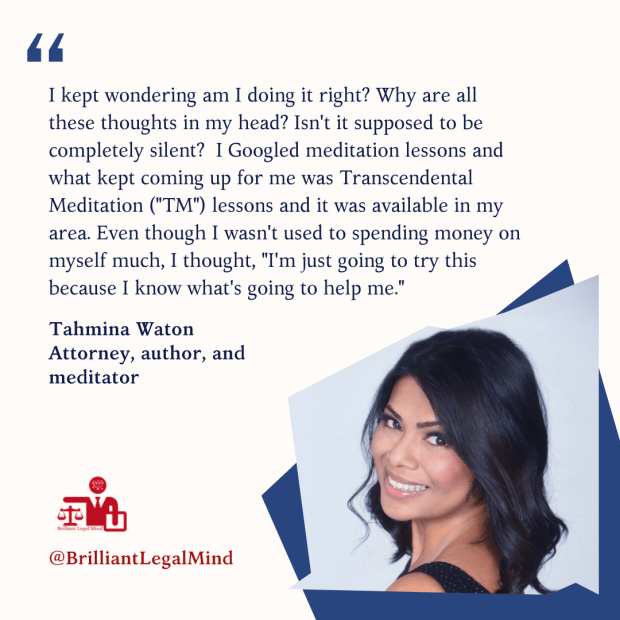
I kept wondering am I doing it right? Why are all these thoughts in my head? Isn’t it supposed to be completely silent? I Googled meditation lessons and what kept coming up for me was Transcendental Meditation (“TM”) lessons and it was available in my area. Even though I wasn’t used to spending money on myself much, I thought, “I’m just going to try this because I know what’s going to help me.” And I also realized that if I didn’t do something about it for me, I would not be able to help my children learn how to manage their own stress.

One of the things that initially concerned me was how do I even find time to go to this training? Because I think one of the things that we all think about is we don’t have time to do extra things, but I put it on the calendar and I attended all of the classes. The TM method recommends two 20-minue meditation sessions a day. Though I confess that I still don’t have that second meditation block, but my first meditation block has served me very well.

Now, once I went through the training, I had to find that 20-minute block of time for practice through trial and error and trial and error. It took me about nine months, believe it or not, to find that practice time. Where was my space? Where was my time? Where was the moment that I could actually have that block without somebody bothering me or a kid jumping in and saying I need this or a client calling or an email popping up? Where was that? I eventually found solace in my parking garage, where it was dark but I have come to cherish that time. So it became my practice of doing TM 20 minutes a day, first thing in the morning after dropping my child off at school.

Q. For those of us who don’t do TM, can you explain procedurally what the practice consists of and how you use the practice in your life?

TM starts with completing a questionnaire with the trained teachers. Based on your answers, they assign a mantra (word or small phrase) that is unique to you. You’re not supposed to share it. When you sit down to meditate you’re supposed to repeat that mantra over and over again. It doesn’t mean that the monkey mind won’t wander, but when it does you come back to your mantra. The mantra is almost like the guiding force for you. The practice method is very simple; you sit down for 20 minutes and repeat that mantra in your head.

Q. What did you do to bring your meditation practice back or shift it to make it work for your life as it is now?

I think what happened during COVID, and we all experienced it, was that suddenly our lives changed. Suddenly there were two kids having school in my house and my husband and I figuring out how to practice law at home. This made it challenging to find a quiet time in the house again. At first, I actually started to stand on my deck and just be outside and we take a few moments to take some deep breaths and that allowed me to really be out in nature. Eventually, I began waking up earlier in the day before the kids woke up so I could resume formal meditation practice. I have gone through various iterations, but I had been able to finally incorporate meditation back into my life with a daily practice of 20 minutes or getting outside. Sometimes my meditation is walking outside in nature and sometimes I do TM for 20 minutes.

Q. How does meditation help you balance everything?

When I was working on one of my books, I was already waking up early to meditate and had to get up even earlier to get in some time for writing. Once I got on this routine established, I didn’t want to break the chain that developed. I continued with that early morning rising and that’s how I would incorporate my meditation first and then my writing. This was never a perfect schedule and sometimes I slept in, but meditation for me was a constant.

Even if it was only a few minutes, meditation became the foundation to continue to be calm and proactive and not reactive, but reflective. And that helped with everything around me. It helps me stay steady when the clients are anxious because their lives or their livelihoods are at stake. Like me, they are often high achievers who are naturally anxious people. And I didn’t really realize how much anxiety I was taking on with each anxious client. But then I realized this meditation was my shield, but also my mirror for them. And so the meditation is really the beginning and end of everything I do, because it’s the foundation to be able to handle as much as you know, that life throws at me all you when I believe that’s how you are able to deal with everything.

To learn more about Tahmina, you can connect with her on LinkedIn. You can read her column on Above the Law or find all of her books on Amazon, including The Start Up Visa: US Immigration Guide for Startups and Founders, which releases today.

Want to learn more about mindfulness and compassion? Check out my new book, How to Be a Badass Lawyer, for a simple guide to creating a meditation practice of your own in 30 days. And to share mindfulness with your little one, check out my new children’s book, Mommy Needs a Minute.

Like this post? Subscribe to the blog here or follow us on social media:

Four Situations in Which Meditation May Not Be the Answer

On a blog about mindfulness, the title for this post may be surprising. I have touted the benefits of meditation for more than two years now and explained myriad meditation practices. Nevertheless, I seem to be admitting here that meditation is not a solution for all problems.

To be perfectly clear, I am not merely seeming to make this admission; I am freely and fully admitting it. Meditation is not always the answer. Over the last ten years, meditation has served so many purposes in my life that I probably couldn’t account for them all if I tried to compile a list. It was foundational to personal growth and healing and it has served as the hub for developing other useful habits, like exercise.

Even so, one of biggest power moves I made in my meditation practice was learning when meditation wasn’t the answer. Ironically, this happened because cultivating mindfulness helped me pay more attention to what I needed and what practices supported me best in different situations.

To help support your own discernment in this manner, here is the list of situations in which meditation is not my first go-to practice.

1. Too Much Energy.

If I am feeling physically energetic, the last thing I want to do is sit for an extended period of time. This could be because I am experiencing stress or anger or even excitement. When you pay attention, you may notice that all of these states create physical energy in the body. My experience has taught me that it works better to go with the energy rather than fight against it. For me, this usually means I need some form of movement.

So, when I feel too jittery, I don’t push meditation. Instead, I take it as an opportunity to get my workout done for the day. If I am strapped for time, I may take a brief walk or do a quick stretch. This is not a hard and fast rule, but using up energy when I feel amped up is using mindfulness as self-care even if I choose not to meditate in that moment.

2. Intense Spiraling Thoughts.

Movement may help when the body has too much energy, so it may stand to reason that meditation may be perfect when the mind is overactive. This can be true. I intentionally choose to meditate often when my mind has thoughts rattling around in it. When the energy level on this is noticeable but moderate, meditation is ideal because it allows the mind to calm down and sort itself out.

But when the energy is high–signified by the volume, amount, or quality of the thoughts–I don’t meditate first. Instead, I have experienced greater relief and clarity from letting the thoughts go in other ways. The option that is most convenient and fully within my control is writing. I will write or type out any thoughts that come to mind for a few minutes just to get them out. If you aren’t a writer, you can also just say the thoughts out loud or do a voice memo if you don’t like talking to yourself.

If you’re lucky, you may end up writing something pretty darn good. Regardless, there’s no need for you to show what you write to anyone or even look at it again yourself. The point here isn’t to create a perfect monologue but just to get some distance from the thoughts. When the thoughts are spiraling hard, I use this strategy first before I meditate.

3. Overwhelming Emotions.

Emotions will come up in meditation so I am not telling you not to meditate if you have emotional responses or to stop practicing if they arise. With that said, when your emotions are very high, you may be best served by not trying to deal with them all by yourself. In the case of strong emotions, especially ones that seem overwhelming, it may work better to seek social support.

I have struggled with this in the past because I had the seemingly logical but misleading idea that talking about a situation wouldn’t help. While sadly true in many cases, this thought is misleading. There is more than one way to address a problem. You can address the root cause or the symptoms. Even if talking with a confidant won’t solve the problem, it may help you handle the symptoms.

Meditators may also have the idea that they need to learn to handle their emotions by themselves. This too is misleading. While it’s empowering and commendable to develop skills for emotional self-care, knowing when to seek support from others is part of that skill set. Sitting in meditation is one great part of your toolkit, but when emotions approach overwhelm seeking social support may serve you better.

4. It’s Time for Action.

Meditation helps you get clarity about a lot of things, but the practice in itself won’t create any change unless conduct follows. Sometimes in mediation practice, you may experience difficulty because you recognize things that need to change. Perhaps you feel regret or guilt because of something you did. Or perhaps you notice real hurt or difficulty in your life that being busy in life had allowed you to overlook.

Meditation practice is intended to cultivate present moment awareness, but if we let it, it can also cultivate wisdom too. Sometimes that wisdom is trying to tell us we need to take action out in the world. If I recall a recent situation and feel strong feelings of guilt, self-compassion may help me in my meditation practice. But in my life, a conversation with the affected person and an apology will serve me better.

If you are reeling from a personal loss, mental health challenge, or major life decision, meditation may also not be ideal (at least on its own). For those new to the practice, trying meditation in such circumstances may just add stress to life. Even very experienced meditators may struggle with the practice in challenging life circumstances. In short, sometimes it makes more sense to focus on cultivating stability in our lives before or instead of cultivating mindfulness in meditation practice.

In short, though I stand by my years of proclaiming the benefits of meditation, I admit that the practice is no panacea. If you practice meditation long enough, you are bound to see that other supports may be more helpful to you in certain situations. Thus, as you work to cultivate mindfulness in your life, never forget to develop self-compassion and wisdom too. Meditation is there as a practice to support a good life and it’s a good thing that it’s not the only one.

Want to learn more about mindfulness and compassion? Check out my new book, How to Be a Badass Lawyer, for a simple guide to creating a meditation practice of your own in 30 days. And to share mindfulness with your little one, check out my new children’s book, Mommy Needs a Minute.

Like this post? Subscribe to the blog here or follow us on social media:

Turning Someday Into Now: My Guest Post about Writing a Book on Above the Law

As I’ve written here before, writing is one of my favorite pastimes. At this point, I consider it a mental health practice. Quite literally, it helps me clean out my mind, process life, and connect more deeply with my world and community.

Even so, I had a lot of doubts when I started writing about things that weren’t related to my law practice. I had ideas that I should devote most of my mental energy to building my law practices and serving clients and than anything leftover should go to my kids.

I’m no math genius, but anyone can immediately puzzle out the problem with this theory: it didn’t leave much for me. Now, you may not consider writing a very restful but for me it was. It let my brain and heart gradually stretch like you stretch your legs after a long trip. Though I read and write a lot for my law practice, I don’t do it the same way I write in a blog or social media post.

It didn’t take long until this little hobby of mine turned into something more. After a few years, I let the idea emerge that I wanted to write a book. Early on, I was confronted with many doubts, such as:

  1. I didn’t have time.
  2. I wouldn’t stick with it.
  3. Nobody will care.
  4. I had more important things to do.
  5. It is too much work.

What did experience teach me? That these doubts were all wrong. If you want to learn what I discovered, check out this new guest post I wrote for the partnership between MothersEsquire and Above the Law.

Want to learn more about mindfulness and compassion? Check out my new book, How to Be a Badass Lawyer, for a simple guide to creating a meditation practice of your own in 30 days. And to share mindfulness with your little one, check out my new children’s book, Mommy Needs a Minute.

Like this post? Subscribe to the blog here or follow us on social media:

Mindfulness, Self-Compassion, and Being a Badass: Interview on The Write Approach Podcast

“You’re doing something wrong. You are about to do something TERRIBLE and you need to just stop.”

How many times has the voice of fear said this to you?

Fear for me used to sound like this about almost everything. If I am being honest, it still sounds like this sometimes.

So what changed? The simple answer is that I learned to manage it and see fear in a new way.

Mindfulness and self-compassion helped me break fear down into pieces – thoughts, physical sensations, emotions – and respond with more skill to each one.

As I discuss, this is an essential skills for lawyers handling big cases or anyone who wants to get more creative.

In addition, my meditation practice helped me get some mental space so I could recognize ideas for writing in the midst of all my other thoughts.

Ultimately, this is how I increased my own confidence, started writing and engaging on social media, and ultimately published my first book.

If you have experienced anything like this or are interested in writing, this episode of The Write Approach podcast with authors Barbara Hinske and Jeremy Richter is for you.

You can find it at the link above, most podcast outlets, or watch it on YouTube here:

Want to learn more about mindfulness and compassion? Check out my new book, How to Be a Badass Lawyer, for a simple guide to creating a meditation practice of your own in 30 days. And to share mindfulness with your little one, check out my new children’s book, Mommy Needs a Minute.

Like this post? Subscribe to the blog here or follow us on social media: