Mindfulness in Crisis: How Titration Helps Lawyers Manage News Stress

Image of man reading news online with title of post that says "Mindfulness in Crisis: How Titration Helps Lawyers Manage News Stress"

I didn’t get a new post written last week. This time, my schedule is not to blame. I was home due to the massive snowstorm that plowed through my community and much of the United States. Instead, my only excuse was that I struggled to write because I was troubled by the news.

I try to avoid taking positions on the news in this blog. I don’t want to give people the wrong idea that mindfulness practice is restricted to a single political persuasion. It isn’t. But as a mindfulness teacher and a lawyer it does not feel right for me to pretend like political and social events don’t affect us. They do.

My point here is not to take a position on the events in the news. I do that via appropriate means in other ways. It is important to address the reality that the news cycle recently has been hard on almost all of us. In this post, I will share a mindfulness strategy that has helps me deal with the news: titration.

Two common solutions for lawyers trying to deal with the news.

There are two common forms of mental health advice when it comes to the news cycle. One camp suggests avoidance and self-preservation. The appeal of this school of thought is obvious. The news cycle recently and often in general is filled with violent images and stories of conflict.

Though these stories stir our emotions, they often relate to things outside of our control. This is a recipe for empathic overwhelm. Based on this, some people argue that we should turn off the news, stay off our phones, and focus on self-care.

Others take the opposite view. They tell us that we are scared and concerned for a reason. They urge us to find ways to act, to call our senators, raise our voices, make donations, or even attend meetings or protests.

This path does not offer the respite of the first, but it promises a greater sense of agency in the world. It also offers a use for all of the energy we are bound to feel watching conflict play out on the news. It could even help us feel less alone and more engaged in our community, especially it leads us to in-person experiences.

Can mindfulness offer lawyers a middle path?

As indicated above, there is wisdom in both of the approaches stated above, but there are also downsides. For lawyers, the downside of the self-care route may be that it could inspire guilt. It could also be really hard to actually relax and rest for too long, knowing that turbulence is happening in the world.

The downside of the engagement approach, of course, is that many lawyers may not feel safe to do so. Client opinion or law firm policies may prevent us from engaging with social or political issues as much as lawyers might like. Some lawyers may not have the energy or mental space to even face the news, let alone engage civically or politically in response to it.

Given the pros and cons for each approach, the mindfulness teacher in me reflexively looks for a middle way. After some struggle this weekend, I think I finally found my answer. The issue is not a true dichotomy between self-care and engaging with the world in turbulent times. Instead, it is possible to do both. A practice called “titration” provides a useful model.

The Mindfulness Practice of Titration

Titration is a mindfulness practice that allows us to approach difficult experiences slowly, gradually, and in manageable doses. A very common way of using this strategy in meditation practice is in response to powerful emotions or difficult bodily sensations.

The classical mindfulness directive is to allow the difficult experience to arise and be fully present with it. But for truly powerful emotions or painful sensations, though, this advice can leave us overwhelmed. For people with trauma or other conditions, this advice may be impractical.

Out of self-compassion and wisdom, then, we can instead learn to titrate by noticing small bits of the experience over time. To do this, you might notice the challenging emotion or sensation for a few moments. Instead of simply staying with that difficult experience, though, you would then shift attention to something pleasant or neutral as a means of rest and recovery.

When you feel ready again, you can return attention to the area of difficulty. This strategy is called pendulation, a specific variety of titration, because it helps you take small doses of a difficult experience instead of taking it in all at once.

Image with question asking what titration is and answer which says "Titration is a mindfulness practice that allows us to approach difficult experiences slowly, gradually, and in manageable doses. To do this, you might notice the challenging emotion or sensation for a few moments, then shift attention to something pleasant or neutral as a means of rest and recovery."

Why titration helps.

Titration is a great skill for lawyers for work and life in general. Many of us face times of high conflict and stress. Lawyers must often deal with people who present us with difficult circumstances and issues.

Titration offers us the ability to face the difficulties of life on our terms. It marries courage with self-kindness. It balances stability with flexibility. It gives us a real strategy for caring for our minds, hearts, and bodies as we engage with a sometimes challenging world.

As someone who has had anxiety most of my life, I have found that mindfulness practices like titration build a lot of confidence. Even though they don’t mean that I will never be afraid, they give me a road map to follow when fear arises.

This means I am allowed to be afraid because I have faith that I can manage it when it arises. If I can be afraid, that means I can do the things in life and work that I need to do. This translates to faith in myself and great confidence for managing my life.

How to apply the concept of titration to a challenging news cycle.

I know it sounds weird to say this, but you can apply titration to the news and world events too. With this practice, you can take the wisdom of the people advocating rest and self-care and combine it with the necessity of engaged citizenship.

With this approach, you do not have to shield yourself entirely from the news during difficult times. You can scroll social media, listen to or watch the news for the purpose of obtaining information. As you do, though, it is best to monitor yourself for how the news is affecting you.

If it is affecting your mood, behavior, or leading to compulsive doomscrolling, it may be time for a break. You also might consider caring for yourself with restorative practices, including exercise, calming strategies, or talking with a trusted friend.

Another strategy that I like is to take some small but productive action in response to what I see on the news. I may make a donation, research ways to offer help, or find ways to support a worthy cause. Then after I have done my part, I let go of the issue and turn my attention elsewhere.

Given how engrossing TV news and social media can be, it may be wise to schedule breaks or plan activities to avoid overwhelming yourself. This may mean scheduling time with other people, getting outside, or just leaving your phone out of arm’s reach.

Conclusion

There is never a lack of challenging information waiting for us on the news and social media. When times are particularly difficult, it can be tempting for lawyers and other professionals to take an all or nothing approach. We can either be sucked in by the neverending news cycle, which may lead to overwhelm. Or we can be tempted to check out in the pursuit of self-preservation.

This post is not intended to tell you how you should respond to the social and political issues you see on the news. Instead, it explains one strategy, titration, that may provide a way to balance self-care and engaged citizenship as we face turbulent times.


Want to learn more about mindfulness and compassion? Check out my new book, How to Be a Badass Lawyer, for a simple guide to creating a meditation practice of your own in 30 days. And to share mindfulness with your little one, check out my new children’s book, Mommy Needs a Minute.

Like this post? Subscribe to the blog here or follow us on social media:

Why Lawyers Need Support in Tough Cases

Image of lawyers dealing with emotional client and title that says "Why Lawyers Need Support in Tough Cases"

I’m presenting a new CLE for Lawline today on dealing with difficult people in law practice. This is something that most lawyers come to experience at some point in their practice.

As I wrote last week, I have practiced with and against many fine lawyers in my years of practice. In fact, the majority of the attorneys I have worked with have been wonderful people.

Unfortunately, though the attorneys who have behaved badly are among the minority in my experience, they have created more than their fair share of stress and difficulty.

Difficult People in Law Practice

Even so, in the presentation I make an effort to separate the people from the behavior. I focus instead on offering strategies rooted in mindfulness and compassion that can help support one’s mental health and well-being when dealing with difficult cases.

I will share more about this in the CLE, but in case you can’t watch or attend, I offer the most important point here. The single best thing lawyers can do to support themselves when dealing with a difficult opposing counsel or party is to get help.

Lawyers Deserve Support with Difficult Cases

I’m sorry if that is a let down but it’s true. Lawyers tend to be independent people. We are accustomed to solving other people’s problems. As a result, we can sometimes exaggerate how many problems we can handle on our own.

But when I say “get help” here, I don’t mean to imply that lawyers can’t handle a difficult case on their own. In fact, most of us probably do this regularly. What I mean instead is that, for those really difficult cases involving counsel or parties with whom you struggle, getting some support can really help.

Social Support Is Essential for Lawyers

Remember that lawyers are humans first. The most effective and healthy way to process and manage stress is to get social support. If you are dealing with a difficult opposing counsel, client, or party in a case, you deserve support from colleagues, family, and friends.

This support may just be good for you. It also may be essential for ensuring that lawyers make good judgments about the case. In difficult times, even the most seasoned lawyers may struggle to see issues objectively when an opposing counsel has made their life miserable for months on end.

In this way, getting support from a trusted colleague or your firm’s ethics or general counsel may help you ensure your choices are strategic and not reliatory. This can help you stay true to your values in difficulty and stress instead of forgetting them due to high emotions.

How Lawyers Can Get Support for Their Cases

Some lawyers may struggle with asking for help. I know that I used to be like this. In recent years, though, I have drastically changed my approach. This is in part because I have learned that I often solve problems faster, most effectively, and with less pain when I do.

Dealing with difficult counsel, clients, or parties can create a lot of problems for lawyers. This can include extra work or overwhelm. It can also include dealing with big feelings, ranging from anxiety, frustration, anger, or even sadness. It can also include confusion about strategy and doubt or imposter syndrome about one’s own abilities.

In this way, you can start asking for help by seeking support or delegating work tasks if possible. You can also ask for help just by asking a trusted colleague or friend to listen while you share your feelings. Where possible, it can be a wonderful support to talk over a case with a fellow lawyer to get perspective and strategy ideas.

Getting Help Can Make Dealing with a Difficult Case Bearable

Of course, you know that getting help when dealing with a difficult case, opposing counsel, or party does not solve the whole problem. Getting help does not make all the stress go away. Social support does not mean lawyers can avoid the people or cases who make their law practice hard.

In my experience, though, getting some help and support does one really important thing. It makes dealing with the difficult case bearable. It makes the situation less lonely. It often reduces overwhelm. It can sometimes inspire confidence and newfound motivation to handle the matter effectively and stay true to your values.

If you are dealing with a difficult case, check out the new CLE on Lawline for tips and strategies for navigating it well. But if you can’t make it, follow my next best advice. Don’t handle the case entirely on your own. Get social support and help as you navigate the difficult case.

Image of founder Claire E. Parsons with details of Lawline CLE called "Dealing with Difficult People: Mindfulness Strategies for Lawyers"

Want to learn more about mindfulness and compassion? Check out my new book, How to Be a Badass Lawyer, for a simple guide to creating a meditation practice of your own in 30 days. And to share mindfulness with your little one, check out my new children’s book, Mommy Needs a Minute.

Like this post? Subscribe to the blog here or follow us on social media:

Tips for Lawyers: Manage Stress Getting Back to School

Image of chalk board and school supplies with title of blog post "Tips for Lawyers: Manage Stress Getting Back to School"

As a school lawyer, I normally love back to school season. This year, though, I am struggling. The summer was busier than I expected and the back to school rush at work happened earlier too. This means that I am feeling overwhelmed, tired, and stressed.

What is a lawyer and meditation teacher to do with this situation? Well, I don’t promise to be an expert here. This struggle is real for many of us for a reason. But I can say that a few intentional strategies have helped me establish order and get ready for back to school.

Manage the Biggest Stress Points First

When things get very busy, I narrow the scope of my focus. My guiding principle is to do now what has to be done today. Clearly, this is not a sustainable approach on a long-term basis. Living day to day has some advantages, but so does planning ahead.

Even so, focusing on what has to be done right now is an essential strategy for regaining order in times of chaos. It can help you build some momentum for managing the challenges of life. It can also help you avoid other problems that may emerge later if you don’t tackle priorities first.

Thus, when your schedule is too busy or life is in flux, a first essential step is identifying prioriy tasks and addressing those first.

Simplify and, If Possible, Delegate

After you have triaged the priority issues, another step for reestablishing order is to simplify whatever you can. Remove unnecessary steps or flourishes from projects. Look for easier ways to accomplish tasks. Delegate or get help in any way that you can.

Many lawyers tend to be high achievers. This means that we often do more than what the circumstances truly require. When time allows, this is not a terrible life strategy to adopt. But in times of stress or change, it can add work and sap energy that you do not have. Simplifying tasks and focusing on what is truly essential can help you avoid this trap.

As a quick example of this, I used this strategy to handle some of the back to school chores for my kids. They had a doctor’s appointment and needed new shoes. Instead of going to my favorite shoe store, I went to one very close to the doctor’s office. This allowed me to consolidate travel time, so the kids could get new shoes and I could get the job done.

When time is limited, don’t make extra work for yourself. Simplify tasks as much as possible.

Image of post it note with question "How could I make this simpler?" as discussed in the blog post about back to school

Prioritize Healthy Habits

When times are busy or stressful, healthy and supportive habits are often the first things to suffer. Even though most of us know what is good for us, disarray in one’s schedule can make it harder to eat, sleep, and exercise like we should. These habits, though, can have an immediate beneficial impact on how we feel mentally and physically.

For this reason, when my schedule is in flux, I often prioritize the basics. I try to refresh my sleep hygiene protocols and get a regular schedule back in place. I make sure I have some healthy ingredients on hand so that I can eat nutrient-dense meals to power my days. Even though it can be a struggle, I get back to my normal meditation and exercise routine too.

Let me be clear. All of these things take time and energy to manage. Despite this, I prioritize them in times of change or stress because I know they are priorities. These habits help me feel my best and manage stress, so that I can face whatever I need to face in my daily life. In addition, because these practices are part of my normal routine, returning to them helps me create a sense of normalcy and order.

Conclusion

Back to school time can be a fun and exciting time. For many lawyers, though, it is also a stressful time. It’s a time of change and extra work to transition to a new phase in life. With some intentionality, though, you can manage the time crunch, stress, and extra work. I hope these tips help you regain some control and establish a new order that will help you and your family thrive this school year.


Want to learn more about mindfulness and compassion? Check out my new book, How to Be a Badass Lawyer, for a simple guide to creating a meditation practice of your own in 30 days. And to share mindfulness with your little one, check out my new children’s book, Mommy Needs a Minute.

Like this post? Subscribe to the blog here or follow us on social media:

Why Self-Compassion Is Key to Managing Anger

Image of woman experiencing anger  with title of blog post that says "Why Self-Compassion Is Key to Managing Anger"

Whenever I get the chance, I talk about self-compassion. It is one of the biggest and most beneficial changes I have made over the course of my life. As a lawyer, it is essential to help me manage the stresses and challenges of law practice. The other day, though, a friend reminded me of yet another reason. Self-compassion can help with anger.

I teach about self-compassion all the time, but it was honestly nice to be reminded of this fact. For one thing, it was good timing because I am preparing to present a CLE on anger management for lawyers. In addition, self-compassion is not always easy to practice, so it was nice to remember yet another benefit of this trait.

The Relationship Between Self-Compassion and Anger

The friend who told me about the positive impact self-compassion can have on anger is another mindfulness teacher. I didn’t doubt her memory, but I wanted to confirm for myself. As a result, I visited researcher, Kristin Neff’s, website to see what I could find.

In a quick search, I found at least 3 studies that confirmed that self-compassion indeed had an impact on anger. These included the following studies showing that:

These are just a few examples, but all of these studies reveal that my friend was right. Indeed, self-compassion has an impact on anger and how we process it.

How Are Self-Compassion and Anger Related?

If you read any of the studies above, you may get some insights about the way that self-compassion can help us navigate and let go of anger. As a mindfulness teacher and someone who has historically struggled with anger, I have seen exactly how the two things are related.

Here are just a few ways that I believe self-compassion has helped me to be a less angry person.

  • I practice anger and judgment less. This means I disrupt the habitual anger reaction. Instead, I have replaced it (most of the time) with remembering common humanity.
  • I allow my feelings more and block them less. It took years but quite literally I have learned to let myself feel my emotions. This has created clarity about what matters and what doesn’t.
  • I focus more on honoring my own needs. When I meet my needs more, I feel better and don’t feel angry as much.
  • I accept my own limitations with more kindness. Constantly striving for perfection creates a lot of frustration. Wisdom around personal limits helps avoid this.
  • All of these things help me see others with kinder and gentler eyes. When I accept how I feel and what I need, I remember more often the humanity of other people.
Image showing 3 examples of research-proven benefits of self-compassion in relation to anger

Why Should Lawyers and Professionals or Anyone Else Care?

This one is obvious to most lawyers. Anger is a constant and frequent threat for us, just like it is for many business professionals. Our jobs often entail stress, time constraints, and conflict. This is a breeding ground for anger in and of itself.

In addition, as I have written before, anger and judgment are strongly correlated. Nothing will create an anger reaction more than the perception that someone has broken the rules or invaded a personal boundary. This kind of analysis is a lawyer’s stock and trade. To some degree, this means that many lawyers and other professionals practice anger every day at work.

As a result, the fact that self-compassion can help us manage or reduce anger may be a lifeline that many lawyers need. Even though anger sometimes feels good, it is volatile and can easily lead to bad results at work. It can lead to even more dire health consequences, including adverse impacts on our sleep as well as cardiac, immune, and digestive systems.

Easy Ways to Begin Exploring Self-Compassion Even If You Are Unsure about It

Despite the promising research, many people remain skeptical or unsure about cultivating self-compassion. Even though research exists to the contrary, they may be concerned that self-compassion will make them weak. In addition, they may be concerned that they can never change, even though countless studies demonstrate that self-compassion can be cultivated.

If this is you, I encourage you to first be self-compassionate towards yourself by not pushing too far. You don’t have to change your mind right away. All of those fears are normal and besides change takes time.

If you want to explore self-compassion more deeply, including to help you manage anger, I hope this list of resources will help:

If You Want to Be Angry Less, Try Self-Compassion

Anger is a human emotion that happens to us all. Though we should not strive to never be angry in life, many lawyers and professionals may need help managing it. If you have a busy, stressful, or conflict-heavy job, you may need to pay extra attention to the role that anger plays in your life and work. The good news is that self-compassion is a trait you can cultivate with simple practices over time. If you give them a try, you may help yourself build a happier, healthier, and less angry life.


Want to learn more about mindfulness and compassion? Check out my new book, How to Be a Badass Lawyer, for a simple guide to creating a meditation practice of your own in 30 days. And to share mindfulness with your little one, check out my new children’s book, Mommy Needs a Minute.

Like this post? Subscribe to the blog here or follow us on social media:

5 Ways to Decompress and Look After Your Mental Health When Applying to Law School

Image of student sorting through application with title for blog post "5 Ways to Decompress and Look After Your Mental Health When Applying to Law School"

It’s no secret that law students are seriously struggling—over 75% report increased anxiety, and over 50% experience depression. Other stats say a staggering 96% face significant stress—far more than medical students or other graduate students. 

But the stress doesn’t start in law school—it begins long before. With admissions growing more and more competitive, students must craft applications that are both deeply personal and meticulously calculated. 

They’re expected to be both authentically themselves and exactly what hard-to-impress admissions committees want to see. Balancing vulnerability with strategy, storytelling with structure, and passion with polish is exhausting.

And that’s only one hurdle. Students also juggle time-consuming extracurriculars designed to impress, competitive internships, near-perfect GPAs, months of LSAT prep, and applying to a dozen or more schools—all under the looming fear of rejection.

But it’s not all doom and gloom. While the pressure is real, there are ways to manage stress, protect your mental health, and set yourself up for success—strategies that can help you not just survive the process but maybe even beat the stats.

Prioritize Movement While Applying to Law School

It’s well-documented that regular exercise improves mental health, boosts emotional well-being, and lowers rates of anxiety and depression. It may sound too simple, but something as basic as walking around your neighborhood can help you decompress

The science behind this link is complex. Some studies suggest exercise affects brain chemicals like serotonin, stress hormones, and endorphins, while others point to the connection between inactivity and mental health struggles. Whatever the reason, the bottom line is that movement helps!

But this isn’t about forcing a strict workout routine into your already packed schedule. Exercise shouldn’t feel like another obligation—it should be something you enjoy. Whether it’s walking, yoga, pilates, or light stretching, find what lets you take a breath and quiet your mind. You can pair it with binaural beats or calming music for added effect! 

Express Your Emotions During the Law School Application Process

The emotions you experience during this process—stress, anxiety, frustration, self-doubt—are valid. Bottling them up will only make them feel heavier. Finding an outlet to release these emotions can help prevent them from spiraling into overwhelming anxiety or burnout.

Talking to someone—a friend, family member, or mentor—can be incredibly helpful. If speaking to someone isn’t for you, consider journaling. Writing your thoughts down, even if no one ever reads them, can be a cathartic way to process your emotions. The simple act of transferring your worries from your mind onto paper can create a sense of relief and perspective!

Image of Jesse Wang, guest contributor, with quote from the blog post "While the pressure is real when applying to law school, there are ways to manage stress, protect your mental health, and set yourself up for success—strategies that can help you not just survive the process but maybe even beat the stats."

Take a nap—Without Guilt to Support Your Mental Health

You don’t need me to tell you how important sleep is, but when you’re buried under deadlines and LSAT prep, it’s easy to sacrifice rest in the name of productivity. 

While getting a full eight hours every night might not always be realistic, ignoring your body’s need for rest only makes the process harder in the long run. Instead of running on fumes (or another cup of coffee), give yourself permission to take a nap if you need one. 

Even a short 20-minute reset can improve focus, memory, and mood. And if you need a full hour or two? Take it. The time you “lose” to sleep won’t make or break you, but being well-rested will make everything else feel a little more manageable.

If you are the kind of person who struggles to nap during the day, a quick meditation or a restful practice like restorative yoga might be great alternatives. Remember, rest isn’t a luxury—it’s a necessity.

Get Outside for a Mental Health Break

We’ve all heard the joke of telling people who are chronically online to “touch grass” as a reminder that there’s a real world beyond their screen. But it’s more than just a joke—literally walking barefoot on grass is a common grounding technique that can help reduce stress, lower anxiety, and bring you back to the present. 

Studies have shown that spending even a few minutes in nature can lower cortisol levels and improve overall well-being. Even if going outside barefoot isn’t your forte, just getting outside—feeling the sun on your face, taking a deep breath of fresh air, or going for a quick walk—can do wonders for your mental health. 

When stress keeps you stuck at your desk, a few minutes outside can be the reset you need to clear your mind, refocus, and feel a little more human again.

Zoom Out to Remember that Law School Application Is Just the First Step

It’s easy to get tunnel vision when applying to law school. Your success starts to feel like it hinges entirely on getting the right grades, getting into the perfect program, and getting that coveted job. However, defining success solely through academic and professional achievements can set you up for more stress and disappointment.

Creating a vision board that extends beyond law school can be a great way to maintain perspective. Think about what else makes you feel fulfilled—hobbies, travel, personal goals, new skills you want to learn. 

By diversifying your definition of success, you remind yourself that your worth isn’t solely tied to your legal career. Plus, updating your vision board with small wins along the way can help you feel a sense of accomplishment throughout the journey, not just at the finish line!

Image sharing the 5 ways to manage stress and support mental health while applying to law school that were shared in the post

Final Thoughts

Stress is an unfortunate but inevitable part of the law school journey. You’re entering one of the most demanding careers, and the path to getting there isn’t any easier. But you don’t have to do it alone. 

Juris Education can help shoulder the burden—guiding you through applications, essays, and interviews—so you can focus on putting your best foot forward without burning out.

At the same time, small habits can make a big difference. Moving your body, expressing your emotions, resting when needed, getting outside, and maintaining perspective can help you manage stress in a healthier way. 

Law school will come with its own challenges, but building these habits now will set you up for success—both in your application process and in your future career!


Author Bio: Jesse Wang is a published author and attorney based in New York City. He completed a JD/MBA from the USC Gould School of Law, where he was Secretary of the Student Bar Association, Co-President of the Diversity Committee, and Founder and President of Gould’s Legal Technology Association. Prior to law school, Jesse graduated magna cum laude from Emory with a Bachelor’s in business administration with dual concentrations in information systems and operations management and marketing and Chinese language and literature. In 2020, he published a novel titled “Underdog” about his law school experience, as well as the experiences of classmates, professors, law school deans, and startup founders within the USC Gould legal community. Jesse has a strong track record of supporting students in their writing processes, having tutored both undergraduate and graduate students across various subjects. Jesse excels at providing comprehensive strategies for the admissions process. He helps students craft persuasive narratives, optimally structure their arguments, and leverage their unique qualities to make an impression on top-tier law schools. He is committed to helping students reach their goals and become part of the nation’s elite legal community. Having faced and overcome the challenges of applying to law school himself, he understands the stress and pressure students experience and works diligently to give them the best chance of success.


Want to learn more about mindfulness and compassion? Check out my new book, How to Be a Badass Lawyer, for a simple guide to creating a meditation practice of your own in 30 days. And to share mindfulness with your little one, check out my new children’s book, Mommy Needs a Minute.

Like this post? Subscribe to the blog here or follow us on social media:

New Download: Stress Management Workbook

Cover image for blog post sharing stress management workbook for lawyers and profesionals

We just finished Well-Being Week in Law. One of the biggest struggles for many lawyers when it comes to well-being is stress. Even though our jobs are very stressful, many lawyers never learn good strategies for stress management.

To be sure, I believe in a holistic approach to stress management. As I have written before, change is needed in workplaces, our culture, and in the legal profession when it comes to mental health. Firms and companies should consider the overall impact of their policies and practices on employee mental health. In addition, lawyers in a position of power to reduce or avoid stress for ourselves or others should certainly do so.

Why Individual Stress Management Can Help

The thing is, though, that not matter how good our workplace policies or personal practices, stress always happens. It is a function of life. For lawyers, too, the challenging circumstances in which we often work play a big part. As a result, it is a good idea for lawyers and others in stressful jobs to understand stress and learn good stress management skills.

In part, this is because the way we respond to stress can have a huge impact in how it affects us. When we respond with awareness and self-kindness, we can learn approaches that work better for us and help us treat others better in the midst of stress.

Cover image for stress management workbook for lawyers and professionals.

Stress Management Is Not Doing It All on Your Own

That is one reason I speak and teach about stress management for lawyers and other professionals. Of course, as an introvert, I know that group discussion is not the only way to gain insights. Sometimes personal reflection may help us learn about ourselves too.

For those who want to consider stress management for themselves, I developed the Stress Management Workbook. It will help you bring awareness to practices and habits around stress and consider other ways of responding to it. Of course, social supports and help (including from trained professionals) is a huge element of stress management. Do not take this resource as a sign to manage stress all on your own. Instead, use it as a tool for fostering better connection with yourself and others.

Where Can I Get the Workbook?

To get the workbook, follow the link here, enter your email address, and download. That’s it.

While you’re at it, you can check out our other downloads for:


Want to learn more about mindfulness and compassion? Check out my new book, How to Be a Badass Lawyer, for a simple guide to creating a meditation practice of your own in 30 days. And to share mindfulness with your little one, check out my new children’s book, Mommy Needs a Minute.

Like this post? Subscribe to the blog here or follow us on social media:

Why Is Attorney Mental Health So Important? Interview on the Is that Even Legal Podcast

I haven’t been asked too many times why I care so much about attorney mental health. Most people, I assume, see this as a pretty obvious thing. After all, I’m an attorney and I’ve personally experienced mental health challenges in myself and for those very close to me. So, perhaps, it goes without saying that attorney mental health is really important to me.

But there’s something deeper here and I got to talk about it on a recent podcast appearance I did for the hilariously named Is That Even Legal Podcast. On the show, fellow attorney Robert Sewell, asked why attorney mental health mattered so much and why mental health was such a struggle for lawyers in particular.

Of course, attorney mental health matters so much because lawyers affect the lives of so many people. Lawyers in big companies or large firms may touch thousands of lives with their cases. And even lawyers in the smallest of firms or companies have a major impact on their clients. In many cases, community and government leaders are lawyers. This is why I am passionate about attorney mental health: because it affects me, my family, my community, and the world.

I liked that Robert asked me these fundamental questions because they matter so much. But as a true lawyer, I have to admit that my favorite part of the interview was that Robert didn’t just accept it when I told him that mindfulness and compassion can help with lawyer mental health. Instead, he played devil’s advocate and pushed me to explain how.

For anyone who has read this blog or my books, you know that’s my jam. While I admitted that mindfulness won’t work in isolation and without solid workplace and legal policies and supports and social change, I argued that mindfulness and compassion offer the stability and the courage to make needed personal and organizational change.

If you care about attorney mental health or want to understand how mindfulness can really work, check out the interview here.

Want to learn more about mindfulness and compassion? Check out my new book, How to Be a Badass Lawyer, for a simple guide to creating a meditation practice of your own in 30 days. And to share mindfulness with your little one, check out my new children’s book, Mommy Needs a Minute.

Like this post? Subscribe to the blog here or follow us on social media:

Book Review: The Upside of Stress by Kelly McGonigal

This month I am focusing on debunking myths relating to mindfulness, compassion, and mental health. After all my years of meditation, I still find myself holding onto a few myths every now and then. One of those myths is that stress is bad for you.

As a lawyer, I have been informally trained to know that stress is a scary thing. The lawyer mental health crisis tells me I have to “manage” my stress. Family, friends, and doctors will tell me to “limit” my stress. And even in my training to become a meditation, yoga, and compassion teacher, I learned that stress can impede us physically and mentally.

But, then I came upon a book by Kelly McGonigal with a title that proclaims that stress is good for me. Her book The Upside of Stress: Why Stress Is Good for You, and How to Get Good at It seemed to fly in the face of everything I thought I knew. The thing is, though, that I adore Kelly McGonigal’s work.

She explains scientific concepts in a simple and engaging way that shows she really understands them. She does this so well that, in turn, I feel like I really understand the concepts too. I thoroughly enjoyed The Willpower Instinct and The Joy of Movement and, despite it being only in audio form, learned a ton from her course on compassion.

So, even though the title made me skeptical, I decided to give The Upside of Stress a try. Guess what? It totally changed my mind. And when I say “changed” I don’t mean that it made me suddenly welcome and enjoy all the stress in my life. Instead, it refined my understanding of what stress meant and how it actually worked.

Most of us know the “fight/flight/freeze” reaction as the stress response, as if it was the only response to stress. In Upside, however, McGonigal explains that this is only one possible response to stress and it usually occurs in dire threat situations. This is when stress can harm us physically, impede our performance, and even lead to bad behavior and aggression.

On the other hand, humans can respond to stress in other ways, including the “tend and befriend” or “challenge” responses. In other words, we can learn to care for and forge connections to deal with stress or see a stressful situation as a challenge that can present opportunities. When we respond to stress in these ways, research shows that it can improve performance, cause us to behave more ethically and collaboratively, and create courage, motivation, and energy.

Now, of course, the skeptics out there are likely to wonder why we hear so many dire warnings about stress if it is good for us. McGonigal acknowledges that stress can be bad, even devastating for some of us, but she explains that the popular discourse of stress is often misleading.

One thing that is often left out of these discussions is that our reactions to and mindset about stress can determine how it affects us. That is why so much of The Upside of Stress is devoted to changing the audience’s mind about stress, because just acknowledging that stress can have an upside is the first step to healthy stress management.

When I read this part of the book, I was ever more surprised because I realized I already knew it or had at least experienced it. I had not officially accepted the idea that stress could be good for me, but I had learned through meditation to respond to stress differently.

Rather than ignore, evade, or fight stress, I had learned to regard it as a normal part of life, to accept it as human, and to treat it with care. In other words, meditation had helped me more frequently invoke a challenge or tend-and-befriend response to stress. As McGonigal argues, it didn’t make the stress go away but it made it easier to bear.

If, like most lawyers, you want some help managing stress, consider checking out The Upside of Stress by Kelly McGonigal. If the only thing it does is change your mind about stress, that alone could be enough to change your life for the better.

Want to learn more about mindfulness and compassion? Check out my new book, How to Be a Badass Lawyer, for a simple guide to creating a meditation practice of your own in 30 days. And to share mindfulness with your little one, check out my new children’s book, Mommy Needs a Minute.

Like this post? Subscribe to the blog here or follow us on social media:

What Is Restorative Yoga and Why Should Lawyers Try It?

Lots of people tell me that they can’t meditate because they can’t sit still. I usually tell them that they don’t have to sit still to meditate. Strangely, people also tell me with a similar frequency that they can’t do yoga because they can’t do the poses. Sometimes they say that they can’t balance. Sometimes they say that they aren’t flexible. Sometimes they express a concern that they look silly. In other words, these people tell me the inverse of what the people who can’t sit still during meditation say: that they can’t move the right way during yoga.

When I hear these concerns, one of the first things I say is to acknowledge that I used to struggle with yoga too, but that letting go of the idea that there was a “right way” to move was what helped me learn to love it. One of the practices that helped me do this was restorative yoga. When I finally tried yoga for real, I already had an active meditation practice but it helped me realize I had to develop some ways of caring for my body in addition to my mind.

Though I’d been athletic growing up, I had not worked out consistently in years, so I started with yoga as a way to ease back into movement even though my earlier attempts with it had not been successful. Because I needed time to build up cardio endurance, I had to start with slow and gentle classes first. That’s when I found restorative yoga. Lucky for me, it was enough like meditation that I could enjoy it but different enough that it could serve as a segue into more yoga exploration.

Restorative yoga is a restful kind of yoga. Poses are part of the process, but the poses are supported rather than held. You don’t build strength and balance with the poses. You practice rest instead and you practice letting yourself be supported. In most cases, the poses are done lying on the floor, reclined on props, including blankets, blocks, or bolsters, or resting against the wall or a chair for support. This is because yogis hold the poses in restorative class for at least 5 and often as much as 15 or 20 minutes at a time.

So, why is this good for lawyers? It’s good for a lot of reasons. Restorative yoga practices rest and being supported. Most of us lawyers are in the habit of being active all of the time and doing many things on our own. For this reason, practicing another way of being is a way to offer balance to our lives. In addition, the poses themselves are beneficial to the body. Poses that help open the chest or arch the back may counteract the effects of sitting at a desk all day and inversions may balance hormones and offer relief from the effects of gravity and wearing uncomfortable shoes.

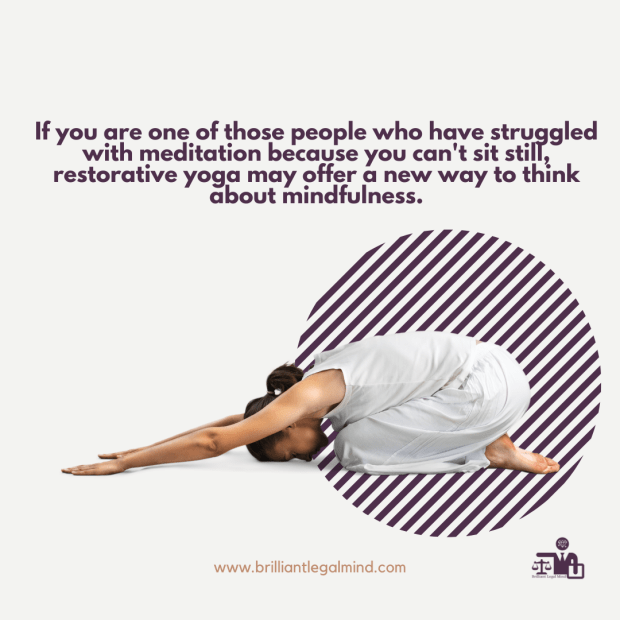
Finally, if you are one of those people who have struggled with meditation because you can’t sit still, restorative yoga may offer a new way to think about mindfulness. The instruction in most restorative classes is just to be in the experience of the pose, to feel oneself resting, and not to drift off in thought.

This is similar to the practice of sitting meditation, but it has some additional physical and restful components that may help you relax into and tolerate the experience more. Even if you enjoy meditation like I do, you may find that restorative yoga is a nice way to mix things up or can offer a chance to find mindfulness when life makes meditation seem a bit too intense.

If you are interested in learning more about restorative practice, you can find it at many yoga studios. Some fitness apps and online platforms, such as Peloton offer it too. In addition, you can easily start a home practice by finding a set of restorative props online.

You can also check out some of the work of Judith Hanson Lasater, Ph.D., P.T. Her book, Relax and Renew offers pictures and explanations of poses and full sequences to help you do the practices on your own at home.

Just as you don’t have to sit still to meditate, you don’t have to move to do yoga. Restorative yoga offers lawyers the chance to practice rest so that they can find peace in stillness and pay closer attention to how their bodies feel. It is a beautiful practice that offers people in stressful jobs many benefits. Giving you the chance to experience how expansive yoga can be is just one of them.

Do you want to try restorative yoga? Check out our Supported Fish Pose with Self-Kindness Guided Mediation. Or you can try our Legs Up the Wall Guided Meditation even if you don’t have any props. All you need are your legs and a wall.

Want to learn more about mindfulness and compassion? Check out my new book, How to Be a Badass Lawyer, for a simple guide to creating a meditation practice of your own in 30 days. And to share mindfulness with your little one, check out my new children’s book, Mommy Needs a Minute.

Like this post? Subscribe to the blog here or follow us on social media:

How Mindfulness Can Help You Survive Virtual Litigation

Before the pandemic, I had almost never used Zoom at all but I have now litigated numerous virtual hearings and done too many webinar presentations to count. If the past year was good for anything, it at least forced me to learn how to take depositions and put on proof over Zoom. Virtual litigation offers many benefits, especially efficiency and convenience, but it is exhausting in every sense of the word. When litigation is already exhausting in normal circumstances, this impact cannot be taken lightly.

Even as we begin to come out of the pandemic, I think its fair to say that virtual litigation options are going to persist even if they are not so common as they have been in the last year. So, you may wonder if there are any tips or tricks for making virtual litigation a little less painful. Several lessons from my own mindfulness practice helped me stay steady during virtual hearings and they might help you too. Here are my tips:

1. Remember Your Limits

One of the first mindfulness lessons I learned is one that many of us lawyers often forget: we are not just brains. We have bodies. Those bodies have needs and limits. When we don’t respect those limits and honor those needs, our performance suffers and we experience a lot of needless pain. The way I handled this when litigating cases remotely was to be conservative in scheduling the cases on the front end. Rather than try to power through with 8-10 hour days on Zoom, we opted for ½ days spread out over time. While I was initially concerned that we wouldn’t finish even with the days allotted, we ended up finishing the proof early because we were conscious of time every day. This reduced the need for multiple breaks and allowed us all to avoid the fatigue and problems that came with prolonged time staring at the computer. Even if you can’t schedule a case this particular way, think practically about how long you can tolerate Zoom litigation as you set the schedule because remembering your humanity in scheduling will help the case go more smoothly.

2. Pick Your Battles

Another lesson my mindfulness practice taught me is that fighting is often unnecessary. Stipulations are essential for managing many hearings and trials to avoid wasting time on undisputed things. When you add the logistical complications of virtual presentation to the mix, that sentiment is even more important. In addition to stipulations of fact or evidence that could make things go more quickly, consider setting procedures or developing plans to make sure everyone is on the same page for the hearing. It may even be useful to hold a dry run with counsel for all parties to ensure that everyone is familiar with the platform you are using. While it may seem foreign to work closely with your opponent in this way, you may find that letting go of fights about minor things can help you all focus better on the disputes that really matter.

3. Plan for Disruptions

Anyone who meditates knows that disruptions happen no matter how much we try to avoid them. Likewise, anyone who has tried a trial or lengthy hearing knows that they almost never happen without a hitch. Prepare yourself for the disruptions. Have a plan for technology issues. Try to develop schedules of witnesses to avoid lag times if testimony goes quicker or slower than expected. In addition, it generally helps not to be a jerk about your opposing party’s situation because it will eventually happen that you are the one who needs the mercy. In one of my virtual hearings, I learned an hour before testimony was set to start that my daughter was required to quarantine due to a close contact at school. I was fortunate that my client, opposing counsel, and the hearing officer granted me a postponement for that day so I could pick her up from school. If my relationships had been less cordial, however, I may have gotten a different result.

4. Slow Down. Then Slow Down Some More.

Rushing is something we all do, especially when we are stressed, but my mindfulness practice has helped me notice it, slow down, and respond more skillfully to life. For most of us, hearings are going to make us stressed whether they are virtual or not. When you present virtually, everything goes through a filter so rushing can quickly become disastrous to your case. To avoid this, remind yourself as much as possible to slow down. Come back to your breath frequently or do a quick body sweep (check your brow, eyes, jaw, neck, shoulders, chest belly, hips, hands) to return to your body. If you are noticing the signs of tension or quick or shallow breathing, try to relax your body and open up your breath. You can do those things in a second or two and it can help keep you steady, focused, and even as you ask questions and present proof.

5. Get Some Rest.

Finally, another important mindfulness lesson is the importance of rest. When we let our attention settle on the breath, we give our minds a chance to stop trying for a moment. For us achiever types, even a little bit of rest goes a long way. When you sit in front of a glaring screen all day and have to listen intently to less than great audio, you need to check in with yourself after and give yourself a break. That likely means an activity away from your computer with some different sensory input. Your normal exercise or relaxation routine might be enough, but I found that I needed to pull out all the stops for my weeks of virtual hearings. In addition to normal exercise, I needed some extra yoga sessions, warm baths, and any time outside that I could get. When you are in a trial or a hearing, it may be tempting to dive right into your inbox piling up with emails but a well-timed break may make your efforts less painful and more efficient.  

I hope we are leaving the COVID-19 era of social distancing but I think the brave new world of virtual litigation is here to stay. Litigating cases remotely presents its challenges to be sure, but the lessons from our mindfulness practices can help us to reduce suffering on Zoom in the same way that they help us to reduce suffering in our lives. If we remember to care for ourselves and bring awareness to the unique challenges and opportunities that virtual litigation presents, we can then focus our whole attention on getting great results for our clients.

Want to learn more about mindfulness and compassion? Check out my new book, How to Be a Badass Lawyer, for a simple guide to creating a meditation practice of your own in 30 days. And to share mindfulness with your little one, check out my new children’s book, Mommy Needs a Minute.

Like this post? Subscribe to the blog here or follow us on social media: