How Much Do Lawyers Need Deep Work?

Image of lawyer working on laptop with title of blog post "How Much Do Lawyers Need Deep Work?"

I have a book club discussion with other lawyers coming up, so I recently read Deep Work: Rules for Focused Success in a Distracted World by Cal Newport. (paid link) Consistent with the book title, I was glad to have had a few hours concentrated time to digest the book during a long car ride.

As you might assume, Deep Work is about finding focus in an increasingly digital and unfocused world. Unlike the book, Stolen Focus, which a friend reviewed on the blog previously, this book is less about examining the role of technology in our lives. Deep Work addresses this but it is more interested in correcting the loss of focus that technology has caused in work and life.

Because Deep Work offers strategies around a common pain point for many lawyers, I decided to share a review here. Read on to learn my likes, dislikes, and takeaways from the book.

What I Like about Deep Work

Though I have a few criticisms of the book, here are the three things I liked most about Deep Work:

1. The Book Addresses a Common Problem for Many Lawyers

It’s hard to argue how distracted and unfocused most lawyers and professionals are these days. Many of us are too busy and our mental health, happiness, and and work performance suffers as a result.

Though Deep Work is now almost ten years old, it remains an important read because focused attention is so lacking for most of us. The book makes a compelling argument about the need to solve big problems and how essential uninterrupted attention is to doing that.

Perhaps my favorite part of the book was that it explains how intertwined focused attention is with happiness. The book discusses the idea that humans find meaning in the places we direct our attention. Though the book primarily addresses focus at work, it points to something deeper about human happiness and well-being. If you struggle with feeling distracted at work, Deep Work may offer some validation and thoughts for a way to find clarity.

2. Deep Work Correctly Identifies Technology as a Major Source of Distraction

It’s hard to argue that technology is both a blessing and a curse for most lawyers and professionals. The evidence continues to pile up which shows that technology has had massive negative effects on mental health and work performance. In this regard, Deep Work correctly zeroes in on technology, specifically email and social media, as the likely problem areas.

As discussed below, not everyone has the freedom to implement limits on email or social media use. Even so, I have had to find ways to manage this myself. Many law firms and companies are now working to implement policies to help employees find a better balance when it comes to work-life balance. Books like Deep Work may have influenced this positive trend by encouraging limits for better focus at work.

3. It Offers Analysis and Solutions that Lawyers and Others Can Easily Implement

Perhaps the best thing about Deep Work is the practical solutions it offers for finding more focus. The book does not claim that focused attention is one-size-fits-all. Instead, it explains the varying approaches that professionals may take with respect to deep work. These include:

  • The monastic approach where you cloister yourself away for periods of intense concentrated work;
  • The bimodal approach which schedules focused work and shallow work on separate days each week;
  • The rhythmic approach which incorporates blocks of focused work into a routine and often follows a pattern; and
  • The journalist approach where you learn to focus in small or found increments of time amidst less concentrated periods.

Identifying your personal philosophy when it comes to focused work can be helpful in itself. Hearing these varied strategies also helped me understand that focused work can manifest differently depending on context.

Of course, even if you have an established philosophy of deep work that suits you, impediments to concentration are bound to arise. For this reason, I appreciated that the book shared some strategies for making email more efficient, limiting social media, or even just getting away from your phone.

One of the best strategies the book offers is the idea of “productive meditation.” This is when you take a walk or do something physical, like cooking or cleaning the house, and let your mind process an idea. I can personally vouch for this approach because I have used it for everything from pondering a question of legal strategy to writing my book.

In short, there are many great points about Deep Work. It addresses and correctly diagnoses a common problem for many lawyers and professionals and it offers practical solutions that can help.

Image titled "What Kind of Deep Worker Are You" with four descriptions as shared in the blog post

Criticisms of Deep Work

As discussed above, Deep Work is a worthy read but it has a few drawbacks. Here they are.

1. The Book Assumes Technology Is the Culprit for Distraction

When I read Deep Work, I kept thinking “but what if it is not email or social that’s distracting you?” As I said above, Newport is correct that our phones have a distracting and in many cases negative influence on our lives and work. But what Newport fails to address is the fact that not all of us can achieve focus just by managing our phones.

Newport references his family at times in the book, but it’s telling when he says he wanted to “be present for them.” As a mom, I never had the option not to be present for my family. My source of distraction was not always my phone, but instead a child who may be hungry, sick, or need a ride to an activity. Deep Work did not address this issue at all and it assumes that you have a certain level of control in life and work that many lawyers or working parents don’t have.

Clearly, not all books can be everything for everyone. If you want more on the art and science of managing time which integrates both work and family caregiving responsibilities, I suggest Laura Vanderkam’s work.

2. It Was Odd that the Author Appeared to Ignore Mindfulness

Deep Work is a book ostensibly about focus. It recommends strategies and practices to increase focused attention at work. Despite the fact, the book barely mentions mindfulness practices.

To be fair, it is possible that the author wanted to avoid delving into a territory in which he’s not an expert. He may have wished to avoid offering what he perceived to be another meditation or mindfulness book. Newport had a right to focus his work in the way he wished.

Still, the book was published in 2016 and there was ample research demonstrating the efficacy of mindfulness practices to improve focus. As a lawyer who has experienced the benefits of these practices in may law practice, especially in relation to focused attention, reading Deep Work felt a bit incomplete.

3. Deep Work Assumes You Need Deep Work

The other thing I kept wondering about as I read the book is “how much do lawyers really need deep work?” Don’t get me wrong, I think most lawyers need some deep work. Some lawyers probably rely on periods of deep work for most of their days.

For me, though, I have to admit that a lot of my work is shallow. Much of my work consists of client emails with simple questions and addressing banal problems. Deep Work addresses this to a certain degree by sharing an example that some C-suite executives thrive in mostly shallow work.

But the book does not offer much in terms of evaluating the relevance and importance of deep work in most professional lives. Instead, the book seems to assume it is valuable and essential for most professionals. Thus, if you are curious about how much deep work matters to your own life, the book may not help to self-assess on that issue.

In short, though Deep Work is a good book to read it is not a perfect book. This is not an argument against reading it, but instead a suggestion that further reading on the topic may be needed.

Brief book review of Deep Work by Cal Newport as shared in the blog post explaining what it offers to lawyers and professionals

Key Takeaways from Deep Work

Deep Work is a good read for lawyers and professionals who are interested in creating a work life that facilitates focused attention. It offers a compelling argument for the importance of deep work for most professionals that holds true to this day. It also correctly identifies technology as a common impediment for focused attention and suggests a variety of practical strategies that may help.

Despite its downsides, Deep Work is worth the few hours of your time. It will help you consider where your attention goes and whether it is serving you well. It is a good book to read, consider, and discuss.


The link to the book mentioned in this review is an affiliate link. The review is unsponsored and sincere but the link to Amazon is paid.


Want to learn more about mindfulness and compassion? Check out my new book, How to Be a Badass Lawyer, for a simple guide to creating a meditation practice of your own in 30 days. And to share mindfulness with your little one, check out my new children’s book, Mommy Needs a Minute.

Like this post? Subscribe to the blog here or follow us on social media:

Tips for Lawyers: Manage Stress Getting Back to School

Image of chalk board and school supplies with title of blog post "Tips for Lawyers: Manage Stress Getting Back to School"

As a school lawyer, I normally love back to school season. This year, though, I am struggling. The summer was busier than I expected and the back to school rush at work happened earlier too. This means that I am feeling overwhelmed, tired, and stressed.

What is a lawyer and meditation teacher to do with this situation? Well, I don’t promise to be an expert here. This struggle is real for many of us for a reason. But I can say that a few intentional strategies have helped me establish order and get ready for back to school.

Manage the Biggest Stress Points First

When things get very busy, I narrow the scope of my focus. My guiding principle is to do now what has to be done today. Clearly, this is not a sustainable approach on a long-term basis. Living day to day has some advantages, but so does planning ahead.

Even so, focusing on what has to be done right now is an essential strategy for regaining order in times of chaos. It can help you build some momentum for managing the challenges of life. It can also help you avoid other problems that may emerge later if you don’t tackle priorities first.

Thus, when your schedule is too busy or life is in flux, a first essential step is identifying prioriy tasks and addressing those first.

Simplify and, If Possible, Delegate

After you have triaged the priority issues, another step for reestablishing order is to simplify whatever you can. Remove unnecessary steps or flourishes from projects. Look for easier ways to accomplish tasks. Delegate or get help in any way that you can.

Many lawyers tend to be high achievers. This means that we often do more than what the circumstances truly require. When time allows, this is not a terrible life strategy to adopt. But in times of stress or change, it can add work and sap energy that you do not have. Simplifying tasks and focusing on what is truly essential can help you avoid this trap.

As a quick example of this, I used this strategy to handle some of the back to school chores for my kids. They had a doctor’s appointment and needed new shoes. Instead of going to my favorite shoe store, I went to one very close to the doctor’s office. This allowed me to consolidate travel time, so the kids could get new shoes and I could get the job done.

When time is limited, don’t make extra work for yourself. Simplify tasks as much as possible.

Image of post it note with question "How could I make this simpler?" as discussed in the blog post about back to school

Prioritize Healthy Habits

When times are busy or stressful, healthy and supportive habits are often the first things to suffer. Even though most of us know what is good for us, disarray in one’s schedule can make it harder to eat, sleep, and exercise like we should. These habits, though, can have an immediate beneficial impact on how we feel mentally and physically.

For this reason, when my schedule is in flux, I often prioritize the basics. I try to refresh my sleep hygiene protocols and get a regular schedule back in place. I make sure I have some healthy ingredients on hand so that I can eat nutrient-dense meals to power my days. Even though it can be a struggle, I get back to my normal meditation and exercise routine too.

Let me be clear. All of these things take time and energy to manage. Despite this, I prioritize them in times of change or stress because I know they are priorities. These habits help me feel my best and manage stress, so that I can face whatever I need to face in my daily life. In addition, because these practices are part of my normal routine, returning to them helps me create a sense of normalcy and order.

Conclusion

Back to school time can be a fun and exciting time. For many lawyers, though, it is also a stressful time. It’s a time of change and extra work to transition to a new phase in life. With some intentionality, though, you can manage the time crunch, stress, and extra work. I hope these tips help you regain some control and establish a new order that will help you and your family thrive this school year.


Want to learn more about mindfulness and compassion? Check out my new book, How to Be a Badass Lawyer, for a simple guide to creating a meditation practice of your own in 30 days. And to share mindfulness with your little one, check out my new children’s book, Mommy Needs a Minute.

Like this post? Subscribe to the blog here or follow us on social media:

How to Stop Procrastination with Mindfulness and Self-Compassion

Cover image for post with professional woman making paper airplane at desk instead of working with title "How to Stop Procrastination with Mindfulness and Self-Compassion"

I made progress on a major project (my first novel) this weekend when I sent off a draft to a beta reader. This felt like an accomplishment, but it made me think about procrastination.

At this point in my life, I am the opposite of a procrastinator. I love getting things done. In fact, I feel uncomfortable when projects linger. They literally clog up my brain and make it hard for me to focus on anything new.

This was not always the case, though, because I used to struggle to start on projects both at home and at work. What changed? To put it simply, mindfulness and compassion came into my life and that changed my approach.

What Is Procrastination?

Before I jump into explaining how to solve procrastination, it is important to define what I mean. When I talk about the issue here, I am not talking about a simple lack of time. Many lawyers and professionals may have too much work or lack sufficient time and resources to handle it.

I’m also not talking about the rational choice to defer a decision or action on a project. As a mindfulness teacher, the best approach in some situations can be waiting. As a lawyer, I can say that inaction can sometimes be a good risk management approach.

On the other hand, procrastination is quite different. It occurs when you have the time to get started on a project and it is in your best interests to do so but you choose to delay action.

Is Procrastination Really a Problem?

Research on procrastination is still developing and there is not a clear consensus on its causes across populations or settings. The impact of procrastination, though, is clear. It increases suffering, adversely affects well-being, and lowers performance.

Sure, there may be times when procrastination can seem to lead to good results. Most lawyers I know, myself included, have had times when the last minute buzz of energy helps us finish a brief or other project in record time. Sometimes this can even feel exciting or fun.

What is not fun, though, is the other side of procrastination. The hours spent worrying about something instead of acting on it are soul-sucking. The shame and regret that come with not managing one’s time well are also no fun to experience.

An image with a quote as explained in the blog post that procrastination is a habit that can be changed

Can you learn to stop procrastinating?

Because researchers are still debating the causes of procrastination, they also do not agree on the best interventions to stop it. With that said, there is research that interventions can reduce procrastination, which suggests that it is possible to learn to manage it.

This has been my experience too. Over the years, I transformed myself from a task avoider to someone who relishes getting things done. Yes, of course, being a blogger and having a recurring weekly deadline to publish posts has been a great habit-building exercise in this regard.

But truthfully the thing that helped me stop procrastinating was the realization that it only increased my suffering. With mindfulness and self-compassion I was able to change this behavior over time. Here are the four steps I took and the ones I still use when the urge to avoid a task arises.

1. Identify Procrastination

Awareness is the first step to solving any issue. Though delay on a project can be a sign of procrastination, it isn’t sufficient in itself. Busy people may have a variety of legitimate reasons outside of their control that can impede starting a task.

The key question, then, is whether the delay is occurring despite (a) the opportunity to begin work; and (b) knowledge that the work is a priority. When these two things are present but you still struggle to get started or create excuses to avoid the work, you know you are dealing with procrastination.

2. Self-Compassion

Shame, guilt, and other forms of self-reproach are common responses to procrastination, but they aren’t helpful ones. As I frequently advocate for in other difficult situations, self-compassion is the better route. Self-compassion is correlated with positive behavior change, including correcting procrastination.

After you raise awareness to procrastination, you can invoke self-compassion by remembering common humanity. This problem is one that many people struggle with across the world and is quite a human challenge. If this is hard for you to accept, remember that self-compassion is not about excusing bad or problematic conduct, but instead giving yourself what you need to do your best.

Image with the 4 steps to ending procrastination as shared in the blog post

3. Manage Conditions

Some lawyers and professionals may hear the phrase “give yourself what you need” and think it sounds like woo-woo new age drivel. When I say it here, though, I mean it in a practical sense. Sometimes this means giving yourself some basic kindness.

But in practical terms it really means managing conditions. For example, if you hate the idea of working on a project, you may decide to take the smallest possible step forward or break it into chunks to help yourself. If you are scared or unsure about an issue, talking it over with a colleague or trusted friend can help you face the challenge. Doing what you can to make facing the project less scary, boring, lonely, or overwhelming is kind to yourself but also practical.

4. Learn from Experience

If you struggle with procrastination, the odds are that you won’t learn to stop it overnight. It may take some trial and error. Even when you struggle, though, there is still one thing you can do to avoid repeating the behavior. That step is to pay close attention.

Yes, this is a stereotypical thing for a mindfulness teacher to say. It’s also effective. The one thing that really helped me kick my procrastination habit was the recognition that it only made my life worse. For one thing, it made my anxiety last longer. It also intensified my fears to challenging levels as the relevant deadline approached.

In a few cases, I saw how my work suffered or was not as good as it could have been if I hadn’t delayed starting the work. Of course, these assessments have to be done without beating yourself up to allow for a clear view of the situation. If you can see clearly, though, life experience can be the best teacher when it comes to procrastination.

Conclusion

Procrastination is difficult to experience but may be even more challenging to stop. With self-compassion, mindfulness, and time, you can make a change. Once you do, you may learn like I did that the exhilaration of moving a major project forward feels even better than the last minute rush the day before a deadline.


Like this post? Subscribe to the blog here or follow us on social media:

Want to learn more about mindfulness and compassion? Check out my new book, How to Be a Badass Lawyer, for a simple guide to creating a meditation practice of your own in 30 days. And to share mindfulness with your little one, check out my new children’s book, Mommy Needs a Minute.

Tranquility by Tuesday Can Change How You Feel about Your Time

How many times have you read a book and thought or proclaimed to a friend that it “changed your life”? While it can be exciting at first to see new possibilities open up in your mind after reading a book, the true test is whether it helped you change your life in meaningful ways. Time management guru, Laura Vanderkam, is a writer, speaker, and podcast host whom I have followed for nearly a decade. Having had time to see the difference, I can honestly say her work changed my life.

When I first encountered Vanderkam’s work, I was in the throes of young motherhood with an out-of-control litigation case load. I felt like I was doing everything wrong. I had no energy and I assumed somebody out there must have some answers. When I read I Know How She Does It: How Successful Women Make the Most of Their Time on a friend’s recommendation, I suppose I was looking for hacks and tricks to make things easier. What I got, instead, was far more valuable: reassurance that my messy life was normal and a reminder to be practical instead of perfectionist about my time.

Over the course of years, the mindset shift to dispense with all or nothing thinking made a huge impact on my life. Gradually, I began incorporating more of what I wanted in my life (writing, exercising, time with friends, etc.) and I let go of the doubts, worries, and guilt that got in the way.

Instead of assuming that I didn’t have time for the things I wanted or couldn’t commit to a new habit, at some point I decided to let myself try. Fortunately for me, meditation was one of the first habits I established. Because it gave me a quick way to recharge, mental space for insights and ideas, and awareness, other good things soon followed. I quickly got more active in my community, started writing more, and established a regular fitness routine.

Now, I find myself with a law practice, a family, an established blog, and a newly published book. Though I am doing more, I don’t feel as time strapped as I did all those years ago. The major difference is that I got more intentional about the use of my time. That is, I decided some of my time—even the tiny bits of it—was time I deserved to spend on me.

Of course, Laura Vanderkam is not the only person to credit for this awakening. Friends, family, therapists and coaches have all helped me understand and craft this for myself. But I just listened to Vanderkam’s latest book, right as my own first book was coming out, and it hit me that I had unwittingly put into place so many of her time recommendations.

In Tranquility by Tuesday: 9 Ways to Calm the Chaos and Make Time for What Matters Vanderkam shares more than a set of 9 steps to manage your time. Instead, this book is about managing how you feel about your time. It’s not a tome that tells you how to manage a to-do list or claims you can simply delegate the tasks you despise. Rather, it recognizes that you may be busy for good reason. In light of that, though, it offers strategies that can help you experience your life as rich and full instead of just overscheduled.

I can’t say that I have put all 9 steps into practice but many of them have been essential to helping me open my mind and my schedule for more of what I want. In particular, fifteen minutes of Friday planning has helped me envision the coming week and prioritize personal and work goals. Likewise, moving early in the day has helped me manage stress and start my days off with energy. Finally, the biggest shift came when I started to prioritize what Vanderkam brilliantly calls “effortful fun.”

Though that sounds like an oxymoron, it makes senses. It means fun that takes a little more effort than standard relaxation. I had never heard the term before I read Tranquility by Tuesday but I can tell you that allowing myself to pick effortful fun more often in my life is one of the most important changes I have made.

When people ask me how I manage so many things, I think they assume that my writing is work. It certainly is, but it’s also a kind of fun I can’t get from watching Netflix, playing a game, or even going to a concert. When I recognized this, I let myself write more and more until it became a habit. Though it takes energy and effort, consistent writing gives me back so much more.

This is the shift that Vanderkam’s work can help you make. She has five kids, two podcasts, numerous books, and a well-updated blog. Even so, I reached out to her to ask for a quote for the blog and she responded within an hour with this gem for all the lawyers and professionals who read the blog:

I think that one of the biggest misconceptions with demanding jobs is that there isn’t any time for other things. There may not be much, but “not as much as I want” is a very different story from “none.” The first story invites us to study our schedules, and see where this time may be, and how we can make the most of what we have, and scale this up over time. The second story is just defeatist. So the first, which is more truthful, is a better option.

I also think it’s important to look at life in terms of weeks. Individual days might be long. But often, over a week, there is space for the things outside work that make us feel like whole people. There are 168 hours in a week. If you work 60 hours a week, and sleep 8 hours per night (56 hours per week) that leaves 52 hours for other things. Again, it is not an infinite amount of time, and you might need to be creative to seize it. But there is likely time for some exercise, reading or hobbies, and quality engagement with family. Think of it as a quest to find this time, rather than dwell on how little there is. 

Laura Vanderkam

Indeed, lawyers rarely have as much time as we want but most of us have more than none. If you want to learn a few ways to make the most of the time you have, check out Vanderkam’s work and her latest book, Tranquility by Tuesday. I don’t promise that it will change your life, but if it changes your mind on a few things that will be a pretty good start.

Want to learn more about mindfulness and compassion? Check out my new book, How to Be a Badass Lawyer, for a simple guide to creating a meditation practice of your own in 30 days. And to share mindfulness with your little one, check out my new children’s book, Mommy Needs a Minute.

Like this post? Subscribe to the blog here or follow us on social media:

Meditation Is Not a Time Suck; It’s a Time Saver

I never ask anyone to explain themselves to me when it comes to meditation. Even so, I give talks about mindfulness a lot and people tend to volunteer why it can’t/won’t work for them. I never mind this because it’s an opportunity for both of us to learn something. The number one reason that people, especially other lawyers, tell me they can’t meditate is insufficient time.

For lawyers, this is surely a believable excuse. We are a notoriously time poor profession. There are significant financial incentives for using any extra time we have to bill hours or market and network to get the next client in the door. And then we might want to actually, hey, have a life to do things besides bill too. Trust me. I get it. I have no intentions here of telling lawyers that they have more time than they think.

Here’s the thing, though. Meditation is not a time suck. It’s a time-saver.

I’m a lawyer, a community leader, a blogger, and a mom. Do you really think I sit around meditating because I’m just bored? Even if you thought that, do you really think I’d pick the single most boring activity on the planet to fill my time? Of course not.

I don’t meditate because I have nothing better to do. I meditate because I have tons of other better things to do besides overthinking, reacting to every little thing in life with anger and hostility, and rushing so much that I miss those tiny joyous moments that creep into life unexpectedly.

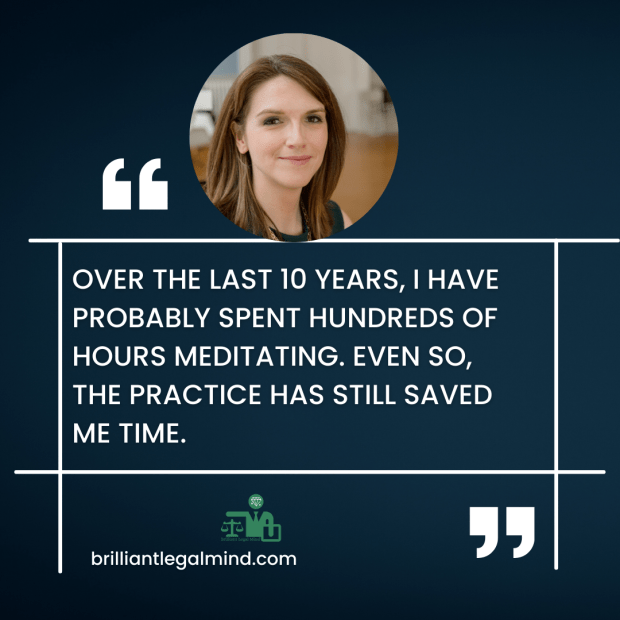
Sure, over the last 10 years, I have probably spent hundreds (if not thousands) of hours meditating. That’s a lot. But what I have not done or done far less is spend hours agonizing over some thing in the future I am worried about that never transpires. Or fretting for days about something awkward I said at a happy hour last week. Or scheming endlessly about the best way to handle a situation.

Instead, now I see when I am stuck in thought mode, regret mode, or perfectionist planning mode and I disrupt the loop. I make a decision to write down a few notes to get the idea out of my brain, talk to a friend, apologize, or just let it go by doing something else. The hours saved alone here is enough ROI for my practice, but the impact on my life by remaining engaged in the world rather than lost in thought is even more significant.

And can we talk about the sleep that I haven’t lost when I am dealing with a stressful situation? Or the fatigue or frustration that didn’t derail my work because I had a quick and reliable way of resting and recharging? Or the physical signs of stress I recognized early on and knew how to care for so I could avoid a disaster?

Look, I don’t write this piece to make you feel bad if you tried meditation and struggled with it because you are busy. The truth is that I have too. I have missed a ton of sessions over the last ten years. I have had to restart and reenergize my meditation habit multiple times. Sometimes it feels like a slog when I do.

I keep coming back to it though, not because I magically find extra minutes, but because I want to be present and content in the minutes I have. So, if time is the thing that sticks in your mind when it comes to meditation, maybe try thinking about time in a new way. Don’t just focus on the few minutes that it will take to meditate. Focus instead on the minutes that meditation might save you and the minutes of your life that meditation might improve.

Want to learn more about mindfulness and compassion? Check out my new book, How to Be a Badass Lawyer, for a simple guide to creating a meditation practice of your own in 30 days. And to share mindfulness with your little one, check out my new children’s book, Mommy Needs a Minute.

Like this post? Subscribe to the blog here or follow us on social media:

Mindfulness Can Help You Stop Rushing and Feel Like You Have More Time

The first book on meditation that I ever read was Mindfulness in Plain English by Bhante Gunaratana. The book had lots of practical tips that served me well when I started a meditation practice in earnest, but the text wasn’t quite as plain as it claimed to be. Gunaratana kept talking about how meditation can help you create space between you and your thoughts. I understood this as a concept but I had no clue what it meant in practice. In fact, the idea itself seemed counterintuitive, since my initial experience with meditation felt like being smothered by my thoughts, instead of creating space around them.

Even so, I pressed on because my mind had been running for so long that it felt like a relief even to take a brief pause just to watch the wheels spin. By the time I worked my way up to 10 minutes of meditation a day, I noticed a variety of spaces emerge in my life that I had never set out to find: I stopped rushing so much. In particular, I noticed my tendency to rush regardless of whether I was dealing with real time constraints.

For example, I used to be in a big hurry every time I went to the grocery store, racing around and grabbing items as if I were on a game show. Rather than prizes, this habit had usually only given me frustration when I had to stand in line or got caught behind someone walking too slowly. Soon after I started meditating, however, a magical voice from nowhere said “What’s your rush?” as I was briskly walking past the gliding doors. At the time, my daughter was just over a year old so time to myself—even running errands—was a rare and precious thing. I slowed down, strolling through the store with ease, gazing with interest at the lovely produce, and even chatting at check out with the clerk. I came home in a good mood, rather than a bad one.

Now, this isn’t to say that my tendency to rush doesn’t come back. It comes back to me all of the time. On one meditation retreat, I realized that I was rushing even in my meditation because I would force myself back to focusing on the breath the second I noticed my thinking. In addition to making me laugh heartily at myself, this also helped me realize that giving myself the time to see what thoughts had emerged would let me have the insights that vipassana (aka “insight meditation”) was supposed to produce.

Not only can rushing make us less aware of our lives, it can also cause us to behave less ethically. This was demonstrated by a famous study of seminary students who were told that they had to give a lecture across campus on, of all things, the Good Samaritan story from the Bible. Some of the students were told that they were late and others that they had plenty of time to get to their talk. The students were set up to pass a victim in need of assistance and, by a wide margin, the students with time to spare stopped more often to help. The conclusion from this is clear: time constraints—even pretend ones—can cause us to forget our higher ideals (and perhaps be totally oblivious to irony too).

This truth of this study is borne out by my life experience. In my small grocery store example, one of the other things that happened was that a petite woman asked me (I’m 5’11’’) to grab a product off a high shelf for her. Do you think she would have felt comfortable doing so if I looked stressed out and grumpy? Probably not. In that case, the absence of rushing on my part freed me up not just to feel better myself but also help someone else. This happened to me in more significant ways as my practice evolved. I was more likely to ask how other people were doing, to check in on friends I hadn’t seen in a while, or to plan ahead so that I had the ability to work fun and meaningful events with friends and family into my schedule. Over time, the reduction in my rushing made me feel less like I had no time, so I realized that, in fact, I had the time to do things I enjoyed, such as writing, or cooking or going to meditation retreats, even while practicing law and raising a family.

Now, if you are a litigator like me, you may think that rushing is somewhat predestined by the aggressive and deadline-ridden nature of our law practice. But, even here, I have found that being mindful of rushing is beneficial too. I try not to delay responding to emails to keep cases moving, but I give myself time if I need to craft a response. I definitely give myself time if the email is at all aggressive and irritating, as emails from lawyers can sometimes be.

I also take the time to be sure clients are on board with case management and that they feel supported and like their voice is being heard in the process. In addition, because I am more aware of how stressful time constraints can be, I am more proactive about managing cases and deadlines with clear communications so that the work gets done with as little human misery as possible. Sometimes there is no way around a hard deadline and you just have to work like hell to get the project done, but that only makes it all the more necessary to develop a habit of paying attention so that you don’t fall into the all too human habit of treating all deadlines that way.

In the years since I started meditating, I have experienced the space that Gunaratana promised in numerous different ways. Though it seemed to have little to do with my copious thoughts, reducing my tendency to rush may have been one of the most important. It provided me with the space that only time can provide to notice how I was living my life, and I was shocked to see that a small adjustment in how I behaved could produce such a significant change in my law practice, personal happiness, and relationships.

If, like me, you are someone who tends to rush, the first step is to notice when it arises. Notice what it feels like in your body when you rush. Notice the thoughts that emerge. Over time, you will see patterns and then the next step is to start to ask yourself whether the perceived time constraints are real. If they are, you can learn to take a deep breath and offer yourself compassion as you face the task. If they are not, take several deep breaths and offer yourself care by slowing down. Then simply repeat these steps over and over again for the rest of your life, congratulating yourself for crises averted and forgiving yourself for any mistakes. We cannot control how much space or time life gives us, but we have some control over how we perceive it. Meditation can help us remember this and that is one way it can make us free.

If you need a quick reminder to help you watch the rushing, check out our quick mini video here:

Want to learn more about mindfulness and compassion? Check out my new book, How to Be a Badass Lawyer, for a simple guide to creating a meditation practice of your own in 30 days. And to share mindfulness with your little one, check out my new children’s book, Mommy Needs a Minute.

Like this post? Subscribe to the blog here or follow us on social media: