Real Talk About the Study Finding Meditation as Effective as Medication to Treat Anxiety

In the last 2 weeks, several contacts have reached out when they read news reports about a study which suggests meditation could be as effective to treat anxiety as medication. Due to my own life experience, I was not surprised when I read the report. Actually, my reaction was closer to relief. After all, I was also aware of the recent research suggesting that medication may not be as effective as once thought to treat depression.

I have used medication to treat depression in the past so I don’t suggest that other people shouldn’t. I have also used therapy several times in my life and benefited each time. The reason I felt relief when I read about the new study, though, is that more information may provide us with more options for treating mental health conditions.

Even so, I have to admit that I was also a little concerned about how the study might be spun or construed. With that in mind, here are a few things to consider when thinking or sharing news about the study.

1. The Good News

We have known for decades that regular meditation can have physical and mental health benefits, but it is not until much more recently that meditation has been embraced as a treatment for mental health conditions. The fact that researchers thought it worthwhile to consider the impacts of meditation practice v. medication shows how much of a mindset shift has occurred.

It is also good that researchers are exploring various treatment modalities because mental health conditions, such as depression and anxiety, are often contextual and individualized. My own life experience has shown me that mental health needs may require a menu of tools, instead of just one or two. The more we learn about how meditation can affect or promote mental health, the more we hopefully can discover about how it can be part of a mental health regimen.

Overall then, the new study signals continued growth of research into the impacts of mindfulness and greater acceptance of meditation by the medical and scientific community.

2. The Potential Downside

Despite the positive indications from the new study, I also had some concerns . The first one that sprang to mind was that, perhaps well-meaning, but uninformed people may tell others to “just meditate” to address their mental health needs. Over the years, I have heard many friends confide in me that a loved one told them this. I have also had friends or contacts beat themselves up about not being able to manage their mental health needs with meditation.

When I speak and write on the topic of mindfulness, I regularly warn people that they shouldn’t feel compelled to rush in with the practice. And I don’t instruct people to attempt meditation to avoid other mental health treatment options. Indeed, I attempted meditation when I was deeply depressed and it only resulted in me crying alone in a dark room feeling even more like a failure. Now, once I stabilized and learned gradually to tolerate the practice, meditation has helped me tame my long-standing anxiety and avoid depression.

So, while it may be accurate advice to tell a person with mental health needs that meditation can help, I don’t think it is good advice. Individuals struggling with anxiety or depression may hear it as an instruction to manage their situation on their own. Instead, the better route is to offer support or encourage someone struggling with mental health to reach out for help.

Moreover, before you share information about the study, you should be aware of what it really says. The study didn’t compare 5 minutes of meditation a day with medication. Instead, it compared an 8-week mindfulness-based stress reduction (“MBSR”) course with medication.

I have taken the MBSR course and it includes weekly classes, a recommendation to meditate 45 minutes a day outside of class (a huge amount for new meditators), and a half-day retreat. In other words, it is an intense and immersive commitment that is at least as time-consuming as therapy. So, be careful when you talk about the study that you understand that context.

3. What I Hope Happens Next

As we know, scientific progress is continually unfolding. Thus, this new study clearly does not represent the final limits of what we can know about the impact of mindfulness practices on mental health. Given the limitations of the MBSR program, I hope researchers continue to study the impact of mindfulness practices at shorter intervals but over longer terms on mental health conditions. I didn’t start at anything even close to the amounts recommended in the MBSR program but experienced significant relief after a few weeks and more pronounced benefits after several months.

I hope researchers also continue to develop studies that show us how meditation may work with medication, or therapy, or exercise, or time in nature, etc. And, of course, I hope we see more studies showing the effects of various meditation practices. Again, MBSR primarily relies on body work and breath practice, but other practices such as loving-kindness can have profound impacts on how we relate to the world and thus our mental health.

In short, I see the new study as an overall positive sign, but care should be taken with how its findings are discussed. Having personally experienced how much meditation helped me manage my own anxiety, I am glad the study shows that meditation may be a promising treatment option. I hope further research will help us understand more to ensure that all people have an array of potential tools to meet their mental health needs.

If you want to learn more about what mindfulness and compassion can do for you in a gradual and approachable way, check out my new book, How to Be a Badass Lawyer, which is available on Amazon.

Like this post? Subscribe to the blog here or follow us on social media:

How to Change Law Firms Without Losing Your Soul

After almost 14 years with my former firm, I made a change to a new firm this May. As excited as I was by the new opportunity, it was a hard process. There were many thoughts swirling in my mind and there was a ton of emotion. My reasons for making the change will remain private out of respect for everyone involved, but I have already said publicly that I was grateful for the start my former firm had given me. In this way, the goal when I left was not just to pursue a new opportunity but to do it while causing as little pain as possible.

Experience tells me that I am not alone in this. Even when a job is no longer right for us, we may feel loyalty to and genuinely want the best for the team we are leaving. We may need to maintain good relationships since lawyers in some jurisdictions might all know each other. Or maybe we just don’t want the personal baggage of knowing we made a hard situation worse with nasty behavior.

With all of those things in mind, here are the steps I took that helped me make my decision and leave with as much grace as possible.

1. Pick a new firm with good values.

Most of us would like to think that we are perfect angels and would always do the right thing no matter what. But, the truth is that we are social beings and are heavily influenced by those around us. Thus, if you want to live your values, it really helps to work at a firm aligned with them. One of the best things you can do to make a good transition is to pick a firm with good people who can support and guide you and will not put inappropriate pressure on you. In other words, the first step towards leaving well is to be sure that you are joining a team with good people.

2. Don’t gossip before you give notice.

This may be one of the hardest things for lawyers to do because we are incredibly social. Yet, this is why you should be cautious about sharing information about your plans too soon. Word spreads quickly among lawyers and the rise of social media has made that phenomenon even faster. To honor the feelings of your colleagues and allow for a planned message to clients, it is best to avoid discussing your plans publicly before you give notice to your firm.

3. Don’t play games with client relationships.

This one should be a no-brainer since the ethical rules prohibit it, but the temptation to get a competitive advantage in retaining clients is always there. Don’t give in. Following the rules when it comes to client relationships in the midst of attorney transitions is essential. Not only does it avoid putting clients in an awkward position, it also avoids behavior that will all but guarantee an acrimonious relationship with your former firm.

4. Talk to calmer and wiser people.

Though you should be discrete about it, life change necessitates seeking counsel from a wise and stable person. Ideally, this person can listen to you and remind you to take the long view and walk in the other person’s shoes. They can help you to focus on your future instead of getting embroiled in issues from the past. They can help you avoid becoming defensive or combative because you feel frustrated or unsure.

In the best case, they can even help you prepare for the difficult conversations that await you and help you plan out how you are going to give notice. Taking the time to talk out your concerns and plan out your course of action with a trusted advisor will help you stay true to your values even in the midst of difficult circumstances.

5. Manage your emotions.

Leaving a law firm is not just a business transaction. It also means changing or perhaps terminating some relationships. Emotions are likely to arise on all sides. It doesn’t work to fight them, so your best bet is to care for them. Expect that you may have to deal with a range of potentially conflicting emotions both in yourself and others. Plan in time to write or talk these issues out with interested parties or trusted friends and relatives. Move as much as possible to discharge excess energy and relieve stress. Give yourself grace as your emotions fluctuate from elation about the future to sadness and even grief about the past.

When you change jobs or think about changing jobs, guilt may be one of the first emotions you feel. Our work as attorneys and roles in our firms can serve as a foundational part of our identities. The idea of changing these roles can cause us to feel like we are being disloyal or doing something wrong. Or it can just cause fear about what the future might bring.

At the core of many of these emotions, you may often find judgment. When you can move past the judgment or at least hold it a little less tightly, another opportunity opens up. Instead of focusing on whether you or your decision is good or bad, you can focus with more precision on how to execute your decision the right way. If you make ethics and values the cornerstone of your transition plan and balance the emotions of yourself and others, you can change your law firm without losing your soul.

Want to learn more about mindfulness and compassion? Check out my new book, How to Be a Badass Lawyer, for a simple guide to creating a meditation practice of your own in 30 days. And to share mindfulness with your little one, check out my new children’s book, Mommy Needs a Minute.

Like this post? Subscribe to the blog here or follow us on social media:

What Does It Mean to Be a Human Lawyer?

This month, I decided to write on the theme of “humanity in the legal profession.” When I settled on this theme, it seemed at first like an easy concept to impart. But, as I sometimes realize when I sit down to write a brief, the writing process quickly reveals the gaps in my understanding. There are lots of things I love about writing but this aspect, humbling as it can be sometimes, is one of my favorites. It forces you to drill down on small things you might have otherwise overlooked.

In this case, the small thing I had overlooked was what does “humanity in the legal profession” really mean? Sure, I’d used the term “human lawyer” many times. I had considered to myself, if not said aloud, that I strived to show what it means to be a human lawyer. Still, I’d never thought about defining the term. When you write about a subject (especially as a lawyer) that’s usually a good starting point.

In this case, though, a dictionary definition was not helpful because I wasn’t trying to understand what the word “humanity” meant. Instead, I was trying to understand what it meant to demonstrate one’s humanity as a lawyer. To be sure, I had witnessed this in several ways in my own life. My family is filled with lawyers and so I was blessed to see regular examples of heartfelt care and concern expressed through legal guidance growing up. As a practicing attorney myself, I’ve benefitted from humanity from my colleagues and opposing counsel. And, on my better days at least, I have employed it too.

But still, the idea of humanity in law implies that it can’t be limited to just one lawyer’s lived experience. Fortunately for me, I happen to have a pretty robust LinkedIn network. So, I asked my lawyer friends there to tell me what being a human lawyer meant to them. Here are some of their answers.

Several respondents told me that humanity as lawyers had to do with how we show up in the world:

I think we are all human lawyers at heart. But we learn to muzzle our humanity to show up as who we think our clients want to see. Ironically, I think this is the exact opposite of what most clients crave. They want real, raw, empathy, humor, relationship. More transparency is the answer.

Still, it’s hard to swim upstream against the prevailing norms. I often encounter attorneys who are very reticent to share anything personal in their bio or express their personality in their content. This is a missed opportunity to stand out from the crowd. For the most part, clients choose you because of who you are and what you stand for. Not who you clerked for, your class rank, or the last case you won.

Marie Sotelo, B2B Content Marketing Consultant in Law/Compliance/Risk Management

I actually say this just about every day! Human-first lawyering is a huge part of in-house practice. Lawyers (just like other humans) like jokes, and play fantasy football, and have interests outside of work and listen to punk rock. We’re just humans who went to law school and we learned some things there that can help you.

Stephanie Solera, Deputy GC at Numerator

Still other lawyers told me that humanity in our profession means honoring our own emotions and the emotions of our clients:

Empathy. Empathy for your clients, coworkers, and opposing counsel.

Emmy Klint, General Counsel and Risk Mitigation Manager

I am a human lawyer because I can speak of practical solutions not just legal ones and advise people to take pathways that are less disruptive to their mental health if they can still meet their basic goals.

Lynda Hinkle, Esq., Attorney, Law Firm Owner (Family, Estates, Guardianships), Family and Estate Mediator, and Real Estate Agent

Some lawyers even suggested that our humanity is essential for counseling clients, even when that means admitting to the limitations of the law:

As lawyers, our role involves “counseling” sometimes more than providing legal advice. Talking your client down from the ledge or from pursuing a vendetta or burning bridges or to encouraging the client to cut all ties and have a “divorce” from the opposing party. I handle probate, trust, and fiduciary litigation, which involves blended family situations or sibling discord. I remind people that sometimes, to be there for yourself, you have to “divorce” or disengage from that toxic or opposing party family member and maybe someday you might be able to see each other at Christmas but not this year. I believe in acknowledging our feelings and then, asking what can you do to feel that again or not feel that again. Acknowledge the client is stressed but also encourage them to concentrate on the next step, not the end result.

Andrea Barr, Managing Attorney, Fiduciary Litigation

I think what can set you apart as “human” with clients is to be humble and admit when “the” answer isn’t clear or straightforward. I work in a science heavy area of law, with cases that are often full of unanswered questions of law. It’s hard sometimes for clients to understand that, but I have had many tell me they appreciate my honest and forthright answers… often after having talked to or worked with other attorneys prior. Sometimes a humble attitude is surprising to clients but it’s also earned loyalty and referrals.

Melissa A. H. , Environmental & Construction Attorney

Now, if like me, you have struggled with your humanity at times, don’t worry. A few of the respondents shared that you can remember or relearn your humanity even if, litigation for example, causes you to lose track of it for a while:

I bring humanity compassion and kindness to all my matters. I used to be a litigator and was becoming a jerk I switched to transactional work 17 years ago doing estate planning and business law. I now enjoy helping people set things up for the present and the future. I also perform about 240 hours of pro bono work every year. If there is anything that can be said for wisdom instilled by the elderly, it is treat people how you want to be treated and create memories because they are all you take with you and no one gets out alive.

Rev. Dr. Marc Paquette, Senior Corporate Counsel/General Counsel

I learned to be a human lawyer after experiencing the personal tragedy of one of my clients. I finally saw the true terrible price of a legal malpractice claim and realized that to help my clients (and myself) I needed a more holistic approach. I took a step back from just defending legal mal lawsuits and now attempt to address lawyers’ problems before disaster strikes.

Jeff Cunningham, Esq. Outside General Counsel for Law Firms Partner at Goldberg Segalla

So, there we have it. Humanity in the legal profession is about showing up as ourselves. It’s about honoring our emotions and those of others. It shines through brightest, perhaps, when we counsel with practical as well as legal advice. And it can even serve as our north star to get ourselves back to goodness if we lose our way in the difficulties of law practice.

Maybe there’s no unifying definition of what it means to demonstrate humanity in the legal profession, but it’s good that there are many examples of it. If you want more, check out The Human Lawyer Podcast. I was a guest on this podcast a few years ago and it curates the stories of some fantastic human lawyers across the country.

How do you show your humanity in your life and work?

Want to learn more about mindfulness and compassion? Check out my new book, How to Be a Badass Lawyer, for a simple guide to creating a meditation practice of your own in 30 days. And to share mindfulness with your little one, check out my new children’s book, Mommy Needs a Minute.

Like this post? Subscribe to the blog here or follow us on social media:

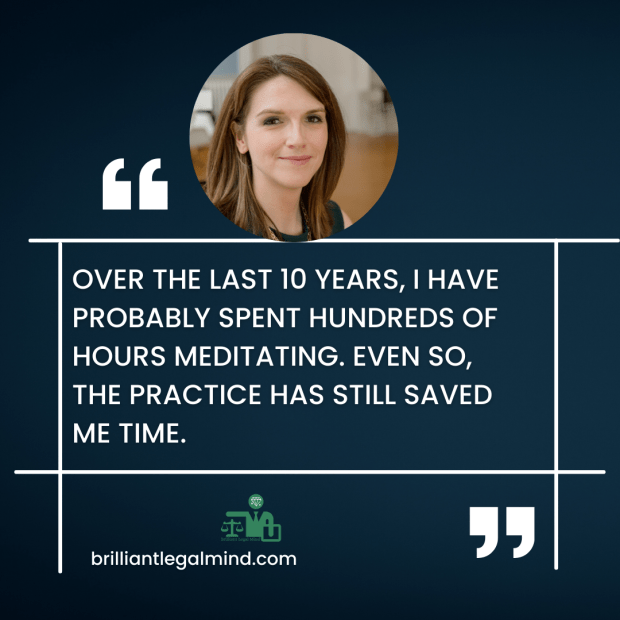
Meditation Is Not a Time Suck; It’s a Time Saver

I never ask anyone to explain themselves to me when it comes to meditation. Even so, I give talks about mindfulness a lot and people tend to volunteer why it can’t/won’t work for them. I never mind this because it’s an opportunity for both of us to learn something. The number one reason that people, especially other lawyers, tell me they can’t meditate is insufficient time.

For lawyers, this is surely a believable excuse. We are a notoriously time poor profession. There are significant financial incentives for using any extra time we have to bill hours or market and network to get the next client in the door. And then we might want to actually, hey, have a life to do things besides bill too. Trust me. I get it. I have no intentions here of telling lawyers that they have more time than they think.

Here’s the thing, though. Meditation is not a time suck. It’s a time-saver.

I’m a lawyer, a community leader, a blogger, and a mom. Do you really think I sit around meditating because I’m just bored? Even if you thought that, do you really think I’d pick the single most boring activity on the planet to fill my time? Of course not.

I don’t meditate because I have nothing better to do. I meditate because I have tons of other better things to do besides overthinking, reacting to every little thing in life with anger and hostility, and rushing so much that I miss those tiny joyous moments that creep into life unexpectedly.

Sure, over the last 10 years, I have probably spent hundreds (if not thousands) of hours meditating. That’s a lot. But what I have not done or done far less is spend hours agonizing over some thing in the future I am worried about that never transpires. Or fretting for days about something awkward I said at a happy hour last week. Or scheming endlessly about the best way to handle a situation.

Instead, now I see when I am stuck in thought mode, regret mode, or perfectionist planning mode and I disrupt the loop. I make a decision to write down a few notes to get the idea out of my brain, talk to a friend, apologize, or just let it go by doing something else. The hours saved alone here is enough ROI for my practice, but the impact on my life by remaining engaged in the world rather than lost in thought is even more significant.

And can we talk about the sleep that I haven’t lost when I am dealing with a stressful situation? Or the fatigue or frustration that didn’t derail my work because I had a quick and reliable way of resting and recharging? Or the physical signs of stress I recognized early on and knew how to care for so I could avoid a disaster?

Look, I don’t write this piece to make you feel bad if you tried meditation and struggled with it because you are busy. The truth is that I have too. I have missed a ton of sessions over the last ten years. I have had to restart and reenergize my meditation habit multiple times. Sometimes it feels like a slog when I do.

I keep coming back to it though, not because I magically find extra minutes, but because I want to be present and content in the minutes I have. So, if time is the thing that sticks in your mind when it comes to meditation, maybe try thinking about time in a new way. Don’t just focus on the few minutes that it will take to meditate. Focus instead on the minutes that meditation might save you and the minutes of your life that meditation might improve.

Want to learn more about mindfulness and compassion? Check out my new book, How to Be a Badass Lawyer, for a simple guide to creating a meditation practice of your own in 30 days. And to share mindfulness with your little one, check out my new children’s book, Mommy Needs a Minute.

Like this post? Subscribe to the blog here or follow us on social media:

PSA: 988 Suicide and Crisis Lifeline Is Now Available

Today is an important day in the United States, we now have a national, dedicated hotline for individuals to call for mental health emergencies. In the case of fire, severe physical injury, or crime, most of us wouldn’t hesitate to say “call 911.” Mental health situations may be different, however, and may require a response from trained professionals other than traditional first responders. Starting today, we can now call 988 for such situations.

What happens when you call 988? The program connects you immediately with a trained mental health professional. This is significant because anyone who has experienced any kind of mental health situation knows that there is almost always a waiting period to begin care. Moreover, like any other professional, counselors, therapists, and other mental health providers usually work during normal business hours. Though we have existing emergency services, like fire, EMTs, and police, those officials are not always trained to provide care for mental health needs.

With the new 988 lifeline, anyone who is experiencing a mental health emergency can now receive immediate help. There is also a chat function available at 988lifeline.org that will allow individuals another means of connecting to help. In addition, the website offers resources to help those of us who may be supporting a loved one experiencing a mental health emergency. It even offers a resource for helping someone you may know less well from social media.

In addition to providing a support for people in need during a mental health emergency, another aspect of the lifeline is normalizing seeking help. The 988 lifeline has media kits and logos for public use and a hashtag #Bethe1To to spread the word about suicide prevention. It also has a collection of stories of hope and recovery from those who have experienced suicidal thoughts or mental health challenges in the past and tools to help those who wish to share their own story. As someone who has written about my own mental health challenges, these are powerful tools for individual healing, building community, reducing shame and stigma, and spreading awareness.

Having experienced mental health challenges myself, I have experienced how hard it can be to recognize symptoms in yourself and to seek out help. For this reason, it is essential to have a lifeline, supports, and education available to empower communities to promote and protect mental health. I am glad that this new tool exists to support lawyers, professionals, and the entire community in the United States with mental health emergencies. Please help spread the word about it.

Want to learn more about mindfulness and compassion? Check out my new book, How to Be a Badass Lawyer, for a simple guide to creating a meditation practice of your own in 30 days. And to share mindfulness with your little one, check out my new children’s book, Mommy Needs a Minute.

Like this post? Subscribe to the blog here or follow us on social media:

How My Long-Term Goal of Writing a Book Became a Reality

I have been quiet on the blog for the last few months, but I promise I have some pretty good excuses. One reason for the break is that, after several years with the same firm, I decided to transition to a new firm. Though I am thrilled with the new role and looking forward to expanding my practice, it was an emotional and complicated process and I needed some time to rest. The other excuse is also pretty awesome: I am writing a book. Actually, I am finishing up writing the book and should send a manuscript to my editor this week.

I have thought about writing a book for many years. I know I first had the idea for it in 2015 after I won two big awards in the span of a few months for community leadership and career success. I had already written how, in 2012 and 2013, I struggled with my first pregnancy, the birth of my daughter, and my transition into life as a working mom. In a few years, though, things changed drastically for me and I remember reflecting at the time that I wanted to write about it.

Of course, not much happened on the writing front for a few years, but in 2018 I decided to try to the Writers in Residence program for Ms. JD. That was the first time I had written about things that weren’t purely legal topics, including mindfulness. It went well and some of my posts were republished and got some kudos from people other than my best friends and mom.

After that, I started to think more seriously about the book and began talking to friends and contacts who had written books to gather information. Late in 2018, I attended a friend’s CLE and she did an exercise where she asked us to take a Jenga block from a symbolic brick wall and write our stretch goal on it to help make the world and legal profession better. I wrote the word “BOOK” on it and kept the block in my office.

Still, a clear idea of what to write about and the way to do it did did not emerge. So, I started writing on LinkedIn regularly. At the same time, I started speaking about mindfulness and compassion. I was nervous about that at first but it, too, went much better than I expected. The LinkedIn writing helped me build a network, allowed me to experiment with writing styles, and let me gather feedback about what people really wanted and needed. The pandemic gave me the time to focus on this writing, to speak a lot about mindfulness and compassion, and to get training so that I could better explain why mindfulness and compassion worked.

This blog was one of the fruits of that experience. I launched it the week I finished my meditation teacher certification as a celebration. The other fruit was that I realized that lawyers were fairly knowledgeable and comfortable with mindfulness but they knew a lot less about compassion. Lawyers like mindfulness because we like the idea of calm and we like the idea that we can get a handle on our thinking. But, compassion cultivation can give us emotional intelligence, resilience, greater happiness, and better relationships. It is the stuff we need when we are not calm and lawyers are often dealing with situations that are not calm.

Then, last year the idea for my book finally hit me. I texted a friend about how I want to write about how compassion is badass. I wanted to explain to lawyers how the soft, gooey, touchy feely side of compassion is actually really powerful. I wanted to write about mindfulness and compassion in a way that was real, funny, and let those of us with messy lives see how good we are. And, so the idea for my book was born in a text message to my friend. I still didn’t know what to do at that point, but at least a vision was starting to emerge.

Shortly thereafter, I met a fellow meditation teacher on LinkedIn who told me about a guy who ran a coaching program that helped people write mindfulness books. I was too busy at the time to act on it but made contact with the coach via email. At about the same time, I recorded an episode of the Legally Blissed Conversations podcast with Suzi Hixon, Esq. and said I planned to write a book “one of these days.”

I promptly forgot about that comment and episode because my law practice became incredibly busy. I dodged the emails from the writing coach and kept apologizing for being too busy. Then, late in 2021, I realized something interesting: I was turning 39 soon. I’m bad at math but even I could figure out what that meant. It meant I would be turning 40 in 2023. So, I reached back out to the writing coach, apologized for the semi-ghosting antics, and set up a call. Ten minutes into that I was convinced it was what I needed, so I signed up.

I got started with the process thinking it would be smooth sailing from there, but then out of nowhere I got the urge to make some changes in my law practice. That totally took over my life for a few months and I was able to write nothing. I even had to stop writing for the blog for a while because my creative energy totally faded away. I eventually decided to just pause the blog posts for while so I could recover and focus on the book.

My patience for myself was rewarded. I started writing the book in May and wrote more than 45,000 words in 12 chapters by the end of June. My coach guided me to scale this back and focus more directly on one topic, so I ultimately revised, removed chapters, and wrote a few more. Now the book is 30,000 words and 10 chapters but I have some extra content for a second book. In addition, as an added bonus, a strange little poem creeped out of my brain that I have turned into a children’s book (Mommy Needs a Minute which should be released in 2023) with my talented friend who draws pictures. Now, I will have my book published by the time I turn 40, have another on the way, and the beginnings of a third.

What is the lesson from all of this? The lesson is to follow your instincts and trust yourself. If something is important to you, a path will emerge. That may mean you have to keep coming back to the path when you get sidetracked. It may mean you have to be patient with yourself as ideas start to form and you learn the skills needed to make the project work. I have been thinking about writing a book for seven years now, but in that time I have not only been thinking. I see now that that steps I took along the way weren’t wasted time or distractions because they helped me build skills, create a community, and find my voice.

If you have a long-term goal, say it to yourself. Then say it to your friends. Even if the timing isn’t right to get started on the goal immediately, don’t let it go and don’t discount the impact that play and experimentation along the way can have for you. I have noticed in my meditation practice that the best ideas tend to come back to me again and again. This can be true in life too. Sometimes life can get in the way of our big goals, but the best ones for us, the most meaningful ones, may come back to us again and again until we are ready to act on them.

Update: the book is now here and available on Amazon, Barnes & Noble, and BookShop!

Like this post? Subscribe to the blog here or follow us on social media:

How Do You Know Which Inner Voice to Follow?

Recently, I came to a startling recognition: I have a somewhat inconsistent view about life choices. On the one hand, I have railed against succumbing to the voice in one’s head so many times that I cannot account for them all. Yet, on the other, I have also said that my life transformed and became much happier when I started to listen to that little whisper inside that told me to try something new. A few weeks ago, it came to me in a flash that perhaps I was speaking out of both sides of my mouth on this one. How could one both ditch the voice in one’s head and yet feel compelled to listen to it to follow one’s bliss?

For me, this flash revealed a paradox more than a cognitive dissonance. I knew from experience that both things were true. The trouble was, though, that I couldn’t quite distill the factors that made them both true. So, I left the question open for a while and sat with it for a few weeks. Ultimately, I concluded that the answer had been staring me in the face all along: life experience was the only real way to tell the difference between the voices in one’s head because experience tells us not just how those voices manifest and feel but also shows us the results of heeding them.

Experience has told me that I have more than one kind of inner voice: the doubt voice and the childlike urge to explore. My doubt voice usually appears in the form of words. It is like a parent that comes to keep me safe and in line. It tries to present itself as the voice of reason but can quickly become abusive at the slightest hint that I may ignore it. The other voice, however, usually isn’t a voice at all. It rarely manifests for me as anything so organized as a sentence. At most, I might get a single word that echoes in my mind for too long. More often, though, I get a sense—just a sense—that I want to try something. It’s like the urge to touch a soft fuzzy blanket just to see what it feels like. If it lasts long enough, my mind may start to offer scenes and imaginings of how this newfangled idea might work. Sometimes my doubt voice may push the idea away as irrational or impractical, but the most powerful ideas come back to me repeatedly when my mind relaxes when I am driving, or exercising, or meditating.

Following the divergent paths my inner voices have offered has produced insights too. The doubt voice invariably tells me to take the road more traveled. In some cases, there is an initial sense of relief when I have decided to let an idea go. What ultimately caused me to stop listening to this voice every time, however, was the recognition that listening to it often led me not to feel safe, but instead cloistered and stuck. Where the voice told me staying with the familiar would help me feel secure, it regularly left me feeling insecure because I kept failing to trust myself. On the other hand, following the childlike urge to explore usually felt more like play. Most of the time I have followed this voice, I would think “I have no idea what I’m doing or why I’m doing it.” I can’t say that this necessarily felt good. In many cases, it felt bad as I worked to create or try something new while my doubt voice stormed in the background of my mind. But the thing was that I didn’t care. It was like I knew I would be proud of myself just for trying even if whatever I did was a total failure and a waste of time.

Unfortunately, I can’t offer anyone a line in the sand that can tell you which inner voice to listen to at any given moment in your life. I can say, however, that awareness of those voices, including how they feel and where they lead, can provide the experience needed to distinguish between the two (or more) inner voices for yourself. A sense of balance and proportion may also serve as a guiding principle for many of us. Lawyers often find themselves guided by the voice of doubt since it is so closely associated with the logic that is our stock and trade. We may, therefore, benefit from time to time in letting another part of our selves take the reins and following those less rational and teleological notions to explore, experiment, and create.

Ultimately, though, the desire to really know the difference between the voices in our head and to have unshakable confidence that we are listening to “the right one” may point to something more fundamental: the reality that we can’t predict the future or totally control our lives. Noting the differences between our inner voices may give us signs to help us make decisions in life, but eventually we just have to let go and give ourselves the grace to make mistakes. Thus, while it may be a challenge to have these competing voices in our heads pulling us in opposite directions, it is not entirely a bad thing.

When we listen to our childlike voice and seek adventure, we may find challenges and a life we never imagined. When those choices lead to mistakes and mishaps, and you can bet that they will, our inner voice of reason may offer us a path to safety and security so that we can heal and recover until we are ready for adventure once again. Perhaps, then, these varying inner voices don’t represent a cognitive dissonance or a fracturing of our psyche at all. Instead, they may just represent the fact that a complete life has many facets and many seasons. In the end, it may not be so important to know which inner voice to listen to in any given moment, as much as it matters that we listen to our inner voices at all.

Want to learn more about mindfulness and compassion? Check out my new book, How to Be a Badass Lawyer, for a simple guide to creating a meditation practice of your own in 30 days. And to share mindfulness with your little one, check out my new children’s book, Mommy Needs a Minute.

Like this post? Subscribe to the blog here or follow us on social media:

Four Reasons Why I Don’t Like the Term “Imposter Syndrome”

It’s no secret that I am a self-doubter. I have struggled with it since I was a kid and, despite all my mindfulness training, I don’t think it’s ever going to go away. Doubt, it seems, is a part of my personality. So, you might be surprised to know that I don’t really like the term “imposter syndrome.” Clearly, I don’t dispute that the phenomenon occurs. And I know how self-doubt, even in the face of overwhelming evidence demonstrating competence, can harm individuals and the organizations who need their talents. But I just don’t like the implications of what the term “imposter syndrome” conveys. Here are a few reasons why.

1. It Pathologizes What Might Just Be a Normal Human Experience.

A “syndrome” doesn’t have to be a medical condition, necessarily, but that is the most prevalent use of term. By saying “imposter syndrome”, therefore, we are reifying the notion that self-doubt is somehow aberrant or harmful. Certainly, as stated below, I don’t doubt the potential for harm on an individual or social level. I am saying, though, that the idea of self-doubt as inherently problematic may not be altogether fair.

Sure, self-doubt hurts and at times it can put us in boxes that we may have to escape. But it is part of the human condition too. Self-doubt, like all so-called negative emotions and experiences, doesn’t necessarily have moral value. Instead, it’s a state that comes and may go if we learn to let it. In my experience, it’s also a personality trait that, when balanced with some care and courage, can have beneficial results. I’ve learned to accept that, though my own self-doubt drives me nuts on occasion, it also makes me check my facts and keeps me honest, humble, and connected to my human experience.

For this reason, I don’t like the implication that “imposter syndrome” is inherently wrong because that view can contribute to self-judgment and impede the understanding and self-compassion that are needed to keep doubt from impeding growth. I think the better approach is to recognize that self-doubt is a part of the human condition and to account for it, with appropriate supports, as part of the healthy path to growth.

2. It Suggests that We Should Feel Solid in Our Identities, Despite the Fact that They Are Always Changing.

Identity is at the core of imposter syndrome. The use of the term “imposter” is intended to convey an experience most of us have had: that other people will somehow discover we aren’t as perfect/talented/smart/capable/kind/beautiful/worthy/lovable, etc. as we may seem. If you break this down logically, you will see that the concern here is that our “true” identities may not measure up to the perceptions others have of us. If you know anything about Buddhist philosophy, however, alarm bells should be ringing in your ears because, according to that school of thought, no true identity in fact exists.

The concept of “not self” or “anatta” as it is traditionally called tells us that there is no stable and lasting self to which we can cling. And even if you haven’t studied Buddhism, you can experience this for yourself. Go ahead and look for your self. Or watch that self of yours behave over time and in different contexts. You can test me on this if you like, but I bet you’ll find it hard to find a sold, steady self in there driving the bus of your life.

What does this have to do with imposter syndrome? Well, imposter syndrome suggests to us that it’s a problem if we feel unsure about our identities. If you look at it from a “not self” perspective, though, it’s not a problem at all. It actually is far more consistent with reality than the so-called “confident” and “normal” people who don’t question their identities. Now, of course, when this analysis becomes protracted, painful, and gets in the way of necessary action or growth, that can become a problem. But those issues are likely to be the result of attempts to cling too tightly to identity. The way out isn’t to strive to feel more solid in our identities, but instead to recognize that identity shifts as life changes and so doubts about it inevitably may arise.

3. It Suggests that People Who Don’t Doubt Their Abilities Are Necessarily Higher Achievers or Better Performers.

How many times have you been told that confidence is essential to success? Probably many, many times, right? Well, did you ever ask that person what confidence means? If you did, they’d probably look at you quizzically and say something like “You know, feeling good about yourself. Feeling capable or self-assured. Feeling strong.” That’s close to the dictionary definition of the term “confidence” to be sure.

But, does this mean that, in the midst of a challenge one must in the present moment feel capable, strong, or self-assured to get good results? As a lifelong self-doubter and high-achiever, I can tell you that’s not true. Not all self-doubt impedes performance. As I’ll discuss when I review The Confidence Gap, it’s the self-doubt that impedes action which is the problem.

And that’s the problem with thinking of imposter syndrome as a syndrome. It doesn’t distinguish between the self-doubt that should be expected with growth and new challenges and the self-doubt that keeps us from taking the actions necessary to grow and face challenges. To truly understand that distinction for ourselves, we need to look at our self-doubt without judgment to see how it affects us.

If we assume it is inherently bad or detrimental, we may get the wrong idea that we are destined to fail or be stuck in our current circumstances until we can force ourselves to feel assured even in the face of risk. But, that’s not confidence, that’s bluster and potentially arrogance and it doesn’t necessarily translate to better long-term performance. So, instead of focusing so much on the detriments of imposter syndrome, it may be more effective to re-think what confidence really means.

4. It Suggests that the Problem Is with the Individual When We Are All Interconnected.

Finally, I don’t like the term imposter syndrome because it perpetuates the myth of separation. While the nod to identity in the term acknowledges that we are social beings with deep needs for social approval, most of the discourse on the subject has focused solely on the individual experience of it.  Last year, the Harvard Business Review offered a refreshing take on the subject which suggested that imposter syndrome for many may be the byproduct of systemic bias. In this discussion, the authors suggest that it is time to dispense with the notion that individuals must fix themselves by overcoming imposter syndrome because, instead, we might spend our time better fixing the systems that have created it.

That’s a pretty good point but I might also add that there are some other cultural biases at play here, including the preference for certainty, authoritarian leadership, and the aversion to vulnerability and emotions in professional life. In this way, I’d agree that the emphasis shouldn’t be on “fixing” the people who have experienced imposter syndrome.

Perhaps, the emphasis should be on creating a society and workplace culture where people, including leaders, feel safe acknowledging risk and doubt. To do this, we probably need the talents and wisdom of the people who know what self-doubt feels like and what to do about it. If the advice continues to be that imposter syndrome must be shed before leadership and success can occur, we may never get the leaders who can help us make that change.

In short, I don’t doubt that imposter syndrome occurs. I have experienced it most of my life. But I don’t like the way it is portrayed most of the time because it is at odds with my mindfulness training and my life experience. I don’t think my self-doubt makes me a bad lawyer or poor leader. Rather, I think facing my self-doubt and learning to care for it is what makes me a great leader and courageous lawyer. So, instead of focusing on ridding ourselves of imposter syndrome, overcoming it or even fixing it, maybe we should learn instead to accept ourselves as we are and life as it is to build the skills needed to face the inherent doubts, risks, and uncertainties in life and work.  

Want to learn more about mindfulness and compassion? Check out my new book, How to Be a Badass Lawyer, for a simple guide to creating a meditation practice of your own in 30 days. And to share mindfulness with your little one, check out my new children’s book, Mommy Needs a Minute.

Like this post? Subscribe to the blog here or follow us on social media:

Sending Loving-Kindness to Opposing Counsel Can Make You a Better Litigator

If I had to pick one style of meditation to recommend for lawyers, it would be loving-kindness practice. When I present seminars on mindfulness, I take any opportunity I get to talk about the practice or share it in a guided meditation. Loving-kindness meditation became my lifeline early in my law practice when I was struggling with the combative nature of litigation. I often turned to it after a lengthy deposition with a difficult witness or when I was freaked out by a case or project. It almost always calmed me down or reminded me that the world was not as dark and terrible as I may have felt before I sat to meditate.

If you aren’t familiar with it, loving-kindness practice doesn’t merely focus on the breath. Rather, it is a dynamic practice where the attention is usually focused on sensations in the heart as you bring individuals and groups to mind and send them kind wishes. Traditionally, these phrases wish that yourself and others are safe, happy, healthy, and at peace and the practice usually starts with oneself and moves outward from a loved one, mentor, neutral person, difficult person, one’s community, and then the whole world.

If you are litigator like me, the first “difficult person” to come to mind may be the opposing counsel who most recently drove you up the wall. Now, for those entirely new to the practice, I don’t usually recommend starting that way because you may find it, well, difficult to send loving thoughts to an adversary, especially if you don’t like them or respect their tactics. But, over time, if you can work your way up to sending loving-kindness to opposing counsel, it can really help.

Now, I know you may be thinking “why would I send kind wishes to someone who is literally trying to hurt me (in a professional sense)?” When you put it that way, it sounds crazy, I know. When it comes to the difficult person, however, I see the practice of loving-kindness sort of like forgiveness. You don’t really forgive others to help them; you do it to help you. Wishing loving-kindness to an opponent or anyone you dislike can soften the reactivity you have for that person and give you space and distance from the situation. Even if you struggle to really feel love for a difficult person initially, just attempting the practice can help you see how your reactivity is manifesting and that might put you in a better position to care for yourself and act more skillfully in the future.

I want to be clear, though, that loving-kindness for opposing counsel is not forgiveness. You don’t have to forgive anyone to do the practice and you certainly shouldn’t ignore or condone bad behavior. Instead, the practice is really about acknowledging that all humans want and need to be safe, happy, healthy, and at peace. It’s an acknowledgment that, even when things appear to separate us from others, we are deeply connected to all people just by virtue of being human. Thus, the paradox of loving-kindness practice is that it gives us distance from our judgments of others by helping us see how we are all connected.

This may sound good in theory, but you may be wondering what it has to do with litigation. In fact, it’s ideal for litigation. I’ve used this practice for an opposing counsel that I often litigated cases against and whose style was drastically different from my own. While I can’t boast that all my antagonistic and judgmental tendances abated, a few sessions helped me see my opponent as a person, rather than some blocking force who made me angry on a regular basis. Now, we have a good working relationship despite our frequent clashes. On a practical level, this has made me calmer and treat opposing counsel with more respect so that we can work together to discuss case scheduling or stipulations or even settle a case when the circumstances are right.

It’s even useful when settlement or conciliation aren’t the aims. Some worry that doing practices like loving-kindness might turn them into a flower child who can’t aggressively advocate for clients. That’s not been my experience. The practice can certainly evoke strong emotions and soften the heart. But it does not empty the head of rationality or logic. Instead, by facing the emotions I may have for difficult opposing counsel and sending them well wishes, I have generally experienced a release that has allowed me greater mental clarity and increased objectivity when it comes to my cases. In turn, this has made me calmer in the courtroom, more incisive in my analysis, and far more courageous in my advocacy.

By no means am I saying that loving-kindness or any kind of meditation can make litigation an easy thing. As an adversarial process where the stakes are frequently high, litigation tends to be difficult on all parties involved, including the attorneys. The difficult nature of litigation, however, is exactly why it helps when attorneys know how to avoid making the situation worse. As odd as it sounds and as uncomfortable as it may feel at first, loving-kindness practice is one tool that can make litigation less painful and litigators more effective. Though it doesn’t make litigation easy, it can help you feel more at ease and that’s why it is the practice I most frequently recommend for lawyers.

Want to learn more about mindfulness and compassion? Check out my new book, How to Be a Badass Lawyer, for a simple guide to creating a meditation practice of your own in 30 days. And to share mindfulness with your little one, check out my new children’s book, Mommy Needs a Minute.

Like this post? Subscribe to the blog here or follow us on social media:

4 Steps to Help Lawyers Handle Shame Triggers from Opposing Counsel

Though most of the attorneys I have litigated cases against are wonderful people who only want to represent their clients well, I’d be lying if I didn’t admit that some just like to play games. They don’t want to turn over documents that are clearly relevant. They don’t want to think practically when evaluating a case for settlement. And they want to object all the time just to be difficult. Sometimes this happens because people lose their patience, get too emotionally invested in a case, or have other pressures that affect their decisions. Since I am an imperfect human and litigation is stressful, I can forgive a lot.

The kind of game that is the hardest to forgive, however, is when lawyers attempt to play games with other lawyer’s minds. Perhaps the most vile instance of this is the intentional shame trigger. This happens when one attorney tries to control another without legitimate power or authority with comments intended only to make the other attorney feel bad. By now, most attorneys know that they can dance like nobody is watching, but must email like it may one day be read in court.

Thus, I usually don’t see attorneys flat out calling names or spewing hate explicitly. Instead, most shame trigger attempts I’ve encountered have been embedded in a discussion of legal or factual issues. This can make them even more insidious, however, because it means that an opposing attorney without good intentions might be able to worm their way into your head without you realizing it.

What is to be done about this situation?  I’ve found that several tools from my mindfulness training have helped me avoid becoming distracted when opposing counsel throws out shame triggers. Here are my tips.

1. Recognize.

The first step for dealing with a shame trigger is to see when it is happening. Clearly, mind games in litigation can come in all sorts of forms, so there isn’t necessarily a single definition that can apply to all situations. Even so, I find that shame triggers tend to occur when one party wants something from the other, but they don’t have legitimate means of obtaining it.

I’ve commonly seen this arise in settlement negotiations when opposing counsel wants me to increase my offer but doesn’t have a good basis for explaining why the risk necessitates an increase. I’ve also seen it occur when parties are discussing things like deposition scheduling or discovery and there is a lack of guidance from the court or civil rules about how something must be done. When the respective parties’ interests and preferences clash, shame triggers might be thrown out to intimidate or manipulate opposing counsel into doing what they want.

Now, of course, it is our job as attorneys to sometimes point it out when things about the other side’s actions or case are wrong. For instance, it’s not inappropriate to tell another attorney that their client’s discovery responses are overdue or that their legal theory has flaws. Shame triggers, though, aren’t pointing out a lack in the other party’s case or a failure to undertake an essential procedural step.

Rather, they are intended to point to a lack in an attorney’s worth as a person or professional. The calling card of the shame trigger, therefore, is that they usually involve passing judgment on an attorney and are unnecessary to making a legitimate request or explaining a position in a case. If you notice this happening, slow yourself down if possible and acknowledge what’s going on before you do anything else.

2. Equanimity.

The thing about shame is that it really hurts. Humans have an innate need for the approval and support from our communities. We go out of our way to avoid feelings of shame and judgment from others, including strangers and people we don’t approve of ourselves. This is exactly why lawyers sometimes stoop to the level of tossing out shame triggers to try to get their way: they sometimes work. Thus, once you are aware that another attorney is trying to shame trigger you, the next step is to draw on equanimity.

If you can give yourself a few minutes to take a break from the situation, that might be enough to calm you down. Unfortunately, though, we don’t always have that option. In times when opposing counsel is playing mind games, I remember my objective for my client and my values. I also recognize that the point of nasty, shaming comments is to elicit an emotional reaction from me and to distract me from my purpose in representing my client. I remind myself that the true test of my worth as a lawyer isn’t what another lawyer might say about me in the heat of a dispute, but only my own actions. This helps me find steadiness and stability as I venture on to respond in a way that serves my client best.

3. Choose Your Response.

Because lawyers use shame triggers to try to exert control when real control is lacking, the best way to undermine them is to choose your own response. As a child who grew up in the 1980’s and 90’s, the image that comes to mind with this is in the final scene of Labyrinth when Sarah (Jennifer Connelly) proclaims “You have no power over me!” to Jareth (David Bowie), thereby dispelling the illusion that his emotional manipulation could dictate her actions. Just like Jareth, lawyers who use shame triggers can present as powerful with their bluster and arrogance but those behaviors often mask a position of relative weakness.

Does this mean you have to call out the other attorney as a shame-triggering hooligan who “has no power” over you? Not necessarily, though an explicit but skillful calling out when discussions get overly personal or aggressive may be necessary in some cases. In general, though, I prefer to just let my actions do the talking. After determining what aspect of the commentary from opposing counsel requires a response, I show my strength with my next move. This may be a motion or settlement offer based on my evaluation of risk or no move at all as I call the bluff of the other attorney threatening a motion of their own.

In other words, I redirect my energy away from their emotion and judgment back to the legal and factual issues in the case where it belongs. Wherever possible, I try to project calm and confidence as I do. In doing this, I avoid wasting time arguing with other lawyers about the propriety of their conduct and I neuter any power the shame trigger might have had because I stay focused on the work for my client.

4. Care for Your Feelings.

Now, this is not to say that emotions can simply be ignored when dealing with nastiness and shame triggers from opposing counsel. As I’ve written before, emotions need to be felt and it’s usually a waste of time to pretend they aren’t there. Though I try to avoid making decisions about legal strategy based on my emotions, it is necessary to deal with them later on in an appropriate and healthy way. In the moment, this may include simply sitting with the feelings of frustration, anger, hurt, or even fear that may arise when opposing counsel uses shame as a weapon. Coupling this with some breathing to calm your body and self-compassion may be enough to steady you so that you can respond and address the situation.

When you have more time, I have usually found it necessary to release the emotions further. Physical exercise has helped me let go of frustrations and the stress of dealing with difficult opposing counsel. Self-forgiveness and self-kindness are usually essential because, in stressful situations with adversarial people, I rarely handle situations perfectly. More significantly, though, I have usually found it most helpful to share my frustrations without revealing client confidences with a loved one or colleague.

More than anything, getting the perspective of someone else helps me ensure that I was seeing the situation clearly, and to validate my experience. Sharing my feelings doesn’t make the other attorney’s conduct any better but it has always helped me feel less alone in dealing with it. Often in litigation, we are in a situation where we must learn not to act on our emotions, so it is essential at some point to reckon with and honor them as normal and human. You deserve this support because the work of an attorney is hard and important, but offering this ongoing support to yourself will also help you build confidence as you face new challenges.

Unfortunately, bad behavior from opposing counsel is part of litigation. To be sure, firms, courts, and the profession must do its part to police and reduce unnecessary personal attacks that arise in the litigation context. As those actions emerge, however, us litigators have the power to not add to the nastiness, to keep ourselves steady, and to focus on the work of our clients. Shame triggers from opposing counsel are too common in litigation but they don’t have to derail your work as a litigator or haunt you. With mindfulness, intentionality, and proper supports, you can stay steady as you litigate cases even with difficult opposing counsel, get the job done for clients, and build confidence in your own abilities.

Want to learn more about mindfulness and compassion? Check out my new book, How to Be a Badass Lawyer, for a simple guide to creating a meditation practice of your own in 30 days. And to share mindfulness with your little one, check out my new children’s book, Mommy Needs a Minute.

Like this post? Subscribe to the blog here or follow us on social media: