Why Lawyers Need Support in Tough Cases

Image of lawyers dealing with emotional client and title that says "Why Lawyers Need Support in Tough Cases"

I’m presenting a new CLE for Lawline today on dealing with difficult people in law practice. This is something that most lawyers come to experience at some point in their practice.

As I wrote last week, I have practiced with and against many fine lawyers in my years of practice. In fact, the majority of the attorneys I have worked with have been wonderful people.

Unfortunately, though the attorneys who have behaved badly are among the minority in my experience, they have created more than their fair share of stress and difficulty.

Difficult People in Law Practice

Even so, in the presentation I make an effort to separate the people from the behavior. I focus instead on offering strategies rooted in mindfulness and compassion that can help support one’s mental health and well-being when dealing with difficult cases.

I will share more about this in the CLE, but in case you can’t watch or attend, I offer the most important point here. The single best thing lawyers can do to support themselves when dealing with a difficult opposing counsel or party is to get help.

Lawyers Deserve Support with Difficult Cases

I’m sorry if that is a let down but it’s true. Lawyers tend to be independent people. We are accustomed to solving other people’s problems. As a result, we can sometimes exaggerate how many problems we can handle on our own.

But when I say “get help” here, I don’t mean to imply that lawyers can’t handle a difficult case on their own. In fact, most of us probably do this regularly. What I mean instead is that, for those really difficult cases involving counsel or parties with whom you struggle, getting some support can really help.

Social Support Is Essential for Lawyers

Remember that lawyers are humans first. The most effective and healthy way to process and manage stress is to get social support. If you are dealing with a difficult opposing counsel, client, or party in a case, you deserve support from colleagues, family, and friends.

This support may just be good for you. It also may be essential for ensuring that lawyers make good judgments about the case. In difficult times, even the most seasoned lawyers may struggle to see issues objectively when an opposing counsel has made their life miserable for months on end.

In this way, getting support from a trusted colleague or your firm’s ethics or general counsel may help you ensure your choices are strategic and not reliatory. This can help you stay true to your values in difficulty and stress instead of forgetting them due to high emotions.

How Lawyers Can Get Support for Their Cases

Some lawyers may struggle with asking for help. I know that I used to be like this. In recent years, though, I have drastically changed my approach. This is in part because I have learned that I often solve problems faster, most effectively, and with less pain when I do.

Dealing with difficult counsel, clients, or parties can create a lot of problems for lawyers. This can include extra work or overwhelm. It can also include dealing with big feelings, ranging from anxiety, frustration, anger, or even sadness. It can also include confusion about strategy and doubt or imposter syndrome about one’s own abilities.

In this way, you can start asking for help by seeking support or delegating work tasks if possible. You can also ask for help just by asking a trusted colleague or friend to listen while you share your feelings. Where possible, it can be a wonderful support to talk over a case with a fellow lawyer to get perspective and strategy ideas.

Getting Help Can Make Dealing with a Difficult Case Bearable

Of course, you know that getting help when dealing with a difficult case, opposing counsel, or party does not solve the whole problem. Getting help does not make all the stress go away. Social support does not mean lawyers can avoid the people or cases who make their law practice hard.

In my experience, though, getting some help and support does one really important thing. It makes dealing with the difficult case bearable. It makes the situation less lonely. It often reduces overwhelm. It can sometimes inspire confidence and newfound motivation to handle the matter effectively and stay true to your values.

If you are dealing with a difficult case, check out the new CLE on Lawline for tips and strategies for navigating it well. But if you can’t make it, follow my next best advice. Don’t handle the case entirely on your own. Get social support and help as you navigate the difficult case.

Image of founder Claire E. Parsons with details of Lawline CLE called "Dealing with Difficult People: Mindfulness Strategies for Lawyers"

Want to learn more about mindfulness and compassion? Check out my new book, How to Be a Badass Lawyer, for a simple guide to creating a meditation practice of your own in 30 days. And to share mindfulness with your little one, check out my new children’s book, Mommy Needs a Minute.

Like this post? Subscribe to the blog here or follow us on social media:

Mindfulness Can Make Litigation Suck a Little Bit Less: New Podcast Interview

“Mindfulness does not make life easy. It can make it suck it a little bit less.”

This is a brilliant quote from me on the Business Litigation and Intellectual Property Podcast with Travis Richins and Jacob Tingen.

They asked me to explain some ways that mindfulness has made my law practice a little bit more calm and kind. I was happy to share some examples with them. I have many such stories that I have compiled over the years.

Meditation has helped me decompress after hard days. It has helped me stay steady when life or a case freaks me out. And it has helped me avoid reactivity in response to the behavior or stress of my fellow lawyers.

But I had to admit that the practice didn’t make me perfect and it didn’t make law practice suddenly become easy. That’s because mindfulness practices aren’t magic. Instead, they are deeply practical.

For this reason, this interview with Jacob and Travis was one of my favorites because we talked about the practical reasons why mindfulness practices can benefit a law practice. This includes managing the day to day stresses of the job, but also facing the long-standing doubts and fears that can keep you from trying things that scare you (like networking for me) or pursuing things you love (in my case writing).

If you are interested in learning what mindfulness may mean for you or your law practice, check out this interview. You can watch it here.

I mentioned a few meditations in the podcast to help lawyers who have to deliver bad news to clients or avoid email wars with opposing counsel. If you want to check those out here they are:


Want to learn more about mindfulness and compassion? Check out my new book, How to Be a Badass Lawyer, for a simple guide to creating a meditation practice of your own in 30 days. And to share mindfulness with your little one, check out my new children’s book, Mommy Needs a Minute.

Like this post? Subscribe to the blog here or follow us on social media:

Why Is Attorney Mental Health So Important? Interview on the Is that Even Legal Podcast

I haven’t been asked too many times why I care so much about attorney mental health. Most people, I assume, see this as a pretty obvious thing. After all, I’m an attorney and I’ve personally experienced mental health challenges in myself and for those very close to me. So, perhaps, it goes without saying that attorney mental health is really important to me.

But there’s something deeper here and I got to talk about it on a recent podcast appearance I did for the hilariously named Is That Even Legal Podcast. On the show, fellow attorney Robert Sewell, asked why attorney mental health mattered so much and why mental health was such a struggle for lawyers in particular.

Of course, attorney mental health matters so much because lawyers affect the lives of so many people. Lawyers in big companies or large firms may touch thousands of lives with their cases. And even lawyers in the smallest of firms or companies have a major impact on their clients. In many cases, community and government leaders are lawyers. This is why I am passionate about attorney mental health: because it affects me, my family, my community, and the world.

I liked that Robert asked me these fundamental questions because they matter so much. But as a true lawyer, I have to admit that my favorite part of the interview was that Robert didn’t just accept it when I told him that mindfulness and compassion can help with lawyer mental health. Instead, he played devil’s advocate and pushed me to explain how.

For anyone who has read this blog or my books, you know that’s my jam. While I admitted that mindfulness won’t work in isolation and without solid workplace and legal policies and supports and social change, I argued that mindfulness and compassion offer the stability and the courage to make needed personal and organizational change.

If you care about attorney mental health or want to understand how mindfulness can really work, check out the interview here.

Want to learn more about mindfulness and compassion? Check out my new book, How to Be a Badass Lawyer, for a simple guide to creating a meditation practice of your own in 30 days. And to share mindfulness with your little one, check out my new children’s book, Mommy Needs a Minute.

Like this post? Subscribe to the blog here or follow us on social media:

A Candid Convo about Compassion for Lawyers

Bulldog lawyer. I hear this term all of the time. Clients say that they want a bulldog lawyer. Sometimes I even hear other lawyers request referrals to bulldog lawyers for friends or other contacts. As a mindfulness teacher, I try to remember nonjudgment and that sometimes people use a term without thinking much about all of its implications.

But I do not use the term bulldog lawyer and I would never refer a case to another lawyer that I primarily thought of as a bulldog. Why? A few reasons. One is that my experience with lawyers who try to craft an image of aggression has not been a positive one. Not only do they create needless fights, I generally haven’t found to be effective.

The best lawyers, in my experience, are the ones that fight hard when its appropriate but are otherwise focused on solving problems. This is what I talked about recently with host, Joe Bravo, on the show Candid Conversations with Get Staffed Up.

Joe had attended a recent presentation I did on confidence for the 2023 Legal Up Virtual Conference. Joe practices yoga and he was intrigued by my discussion of compassion, in particular self-compassion, in relation to confidence so he invited me on the show. Though polite, Joe was not shy about resolving the apparent cognitive dissonance between being an effective lawyer and compassion.

But I didn’t shy away from this in my response either because I know that mindfulness and compassion don’t get in the way of being an effectively aggressive lawyer at all. To the contrary, as I explain in the interview and in more detail in my book, How to Be a Badass Lawyer, compassion is foundational to this.

To break this down as simply as I can, I offer this logical syllogism.

When you see it this way, it’s clear that compassion and mindfulness don’t make lawyers that are too chill to care about their clients and act with force and power. Instead, the opposite is true. Mindfulness can help lawyers see things clearly and manage the cold hard facts as they are. Compassion is the capacity to be present with difficult problems and remain willing to help. This is what good lawyers (or as I would describe “badass lawyers”) should be able to do for their clients.

If you want to check out the full interview, you can find it shared on our YouTube channel or watch it here:

Want to learn more about mindfulness and compassion? Check out my new book, How to Be a Badass Lawyer, for a simple guide to creating a meditation practice of your own in 30 days. And to share mindfulness with your little one, check out my new children’s book, Mommy Needs a Minute.

Like this post? Subscribe to the blog here or follow us on social media:

3 Ways Mindfulness Can Help Lawyers Prepare a Witness Who Is Afraid to Testify

Founder’s Note: There are a wide variety of reasons that witnesses may be afraid to testify. This blog post is about situations in which testifying will not put a witness in physical or significant or long-term emotional peril. Situations like those may require additional steps and even judicial intervention to manage appropriately. This post is not intended to suggest that all potential witnesses can or should be pushed to testify.

I was recently asked to do a brief presentation about trial preparation essentials. One of the first things to come to mind was the problem of the nervous witness. I have encountered this problem frequently in litigation, even when the facts of the case are not emotionally intense. The reality is that testifying in court or even a deposition can be nerve-wracking and create a lot of emotion. The good news is that mindfulness and compassion can help. Here are my 3 tips for using those strategies to help calm a nervous witness.

1. Watch Your Judgment

Let’s say you go to meet with an essential witness in a big case and they are visibly nervous. They may express concern about what they have done and show emotions like guilt, shame, or even defeat. Or perhaps they are just terrified about speaking in front of others. How do you react? Most likely, you may feel nervous too and worry about how this will affect your case and your ability to do your job. This is where you have to be really careful.

If there is anything that doesn’t help in a situation like this, it’s judgment. Sure, judgment is perhaps the most normal reaction in a situation like this. Even the best lawyers might react with a sigh and a “Really?” when they are dealing with stressful trial preparations and encounter a witness who is making their lives harder. But please resist the urge.

Judgment in this case may cause the witness to feel more shame and this could cause lead withdraw from the process, clam up, or even become hostile. As you work with the witness, remain calm and attempt as much as possible to show compassion for their situation. If you can do this, you can create open dialogue, potentially calm the witness down, and form the best plan for dealing with the testimony and the nerves.

2. Establish Trust

When people are scared, what do they often do first? They often look around to someone else for direction. If you have a witness who is scared and you have to call them to testify, you surely do not want them to look to opposing counsel for direction on cross-examination. This is why it is essential in prep to establish trust with the witness yourself.

Keeping in mind the warning against judgment just mentioned, be clear and honest with the witness about the process. Help them envision how the testimony and cross-examination will go, so they can process it before they take the stand. Help them understand their role in the case: just to testify accurately. Take responsibility for your part, which is the overall management of the case.

In short, use your skills of organization and empathy to create comfort and trust in the witness by answering questions and helping them process the experience.

3. Help the Witness Identify Their Own Purpose

Once the witness takes the stand, it’s all on them. There’s no way around this and that’s perhaps why testifying for many people is so scary. In most situations, objections won’t be an effective way for you as legal counsel to protect a witness. Thus, at a certain point the witness has to protect themself. They have to listen attentively, not allow someone else to put words in their mouth, and articulate their view of the facts.

This takes courage. What helps most people find courage in difficult circumstances? A purpose. In this way, as you go through steps 1 and 2, listen as much as you talk to understand what matters to the witness. If the witness is scared, there likely is something they care about that causes the fear.

If you can help the witness understand how their testimony relates to an important purpose, for the case or ideally for them, it may help them find stability in testifying. Be careful, however, in crafting this purpose that you don’t emphasize it so much that you put extra pressure on the witness. As in all things, balance is essential.

At the end of the day, nothing can make the task of testifying in a litigation matter easy. Being put on the spot to answer questions, including those that can be personal or feel invasive, is hard. With some awareness, thought, and compassion, however, attorneys can help witnesses care for those nerves and reclaim their agency which may help their cases in the process.

Want to learn more about mindfulness and compassion? Check out my new book, How to Be a Badass Lawyer, for a simple guide to creating a meditation practice of your own in 30 days. And to share mindfulness with your little one, check out my new children’s book, Mommy Needs a Minute.

Like this post? Subscribe to the blog here or follow us on social media:

Grounding Practices Can Catch You When You Feel Untethered

When I was preparing for my first ever appellate oral argument, I remember a swirl of questions flurrying through my mind. What if the panel is hostile to my position? What if they don’t like my presentation? What if they ask the dreaded question that exposes the fatal weakness in my case? What if they ask a question that I just can’t answer? When you prepare for oral argument, these questions are normal and can even be a healthy part of preparation. But, ideally, they settle down before you walk up to the podium and say “may it please the court.”

I love oral argument and always have. Answering questions on the fly is fun for me. I did 3 moot courts in law school because I loved it so much. Today, when I have an argument or present to an audience, I fear a cold panel much more than an active one. So, it came with some surprise when I did my first oral argument years ago and I was more nervous than I expected. It was a straightforward argument, and my brief was strong. But still, standing in the lush but austere chambers of the Sixth Circuit made me feel shaky and out of control. So, what did I do?

I walked to the podium and placed my hands down. As I was awaiting a cue from the bench, I felt my feet on the ground and let the weight of my body stabilize me. Having made a conscious choice not to mentally flee the experience, I began my argument and gathered momentum along the way. A few minutes in, I got questions from the judges that made it clear to me that I had already won so I made the best choice I could in that situation: to quit while I was ahead. I made a conclusion, ceded my time, and sat down to watch opposing counsel try to fight off blows from the panel on rebuttal.

In retrospect, I now see that I had little reason to feel nervous. We got a favorable ruling days later that indicated that the judges had no trouble accepting my arguments. But I was still super proud of my work and not just because it was my first victorious appellate oral argument. Instead, I was proud that I stayed present for the whole experience and didn’t let my nerves get in the way of seeing facts in the moment so I could react skillfully to them. If I had not been paying attention, I could easily have plowed onward in my argument, unnecessarily risking raising dangerous issues or annoying the judges. Because I had managed my nerves, this didn’t happen and I didn’t lose any of the ground I had gained with my brief.

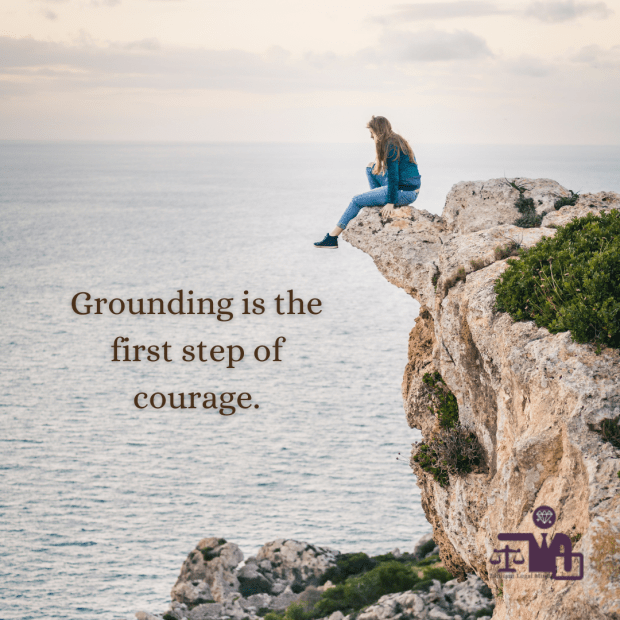
That’s what grounding can do for us lawyers in times of stress. Grounding is a practice of feeling the physical sensations of the body and most commonly emphasizes the sensations of being rooted to the earth. Most grounding practices suggest feeling the weight of one’s body or the contact that one’s body (such as the rear end, back, or feet or even hands on a podium) with the earth or other stable object. When emotions are high, this strategy works on a practical level because it helps us find stability when things seem beyond our control. It also helps us minimize the impact of a mind churning with thoughts that usually only serves to increase our anxiety. On a psychological level, though, grounding is the first step of courage.

When we root into our physical experience, we say “yes” to it on a fundamental level. We make a conscious choice to stay with whatever experience arises instead of retreating into the dark recesses of our mind. By rooting into our experience and feeling whatever is going on in our body, we implicitly tell ourselves that we can handle whatever uncomfortable emotions may come as we do.

In doing this, we open our minds up to what is actually happening in the situation, rather than merely seeing our preconceived judgments or being blinded by the things we fear. In a situation like an oral argument, where a single question could change the course of a case, clear awareness is critical. But the same is true for so many other areas of our law practices and lives. To be sure, our ability to be fully present affects the way we interact with clients so that they learn to trust and rely on us. It affects our ability to care for ourselves as we deal with the risk, time pressure, and stresses of law practice. And, it affects our ability to show our loved ones that we care for and support them in life.

So, if you experience a time in law practice when you feel unsteady, resist the urge to judge yourself or panic. Instead, it may be more effective to just find steadiness. Fortunately, no matter where you go (on earth at least) the force of gravity is always connecting you to your bodily experience as a human. Look for that sensation by feeling the weight of your body in the chair or your feet on the floor. Pause for a moment and rest in the feeling. Though it may seem like a small thing, this first, tiny act of courage may be all that you need to stay present, see clearly, and react with wisdom and skill to whatever life sends your way.

Want to learn more about mindfulness and compassion? Check out my new book, How to Be a Badass Lawyer, for a simple guide to creating a meditation practice of your own in 30 days. And to share mindfulness with your little one, check out my new children’s book, Mommy Needs a Minute.

Like this post? Subscribe to the blog here or follow us on social media:

Sending Loving-Kindness to Opposing Counsel Can Make You a Better Litigator

If I had to pick one style of meditation to recommend for lawyers, it would be loving-kindness practice. When I present seminars on mindfulness, I take any opportunity I get to talk about the practice or share it in a guided meditation. Loving-kindness meditation became my lifeline early in my law practice when I was struggling with the combative nature of litigation. I often turned to it after a lengthy deposition with a difficult witness or when I was freaked out by a case or project. It almost always calmed me down or reminded me that the world was not as dark and terrible as I may have felt before I sat to meditate.

If you aren’t familiar with it, loving-kindness practice doesn’t merely focus on the breath. Rather, it is a dynamic practice where the attention is usually focused on sensations in the heart as you bring individuals and groups to mind and send them kind wishes. Traditionally, these phrases wish that yourself and others are safe, happy, healthy, and at peace and the practice usually starts with oneself and moves outward from a loved one, mentor, neutral person, difficult person, one’s community, and then the whole world.

If you are litigator like me, the first “difficult person” to come to mind may be the opposing counsel who most recently drove you up the wall. Now, for those entirely new to the practice, I don’t usually recommend starting that way because you may find it, well, difficult to send loving thoughts to an adversary, especially if you don’t like them or respect their tactics. But, over time, if you can work your way up to sending loving-kindness to opposing counsel, it can really help.

Now, I know you may be thinking “why would I send kind wishes to someone who is literally trying to hurt me (in a professional sense)?” When you put it that way, it sounds crazy, I know. When it comes to the difficult person, however, I see the practice of loving-kindness sort of like forgiveness. You don’t really forgive others to help them; you do it to help you. Wishing loving-kindness to an opponent or anyone you dislike can soften the reactivity you have for that person and give you space and distance from the situation. Even if you struggle to really feel love for a difficult person initially, just attempting the practice can help you see how your reactivity is manifesting and that might put you in a better position to care for yourself and act more skillfully in the future.

I want to be clear, though, that loving-kindness for opposing counsel is not forgiveness. You don’t have to forgive anyone to do the practice and you certainly shouldn’t ignore or condone bad behavior. Instead, the practice is really about acknowledging that all humans want and need to be safe, happy, healthy, and at peace. It’s an acknowledgment that, even when things appear to separate us from others, we are deeply connected to all people just by virtue of being human. Thus, the paradox of loving-kindness practice is that it gives us distance from our judgments of others by helping us see how we are all connected.

This may sound good in theory, but you may be wondering what it has to do with litigation. In fact, it’s ideal for litigation. I’ve used this practice for an opposing counsel that I often litigated cases against and whose style was drastically different from my own. While I can’t boast that all my antagonistic and judgmental tendances abated, a few sessions helped me see my opponent as a person, rather than some blocking force who made me angry on a regular basis. Now, we have a good working relationship despite our frequent clashes. On a practical level, this has made me calmer and treat opposing counsel with more respect so that we can work together to discuss case scheduling or stipulations or even settle a case when the circumstances are right.

It’s even useful when settlement or conciliation aren’t the aims. Some worry that doing practices like loving-kindness might turn them into a flower child who can’t aggressively advocate for clients. That’s not been my experience. The practice can certainly evoke strong emotions and soften the heart. But it does not empty the head of rationality or logic. Instead, by facing the emotions I may have for difficult opposing counsel and sending them well wishes, I have generally experienced a release that has allowed me greater mental clarity and increased objectivity when it comes to my cases. In turn, this has made me calmer in the courtroom, more incisive in my analysis, and far more courageous in my advocacy.

By no means am I saying that loving-kindness or any kind of meditation can make litigation an easy thing. As an adversarial process where the stakes are frequently high, litigation tends to be difficult on all parties involved, including the attorneys. The difficult nature of litigation, however, is exactly why it helps when attorneys know how to avoid making the situation worse. As odd as it sounds and as uncomfortable as it may feel at first, loving-kindness practice is one tool that can make litigation less painful and litigators more effective. Though it doesn’t make litigation easy, it can help you feel more at ease and that’s why it is the practice I most frequently recommend for lawyers.

Want to learn more about mindfulness and compassion? Check out my new book, How to Be a Badass Lawyer, for a simple guide to creating a meditation practice of your own in 30 days. And to share mindfulness with your little one, check out my new children’s book, Mommy Needs a Minute.

Like this post? Subscribe to the blog here or follow us on social media:

4 Steps to Help Lawyers Handle Shame Triggers from Opposing Counsel

Though most of the attorneys I have litigated cases against are wonderful people who only want to represent their clients well, I’d be lying if I didn’t admit that some just like to play games. They don’t want to turn over documents that are clearly relevant. They don’t want to think practically when evaluating a case for settlement. And they want to object all the time just to be difficult. Sometimes this happens because people lose their patience, get too emotionally invested in a case, or have other pressures that affect their decisions. Since I am an imperfect human and litigation is stressful, I can forgive a lot.

The kind of game that is the hardest to forgive, however, is when lawyers attempt to play games with other lawyer’s minds. Perhaps the most vile instance of this is the intentional shame trigger. This happens when one attorney tries to control another without legitimate power or authority with comments intended only to make the other attorney feel bad. By now, most attorneys know that they can dance like nobody is watching, but must email like it may one day be read in court.

Thus, I usually don’t see attorneys flat out calling names or spewing hate explicitly. Instead, most shame trigger attempts I’ve encountered have been embedded in a discussion of legal or factual issues. This can make them even more insidious, however, because it means that an opposing attorney without good intentions might be able to worm their way into your head without you realizing it.

What is to be done about this situation?  I’ve found that several tools from my mindfulness training have helped me avoid becoming distracted when opposing counsel throws out shame triggers. Here are my tips.

1. Recognize.

The first step for dealing with a shame trigger is to see when it is happening. Clearly, mind games in litigation can come in all sorts of forms, so there isn’t necessarily a single definition that can apply to all situations. Even so, I find that shame triggers tend to occur when one party wants something from the other, but they don’t have legitimate means of obtaining it.

I’ve commonly seen this arise in settlement negotiations when opposing counsel wants me to increase my offer but doesn’t have a good basis for explaining why the risk necessitates an increase. I’ve also seen it occur when parties are discussing things like deposition scheduling or discovery and there is a lack of guidance from the court or civil rules about how something must be done. When the respective parties’ interests and preferences clash, shame triggers might be thrown out to intimidate or manipulate opposing counsel into doing what they want.

Now, of course, it is our job as attorneys to sometimes point it out when things about the other side’s actions or case are wrong. For instance, it’s not inappropriate to tell another attorney that their client’s discovery responses are overdue or that their legal theory has flaws. Shame triggers, though, aren’t pointing out a lack in the other party’s case or a failure to undertake an essential procedural step.

Rather, they are intended to point to a lack in an attorney’s worth as a person or professional. The calling card of the shame trigger, therefore, is that they usually involve passing judgment on an attorney and are unnecessary to making a legitimate request or explaining a position in a case. If you notice this happening, slow yourself down if possible and acknowledge what’s going on before you do anything else.

2. Equanimity.

The thing about shame is that it really hurts. Humans have an innate need for the approval and support from our communities. We go out of our way to avoid feelings of shame and judgment from others, including strangers and people we don’t approve of ourselves. This is exactly why lawyers sometimes stoop to the level of tossing out shame triggers to try to get their way: they sometimes work. Thus, once you are aware that another attorney is trying to shame trigger you, the next step is to draw on equanimity.

If you can give yourself a few minutes to take a break from the situation, that might be enough to calm you down. Unfortunately, though, we don’t always have that option. In times when opposing counsel is playing mind games, I remember my objective for my client and my values. I also recognize that the point of nasty, shaming comments is to elicit an emotional reaction from me and to distract me from my purpose in representing my client. I remind myself that the true test of my worth as a lawyer isn’t what another lawyer might say about me in the heat of a dispute, but only my own actions. This helps me find steadiness and stability as I venture on to respond in a way that serves my client best.

3. Choose Your Response.

Because lawyers use shame triggers to try to exert control when real control is lacking, the best way to undermine them is to choose your own response. As a child who grew up in the 1980’s and 90’s, the image that comes to mind with this is in the final scene of Labyrinth when Sarah (Jennifer Connelly) proclaims “You have no power over me!” to Jareth (David Bowie), thereby dispelling the illusion that his emotional manipulation could dictate her actions. Just like Jareth, lawyers who use shame triggers can present as powerful with their bluster and arrogance but those behaviors often mask a position of relative weakness.

Does this mean you have to call out the other attorney as a shame-triggering hooligan who “has no power” over you? Not necessarily, though an explicit but skillful calling out when discussions get overly personal or aggressive may be necessary in some cases. In general, though, I prefer to just let my actions do the talking. After determining what aspect of the commentary from opposing counsel requires a response, I show my strength with my next move. This may be a motion or settlement offer based on my evaluation of risk or no move at all as I call the bluff of the other attorney threatening a motion of their own.

In other words, I redirect my energy away from their emotion and judgment back to the legal and factual issues in the case where it belongs. Wherever possible, I try to project calm and confidence as I do. In doing this, I avoid wasting time arguing with other lawyers about the propriety of their conduct and I neuter any power the shame trigger might have had because I stay focused on the work for my client.

4. Care for Your Feelings.

Now, this is not to say that emotions can simply be ignored when dealing with nastiness and shame triggers from opposing counsel. As I’ve written before, emotions need to be felt and it’s usually a waste of time to pretend they aren’t there. Though I try to avoid making decisions about legal strategy based on my emotions, it is necessary to deal with them later on in an appropriate and healthy way. In the moment, this may include simply sitting with the feelings of frustration, anger, hurt, or even fear that may arise when opposing counsel uses shame as a weapon. Coupling this with some breathing to calm your body and self-compassion may be enough to steady you so that you can respond and address the situation.

When you have more time, I have usually found it necessary to release the emotions further. Physical exercise has helped me let go of frustrations and the stress of dealing with difficult opposing counsel. Self-forgiveness and self-kindness are usually essential because, in stressful situations with adversarial people, I rarely handle situations perfectly. More significantly, though, I have usually found it most helpful to share my frustrations without revealing client confidences with a loved one or colleague.

More than anything, getting the perspective of someone else helps me ensure that I was seeing the situation clearly, and to validate my experience. Sharing my feelings doesn’t make the other attorney’s conduct any better but it has always helped me feel less alone in dealing with it. Often in litigation, we are in a situation where we must learn not to act on our emotions, so it is essential at some point to reckon with and honor them as normal and human. You deserve this support because the work of an attorney is hard and important, but offering this ongoing support to yourself will also help you build confidence as you face new challenges.

Unfortunately, bad behavior from opposing counsel is part of litigation. To be sure, firms, courts, and the profession must do its part to police and reduce unnecessary personal attacks that arise in the litigation context. As those actions emerge, however, us litigators have the power to not add to the nastiness, to keep ourselves steady, and to focus on the work of our clients. Shame triggers from opposing counsel are too common in litigation but they don’t have to derail your work as a litigator or haunt you. With mindfulness, intentionality, and proper supports, you can stay steady as you litigate cases even with difficult opposing counsel, get the job done for clients, and build confidence in your own abilities.

Want to learn more about mindfulness and compassion? Check out my new book, How to Be a Badass Lawyer, for a simple guide to creating a meditation practice of your own in 30 days. And to share mindfulness with your little one, check out my new children’s book, Mommy Needs a Minute.

Like this post? Subscribe to the blog here or follow us on social media:

Litigating a Big Case Terrified Me, but Left Me Feeling Like a Badass

Cover image for post with title "Litigating a big case terrified me but left me feeling like a badass."

Every so often, there are cases that come along that test your limits as an attorney. Maybe they are high profile. Maybe they come from an area of law that is outside of your comfort zone. Or maybe the result in the case could have huge consequences for your client or community.

Earlier this year, I had a case that included all these things and it scared me to death. This was a problem because I was lead counsel and it was my job not only to develop a strategy to manage the litigation, but also look confident enough for my client to have faith in my abilities.

How I Knew the Case Scared Me

For days after the case was filed, I was in a nasty mood. I was tensed up like a spring that had been held back and might burst open at any moment. I found it difficult to do small tasks on the case and focus, dig in, and do the work. While I had support from colleagues and friends, I kept feeling like I was lost in an unknown land with no idea how to get home. When I interacted with my client, I gave directives, identified risks and strategies, and offered consolation for their nerves. But as I did, I knew I was in ‘fake it until you make it’ mode.

When in Doubt, Meditate.

I knew I had to get my head right to litigate the case well. I had critical and complex briefs to write and I had to quickly prepare to put on and attack proof in a hearing. How was I going to shake my fears and get my head in the game? I didn’t know what to do, so I kept doing what I always did. Fortunately, for me, that included meditation.

Image with quote from the post that says "you can't control what happens, but you can control how hard you fight and how kind you are to yourself."

Meditation Is Not Magic, or Is It?

I am adamant about reminding people that meditation isn’t magic but it is a practice that has helped me over the years and gotten me out of many mental jams in the past. Honestly, the fear and loathing I was feeling about the case made me reluctant to sit.

In times when I am really struggling, meditation is the last thing I want to do because I know it will force me to confront things I’d rather not feel. Even so, I knew I needed to manage my stress and that I needed a lifeline to keep me steady. I made myself sit even though I knew I wouldn’t enjoy it.  

Meditation Helped Me Just Sit with My Fear

I didn’t do any special practice or guided meditation and I barely focused on my breath. Instead, I just sat in the dark of my mind and let the thoughts swirl around. The thoughts were so intense and mixed up with my emotions that it took me a few days to get my bearings. Something in me must have recognized that I just needed to give it time.

My meditation on the first night was a dark haze with little focus and minimal relief. I forgave myself and tried again the next night. I was surprised to find that my mind was less scattered and I was even able to do some loving-kindness practice for myself. That seemed to unlock a door because the third night was when I broke through.

Meditation Helped Me Face My Fear, Literally

As I sat, I found my mind settling on its own and connecting to my body like a final puzzle piece falling into place. Even as thoughts surfaced about the case, I was calm without effort and could just see them arise. This let me look at—examine—my fear. I could see it as a vision in my mind in addition to feeling it in my body. I saw the vision of me losing the case, making a mistake, and having to deal with the consequences.

As I watched, my favorite phrase from my loving-kindness practice– “may I greet my life with joy”—sprang to mind. I selected this phrase for myself because embedded in it is the idea that life isn’t always a joy, but I can still choose to bring it in when I respond to situations in my life. This recollection made me break down in tears for a moment.

Image of lawyer looking at files in a state of anxiety with a quote from the post that says "you don't have to conquer all of your fears to be a great lawyer."

When I Could Be Afraid, Then I Could Brave

When I recovered, my mind collected itself and, in a kind, wise voice from nowhere, said: “Claire you can’t control what happens in this case. But you can control two things: how hard you fight and how kind you are to yourself as you fight.” And that was it. I didn’t conquer my fear at all.

I acknowledged it. It was big, and drawn out, and overwhelming. It went right to my ego and shook it to its core. It took me 3 days before I was ready, but I stared that fear right in the eye and saw the truth: that I couldn’t make the fear go away but I could care for myself as I felt it.

After Facing My Fear, I Could Focus on the Case Again

Remembering this set me free. I slept better that night than I had in a week. I got up the next day and found it easier to focus. I wrote one of the best briefs I have ever written, with force, clarity, and solid legal analysis. I orchestrated a defense and showed confidence and compassion in preparing my client to testify.

The litigation was stressful and worrisome to be sure, but I remained focused and steady throughout. Despite all my fears, the results for my client were much better than I had expected, and I was proud of the job my team and I had done. The funny thing is, though, that the results were not what made me most proud.

Meditation Helped Me Focus on the Work and Let Go of the Result

I had started the case focused on the result and it made me feel alone, vulnerable, scared, and even a little like a fraud about to be revealed. I ended it feeling like a badass because I let the results go.

My meditation practice helped me get out of the mindset of treating the case like a test of my worth as an attorney or a person. It helped me stop punishing myself for all of the things in the case I couldn’t control so I could focus solely on the things I could.

A Scared Lawyer Can Be a Great Lawyer

In the end, the case didn’t test my limits as a lawyer, but rather expanded them. I had believed unconsciously that a scared lawyer wasn’t a good lawyer. I now know that a scared lawyer can be a great lawyer. I didn’t have to conquer all of my fears to do great work for my client. Instead, I needed to let myself expand to hold the fear with kindness so that it could transform to compassion and courage.

Image with quote from post that says: "Fear held in kindness can transform to compassion and courage."

If you are dealing with anxiety relating to a case, you aren’t alone. We have a guided meditation for you. It uses visualization and loving-kindness practice to help you take care of yourself as you serve your clients.


Want to learn more about mindfulness and compassion? Check out my new book, How to Be a Badass Lawyer, for a simple guide to creating a meditation practice of your own in 30 days. And to share mindfulness with your little one, check out my new children’s book, Mommy Needs a Minute.

Like this post? Subscribe to the blog here or follow us on social media:

How Mindfulness Can Help You Survive Virtual Litigation

Before the pandemic, I had almost never used Zoom at all but I have now litigated numerous virtual hearings and done too many webinar presentations to count. If the past year was good for anything, it at least forced me to learn how to take depositions and put on proof over Zoom. Virtual litigation offers many benefits, especially efficiency and convenience, but it is exhausting in every sense of the word. When litigation is already exhausting in normal circumstances, this impact cannot be taken lightly.

Even as we begin to come out of the pandemic, I think its fair to say that virtual litigation options are going to persist even if they are not so common as they have been in the last year. So, you may wonder if there are any tips or tricks for making virtual litigation a little less painful. Several lessons from my own mindfulness practice helped me stay steady during virtual hearings and they might help you too. Here are my tips:

1. Remember Your Limits

One of the first mindfulness lessons I learned is one that many of us lawyers often forget: we are not just brains. We have bodies. Those bodies have needs and limits. When we don’t respect those limits and honor those needs, our performance suffers and we experience a lot of needless pain. The way I handled this when litigating cases remotely was to be conservative in scheduling the cases on the front end. Rather than try to power through with 8-10 hour days on Zoom, we opted for ½ days spread out over time. While I was initially concerned that we wouldn’t finish even with the days allotted, we ended up finishing the proof early because we were conscious of time every day. This reduced the need for multiple breaks and allowed us all to avoid the fatigue and problems that came with prolonged time staring at the computer. Even if you can’t schedule a case this particular way, think practically about how long you can tolerate Zoom litigation as you set the schedule because remembering your humanity in scheduling will help the case go more smoothly.

2. Pick Your Battles

Another lesson my mindfulness practice taught me is that fighting is often unnecessary. Stipulations are essential for managing many hearings and trials to avoid wasting time on undisputed things. When you add the logistical complications of virtual presentation to the mix, that sentiment is even more important. In addition to stipulations of fact or evidence that could make things go more quickly, consider setting procedures or developing plans to make sure everyone is on the same page for the hearing. It may even be useful to hold a dry run with counsel for all parties to ensure that everyone is familiar with the platform you are using. While it may seem foreign to work closely with your opponent in this way, you may find that letting go of fights about minor things can help you all focus better on the disputes that really matter.

3. Plan for Disruptions

Anyone who meditates knows that disruptions happen no matter how much we try to avoid them. Likewise, anyone who has tried a trial or lengthy hearing knows that they almost never happen without a hitch. Prepare yourself for the disruptions. Have a plan for technology issues. Try to develop schedules of witnesses to avoid lag times if testimony goes quicker or slower than expected. In addition, it generally helps not to be a jerk about your opposing party’s situation because it will eventually happen that you are the one who needs the mercy. In one of my virtual hearings, I learned an hour before testimony was set to start that my daughter was required to quarantine due to a close contact at school. I was fortunate that my client, opposing counsel, and the hearing officer granted me a postponement for that day so I could pick her up from school. If my relationships had been less cordial, however, I may have gotten a different result.

4. Slow Down. Then Slow Down Some More.

Rushing is something we all do, especially when we are stressed, but my mindfulness practice has helped me notice it, slow down, and respond more skillfully to life. For most of us, hearings are going to make us stressed whether they are virtual or not. When you present virtually, everything goes through a filter so rushing can quickly become disastrous to your case. To avoid this, remind yourself as much as possible to slow down. Come back to your breath frequently or do a quick body sweep (check your brow, eyes, jaw, neck, shoulders, chest belly, hips, hands) to return to your body. If you are noticing the signs of tension or quick or shallow breathing, try to relax your body and open up your breath. You can do those things in a second or two and it can help keep you steady, focused, and even as you ask questions and present proof.

5. Get Some Rest.

Finally, another important mindfulness lesson is the importance of rest. When we let our attention settle on the breath, we give our minds a chance to stop trying for a moment. For us achiever types, even a little bit of rest goes a long way. When you sit in front of a glaring screen all day and have to listen intently to less than great audio, you need to check in with yourself after and give yourself a break. That likely means an activity away from your computer with some different sensory input. Your normal exercise or relaxation routine might be enough, but I found that I needed to pull out all the stops for my weeks of virtual hearings. In addition to normal exercise, I needed some extra yoga sessions, warm baths, and any time outside that I could get. When you are in a trial or a hearing, it may be tempting to dive right into your inbox piling up with emails but a well-timed break may make your efforts less painful and more efficient.  

I hope we are leaving the COVID-19 era of social distancing but I think the brave new world of virtual litigation is here to stay. Litigating cases remotely presents its challenges to be sure, but the lessons from our mindfulness practices can help us to reduce suffering on Zoom in the same way that they help us to reduce suffering in our lives. If we remember to care for ourselves and bring awareness to the unique challenges and opportunities that virtual litigation presents, we can then focus our whole attention on getting great results for our clients.

Want to learn more about mindfulness and compassion? Check out my new book, How to Be a Badass Lawyer, for a simple guide to creating a meditation practice of your own in 30 days. And to share mindfulness with your little one, check out my new children’s book, Mommy Needs a Minute.

Like this post? Subscribe to the blog here or follow us on social media: