Do You Know the Cost of Clutter? Interview with Coach and Author, Monica Jenkins

This may be the only time you see a post about organization and clutter on this blog. I am not a neat freak and never have been. But with two kids in school, a busy law practice, and all the demands of life, I can certainly see the value in taking the time to get organized in life. This summer, I have been thinking a lot about this because we did some cleaning up around my own house. It made a big difference because getting rid of old, unused items helps make space to live the life I wanted.

At the same time, my friend Monica Jenkins published her book, The Cost of Clutter. I met Monica through a book writing program that I did last year. Since she is also interested in attending law school, I thought it made sense to connect with her here for an interview. If you want to learn more about ways to manage clutter or get started with better organization, check out the video interview below. If video is not your thing, scroll down for the full transcript.

Interview Transcript

Claire:

Hi, everyone. This is Claire Parsons, the founder of the Brilliant Legal Mind blog and author of How to Be a Badass Lawyer. I am here today with my friend Monica, who actually went through a book coaching program with me last year which for any lawyers watching this is a little bit like one year of law school, except our coach was, I think, a lot nicer than a lot of law professors are. Monica actually published her book shortly after I published mine and I have it here. It’s called the cost of clutter. And it’s about learning how to get a little bit more organized in your house and your life and your work, so I wanted to have Monica here to talk about her book and herself.

I want to introduce Monica first before I get some questions for but Monica Jenkins Jenkins is a speaker and bestselling author of the cost of clutter a billion dollar vision for culture, communities and companies. She helps executive leaders and professionals have more peace of mind clarity and direction at work and at home. Monica has trained leadership teams and global corporations, faith based organizations and diverse communities. She draws on my personal experiences with racism being let go from a job and as an overwhelmed mother and wife in her book and she offers a step by step guide to personal and professional transformation that begins with cleaning out your closets. So I’m sure a lot of us here today can definitely benefit from that. So, Monica, do you want to tell me a little bit more about yourself that your bio doesn’t cover?

Monica:

Sure sure. Thank you for having me too. Well, one of the things that probably doesn’t say is that I am a Jesus freak. Yes, I am. Yes, I’m a wife. I have an amazing husband. I’m a mother of two beautiful children. And something that I find interesting about my life is I was born in Detroit, Michigan. I grew up on an island and more states. I attended probably seven different schools before I graduated high school. I do have a bachelor’s degree from University of Connecticut – Go Huskies.

As far as my work career has spanned from banking, higher education, social services. And lastly before I went out on my own to do all this work, legal work in a corporate legal department. So with something else I would add to is that I’m an author, as you just said, which is you trimming out of an author, I am also a coach and I, I kind of defined my coaching as clarity, clarity, lifestyle coaching, and so we can talk about that a little more as we dive into some of the questions but that’s kind of my coaching model and I’m also the managing partner of our family home business called CMON enterprises and that CMON enterprises LLC. And the book is one of our first babies born from that business. And my coaching services are aligned with that as well.

Claire:

And I thought at some point, Monica that there was some interest in adding on a J.D. to that long list of accomplishments and maybe going to law school?

Monica:

Yes, yes, you are definitely accurate in that and I still plan to make that happen for myself. What I found with the book and everything that’s come from the book, the business, and having had an opportunity to kind of share more about it in my coaching. I feel like I’m kind of trying to balance when that start with that start will look like. So yes, I am studying for LSAT.

I am looking to possibly apply for 2024. And so that’s that’s still on the table. Because I’m very passionate about some things that really kind of still everything I do aligns with our book and so something that I’m passionate about my law career can hopefully support is housing matters. It happened concede standpoint and also from a federal kind of standpoint, federal Fair Housing law, things of that nature. So yeah, you got me on that one.

Claire:

Well, I understand the importance of picking your projects and having to take your time when you’re managing a lot of things. I definitely get that myself. I can say from my law practice, that some of the housing issues from an advocacy standpoint for individuals and I work with some local government entities that have dealt with that as well. It’s just really important because there’s so much need right now. Affordable housing is such an issue. So I wish you well on that.

I do want to talk about the book though. You know? I kind of want to start out with this blog, my blog is really about lawyer mental health and mindfulness and well-being. I can definitely see how clutter and, having read your book, I can see how that ties in with it. But, I think you’ll explain it better. So can you bridge the gap for people about what clutter has to do with mental health?

Monica:

I absolutely can’t thank you for asking that question. So one of the things I would start with is what comes to mind when you hear the word clutter? So through my research and talking with in conversations, so we started conversations, a lot of people are overwhelmed, they’re stressed and they just feel stuck when it comes to clutter. The way in which we define it is often very different. So it’s always in terms of a physical space. Like my closet is messy. My closet is unorganized. My shoes, everything isn’t organized, or a particular space that we utilize in our home. It’s messy, it’s junky didn’t have time for that.

And so how I think the two lines that people are finding out and definitely I found out that mental clutter alliance with your physical spaces, so you can be you know, your spaces. In other words, we see the space, right? We see the space, we see their stuff all around, but what’s going on in our on our minds, our lives are full. And I talked about this a little in the book about busyness, lawyers in particular, just because I’ve had the opportunity to work with some high profile attorneys and see how they function throughout the day.

And also just as I explored the profession of myself, and having worked also in a law school, I have been able to see kind of firsthand the type of I don’t like use the word business without their full lives, you know, what’s the focus that’s required? Having a certain mental capacity to do a lot of reading and writing. And so what I would say is that letter is really about like, one of the first things is how we use our time and it starts with time, like what’s going on in our lives. How are we valuing our time? So I would I would start with that.

Claire:

So you mentioned that you would work with lawyers, and you mentioned that you have in the past even worked with lawyers in your actual work. You kind of alluded to this a little bit, but if you can dig into it a little bit more. What makes it so hard for lawyers, what makes clutter is such a hard thing for lawyers. In particular, like what gets in the way and no pun intended with that question, but what’s our what’s our big issue, maybe extending from the idea of lack of time.

Monica:

Lack of time is definitely a big one. But also I’ll use a case study to kind of give an example of a woman who was a lawyer who battled cancer, and she survived and reached out to me and was getting her life back. But it starts in our home. So are lawyers maybe second, maybe third, because if you’re a mother or a father or you know a wife or husband, those kinds of things do matter in how we show up every day.

And so in talking with this woman and going on a journey with her to try to claim her house back so that she can then begin to get back to work. Our model was going to be that she was gonna be working from home as she just you know, was starting out and she were doing major cities so she’s working from home, but also it didn’t really start with the workspace. It started with like her personal space. What’s the priority? What is the priority? What was the priority I had to ask her as he walked around her home and I saw that it was a home that was lived in that really represented there was she was built, you know, it became her hospital almost.

So I think that recognizing that although you have such a humongous responsibility that we need and appreciate. We also at the end of the day are human beings who get colds, we get sick, like things that happen. We get fired. And some other things you know, that happen in our lives and sometimes one part of our life overtakes another and we don’t have time for the other and I will say that not only for lawyers but the time issue because one of the biggest straightening up a certain room.

At the end of the day, no one’s going to turn right back to that after the week is over. So my book is also about lifestyle. You as a lawyer are creating a lifestyle with mindfulness. And so it’s not going to just be for the summer when you’re on vacation or on your breaks are supposed to be better your lifestyle. And that is exactly what the crux of clutter is about. That’s exactly what clarity, clarity coaching life coaching is about. It’s about creating a lifestyle, that you live with less clutter so that you’re able to have some direction and have a little peace of mind.

Claire:

Monica, I think you already answered my next question, which was going to be why is it worth it? I think you’ve already spoken to that a little bit. But I wonder about like the initial difficulties of deciding to invest the time or maybe even the resources to have someone come and help you and I have a personal story with this.

This summer I started getting some of my backyard area a little bit more cleared out and getting some new things. We don’t have any shade in the back and I really love like swings and rocking chairs. So I kind of did that this summer. But the first thing I had to do was get rid of an old hot tub that hasn’t been working for years and has just been sitting there and like I actually had to hire someone to come in and get it cuz it’s so having a big and it took me forever to do that. And finally, the thing that ultimately got me there was when I started to imagine what I’m going to do with that space if the hot tub was gone, but I had to like go through this weird long process you know of doing that and it was kind of honestly a little silly.

How does how does someone like you come in and help someone you know get past that initial block so they don’t waste years? You know, with a dingy space or you know, having too much stuff around it gets in the way of living their lives.

Monica:

I think we start small. I think there have been people that I’ve met with examples and case studies actually even in the book, people that I’ve met with who were overwhelmed with that place that they saw like you like Oh, I’m going to use this for this or that. And one of the things that I said was what you said, “What do you imagine for that to be?” That’s one of the that’s one of the one of the steps in the book, like what do you imagine that to be?

You know, like someone who’s overwhelmed like what are you thinking, putting it on paper. What are you thinking about what you want was the priority for that space? And so there’s one particular client I had that I like to call a 911 call or 911 text or DM, was that okay? You’re in this space right now and you’re like, what is it supposed to be? Alright, so you’re not going to do that today, right? We’re going to decide like, what’s going to be the timeline for this like I would like it done in like 90 days.

Okay, so then you need to map out what 90 days will look like. And you know, I often times people want to just start going with the stuff and I always say don’t go with the stuff just sit with the back like I know myself as myself. In this case. I have a basement there’s still some areas that I need to tackle and it has been actually a two year project. Okay, because we’ve set it you know, there’s people there’s this empty nesters now, we have adult children and out so it’s a two year project. Why? Because in talking to my husband who would be the client or in talking to this other person who’s on the phone, like you have to determine that space that you want is specifically for you. But, you have all this stuff in the basement alongside three other people for the people, their adult kids who doubt like similar to me that was the case although kids didn’t data left me tonight.

So it’s like five weeks first and we start small. We write out what we want that area space to look like. And then we go from there. We have to have a conversation about journey because oftentimes we start getting rid of things and letting go. It brings up a lot of that stuff that stops the project, because we haven’t thought about it most people well. I would say most people know what’s in spaces that they need to reimagine, organize so there’s that thought of like, okay, well, Johnny and Susan stuff is here. And we had a conversation about this particular call. So when are you going to let Johnny and Susie come and get their things? Or is there like some creative zone for Johnny instances things so you don’t go so crazy about it?

Yeah, it’s always about starting small. It’s always about like, you know, for me writing things down. You know, taking those things out. And I’ve actually tack them on to spaces in the house like because I need to remind myself that this is something we’re not gonna like go another year. And metaphorically and like for real. So yeah, I think that’s that’s kind of important, starting small.

And I always read inhale, exhale, because anytime we’re going to tackle something that we know that is going to just take you into stress. I know I’ve been through that. That’s why I say that. So it’s like inhale, exhale, breathe. Let’s do exercises that three times before I tackle it, and after I finish it because an anxiousness comes, when you see how inspired you are to kind of do this and then you can just want to everything all quick and fast. And that’s not always the way it’s slow and steady, I believe into the race in this process, but it’s also how much time someone has. And so that’s part of kind of like my assessment process when I talk to people so I kind of getting an idea of what’s your priority? How much time do you want to do this? And you know, asking for help was the first first part so I always said in the book lock, ask for help you can do everything. So help me help.

Claire:

I agree with a whole lot of that and I of course love that you’re using breathing to help. One of the things that I often do when I present on mindfulness and compassionate whatever for lawyers is I kind of know that probably most of the audience is not going to go start a meditation practice just because they heard me speak. So what I tried to do is have this kind of blend of here’s how you can meditate. And by the way, here’s also these few little practices that maybe these micro practices that you can sort of bring into your day, maybe test what I’m trying to tell you and you can experience it yourself, but maybe not it just helps you and it just a little thing.

When it comes to clutter, Monica, maybe there’s some people out there who aren’t ready to go clean out their basement or read your book or whatever. Can you give me a few practices or little things that people can do to help manage their clutter where maybe they can they can try it out for themselves and say hey, that Monica is really smart. Maybe I should go buy her book. Can you give me some of those kind of things?

Monica:

Sure. I like how you said “micro.” So I would say micro-organizing and I’ll go back to starting small. What might this mean looking in your purse or backpack or a bag? I think it’s carry with you every day. Or it might mean looking at the well, I’ll say multipurpose drawer, formerly known as the junk drawer. Okay. And that’s in the book. I tell a little story about that. And so I would start there. When I got fired from a job many years ago, I thought the world was watching and I never knew anyone who got fired before it was like something that I felt like it was really taboo. I felt like I felt shame. I felt shame. Shame is big enough.

And so as I began to kind of create this work that I am now presenting to both now through the book, I started with my verse I was depressed. I was not going to inhale, exhale briefing. I am a person of faith but I felt like it failed me. And so I’m just like, and what studies show you start with this something and it’s gonna do something to you. Endorphins and things are gonna happen mentally. So I started with something like a drawer or something that you a person something for me and for others who carry backpacks or whatever you carry daily. That that was something that was very intentional for me.

So I started to look at my bag and I said, What’s the vision for the bag? Because that’s part of my part of my method was the vision for the bag. So I then began to declutter my bag and now I carry only certain things in my bag, a habit that now I’m creating a habit every week. I will look at my bag on a Sunday night or early Monday morning and make sure I have what I need to start the week and that’s gonna look different for everybody. So there’s certain things that I need to have in my in my purse or my work bag, I like to call a tote bag that I need. That’s very simple. And what ends up happening from there is you start moving to other things. So then I went to a junk drawer.

We had multiple, I’ll call them multi-purpose drawers, several of those, but I went to one of them. And I said okay, what do I want this to be based on his location, I, you know, I put certain things in it, so that I knew that they would be there. So that is one way that we can start we have to create, I believe schools and little habits. Another thing I would say is, you know, again, it’s gonna go back to time and I talked about this in the book, and I talked about value a lot. So how are you valuing your time? Like what are you doing when you get up in the morning and is it serving you for when you get to work? Or what are you doing at work when you get there? And is it really serving you? It’s I think that that’s that’s very important, we create these little micro habits that then kind of start to make us start to look at other things. So I’ll give those to you. And then the rest of them are in the book.

Claire:

All right, Monica. So my last question is, is just where can people find you and this wonderful book?

Monica:

The book is on Amazon currently I always thought there will be any other other spaces online right now. It’s definitely on Amazon. I mean, if people have questions want to reach out the class, the clutter, my email address is cluttertoclarity2022@gmail.com. We are currently getting ready to release the website very soon and it’s going to have all of the fun things that we’re doing. And so if you reach out via email, you want to know when all that happens and you’ll be in the know, that’s our campaign, the in the know kind of do you know the cost of clutter? So that’s people who have bought the book know the cost and the hashtag is #DoYouKnowtheCostofClutter, so that means you might get the book.

I’m hoping that the website will be a blessing to people that’ll be coming out very soon. That’s thecostofclutter.com. So it is currently under construction right now but certainly go on there and I believe there’s a link for you to order the book. And I’m also excuse me, all things social media, Facebook, I have a group and I am also on Instagram. So my handle on Instagram is @TheCostofClutter. And yeah, and I’m also on LinkedIn. So you can find me on LinkedIn and I’m gonna feel bad because I’m not going to know how to tell you how to find me on LinkedIn, but I’m there under Monica Jenkins.

Claire:

You can totally make a custom link if you haven’t, but we can talk about that later. But yes, you can find our Monica Jenkins and I will be doing a blog post and tagging Monica there if you want to find us that way as well. So I will also just kind of show you that one last time and let everyone know that August is National Black Business Month, so if you want to support Monica’s book, it’s a great time to do it. So please help her out and get the wisdom from her book that probably all of us need. So Monica, I appreciate you being here. Any parting words?

Monica:

Yeah, I’m just holding on to this. Mine’s a little different than hers cuz I have the bestseller tag on it. But okay, the one that that’s alright. Alright, so the ones that people that will order that’s the one that’ll come to you with the tag on it. So I was pretty exciting. I guess I would say about decluttering your life, that it’s one step at a time. It’s lifestyle change. And all you need is a little faith, a lot of courage, and really the motivation to clean out your closet and that’s just not your physical fitness metaphorically because your closet, the clothes and the things we can keep in your closet help you show up day to day. metaphorical positive what’s going on in your professional and personal life. And I think that’s very important to tie the two together so that you can live with less clutter, get direction and have more peace.

Claire:

Alright, that is my goal too. So thank you, Monica. And I hope I hope everything goes well with the book and all your new ventures.

Monica:

Thank you so much for having me again, Claire. Bye everyone.


Want to learn more about mindfulness and compassion? Check out my new book, How to Be a Badass Lawyer, for a simple guide to creating a meditation practice of your own in 30 days. And to share mindfulness with your little one, check out my new children’s book, Mommy Needs a Minute.

Like this post? Subscribe to the blog here or follow us on social media:

Why Is Attorney Mental Health So Important? Interview on the Is that Even Legal Podcast

I haven’t been asked too many times why I care so much about attorney mental health. Most people, I assume, see this as a pretty obvious thing. After all, I’m an attorney and I’ve personally experienced mental health challenges in myself and for those very close to me. So, perhaps, it goes without saying that attorney mental health is really important to me.

But there’s something deeper here and I got to talk about it on a recent podcast appearance I did for the hilariously named Is That Even Legal Podcast. On the show, fellow attorney Robert Sewell, asked why attorney mental health mattered so much and why mental health was such a struggle for lawyers in particular.

Of course, attorney mental health matters so much because lawyers affect the lives of so many people. Lawyers in big companies or large firms may touch thousands of lives with their cases. And even lawyers in the smallest of firms or companies have a major impact on their clients. In many cases, community and government leaders are lawyers. This is why I am passionate about attorney mental health: because it affects me, my family, my community, and the world.

I liked that Robert asked me these fundamental questions because they matter so much. But as a true lawyer, I have to admit that my favorite part of the interview was that Robert didn’t just accept it when I told him that mindfulness and compassion can help with lawyer mental health. Instead, he played devil’s advocate and pushed me to explain how.

For anyone who has read this blog or my books, you know that’s my jam. While I admitted that mindfulness won’t work in isolation and without solid workplace and legal policies and supports and social change, I argued that mindfulness and compassion offer the stability and the courage to make needed personal and organizational change.

If you care about attorney mental health or want to understand how mindfulness can really work, check out the interview here.

Want to learn more about mindfulness and compassion? Check out my new book, How to Be a Badass Lawyer, for a simple guide to creating a meditation practice of your own in 30 days. And to share mindfulness with your little one, check out my new children’s book, Mommy Needs a Minute.

Like this post? Subscribe to the blog here or follow us on social media:

A Candid Convo about Compassion for Lawyers

Bulldog lawyer. I hear this term all of the time. Clients say that they want a bulldog lawyer. Sometimes I even hear other lawyers request referrals to bulldog lawyers for friends or other contacts. As a mindfulness teacher, I try to remember nonjudgment and that sometimes people use a term without thinking much about all of its implications.

But I do not use the term bulldog lawyer and I would never refer a case to another lawyer that I primarily thought of as a bulldog. Why? A few reasons. One is that my experience with lawyers who try to craft an image of aggression has not been a positive one. Not only do they create needless fights, I generally haven’t found to be effective.

The best lawyers, in my experience, are the ones that fight hard when its appropriate but are otherwise focused on solving problems. This is what I talked about recently with host, Joe Bravo, on the show Candid Conversations with Get Staffed Up.

Joe had attended a recent presentation I did on confidence for the 2023 Legal Up Virtual Conference. Joe practices yoga and he was intrigued by my discussion of compassion, in particular self-compassion, in relation to confidence so he invited me on the show. Though polite, Joe was not shy about resolving the apparent cognitive dissonance between being an effective lawyer and compassion.

But I didn’t shy away from this in my response either because I know that mindfulness and compassion don’t get in the way of being an effectively aggressive lawyer at all. To the contrary, as I explain in the interview and in more detail in my book, How to Be a Badass Lawyer, compassion is foundational to this.

To break this down as simply as I can, I offer this logical syllogism.

When you see it this way, it’s clear that compassion and mindfulness don’t make lawyers that are too chill to care about their clients and act with force and power. Instead, the opposite is true. Mindfulness can help lawyers see things clearly and manage the cold hard facts as they are. Compassion is the capacity to be present with difficult problems and remain willing to help. This is what good lawyers (or as I would describe “badass lawyers”) should be able to do for their clients.

If you want to check out the full interview, you can find it shared on our YouTube channel or watch it here:

Want to learn more about mindfulness and compassion? Check out my new book, How to Be a Badass Lawyer, for a simple guide to creating a meditation practice of your own in 30 days. And to share mindfulness with your little one, check out my new children’s book, Mommy Needs a Minute.

Like this post? Subscribe to the blog here or follow us on social media:

Balance Is My Mantra: An Interview with Lawyer, Author, Mom, Community Leader, and Meditator, Tahmina Watson

My friend, Tahmina Watson, is one of the most accomplished lawyers I know. She’s an immigration lawyer, mom, community leader, podcaster, as of today, the author of three books, and an avid birdwatcher and photographer. Like me, meditation has been part of what helps her balance all of these demands and interests. In celebration of her latest book, which is released appropriately today on July 4th, I offer this interview to share information about a different style of meditation and a new story showcasing the benefits of meditation for lawyers.

Q. Tahmina, can you tell me a little bit about yourself?

A. I’m an immigration attorney in Seattle, Washington. My firm, Watson Immigration Law, is a boutique firm that focuses on business immigration law, which primarily serves small to mid-size businesses. And within business immigration I have a specific focus on startups and visas. We do a little bit of family-based immigration (parents, spouses, children) and some citizenship work as well. I don’t normally do defense in immigration court, but as a community leader I have volunteered to serve humanitarian interests relating to immigration. I’m also the author of three books, a podcaster, a columnist for Above the Law, a bar leader, and an avid birdwatcher.

Q. How did you become interested in immigration law?

It was very random. I moved from the United Kingdom to be with my American husband, and I really didn’t want to practice immigration law. When I moved from the UK, my UK law degree and experience as a barrister did not mean I could obtain a license to practice in the U.S. I took the New York bar exam because it was the one that I could take without going to law school again. But that limited my practice options to federal law since I lived in Washington State. Immigration matters kept coming my way, even though I said no to it about four times. And then the fifth time I said, Okay, well, let’s just do this.

The first day of practicing immigration law made me realize I wanted to keep going. It’s fast paced and intellectually challenging. I’m touching people’s hearts and minds and lives very tangibly. I can see the results of the work and I’m really helping people’s lives for generations to come. It allows me to work with intelligent people who have ambitious goals of changing the world every day, and that really fulfills me in trying to make their dreams come true.

Q. I know you had a really positive experience with meditation. Can you tell me a little bit about your practice and how you got started with it?

Political turmoil over the last several years has created a lot of stress in my law practice. It was overwhelming to be able to practice law, serve my community, be a mother and a wife, and do all the things I do. I was stressed and the stress kept building. And I didn’t really know what the answer was, but I considered meditation even though I wasn’t really sure what it was. I used the Insight Timer app on my phone informally and as needed for a while and that was an entry point for me. But, I had a few incidents where I realized I really needed to have a more robust meditation practice.

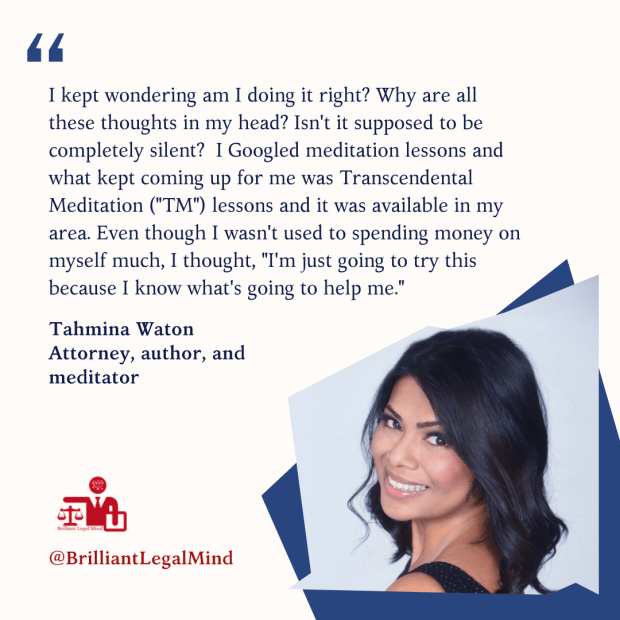
I kept wondering am I doing it right? Why are all these thoughts in my head? Isn’t it supposed to be completely silent? I Googled meditation lessons and what kept coming up for me was Transcendental Meditation (“TM”) lessons and it was available in my area. Even though I wasn’t used to spending money on myself much, I thought, “I’m just going to try this because I know what’s going to help me.” And I also realized that if I didn’t do something about it for me, I would not be able to help my children learn how to manage their own stress.

One of the things that initially concerned me was how do I even find time to go to this training? Because I think one of the things that we all think about is we don’t have time to do extra things, but I put it on the calendar and I attended all of the classes. The TM method recommends two 20-minue meditation sessions a day. Though I confess that I still don’t have that second meditation block, but my first meditation block has served me very well.

Now, once I went through the training, I had to find that 20-minute block of time for practice through trial and error and trial and error. It took me about nine months, believe it or not, to find that practice time. Where was my space? Where was my time? Where was the moment that I could actually have that block without somebody bothering me or a kid jumping in and saying I need this or a client calling or an email popping up? Where was that? I eventually found solace in my parking garage, where it was dark but I have come to cherish that time. So it became my practice of doing TM 20 minutes a day, first thing in the morning after dropping my child off at school.

Q. For those of us who don’t do TM, can you explain procedurally what the practice consists of and how you use the practice in your life?

TM starts with completing a questionnaire with the trained teachers. Based on your answers, they assign a mantra (word or small phrase) that is unique to you. You’re not supposed to share it. When you sit down to meditate you’re supposed to repeat that mantra over and over again. It doesn’t mean that the monkey mind won’t wander, but when it does you come back to your mantra. The mantra is almost like the guiding force for you. The practice method is very simple; you sit down for 20 minutes and repeat that mantra in your head.

Q. What did you do to bring your meditation practice back or shift it to make it work for your life as it is now?

I think what happened during COVID, and we all experienced it, was that suddenly our lives changed. Suddenly there were two kids having school in my house and my husband and I figuring out how to practice law at home. This made it challenging to find a quiet time in the house again. At first, I actually started to stand on my deck and just be outside and we take a few moments to take some deep breaths and that allowed me to really be out in nature. Eventually, I began waking up earlier in the day before the kids woke up so I could resume formal meditation practice. I have gone through various iterations, but I had been able to finally incorporate meditation back into my life with a daily practice of 20 minutes or getting outside. Sometimes my meditation is walking outside in nature and sometimes I do TM for 20 minutes.

Q. How does meditation help you balance everything?

When I was working on one of my books, I was already waking up early to meditate and had to get up even earlier to get in some time for writing. Once I got on this routine established, I didn’t want to break the chain that developed. I continued with that early morning rising and that’s how I would incorporate my meditation first and then my writing. This was never a perfect schedule and sometimes I slept in, but meditation for me was a constant.

Even if it was only a few minutes, meditation became the foundation to continue to be calm and proactive and not reactive, but reflective. And that helped with everything around me. It helps me stay steady when the clients are anxious because their lives or their livelihoods are at stake. Like me, they are often high achievers who are naturally anxious people. And I didn’t really realize how much anxiety I was taking on with each anxious client. But then I realized this meditation was my shield, but also my mirror for them. And so the meditation is really the beginning and end of everything I do, because it’s the foundation to be able to handle as much as you know, that life throws at me all you when I believe that’s how you are able to deal with everything.

To learn more about Tahmina, you can connect with her on LinkedIn. You can read her column on Above the Law or find all of her books on Amazon, including The Start Up Visa: US Immigration Guide for Startups and Founders, which releases today.

Want to learn more about mindfulness and compassion? Check out my new book, How to Be a Badass Lawyer, for a simple guide to creating a meditation practice of your own in 30 days. And to share mindfulness with your little one, check out my new children’s book, Mommy Needs a Minute.

Like this post? Subscribe to the blog here or follow us on social media:

The Voice of Compassion: Podcast with Psychologist and Public Speaking Coach Doreen Downing

Voice is really important to my history but I probably wouldn’t have recognized this so clearly if I hadn’t met Doreen Downing through the Mindful Professionals Network. Doreen is a therapist and public speaking coach, the author of The 7 Secrets to Essential Speaking, and the host the Find Your Voice Change Your Life Podcast. As I learned, she’s also a gentle but powerful soul and asks some really great questions.

During the interview, we talked about my history with perfectionism, overthinking, introversion, and doubt. But we also talked about how voice was a surprising lifeline for me. Unlike many people and despite my introversion, I had always been drawn to speaking because I loved teaching and explaining things to others As an auditory learner, I have found that teaching and speaking out issues helps me understand things better.

When I stated meditating, I learned to trust my voice and let it guide me. As I have discussed here before, the first step with this was to begin writing regularly. Eventually, though, I also began speaking and teaching mindfulness, meditation, and compassion too. As you can imagine, this was not an easy process and I had to learn to figure out what voice corresponded to this new piece of my identity.

And you know what I learned? It wasn’t a new voice at all. My meditation teacher voice was the same as my lawyer voice and my mom voice and my good friend voice. This new part of me had been there all along and what I needed to do was trust it and start using it more.

If you are someone who hates public speaking or wants to think about your inner voice, this is an interview for you. Doreen is also an excellent resource on this and I hope you connect with her and check out her book. As for the full interview, You can check it out here or watch the full episode on YouTube.

Want to learn more about mindfulness and compassion? Check out my new book, How to Be a Badass Lawyer, for a simple guide to creating a meditation practice of your own in 30 days. And to share mindfulness with your little one, check out my new children’s book, Mommy Needs a Minute.

Like this post? Subscribe to the blog here or follow us on social media:

It Was a Great Well-Being Week in Law

It was a busy week but a great week for me. I got to celebrate Well-Being Week in Law in several different ways.

First, I got to present on mindfulness and confidence for a law firm. The session was well-attended and the engagement from the audience was excellent. I shared how mindfulness can help build confidence because it can help you break down fear and doubt into component parts and learn strategies to care for each aspect.

Well-Being Week in Law Event Number 1

On Wednesday, I connected with Kristin Tyler, a founder of LAWCLERK Legal and a long-time friend of the blog, and coach and one of my co-authors from the book #Networked, Olivia Vizachero, to discuss mental health in the legal profession.

We discussed everything from strategies for time management and reducing decision fatigue to the practices that support our personal and professional well-being. It was a fun conversation and I was so proud that LAWCLERK chose my book, How to Be a Badass Lawyer, as a giveaway item to support attorney wellness.

You can watch the recording of event here on YouTube:

Well-Being Week in Law Event Number 2

For my last event of the week, I came back home. Specifically, I did a brief talk and guided meditation for my local bar association. I’m a proud member of the Northern Kentucky Bar Association Lawyers Living Well Committee. I talked about how to manage the early phases of meditation practice when you may not immediately feel calm and relaxed. In the guided meditation, I focused on ways to learn to practice relaxation and rest.

To listen to the talk and try the meditation, check out the recording of the event here:

Did you do any special activities this week? Leave a comment to let us know what you tried.


Want to learn more about mindfulness and compassion? Check out my new book, How to Be a Badass Lawyer, for a simple guide to creating a meditation practice of your own in 30 days. And to share mindfulness with your little one, check out my new children’s book, Mommy Needs a Minute.

Like this post? Subscribe to the blog here or follow us on social media:

Living a Rich Life with Stage IV Renal Cancer: Interview with Lawyer and New Author, Joel Stern

Cover image for blog post entitled "Living a Rich Life with Stage IV Renal Cancer: Interview with Lawyer and New Author, Joel Stern"

Q. Joel, tell us a bit about yourself, including your status now and a brief history of your work. Where were you in your life and career when you received your diagnosis?

For the great majority of my career, I was a corporate attorney leading large groups of legal and contract management personnel.  I started off at Allstate Insurance Company and then was General Counsel of a Sears/IBM telecommunications and data processing joint venture. I then moved onto Accenture where I was the Deputy General Counsel managing the Americas legal team, global contract management team and COO of the legal group.  After achieving everything I wanted to achieve in my legal career, I became the CEO of the National Association of Minority and Women Owned Law Firms – a non-profit organization now made up of over 215 minority and women-owned law firms seeking the opportunity to compete for and win business from fortune 500 corporations.

I have always been passionate about DEI and frustrated by the lack of progress in the legal profession so decided to become the change in the world I wanted to happen and make DEI my full-time focus. I also thought it was critical for me (a white male) to play a role in this because change is not going to happen without everyone in the fight. Affinity groups are critical, but they can’t move the ball forward without the majority working towards the same goals.  I’m proud of the work I have done at NAMWOLF and for my DEI efforts generally but there is so much more to do.  Even though I am retired, I am still actively involved in DEI efforts by serving on an internal advisory board and as a mentor for Diversity Lab’s On-Ramp Fellowship program. 

In November of 2020, I was diagnosed with stage IV renal cell carcinoma (“RCC”).  I was having terrible back pain that I thought was just a continuation of history with my back. When they did an MRI of my spine, they found a large tumor destroying my iliac bone. When they biopsied the tumor, they concluded it was kidney cancer and I had several tumors up and down my spine from the back of my skull down to the hip. I also had a small kidney tumor that was causing no harm to my kidney.  Coincidentally and thankfully, the diagnosis came three months before my long-awaited retirement from NAMWOLF, so I was able to seamlessly transition my job duties to my successor and begin to focus on my battle with stage IV cancer.

Image with quote: "The stages of dealing with cancer are real: shock, anger, sadness, anxiety, depression and then 'I'm going to kick the you-know-what out of this disease."

Q What were the most important practices or supports that helped you cope with the diagnosis and treatment? 

The stages of dealing with cancer are real: shock, anger, sadness, anxiety, depression and then “I’m going to kick the you-know-what” out of this disease. Some get to the last stage sooner than others. It took me four months to get to that stage and I remain at the stage today. But for many, including me, you must get into some pretty dark areas before you can finally see the light.

Several things helped me get through this. First, I have an incredible family (“team Stern”) who refused to let me get too down in the dumps. They pushed me when I needed to be pushed and let me rest and wallow in self-pity when I needed to. Second, I have a great group of friends who were very helpful in supporting me. Third, having an excellent medical team composed of experts in the disease who combine great skill and bedside manner is critical. I’m a great believer in large teaching hospitals in big cities if possible. 

I also must thank my mother for teaching me how to fight this disease. She was diagnosed with breast cancer when I was five and fought the disease for 15 years as it spread throughout her body. She never complained about her plight, raised three sons while fighting, and fought until the very end. While I never appreciated her lessons while she was alive, my mother is a role model now that I am going through a very similar fight. I also love to write about my disease. Writing has been extremely cathartic for me and helps me deal with and express emotions that I would struggle to say verbally.  

Image with quote from the blog post sharing Joel Stern's book and resources for people with Stage IV renal cancer

Q. What made you decide to write a book to share your experience? 

I joined a Facebook community of stage IV RCC patients and caregivers and started to write “thankful Friday” posts every week. I shared the lessons I learned and how, in some ways, I am a better person now that I have this disease. The group suggested I compile the 18 months of weekly posts and put them in a book and my family supported it.

I decided to self-publish and donate all proceeds to kidney cancer non-profits. I have been pleasantly surprised by the number of people who have written to me, saying they have gotten a lot out of the book even though they don’t have cancer. I know doctors around the country are recommending this book to their patients. 

I wrote the book for three reasons: (1) to inspire people dealing with life’s challenges not to give up and find the sun in an otherwise very cloudy day whether cancer or not; (2) to collect the lessons I learned as a reminder during tough times; and (3) to leave a gift for my three grandchildren so they would know who I was as a person in case I am not around when they are adults. 

Q. We often hear about the bad aspects of social media, but part of your story includes a support network you found on Facebook. Can you share a bit about why that group was so important to you? 

I was a very late joiner of Facebook and started post-COVID because I had more time on my hands. When I got my diagnosis, I used Facebook to see if there were communities that could be of help to me and was pleased to find several. The group I am currently in “Our Stage 4 Journey Renal Cell Carcinoma” is a community of kind and informative RCC patients and caregivers who love to share, listen, and help others.

I admit I am addicted to this group, but have found it extremely helpful in dealing with this disease.  We have members around the globe and I’m proud to say that we truly respect and love each other, and our primary motivations are to help people dealing with RCC. It is an incredible group of people who are passionate, caring, loving, helpful and are all warriors.  It’s a private community, but if you have kidney cancer or are a caregiver, please join.  

Quote from the blog post: "I believe dreaming is one of the most important pieces of dealing with this disease. If you are always negative, you can't dream; if you don't dream, you will not accomplish."

Q. You have written a lot about having a positive outlook in response to your diagnosis. This is one of the most impressive things I noticed in reading your book. Do you have any secrets or wisdom you can share about how to do this when life does not make it easy? 

While there may be no empirical evidence definitively confirming that having a positive attitude makes a difference with having a prolonged and quality life with a terminal disease, my doctor and many others believe having that positive attitude truly makes a difference. I agree. Having a positive attitude allows you to dream, make plans, get out of the house when you want to stay in bed all day, give the next new treatment a chance to work, not give up before it’s time and find opportunities to enjoy time with friends and family.

I believe dreaming is one of the most important pieces of dealing with this disease. If you are always negative, you can’t dream; if you don’t dream, you will not accomplish. And, assuming I am wrong and there is no correlation in attitude and response to diagnosis, what is the downside? Having this positive attitude has allowed me to have a great two plus years despite this disease. It has allowed me to watch my grandchildren grow up, take several vacations, go to my first Super Bowl, enjoy nature in ways that I never appreciated, and help others. 

There are a few things I do to try to maintain the positive attitude. They include:

  1. giving myself 30 minutes each day to think about the worst and be anxious, negative, angry or whatever. After thirty minutes, I don’t allow my brain to take me anywhere negative for the day.  It’s not realistic to expect that we will never have down moments, but being able to compartmentalize them into just thirty minutes each day helps. I do this at 1 AM every morning and then done for the day. 
  2. appreciating that anxiety for tomorrow just ruins today and that anxiety is almost always worse than reality. When nervous, I repeat this as a mantra.
  3. make a bucket list of things I want to accomplish in the next 12 months. This has been extremely helpful to me and I’m shocked at how many I have accomplished;
  4. living in the moment and focusing on today and tomorrow and not the negatives that may occur six months out.
  5. asking “why not?” versus “what if?” For example, “why not continue to beat this disease?” versus “what if I have progression?”
  6. continuing to write my “thankful Friday” posts every Friday and help people.
  7. focusing on my legacy and trying to ensure that I leave a positive imprint on the people I touch.
  8. finding joy in all the positives that happen in my life every day which can be as simple as spending time with my grandchildren, having lunch with a friend, or reading a good book.  
  9. journaling my thoughts and having an open book with respect to sharing.
  10. staying active both in DEI and the kidney cancer space. The Board I am on and speaking I do keep me going. 
Image with tip: If you find yourself getting negative, give yourself a time limit and move on when the time is up.

Q. Are there any resources, besides your book, that you would like to share with our readers? 

Other than the Facebook community I already mentioned, two of my favorite books dealing with cancer are When Breath Becomes Air and Tuesdays with Morrie.  

Joel Stern is an attorney with a 25-year career as a general counsel attorney for corporations. From 2014-2021, he served as CEO of NAMWOLF and his service to that organization and DEI efforts were recognized when the organization created a scholarship in his name in 2021. Currently, Joel is successfully waging a two year plus war against Stage IV RCC and writing and speaking about the challenges of dealing with a terminal disease. He recently published a book titled, My Journey with Renal Cell Carcinoma: How to Make the Most of a Dire Diagnosis. Joel sits on the Boards of the Kidney Cancer Association and the Judy Nicholson Kidney Cancer Foundation. Joel resides in the Chicago area with his wife, Donna, and his now three grown up daughters, who all live within twenty minutes of Joel’s home, Brittany, Amanda, and Taylor. He is a grandfather to five-year-old Aidan Joel, sixteen-month-old Oliver, and seven-month-old Lucas.


Want to learn more about mindfulness and compassion? Check out my new book, How to Be a Badass Lawyer, for a simple guide to creating a meditation practice of your own in 30 days. And to share mindfulness with your little one, check out my new children’s book, Mommy Needs a Minute.

Like this post? Subscribe to the blog here or follow us on social media:
Mindfulness, Compassion, and Meaning: Guest Appearance on The Mindful Fire Podcast

I really love appearing on podcasts and it’s not just because I’ve got some books to sell. I love answering questions. This sounds kind of weird but I love the way they put me on the spot. It’s almost like a jungle gym for the mind. If you give it an obstacle, you will be amazed to see the connections and insights it offers.

Many times when I am invited on podcasts, the hosts present me as an expert. Even so, I find that I learn so much from thinking about things in a new way and getting the perspective from the host. When I appeared on The Mindful Fire podcast with Adam Coelho, I was not disappointed.

Most frequently, I have appeared on podcasts with lawyers or for lawyers. Adam however, is not a lawyer and he’s somebody I never would have met but for LinkedIn. Adam works at Google and he teaches mindfulness there as part of the Search Inside Yourself program.

Like me, Adam has a side hustle and a goal to help other professionals use mindfulness to achieve financial independence and build the life they want. Because of this background, Adam knew the questions to ask to fully explore mindfulness and compassion practices to professionals of all kinds.

As such, we talked about various topics during the interview, including:

My favorite insight from the interview, though, was when Adam asked me what I would tell other people who were starting to build “a life they loved.” This is a great question for many reasons because it forces us to focus on two things: what we want in life and how we feel in our lives. It also assumes we can and deserve to be excited about our lives.

Though I didn’t feel any hesitation as I started to respond, my answer surprised me. The key, I explained, was meaning. Mindfulness and compassion helped me because the practices helped me manage stress, build inner resources, and connect with who I was. But mindfulness and compassion changed my life because all of those things allowed me to connect with my deepest values, build a community, and create meaning in my life.

If you want to dive into these topics more, you can listen to the episode here or on your normal podcast platform.

Want to learn more about mindfulness and compassion? Check out my new book, How to Be a Badass Lawyer, for a simple guide to creating a meditation practice of your own in 30 days. And to share mindfulness with your little one, check out my new children’s book, Mommy Needs a Minute.

Like this post? Subscribe to the blog here or follow us on social media:

What Is the Enneagram? Interview with Type 6 Coach Kristin Messegee

A few weeks ago, I called my lawyer friend about a totally unrelated matter and she revealed that she’s a Type 6 on the Enneagram. How the conversation made that turn I do not recall. What I do recall, on the other hand, is exclaiming “I’m a 6 too!” I hadn’t thought too much about this until she told me that there’s a coach, Kristin Messegee, the subject of this interview, who works with Enneagram sixes.

I checked out some of Kristin’s content and a lot of rang true from my own experience. If you are a six, you may know that anxiety, overthinking, fear, and doubt are part of life. Since I had not covered personality types yet for the blog, I asked Kristin to do the following interview to share some information about the Enneagram. Keep reading to learn more.

What is the Enneagram?

The Enneagram is a system that projects onto a 9 sided figure. This system is used to help people on their life journey. It has value in relation to self as well as others. This system helps reveal personality traits that are separate from our core self; like a truth revealing mirror of who we are actually being in any given moment.

And why! Then the system is used as a map back to our core selves. We often move through life asleep, ending up feeling lost. The Enneagram can wake us up from our wandering sleep and then show us the way home. 

Why is it helpful for people to learn their type?

Learning type is useful because it orients to what our core wounding is and what our adaptive strategies look like in our lives today.  We developed these strategies to get through and cope with the realities of childhood. Well done adaptive strategies! We made it.

However, these same automatic patterns are often what end up being in the way of us having more of the life we want. Our relationships can be impacted, our sense of ourselves, our work. Our automatic patterns are playing some part in all the things we want to change.

We often end up trying to change things about ourselves through more “push” and “effort” and wonder why we can’t just do what we think we should do, so we can finally enjoy our lives already!  The Enneagram points us toward healing what was wounded rather than ending up on the never ending self improvement hamster wheel. 

Can someone be more than 1 type and what does that mean?

People can only be one of the core 9 types. Of course as humans, we hate that. It can feel boxy or limiting in the beginning. However, within each core type is a world of variability and nuance. The “core” type functions to reveal our deepest fears, the particular (and most fundamental) way we are disconnected from true self, spirit, God, the source beyond our own “efforting”.

From there, we all have ways we move around the enneagram figure itself to reveal more depth in what we experience in terms of inner life and outer behaviors. One example would be the wings. Each number touches a number on either side which has influence on what personality strategies we use to compensate for discomfort.

This is just one of how each of us uses different “types” in our whole make up. At the end of the day, of course, the idea is that we are not a “type” at all, but rather have predictable type patterns in the way of who we really are.

One interesting thing about the Enneagram is that the report shows how your “type” can manifest in positive and less wholesome ways. Can self-care strategies impact which of these ends of the spectrum show up? 

Yes! Absolutely. Learning to take care of ourselves increases our capacity to see ourselves in more true and honest ways. We could say that self-care increases our tolerance to clean the mirror and not totally freak out over what we see, namely, the less savory parts of ourselves.

I don’t see any Enneagram work actually being useful without self care strategies going along with it. Otherwise it can become just another list of “things that are wrong with me” and “tools to use against myself”.

Mindfulness training, self compassion work, body practices…any and all of the modalities help us slow down and be with exactly what is present. These practices help us to notice when we are “being our type” and insert a pause to make a choice instead of acting automatically.

What resources would you recommend to someone interested in learning more about the Enneagram, including their type?

The Enneagram Institute is a wealth of information for someone getting started. There are lots of free tests and resources online and it’s important that people only use those as a starting off point and places to get curious. They aren’t to be trusted as accurate for type, yet can be fun to jump off from.

If someone is new, I recommend reading the core fears, desires, general description of each type and feeling what comes up. When we get close to ourselves, usually there is bit of a sting or internal cringe, even a hint of embarrassment like someone knows your insides more than you might like! When that comes up, it’s a good sign to keep exploring.

Kristin Messegee is a Life Coach for Enneagram Sixes. As a six herself, equipped with years of training and coaching experience, she knows the blessings of burdens of the six brain, and helps guide sixes back to their lost connection to their inner authority. She brings a trauma informed, unshaming approach to all of her work. You can find Kristin on Instagram @kristinmessegeecoaching or Facebook inside the group Life Coaching For Enneagram Six or visit her website at https://www.kristinmessegee.com/

Want to learn more about mindfulness and compassion? Check out my new book, How to Be a Badass Lawyer, for a simple guide to creating a meditation practice of your own in 30 days. And to share mindfulness with your little one, check out my new children’s book, Mommy Needs a Minute.

Like this post? Subscribe to the blog here or follow us on social media:

Don’t Do the Hustle: Interview with Authority Magazine on Hustle Culture

What do you think when you hear the word “hustle culture”?

Would it ever occur to you that a side hustle might be an answer to this?

I recently did an interview with Authority Magazine where I shared how adding creativity into my life helped me avoid hustle culture at work.

In this interview, I talk about the human realities and workplace practices that lead to hustle culture and she offers some insights about how to get out of the trap.

Her five steps include:

  1. Cultivate self-awareness.
  2. Cultivate self-compassion.
  3. Honor all your needs and respect the needs of others.
  4. Move and create.
  5. Grow and expand outside of yourself.

To read more, find the full interview here.

What is your definition of hustle culture? What are the strategies that you have used to avoid it?

Want to learn more about mindfulness and compassion? Check out my new book, How to Be a Badass Lawyer, for a simple guide to creating a meditation practice of your own in 30 days. And to share mindfulness with your little one, check out my new children’s book, Mommy Needs a Minute.

Like this post? Subscribe to the blog here or follow us on social media: