Five Steps to Help Lawyers Handle Hopelessness

Image of sad lawyer sitting by laptop  with title of blog post "Five Steps to Help Lawyers Handle Hopelessness"

­There is a lot going on in the world right now, but if you are a lawyer in the United States the term “a lot” doesn’t quite cover it. It’s not just that major and devastating events are happening. It’s that the conflict surrounding each event may call into question the legal system in which we work every day.

Regardless of your political viewpoints on the events themselves, the turmoil surrounding our institutions of government might leave any lawyer questioning their work. The term that keeps popping up in conversations, messages from lawyer friends, and my social media feed is “hopelessness.”

While you may not have thought about it this way, hope is important to legal work. Clients put faith in us to handle their problems. In turn, we put our faith in the law, the legal system, and our own talents and processes to secure the best results we can.

All of this turns on the idea of hope: that we have the power to do something good for someone else. But, when institutions change, appear to change, or are called into question by world events, hope can be hard to muster. This can drain energy, distract us from critical work, and in the extreme lead to conditions like rumination, anxiety, and depression.

So, what can lawyers do when they feel a sense of hopelessness? It’s a hard problem and I don’t know that there is one perfect answer, but I have experienced this before myself. Here are the steps that have helped me.

Image with quote from blog post about dealing with hopelessness for lawyer which states "Feelings just need to be felt."

1. Let yourself feel the hopelessness.

People ask me all the time how to “mitigate” or “deal with” emotions like sadness, anger, loss, or even hopelessness. My answer is always the same: let it be there. This is the hardest step and perhaps the hardest truth of life to accept, but feelings just need to be felt.

Sometimes we may want to push them away or try to rush through them because we may fear that the feelings will last forever or that they signify more doom and gloom in the future. As we all know, though, all things are temporary, and we can’t really know the future until it comes.

So, if you are feeling hopeless, let yourself feel hopeless. That means noticing what’s there, whether it is thoughts or physical sensations or moods. Don’t push yourself to feel hopeful or pretend that you are happy when you’re not. Just let yourself feel how you feel.

2. Treat hopelessness like a form of grief.

When you allow your feelings to be there, it may be obvious to you what you need next. Directly experiencing your own pain or emotions often gives you clues about what you need to address them. If not, though, your imagination can help.

My experience of hopelessness is often very similar to any other kind of loss. The bad news is that most lawyers hate and fear loss. The good news is that most emotions, including those relating to grief and loss, don’t last forever. Thus, the best approach is to care for yourself the way you would care for any friend who has experienced a loss.

Image of woman comforting man with quote that says "When you feel hopeless, care for yourself just as you would care for any friend who experienced a loss."

To do this, you’d ask them if there was anything you could do or anything they might need. Do this for yourself and give yourself what you need. If this is too much for you to do effectively on your own, connect with a friend or loved one and ask for help. Most of us wouldn’t try to handle a broken heart on our own, so don’t feel any obligation to deal with your own hopelessness by yourself.

After you have given yourself the time to feel and heal a bit, it can help to start reconnecting with positive things in your life. When you experience hopelessness, you may almost need to remind yourself that good things still exist.

Let yourself experience those things as if they are totally new to you. Let yourself be surprised by how much even small things mean to you. Resist the urge, however, to jump to this step to push the negative feelings away with positive distractions. The point here isn’t to override or ignore how we feel, but instead to reconnect with the positive parts of our life as part of the healing process.

Image with quote from blog post that says "The nature of our human experience is that we can enjoy beauty in a world that is often harsh and find goodness even in dark times."

You may have to be intentional about this because, when bad things happen, we can sometimes feel guilty or even foolish for enjoying positive things. In truth, however, the nature of our human experience is that we can enjoy beauty in a world that is often harsh and find goodness even in dark times. We also may have to get away from our devices so we can stop the negative information loop.

We don’t have to rid the world of all darkness or ourselves of all dark emotions to earn the right to good things. We deserve good things and, as a practical matter, we need them more when life is hard. Reconnecting with positive things, whether we plan them specially for ourselves or just enjoy what’s there in our everyday lives, is a way to remind ourselves of this truth.

As I have written and shared before, some examples of positive things that always lift my spirits include:

4. Draw inspiration from lawyers who didn’t quit.

Once I have reached a certain level of equilibrium with bouts of hopelessness, it always helps me to remember the people who didn’t quit when they faced hopelessness. I intentionally wait to do this step until later in the process because it can easily turn into comparisons and self-judgment.

Image with quote from blog post that says "When I feel discouraged, I draw inspiration from people in my life or historical figures who didn't quit when they experienced hopelessness."

After stabilizing my emotions, though, I find it inspirational to remember the people in my life or from history who must have faced hopelessness and continued in their struggle. This is a way of connecting with the idea of “common humanity” because it reminds me that it is normal and human for even the best people to experience hopelessness at times. It also helps me because it reminds me that there is value in doing good work even if success doesn’t happen every time or if circumstances derail your efforts.

In case you need help with this, I created a guided meditation with this very practice. It’s inspired by Mr. Rogers’ sage advice to “look to the helpers” in times of trouble. I have used this practice during stressful times in my law practice and I hope it helps you.

5. Remember your values.

One of the hardest parts of hopelessness is that it can cause us to question our identities or our roles in the world. Hopelessness happens when our faith in something essential is shaken, so it can create all kinds of doubts about the work we do, the way we are living our lives, and the people with whom we spend our time.

Doubt can be hard for us lawyers because we often look for certainty and solidity since we rely on those things as we advise clients and help them through difficult times. Yet, the truth is that we don’t really need certainty or solidity; those things just make us feel more comfortable, safe, and supported.

So, what can we do when the world gives us a lot of reasons to doubt? The same thing we do when there are gray areas in the law: we trust ourselves and make a judgment call. When it comes to something like hope, this means we remember what we value and we try to live accordingly. World events may shake our faith in institutions and may make us worry about what the future may bring. That’s when our personal values matter the most because wise action may be even more essential in times of uncertainty. For this reason, reconnecting with our personal values may help us remember the ways that we can bring good into the world even during difficult circumstances.
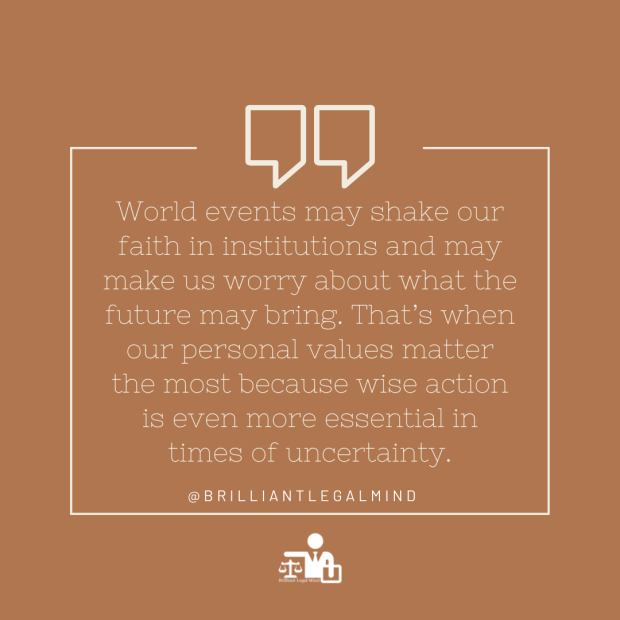
Image with quote from blog post that says "World events may shake our faith in institutions and may make us worry about what the future may bring. That's when our personal values as lawyers matter the most because wise action is even more essential in times of uncertainty."

Hopelessness is a difficult emotion to experience because it is something that can make us feel helpless, alienated, unmotivated, and alone. Though it can be a challenging emotion to face, each of us can learn to hold our own hopelessness in kindness.

This will help us reconnect to ourselves, reevaluate our roles in our communities, and better understand the values we wish to bring into the world. Perhaps we may never recover the same hope we experienced before, but I don’t know that must do so in order to lead a good and happy life. Instead, it may be more effective to learn to let new forms of hope grow in us in each new phase of our lives.


Want to learn more about mindfulness and compassion? Check out my new book, How to Be a Badass Lawyer, for a simple guide to creating a meditation practice of your own in 30 days. And to share mindfulness with your little one, check out my new children’s book, Mommy Needs a Minute.

Like this post? Subscribe to the blog here or follow us on social media:

Need Support This Election Day? Find It Here.

Image with details about meditations offered by the Mindfulness in Law Society to provide community and support during election day

If you haven’t voted already, I hope that you have a plan to do so. I was lucky to early vote yesterday few challenges and only a short wait. The only bad thing about this is that now all I can do is wait for the election results.

Waiting is not something I enjoy in normal circumstances. Most of us, regardless of political persuasion, would probably agree that this election cycle is anything but normal. It’s likely that you may be feeling stress, anxiety, or even significant fear about the election results.

Meditation Is Not a Magic Pill but It Can Be a Refuge

I take great pains as a lawyer and mindfulness teacher to avoid treating mindfulness practice like a magic pill. Meditation isn’t something you can do to make all the problems of life go away. To the contrary, when done right, meditation may help you get clearer about life. It’s one reason why the practice is hard.

Paradoxically, though, at the same time meditation can also be a refuge. It can be a safe space to find calm when the world is turbulent. Meditation can offer an opportunity for self-acceptance to deal with difficult emotions. At the most basic level, it can offer us at least a few minutes where we aren’t ruminating or doom scrolling about the state of the world.

Meditation Can Help Us Reorient to Goodness

The purpose meditation most often serves for me as a lawyer, mom, and community leader is that it reorients me to goodness. I’m a busy lady, I frequently deal with conflict, I’m often lost in my thoughts, and I tend to be intense and competitive. Meditation helps me rebalance the scales.

When I meditate, I let go of controlling things for a while. I let go of thinking and instead reactivate my faculties to perceive and sense. I stop judging and instead let holding and allowing to take the lead. And instead of closing off my heart, I work on opening it to myself, my community, and even the people who challenge me. This is how meditation can be a refuge that enables us to find stability so we can engage more deeply with life.

MILS Practices for Election Day

It is this idea that motivated me to volunteer to lead a meditation practice for the Mindfulness in Law Society on Election Day. First, I knew that offering a practice would be the most compassionate things I could do for myself. It would keep me busy and allow me to do something good and that I loved on a hard day.

Second, I knew that other lawyers out there were probably worried like me. Meditation can be a challenge when times are hard, so doing the practice in community can really help. Frankly, just remembering that you have a community can really help. That’s why MILS is offering a special practice on Election Day and the day after to offer the support of community to all in the legal profession.

Details of the MILS Election Day Support Practices

The Mindfulness in Law Society is offering 2 special practices on Election Day and the day after, Wednesday November 6th. Here are the details:

Election Day Sit

Event Details: I will offer a self-compassion meditation practice at 12 PM PST / 3 PM EST on Election Day, November 5th, on Zoom. This will be open to any law student or professor, lawyer, or anyone who works for a law firm or in the legal profession. The practice will focus on finding refuge in one’s community to support oneself.

How to Join: As a special event, you will need to register on Zoom to join the sit. The event is free of charge but you must register here for the link.

Special Wakeful Wednesday Sit

Event Details: I was set to guide the Wakeful Wednesday Sit this week, but my friend and highly experienced teacher, Judi Cohen, agreed to fill in for me. Knowing that none of us can predict what will happen this week, Judi will offer a special practice about welcoming whatever emotions may arise.

How to Join: This is a recurring event for MILS so simply click this link to the Virtual Sits page and hit “Wakeful Wednesday” to join on Zoom at 12 PM PST / 3 PM PST on November 6th.

Feel Free to Join Us in Community

I hope that you are making your voice heard at the polls this week. After you do that, please join us to practice meditation in community. Both practices are open to law students, law professors, lawyers regardless of practice status, paralegals, and anyone who works in the legal profession.

Even if you cannot join us for the sits, I will be wishing that all of you are safe, healthy, happy, and at peace.


Want to learn more about mindfulness and compassion? Check out my new book, How to Be a Badass Lawyer, for a simple guide to creating a meditation practice of your own in 30 days. And to share mindfulness with your little one, check out my new children’s book, Mommy Needs a Minute.

Like this post? Subscribe to the blog here or follow us on social media:

5 Books to Help You Prepare Emotionally for Election Year

Cover image for blog post offering 5 books to help you prepare emotionally for election year

I don’t usually talk about politics or religion on this blog very often, but election year is upon us. I am careful about political discussion here, and it’s more than just the desire to not make anyone mad. Part of what I do as a mindfulness teacher is debunk myths and misconceptions about mindfulness practices. Some of the myths I have encountered have been about the kind of people who are able to benefit from meditation.

As I discussed last week, it’s easy to get caught into the trap of identity about the kinds of people we are. When I teach mindfulness, therefore, sometimes I find myself subtly hinting at the idea that identity is not nearly as stable as we’d all like to think. But I usually try to avoid launching into a direct attack on identity because that can be pretty scary.

Election year is tough. Are you ready?

When you talk about politics and religion, you are bound to encounter identity. In America right now, lots of us may feel like our identities are under attack. We may feel like we have to fight to protect who we are and to save the country or state or city we know and love. I know this is a hard place to be and so I try to be respectful and give people time to consider the impact of their identity on their own terms and in their own time.

But here are the facts. The last two election cycles in the United States have been brutal. The next election coming in 2024 doesn’t look like it is going to be any easier. As someone with personal experience letting politics drive me crazy, I don’t judge anyone who feels this way.

Having been tossed about by polarized politics in America for years now, I started to wonder whether there is a better way. I don’t claim that this post offers the better way. That is, I don’t know that there is one way to do things better. In truth, I think there may be many better ways.

Cover image with tips about talking about politics and how mindfulness can help

How to get ready for election year

What has been the better way for me? Well, it has been trying to learn how to judge a little bit less when it comes to politics. When I say this, I don’t mean to disengage. I still vote- even in primaries and especially in local races. I still donate. I pay attention to the issues and I call my representatives. However, the internal reactions- to elected officials, my neighbors, and the situation – I have had to learn to relax to save my own sanity.

Obviously, sticking with my meditation practice has been an essential component to this solution. Calming down and becoming aware of thoughts is a fundamental step to being mindful of judgments. But I noticed that I had been engaging in another form of mind training over the last year or so. I looked at my reading list and I saw a pattern of books that I had read (or read again) to help me watch my judgments this election year.

Here are the 5 books that have helped me understand things a bit better so I could judge a bit less and have more peace in the coming election year.

Image listing 5 books to help you prepare emotionally for election year

1. Braving the Wilderness by Brene Brown

I‘ve talked about loneliness a few times on this blog. Has it ever occurred to you that political polarization is happening at a time when loneliness is being recognized as a public health crisis? Sure, there are other factors at work here too, but Brown makes an interesting point in Braving the Wilderness (paid link).

She helps us see that what we want as humans – belonging and connection – is the exact opposite of what we find when we polarize and segregate ourselves. The point here is not to judge anyone for wanting a safe space with like-minded individuals, but instead to help us reevaluate how we can make spaces truly safe for all. If you need some courage or help eliminating shame and dehumanizing speech from your vocabulary (and trust me most of us do) check this book out.

2. Nonviolent Communication by Marshall Rosenberg

So, you may be thinking, “fine I agree that we all want connection, but how can I possibly relate to people with whom I can’t even talk?” I’m not telling you to rush into protracted debates with people on the opposite end of the political spectrum. Nonviolent Communication, though, may help you learn some skills so you can understand people better (paid link).

This book is about owning and respecting our human needs and interests and doing the same for others. This sounds simple but it’s something you will probably hardly ever hear in ordinary communication at work and at home. Some of the references in this book are a bit dated, but the practices remain valuable and practical today.

3. Against Empathy by Paul Bloom

This one may sound surprising in this context. Nonviolent Communication, which I just recommended, strongly encourages empathy as a tool for communication. And, in fact, it can be. As Bloom points out in Against Empathy, though, it can also become a block to it. This book really isn’t against empathy in all cases. Rather, Bloom argues instead that empathy can create problems for us in moral decision-making.

Why? Well, in part because empathy “spotlights” certain individuals. Depending on our morality, we may disagree on who deserves the spotlight. Bloom argues instead for a “rational compassion” to guide our moral and policy decisions. As a teacher of compassion, I’m certainly inclined to agree. This book can help you see how emotions may come up in morality and politics in ways you may not have noticed before. That awareness may help you understand better how others process things so you can judge less and understand more.

Image with a quote about how judging less can aid communication and connection during election year

4. Why We’re Polarized by Ezra Klein

I thoroughly enjoyed this book, but I have to admit that I recommend it with some hesitancy. This book didn’t make me feel better exactly, but it definitely helped me judge others different from me less. In Why We’re Polarized, the Vox founder did what he does best: he explains polarization (paid link). In particular, he explains why American politics as a system tends toward polarization and how that system polarizes all of us individuals in turn.

It examines the government structure, the parties as organizations, American history, and even the media to explain how polarization has evolved. Did this book change my political beliefs? No, not at all. Did it help me understand the factors that shaped my beliefs better? Absolutely. And it helped me consider how my fellow citizens are subject to the very same forces.

5. Love Your Enemies by Sharon Salzberg & Robert Thurman

Even if you learn to talk nicer and you understand more, the reality remains that people can still piss you off. That’s why the final book, Love Your Enemies, is about how to not get so pissed off all the time (paid link). Authors, Sharon Salzberg and Robert Thurman, say it is about loving enemies, but make no mistake it is really mostly about loving yourself.

Quite appropriately, the book starts off by talking about “external enemies” – the other people in our families, workplaces, and communities who drive us nuts. But you will be surprised to see how much of this is devoted to getting clear on your own pain and frustration and learning to care for it. Like I’ve discussed before when talking about compassion, this book is not about being a doormat. Instead, it’s about being brave enough to be kind in a world that sometimes isn’t.

These are the books that have helped me prepare to judge less, stay kind, without checking out too much during the next election year. As I said before, this isn’t an exhaustive list. What books would you add to this list? What other resources or practices are helping you stay steady these days?


The links to the books mentioned in this post are affiliate links. The reviews are unsponsored and sincere but the link to Amazon is paid.


Want to learn more about mindfulness and compassion? Check out my new book, How to Be a Badass Lawyer, for a simple guide to creating a meditation practice of your own in 30 days. And to share mindfulness with your little one, check out my new children’s book, Mommy Needs a Minute.

Like this post? Subscribe to the blog here or follow us on social media: